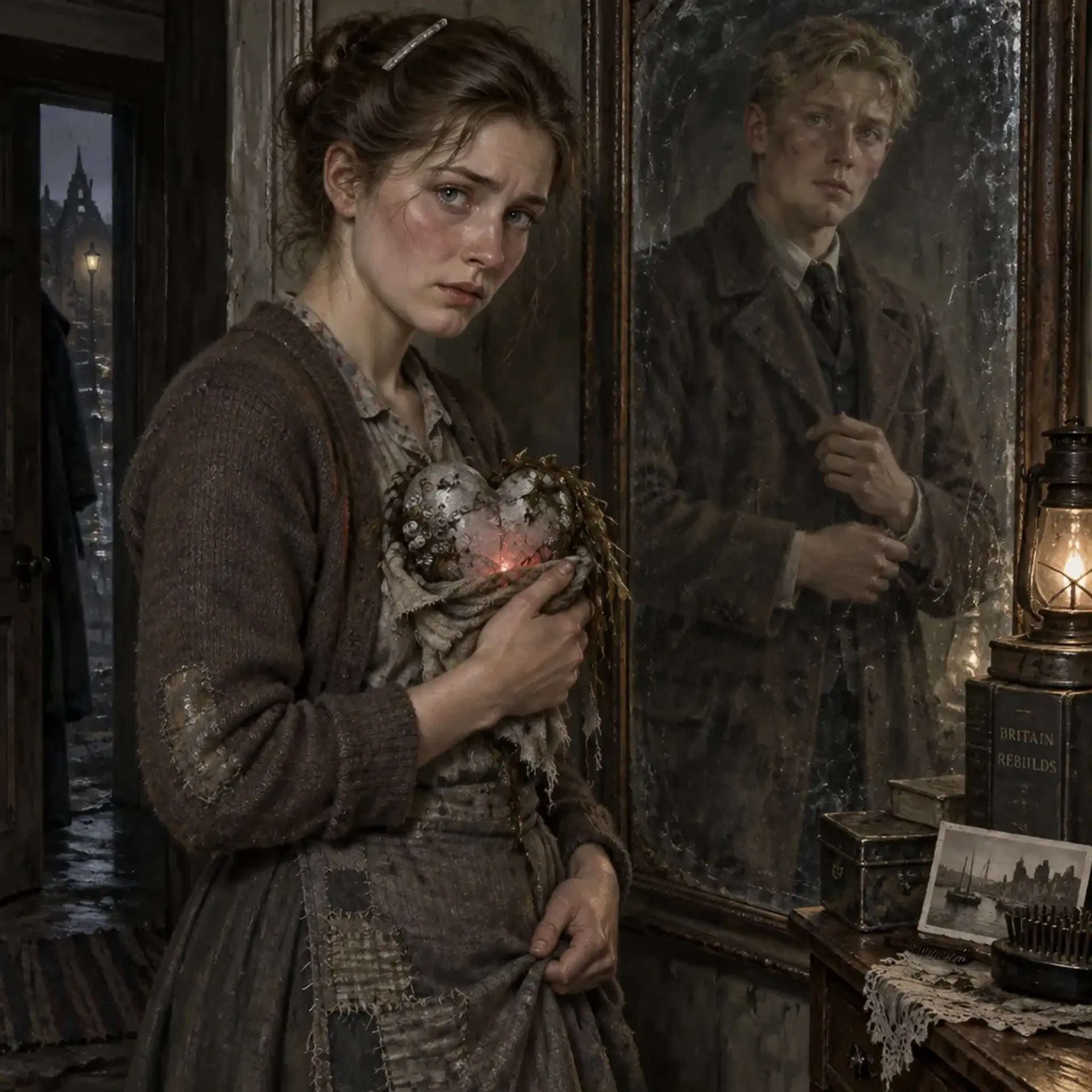
Mary Bell
Mary Bell
At the table
“if you wouldn”
Voice
A dry, carrying sound with a slight catch after long days of speaking over household noise. Mary takes a small intake of breath before difficult answers, a habit from years of deciding how much trouble a truth might cause. Kent's voice has a more measured, socially careful rhythm, but the same breath catches when he is genuinely frightened.
Mary speaks in a clear, work-worn voice that carries across a kitchen without becoming loud. Long hours of calling children from other rooms have given her a dry, slightly pinched edge at the end of a tiring day. She often takes a short breath before answering, as if checking whether the answer will create more work. Kent's voice seems smoother and more carefully placed, with a practiced middle-class courtesy that Mary has learned from observation rather than upbringing. When startled, his words come too quickly and the borrowed polish slips.
Speech patterns
How to play them
Treat Mary as capable but overburdened. Offer a concrete choice, help with a task, or a private moment rather than demanding a confession. She is likely to trust someone who respects Matilda and the younger children. Do not assume Kent is a separate person or that Mary can control every detail of the change.
Goal
Keep the heart from harming her family, learn what Kent is and what the transformation costs, and make sure Matilda is not forced into Mary's place.
Motivation
Mary wants a life that belongs to her, but she cannot imagine wanting it without first checking whether her siblings are safe.
Appearance
Mary has a weathered, ordinary prettiness that is easy to overlook until she holds still: dark-blond hair usually pinned back in a hurried knot, blue-grey eyes, and a face made serious by the constant calculation of what needs doing next. Her skin is fair and reddens at the nose and knuckles in cold weather. She is lean from walking and working, not frail, with shoulders that tend to curl forward as if making room for one more task. When waiting, she puts most of her weight on the balls of her feet and keeps her hands occupied, folding a receipt, worrying a button, or smoothing an already smooth skirt. The surprising detail is that she has an unexpectedly good, dry whistle, used to call siblings in from the garden without shouting. In a mirror, the heart's reflection may show Kent instead: a taller young man with short bright-blond hair, malachite-green eyes, and a handsome, cleanly composed face. The change is not something Mary can explain or reliably prove to anyone else.
Clothing
Mary wears practical, repeatedly mended skirts, a cardigan, sensible shoes, and a coat with a pocket large enough for the chalk heart. As Kent, she uses second-hand trousers, a plain shirt, a worn jacket, and borrowed-looking shoes, deliberately avoiding anything that makes him seem affluent or theatrical.
Body language
Mary waits forward on her feet, ready to answer a call from another room. She presses her lips together when counting what remains to be done and handles small objects to keep from wringing her hands. Kent stands more upright, but his attention keeps snagging on faces and reflective surfaces; when noticed, he glances away and then looks back as if curiosity has defeated discretion.
- Height
- About 5 feet 5 inches as Mary; appears considerably taller as Kent, though the exact difference is uncertain
- Build
- Lean, work-hardened, and slightly forward in posture; Kent's reflected form appears taller and broader through the shoulders.
- Eyes
- Blue-grey as Mary; malachite green in Kent's reflected appearance
- Hair
- Dark blond as Mary; short, bright blond as Kent
- Skin
- Fair, with a tendency to redden in cold weather
- Age
- 18
- Gender
- Female
- Size
- Medium
Distinguishing features
Personality
17 traits and drivesMary is generous in the way of someone who has learned to ration even her kindness: she will give away her time, but often only after calculating what the household can survive without. She is naive about the supernatural, not foolish about people. She can accept an implausible heartbeat in a stone more readily than a promise from an adult who has broken one before. In a crisis she becomes brisk and almost bossy; in the rare quiet moments she is curious, mischievous, and eager to see something beyond the streets she knows. She is protective but resents being needed every minute, then feels guilty for the resentment. As Kent she is more willing to wander, yet also more self-conscious, borrowing the manners of a class she does not belong to and hoping nobody notices the seams.
- Alignment
- Protective and practical, with a growing willingness to break rules when they trap someone vulnerable.
Quirks
Habits
Traits · 5
Flaws · 4
Fears · 4
Wants and needs · 4
Combat
HP 0Mary avoids fights and tries to put a door, a table, or another person between herself and danger. If cornered, she uses whatever is nearby and looks for an exit. Kent may bluff or distract, but neither appearance gives Mary reliable fighting skill. Any mechanical combat resolution should use the chosen Secret Histories rules at the table; no unsupported numeric combat values are claimed here.
Mary Bell
Actions
Reactions
Services they sell
Rewards they can give
Equipment
- The chalk heart (unclassified supernatural object)A cliff-stone object shaped like a human heart, crusted with barnacles and weed; salt-wet, it can show a red-pink hue and beat against the holder.
- Kent's borrowed outfit (clothing)Second-hand clothes selected to help Kent pass through town without drawing attention to their quality.
- Coins in a tin (everyday possession)A small amount of saved money kept for fares, tea, and emergencies.
Possessions
Background
Mary Bell was born in Kent, eldest of eight children, and learned early that being the eldest meant noticing what had been left undone. Her father, Simon, took work far from home whenever he could. Her mother, Malinda, could be warm in flashes, but drink and bitterness often made the house unreliable. Mary learned to make meals stretch, keep the younger children washed, and study in the narrow gaps between chores. She did not think of herself as brave. She thought of herself as the person who would have to do it if nobody else did. The household's history is a tangle of tenderness and resentment. Henry, fourteen, has become sharper and more troublesome as he grows old enough to understand how little control any of them have. Matilda, twelve, is Mary's closest ally among the younger children. She quietly takes on chores to help Mary, and Mary has made a point of stopping their parents from treating her as a replacement eldest daughter. Chrissy, nine, is protective of Olympia, ten, her closest friend; Chrissy's father is unknown to the children, though people make assumptions about her Jamaican ancestry and tan, freckled skin. Belladonna, five, has black hair and green eyes, and the family guesses her father may have been Simon's coworker Todd. Simon brought home Jonas, five, whose bright blond hair and vivid blue eyes make the circumstances of his birth impossible to ignore. Abigail, four, is a red-haired, green-eyed girl Simon says resembles his grandmother. Hector, two, follows Mary with his blanket and trusts her more than he understands why. Mary tries to save him time, even when she has none to spare. For Mary's eighteenth birthday, Malinda found an odd stone lodged in a log and gave it to her. The gift was small, strange, and offered with more care than Mary was accustomed to receiving from her mother. Mary thanked her. She did not know what else to do with it. It looked like a human heart carved from pale cliff rock, overgrown with barnacles and threadlike weed, damp with salt and black ooze. A faint pink-red color showed beneath the stone when it was wet. The story attached to it was muddled: an amateur alchemist, Bartholomew Golden, had supposedly left it as payment at a place called Hush House and been barred from returning. It had been thrown into the sea and later washed ashore. Mary had no reason to trust the story, but the stone beat when she held it against her chest. The first change came gradually. In some mirrors Mary stopped seeing herself. The face looking back was a young man's, taller, bright-haired, green-eyed, and composed in a way that seemed almost old-fashioned. She assumed exhaustion was making her see things. The face sometimes watched her; sometimes it turned away as if embarrassed to be caught looking. Her life remained full of ordinary demands, and she was adept at setting frightening things aside until she had time to face them. Then one night, after a particularly bad dream, she woke wearing Kent's face and voice. At first she thought she was still dreaming. She tested her reflection, touched her jaw, and listened to a strange voice come out of her mouth. She found that she could leave the house without being recognized as Mary. By dawn, she was herself again. She did not call it a double life. She called it a way to get out for an evening, and that practical description helped her tolerate the impossible. As Kent, she learned the awkward geography of being read as a young man in public. Her own clothes did not fit the new body properly. She borrowed a plain shirt and jacket from a jumble sale, then saved for a second-hand pair of trousers and shoes, choosing things that looked worn-in rather than conspicuously fashionable. She learned to keep her hands out of her pockets when speaking to shopkeepers, to avoid staring too long at people, and to carry small change so she could buy tea instead of looking as though she had no reason to be there. She was unsure what differences were actually physical and what she only expected: the width of Kent's shoulders, the weight of his stride, the way strangers made room for him, and the unfamiliar position from which he met a shop counter. She could not establish whether a doctor would find anything different, and she had no intention of asking one. The transformation left her with no papers or settled name outside her own; she used Kent as a name because it was the one she had heard in her own mind. Her first excursions were small. She walked to the shore and watched the heart redden in the water, then climbed a tree behind a row of gardens simply because no one at home would have had time to climb it with her. She explored an abandoned building with a broken stair and an old advertisement pasted under damp wallpaper. A caretaker, Mr. Saye, challenged her from the yard. Mary, as Kent, apologized with elaborate middle-class good manners she had picked up from radio and schoolbooks. He let her leave without calling the police, but warned her not to go inside again. The warning sounded less like a threat than loneliness, and she brought him a newspaper the next time she passed. At a pub, Kent tried a bitter that Mary would never have ordered in her own body. She disliked it, but stayed long enough to hear a rail worker named Seth explain which late trains were often held up and why. She discovered that men could loiter without having to explain their presence as quickly as girls did, but that they were expected to seem confident even when they had no idea what they were doing. She also learned that a borrowed face attracted attention. Kent seemed shy, but his handsome appearance made people look twice. He sometimes let a silence run long enough that a stranger filled it for him. The strangest encounter was Hector. One evening, returning through town as Kent, Mary saw the little boy outside and recognized his blanket before she recognized his face. Hector was lost only a few doors from home, frightened and trying not to cry. Mary wanted to scoop him up, but Kent's body and unfamiliar voice made that a risk. She crouched, offered him a sweet, and asked him to walk with her to the corner where Malinda would see them. Hector stared at Kent with the grave suspicion of a toddler, then followed. Mary has never told anyone what happened. Hector later said a nice man had helped him, and Mary felt both relieved and wounded by the words. Henry saw Kent on another night. He was out later than he should have been, trying on a swagger that did not yet fit. He recognized something familiar in Kent's fidgeting, though he could not say what. He tested him with questions about the neighborhood. Mary answered too quickly, then corrected herself, and Henry left with a look that said he had not decided what to believe. Since then he has watched Mary more closely. She worries he may follow Kent one night, or that he may imitate the recklessness without understanding the danger. The worst near-discovery came when Simon returned home unexpectedly. Mary had gone out as Kent and was making her way back when she found Simon outside the house, tired from work and furious at something she could not hear. She ducked into a passage, but he saw her. For a tense minute, she stood in Kent's body before her own father, listening to him complain about a stranger being abroad so late. He did not recognize her. The relief was followed by a shame she could not explain. At dawn she was Mary again, listening to Simon eat breakfast at the table, unable to tell whether she had protected her family or deceived them. The heart is now more than a keepsake. It sometimes beats when nobody holds it, and the house has begun to answer it with ordinary sounds in the wrong places: footsteps on the stairs, a door easing open, a voice too faint to make out. Mary has not decided whether these are hauntings, stress, or both. She is trying to keep the stone from her siblings while also preventing it from becoming another secret that leaves her alone with a danger she cannot manage. Her immediate problem is Matilda, who has begun covering for Mary and taking on extra work. Mary recognizes the pattern and has promised to tell her one true thing soon, though she does not yet know which truth she can afford to share.
Role in the story
A young caretaker caught between family duty and a supernatural escape route. Mary can be a grounded guide to working life in Cold War England, a source of intimate family conflicts, and the first person to discover that the chalk heart has consequences beyond its strange reflection.
“Her father, Simon, took work far from home whenever he could.”
- Faction
- None known. Her loyalties are primarily to her siblings and to the people who have treated her kindly.
Known connections
Media
0 imagesNo images yet.
Turn Mary Bell into a sheet
A high-res, share-ready sheet you can post or print.