William Windon
William Windon
At the table
Voice
A bodily, close-miked sound rather than a ghostly whisper: William's breath can snag and flutter when frightened, while Wilt's words arrive with a steadier chest resonance, old-fashioned diction, and dry precision. Their shared voice becomes especially unsettling when William's familiar mouth forms Wilt's unfamiliar regional accent.
William speaks in a warm, ordinary Wiltshire-influenced English voice, with the straightforward phrasing of someone used to outdoor work. When upset, his breath catches and words come unevenly before he forces a steady pace. Wilt uses the same mouth but an older, deeper-sounding cadence, crisp consonants, dry understatement, and formal turns of phrase. The voice seems to come from the body's chest and throat rather than from a supernatural echo. In moments of strong control, William's regional rhythm shifts into a thicker Wiltshire accent that surprises even him.
Speech patterns
How to play them
Meet William with patience and concrete questions. Do not assume the reflection is a ghost, a demon, or merely an illness. Offer practical help and let him choose whether to discuss Wilt. Hector's study, the sealed window, and the bricked cellar are sensitive subjects. Wilt responds better to directness than pity, but reacts badly to threats against William's family.
Goal
Keep his family safe, remain in his home, understand the coastal presences, and find a way for William and Wilt to share a life without either being erased.
Motivation
William wants to preserve the home and people he loves. Wilt wants safety from the sister searching for him, the chance to understand this unfamiliar era, and a place in the life he now shares. Their motives overlap, but neither is fully willing to surrender control.
Appearance
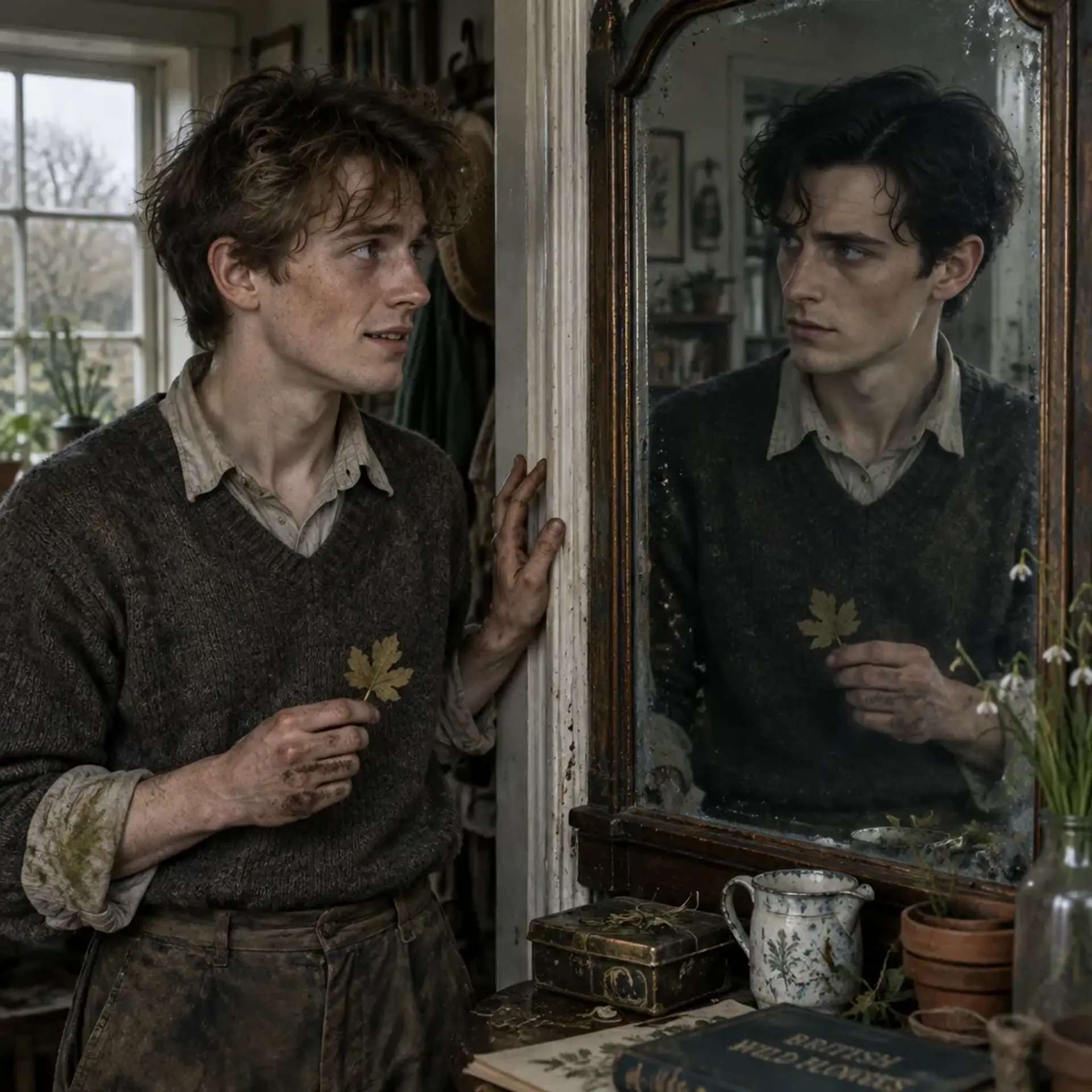
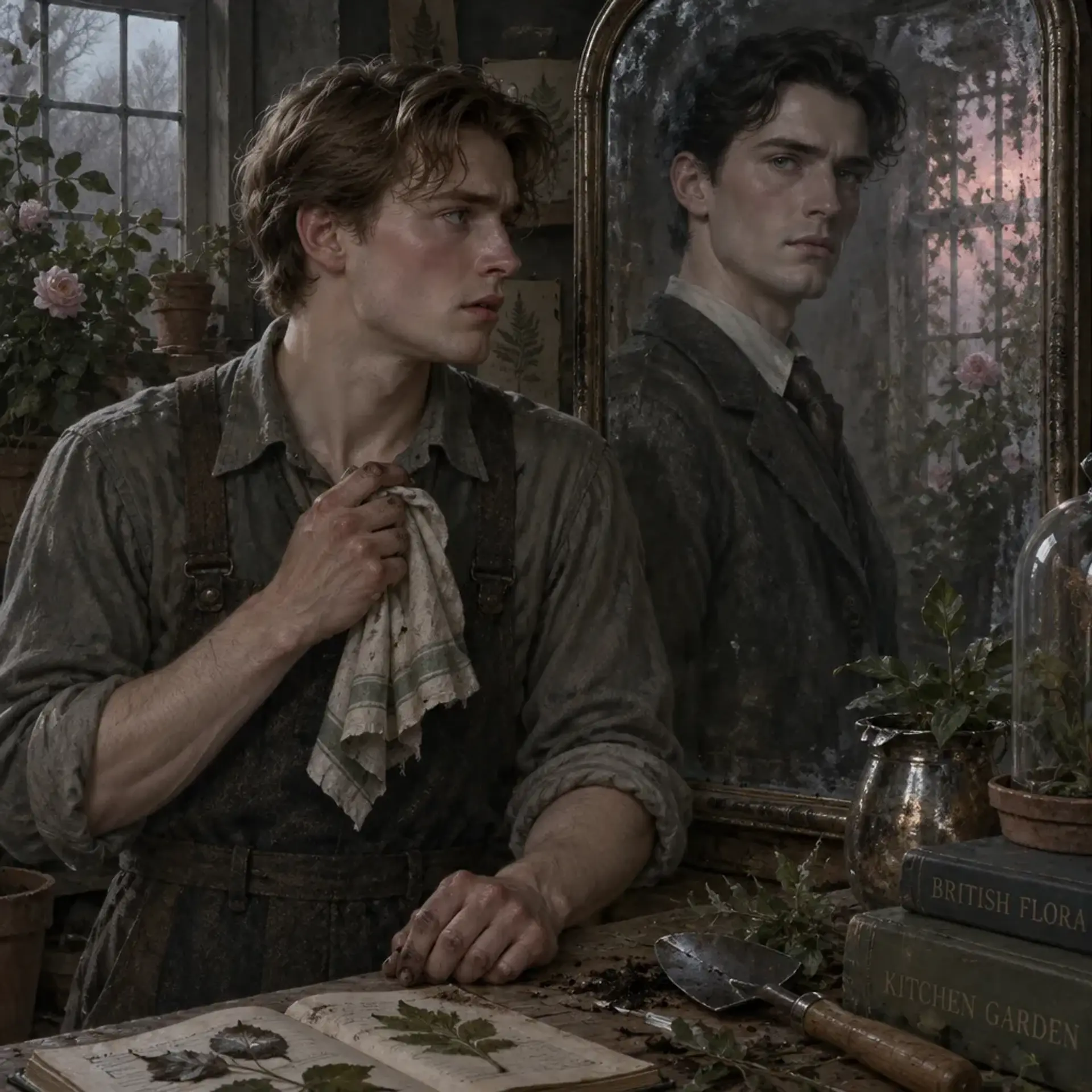
William Windon is an average-height young man for his cold-war-era English setting, but the face appearing in glass is taller, more composed, and handsome in a way that looks almost too carefully arranged. William's face is open and a little soft around the mouth; Wilt's is long, dark-haired, blue-eyed, and held in an aloof, stern expression. The reflected face is not William's, though it wears whatever William has on. Wilt's short hair seems perpetually better groomed, as if the glass has silently corrected it. William moves with a gardener's attentive economy, pausing to notice leaf damage, wet soil, or a draught under a door. When Wilt takes the body, the spine straightens, the chin settles, and every movement seems measured against old rules of posture. His everyday clothes acquire an unsettling formality at tea: a collar tugged straight, a cuff smoothed, a chair drawn out with a precision William never learned. People meeting him notice his breath first when he is rattled: it catches high, then resumes in a deliberate, almost counted rhythm. His always-carried gardening handkerchief has a dark, polished wear-spot at one corner from being worried between thumb and forefinger. An unexpected detail for a young gardener is Wilt's fastidious insistence on proper table manners and the order of tea service, enforced even when nobody else cares.
Clothing
Work trousers, sturdy shoes, and practical shirts suited to gardening. He keeps a handkerchief close and may have soil beneath his nails. When Wilt has influence, collars and cuffs are carefully set, the hair is trimmed into a neater short style, and tea clothes are worn with conspicuous propriety.
Body language
William's shoulders curl when he is embarrassed and his hands are constantly ready to touch or examine plants. Wilt draws the same body upright, keeps his head still, and turns with deliberate precision. During a change, William's breath catches, his jaw sets, and a second, steadier rhythm seems to take over. He avoids reflective surfaces when frightened but seeks them when he needs to speak privately.
- Height
- Average for a young adult English man of the period; Wilt appears taller through posture and, when distinct, is taller in fact.
- Build
- Average, practical, and lightly conditioned by outdoor estate work; Wilt's bearing makes the same body seem taller and more imposing.
- Eyes
- Blue; in the reflection they appear like moonlight over a fresh-water pond.
- Hair
- William's hair is dark blond; Wilt's reflected hair is black and kept in a neater, short style.
- Skin
- Fair English complexion, often reddened by cold or outdoor work; the reflective face looks similarly pale and carries a faint, uncanny suggestion of sea-cold light.
- Age
- Young adult; looks about eighteen, as does Wilt.
- Gender
- Male
Distinguishing features
Personality
20 traits and drivesWilliam is tender-hearted but not weak: he notices when people are frightened and offers practical comfort, yet can become stubborn when someone treats him as foolish. Wilt is controlled but not emotionless, formal but curious, and capable of both a cutting insult and an awkward act of care. Their shared personality shifts with circumstance. In the garden, William's patience usually leads and Wilt becomes absorbed in plants and unfamiliar machines. At tea or during grooming, Wilt's standards take over and William grows flustered. Around family, William tries to keep peace; Wilt will puncture Hector's pretensions if he thinks Hector is being cruel. Around Adaline, Wilt's fascination makes William jealous and ashamed. When threatened by the coastal siblings, Wilt becomes terse and protective, while William resents being controlled even as he recognizes the danger. Neither is a simple villain or victim: affection, resentment, fear, and curiosity coexist, and their memories are beginning to overlap.
Quirks
Habits
Traits · 5
Flaws · 5
Fears · 5
Wants and needs · 5
Combat
HP 0Not a trained combatant. William avoids violence and seeks cover, a door, or help. Wilt is more decisive but prioritizes escape, concealment, and protecting the shared body. Any numerical resolution should use the group's chosen Secret Histories procedures; no canonical combat statistics are asserted.
William Windon
Actions
Reactions
Services they sell
Rewards they can give
Equipment
- Gardening handkerchief (personal)A practical cloth for wiping hands and tools; one corner is worn smooth from anxious handling.
- Gardening tools (work)Ordinary working tools used for estate gardening. Wilt may hide a tool rather than explain why he wants it close.
- Hidden household knife (improvised weapon)A knife once found hidden in his coat. Its presence is troubling, and William does not claim to know when Wilt took it.
- Concealed provisions (supplies)Small, incongruous reserves of sweets, cheese, tinned fish, cigarettes, or other things Wilt has secreted under the bed.
Possessions
Background
William Windon was born in Wiltshire to a family rooted in the county, the son of Hector Windon, a historian, and Clare, whose steady warmth has survived several generations of family strain. He grew up a sensitive, observant boy, happier with plants and books than with arguments about what counted as serious study. Hector wanted an intellectually ambitious son, but his own tastes ran toward modern art and social questions, and he could be dismissive of old ceremony and old loyalties. His father, known in the family as Bobby, had been a fierce veteran of the Second World War. Hector resented the certainty of that generation and avoided speaking plainly about what the war had demanded of it. William absorbed both men: a suspicion of rigid systems from Hector, and a quiet inheritance of old habits from a history nobody in the house quite knew how to discuss. William took work as a gardener on an estate and began training toward botany. He found patience in the repetitive work: pruning, naming, noticing what a plant needed before it failed. Clare sometimes kept him company outdoors, reading from a book or the Bible while he worked and bringing tea and snacks. His father treated this as a pleasant but insufficient ambition. William's younger sister Elizabeth delighted in teasing him about manners, clothes, and the girl he liked. His friends Tommy DeHare, John Mollask, and Ryan O'Leary brought ordinary school-and-town companionship. Adaline, auburn-haired and soft-eyed, became his girlfriend. William's ordinary future seemed narrow but his own. Then a strange object reached him through a chain of bad decisions. The amateur alchemist Bartholomew Golden had once presented a purportedly fossilized living heart as payment for entry to the Hush House, claiming it could bring servants from the shadow of man, from the hearts of chalk cliffs and borderlands. The thing looked like a human heart carved from Dover chalk, its surface colonized by barnacles and sea grass. Golden was thereafter forbidden near Brancrug. The object was cast into the sea and came back to shore, wet with salt water and black ooze, its rock showing a faint red-pink light beneath the crust. Abraham Groff, a young Londoner visiting Wiltshire, found it and took it home. It beat under his coat on the train. In his house it seemed to die in the presence of visitors, then revive when brought to the Hampshire shore and put in water. Groff grew attached to it, partly because it seemed to dislike company as much as he did. The house filled with footsteps, voices, and doors moving on their own. Frightened, he sold it to seventeen-year-old William, one of the people who had seen it before it went cold. William treated it as a curious stone until he felt its pulse in his chest. After tasting ocean, blood, and soil in his mouth, he tried to break it with a hammer. The blow seemed to strike his own heart. He collapsed, groaning blood and a voice that did not sound like his. His mother found him after his heart had stopped. Days later he left the stone in a hollow log. It looked untouched by the hammer blow and cold as ever. The first warning came in a mirror. William's reflection was a long-faced young man with black hair and blue eyes like moonlight over a pond. It held itself to an older English standard of grooming and bearing. At first it merely failed to follow his movements properly. Then it spoke through his mouth while he was getting ready for bed: “Well, it's not often you use that one.” The accent was older than William's, the voice deeper, and the remark sounded less like a haunting than an observation from an unsentimental roommate. The reflection became an unwelcome companion. It corrected William's hair, commented on his clothes, and made cutting remarks about his family and neighbours. Sometimes it stopped him from saying what it considered improper. In time it spoke through his body even when no glass was nearby, and could answer Elizabeth when she knowingly addressed the stranger. It liked books and films, was fascinated by cars and electronics, and had a suspicious appetite for cigarettes, tinned fish, sweets, cheese, and alcohol. William found stolen household things hidden in his room, including an alcoholic bottle passed off as apple juice. Its taste for old table customs turned tea into a battleground, particularly with Hector. The relationship was not simply hostile. The reflection could be funny, curious, and almost companionable. One night, after Hector left spirits intended for William's recovery, the two became drunk in the same body. The reflection teased, yelled, smiled, sang, and argued as if they were in a pub together. It wanted to take off William's shirt as an act of rebellion, though they agreed that going further would be too much. In the morning Clare found the empty bottle. Hector shouted, then stopped and tried to give William things to do around the house. Clare began taking William out to garden at set times. Her company steadied him; the reflection did not insult her and sometimes answered her Bible passages with others William did not know. The reflection also carried fear. A war film on television provoked an episode that seemed to overwhelm William's body. He fought and screamed, while Hector and the family thought his heart had failed again. When William recovered control, Hector looked at him differently. Later the reflection mumbled an apology and offered a memory in place of an explanation: an experience of terror, noise, and helplessness that it described as if discussing weather. William could not know whether it was memory, borrowed history, or something neither of them had language for. The most frightening night began when William woke cold and unable to move. Wilt spoke through him in a low, firm voice: “My sister is outside. They're looking for me. Go back to bed.” William heard words seeping through the walls, a name or call breaking apart before he could catch it. He tried to shout. Wilt shut his mouth and rolled him silently to the floor, then pulled the body beneath the bed. William forced out a question: “The bloody hell, your siblings?” The phrase came in a thick Wiltshire accent that was not his. Wilt answered that his sister was trying to draw him out, that the more he spoke the greater the chance she would find him, and that they would talk in the morning. They lay beneath the bed through a long, moonlit stretch of silence. Moonlight moved across the wall in a thin pale band. Shadows of the bedstead lengthened and shrank with passing clouds. William could smell wet grass, salt, and something like blood. Each faint sound from beyond the house seemed to reach into Wilt, tightening the body until William felt his own muscles held like a fist. He struggled at first, then realized Wilt had stopped fighting him. The quiet was not victory; it was concealment. The moon showed the room in pieces: the chair with William's coat, the washstand mirror turned toward the wall, the closed door, the narrow gap beneath it. Somewhere outside, a presence moved without footsteps. William stayed awake until fear blurred into exhaustion. He woke under the bed in the grey morning and crawled out to the bathroom. The mirror still held the stranger's face. William pressed his own hand to his cheek and felt his familiar features again. Wilt said, “See, you're fine now,” with an awkwardly plaintive gesture. William was angry at being controlled, but he understood that Wilt had been hiding from something. Outside, he found the smell of salt water, damp grass, and black ooze. Wilt tensed when William insisted on looking around. The house had become a shelter from something that could find its way through sealed doors and remembered places. Wilt admitted that one of the presences was his sister. Asked how many there were, he only said, “More.” William's father had sealed a damaged study window behind a bookcase, and a cellar had been bricked shut before Hector bought the house. Sometimes a draught crept through the study, carrying a smell of sea and blood or, on other nights, meadow grass. William discovered Hector's private occult writings while searching for answers. Hector belonged to an occult circle, a fact the family did not know. He did not understand the stone's nature, but recognized it as strange and unnatural. His private knowledge gave William clues and made him more anxious about what his son might be involved in. William returned to work after recovering, and the ordinary rhythms of the estate and town made the sharing easier. Five months after his heart stopped, Wilt had mellowed somewhat. Gardening and wandering through woods gave them a shared life with enough room to breathe. Hector grew more suspicious all the same. He noticed the change in posture, the archaic manners, the knowledge William could not explain, and the way the study seemed to interest him. He asked questions that sounded casual and listened too closely to the answers. Clare remained warm and watchful. Elizabeth had privately decided her brother had “brain damage,” but her teasing gave way to concern; she spied on him to learn what was happening and to see whether he was safe. Her boyfriend Romy Brock, an artist who played rock and roll on guitar, remained blissfully unaware and followed Elizabeth into whatever new plan she proposed. William's own friendships and romance became difficult. Wilt found Adaline beautiful and treated her as an object of intense interest, making William feel that his greatest rival was himself. William resented the intrusion, yet could not separate Wilt's impulses from the body they shared. Bathing became awkward because the water showed Wilt rather than William, and both seemed to possess a kind of English prudishness. At times Wilt took over the grooming because William was embarrassed, commenting with dry sarcasm. William once felt Wilt blush. These small moments made the mystery harder to file under monster or possession. The heart's principles are not established here as canonical game rules. In the story's custom interpretation, its affinities are Scale and Nectar, with Forge as a major solar principle and Moon as a minor lunar one; Scale and Nectar are subverted through one another. Hector might call Wilt a changeling of Wiltshire: a glimmering thing, not a conventional human soul or ghost, but close enough to be mistaken for either. The heart has given Wilt an anchor in William, a human soul with which to mingle. Neither William nor Wilt understands the process completely. The implication is that the distinction between them may not survive unchanged, and the reflection's appearance may replace William's as the joined being settles into the county and its ideals. This is a story truth, not a claim that these terms or mechanics are official Secret Histories rules. After a night before Christmas, three months into the worsening changes, William woke and found that his old face had simply slipped away. There was no wound, no blood, no dramatic pain: only a cold, uncanny certainty that the face in the glass was now the face he felt beneath his hands. It was Wilt's longer, more composed face. The family saw William, but no longer quite as they remembered him. His memories began to cross and tangle. Sometimes he said “I” and meant William; sometimes he meant Wilt; sometimes he could not tell which life had supplied a memory. He remained sensitive, loving, and attached to Clare, Elizabeth, Adaline, the garden, and his friends, but he had acquired Wilt's formal bearing and sharpness. He increasingly treats the joined identity as William, without understanding what has settled into him. Now he sometimes moves through his own home in Wilt's face, avoiding windows and family sightlines, to search Hector's study or keep watch on the sealed window and cellar. He is haunting his own house to protect it and find a way to understand the coastal siblings. Hector suspects that his son is lying about the study, the strange nighttime sounds, and the changes in his manners. He has begun checking locks, watching William's movements, and asking whether he has been reading his private papers. Hector is torn between fear, guilt, and a historian's need to explain the inexplicable. He worries that his occult interests or his contempt for his father's legacy somehow helped bring this about. Clare understands less but refuses to abandon her son. Elizabeth watches him with concern and may become the first person to recognize that the change is not simply illness. Whether William can stay home depends on trust: if he can persuade Hector that the danger is outside the family, the house can remain refuge; if Hector decides William is a threat or a symptom of his own occult work, he may try to isolate him. William wants to stay, protect his family, and learn what is outside the walls without letting either self be taken from the other.
Role in the story
A vulnerable, evolving ally and mystery at the centre of a domestic gothic story. William's home is both refuge and contested ground. The family may help him, expose the occult danger, or become divided over whether he is still himself. His transformation offers players a personal stake in the question of identity without making the answer simple.
“He grew up a sensitive, observant boy, happier with plants and books than with arguments about what counted as serious study.”
- Faction
- No known formal affiliation. Hector participates in an occult circle, unknown to most of the family. Wilt's connection to the coastal presences is familial and hostile, not a known organization.
Known connections
Media
0 imagesNo images yet.
Turn William Windon into a sheet
A high-res, share-ready sheet you can post or print.