William Windon
William Windon
At the table
Voice
William's voice is an ordinary young man's, shaped by outdoor work and country conversation: clear when rested, slightly breathy after exertion, with a small catch at the end of an exhale. When the reflection speaks, the same throat produces a more settled, deeper sound, with careful consonants and the confidence of someone who expects to be heard. If startled, William's breathing becomes uneven before the words do; the reflection's speech can then sound unnervingly composed against his visible distress.
William speaks in a straightforward rural English manner, with the practical vocabulary of someone used to talking about weather, soil, and work. His breath catches at the end of sentences when he is fatigued, and he sometimes stops to start a thought again. The reflection's voice comes through William's own throat but sounds older and deeper, with clipped, assured phrasing and an accent that seems to belong to an earlier generation. It does not sing or whisper by default. When the reflection is rattled, William's breath becomes shallow and the words may emerge before he has decided to speak.
Speech patterns
How to play them
William is guarded at first, but responds to patient questions about plants, work, or the practical details of his recovery. Do not corner him about the reflection in front of his family or Adaline unless the scene is deliberately confrontational. He needs help, but asking directly for it is difficult. The reflection may interrupt if it thinks a conversation is tedious, improper, or useful to its own curiosity. Treat William and the reflection as distinct personalities sharing one body, not as a simple disguise or a convenient source of exposition.
Goal
Recover enough to investigate the heart, find Abraham Gorff, and learn whether the reflection can be separated from him without killing either of them.
Motivation
To be a gardener and botanist in his own right, rather than a patient, a local curiosity, or a body shared with an unknown stranger.
Appearance
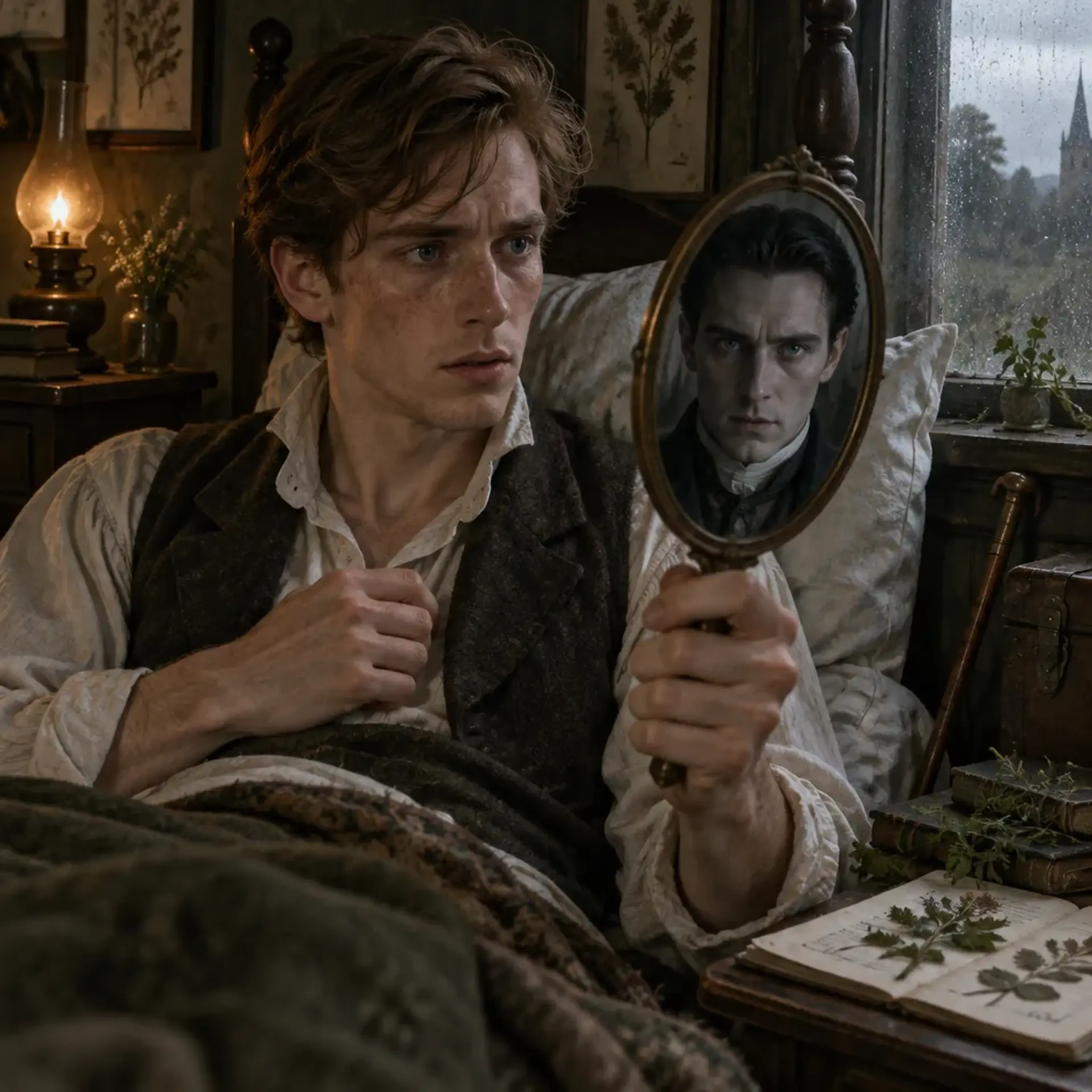
William is a country-bred young man with a long, watchful face, brown-spotted fair skin, and dark blond hair that never quite stays where he combs it. He holds himself as though he is trying not to disturb a sore place beneath his breastbone: shoulders slightly forward, elbows close, and weight carefully shared between his feet. When he waits, he rocks almost imperceptibly from heel to toe, then catches himself and stands still. His breathing is shallow when he is tired, with a faint hitch at the end of an exhale; fear makes the hitch conspicuous, while anger makes him hold his breath. His blue eyes look ordinary until he sees his reflection, when they fix on it with the concentration of a man listening at a locked door. In glass, polished metal, and dark windows, the face looking back is not his: it belongs to a handsome, long-faced young man with a more severe brow, short black hair slicked neatly back and trimmed at the sides, and blue eyes like moonlight lying on a pond. The stranger carries himself with an old-fashioned, unhurried confidence. The unsettling detail people do not expect of a gardener's apprentice is that William can identify a plant by the smell of its bruised stem, even while ill, and will pause mid-conversation to breathe it in.
Clothing
Practical country clothes: work trousers, sturdy boots, shirts with sleeves rolled for garden work, and a plain waistcoat when he wants to look presentable. On bed rest he wears soft, ordinary indoor clothes, though he still tries to comb his hair neatly. He dislikes collars that press against his throat and has become particular about how his shirt sits over his chest.
Body language
William keeps his shoulders slightly rounded and his hands close to his torso, conserving energy after his collapse. When he is waiting, he shifts weight from heel to toe, then stills himself as if caught doing something impolite. His face is easy to read when he is embarrassed, but his eyes become intensely fixed when he sees the reflected stranger. When the reflection takes over his speech, his body remains tense and unwilling: fingers clenched, jaw set, breath interrupted. The stranger's reflected posture is markedly different, upright and settled, with its head held as though it expects a room to make space for it.
- Height
- Approximately 5 ft 9 in (175 cm)
- Build
- Lean, lightly muscled from gardening, currently weakened by illness and restricted activity.
- Eyes
- Blue
- Hair
- Dark blond
- Skin
- Fair, with scattered brown freckles and sun spots
- Age
- Young adult, approximately 18
- Gender
- Male
- Size
- Average adult human
Distinguishing features
Personality
19 traits and drivesWilliam wants to be thought dependable and sensible, but his curiosity repeatedly takes him toward the very things he ought to leave alone. He is gentle with plants and children, yet can be stubborn and defensive when someone treats him as foolish. Among friends he tries to make light of trouble; alone he pores over details until every ordinary sound becomes evidence. He is proud of his local roots, but worries that his lack of formal education makes him easy to dismiss. He dislikes making a scene, though he has begun to snap when people insist that he is imagining what he sees. With Clare he tries to reassure; with Hector he becomes guarded and occasionally resentful; with Elizabeth he swings between protective affection and irritation at her questions. Around Adaline he is shy but sincere, and increasingly anxious that the reflection wants what he wants. The reflection is not William's hidden mood or a second voice he can summon at will. It has its own emotions, tastes, opinions, and curiosity. It can be dryly amused, affronted by bad manners, fascinated by books and movies, and suddenly wary of ghosts or fairies. It speaks of its own family as if describing distant weather. It appears to enjoy making William uncomfortable, but its interest in him is not simple cruelty: it tries to converse, asks questions, and sometimes seems genuinely pleased by things William enjoys. Its conduct toward Elizabeth is especially strange. It calls her “interesting,” notices her expressions, and watches her in mirrors with an attention William cannot interpret. It may be curious about her as a person, or about what she represents in William's life. It is not openly threatening to her, but William cannot relax when it is watching. With Adaline, the reflection becomes competitive. It comments on her appearance, tests William's embarrassment, and treats her affection as something to examine and perhaps claim. William feels jealous of his own body and ashamed of that jealousy. Neither personality is consistently in control: William can be affectionate and frightened in the same breath, while the reflection can offer a clever observation and then turn abruptly cold when something reminds it of the supernatural.
Quirks
Habits
Traits · 5
Flaws · 4
Fears · 5
Wants and needs · 5
Combat
HP 10 · Ordinary walking pace when well; currently limited by recovery and bed restWilliam avoids violence and is a poor choice for a sustained fight, especially while recovering. If cornered, he tries to get away, call for help, or put furniture between himself and an attacker. The reflection may speak or take control of his mouth, but it has not demonstrated reliable fighting ability. Do not grant it extra attacks or supernatural combat statistics without establishing a custom rule at the table.
William Windon
Actions
Reactions
Services they sell
Rewards they can give
Equipment
- Hand mirror (personal item)A small hand mirror he uses to check whether the stranger is present, though he often regrets looking.
- Botanical notebook (personal item)A notebook of plant observations, interrupted by notes about the heart, the reflection, and questions for Abraham Gorff.
- Walking stick (aid)A walking stick kept near his bed for balance when he is permitted to get up.
Possessions
Background
William Windon was born in Wiltshire, into a family whose roots there reach back farther than anyone can prove without asking his father to check the parish records. His father, Hector, is a historian, a man who can make a dinner table go quiet by explaining why a boundary stone is in the wrong field. His mother Clare keeps the household together with practical patience and a clear sense of which problems can be mended with food, sleep, or a stern word. William's younger sister Elizabeth has a talent for finding the one subject he would rather avoid and making it sound like a perfectly ordinary question. Their house is familiar, close, and full of small frictions: Hector can be dismissive of country people when he is feeling clever, Elizabeth borrows William's things without asking, and Clare has learned to tell the difference between her son's ordinary silences and the silence that means something is wrong. William grew up outdoors. He knew the damp smell of a greenhouse before he knew the names of all the books in his father's study. He learned to notice how soil clings differently to roots after rain, how a plant leans toward light, and how a neglected border advertises the history of whoever last cared for it. He works as a gardener on an estate and hopes to train as a botanist. The job gives him a place to put his hands and a reason to believe that patience can improve a living thing. He is proud of being useful, though he sometimes mistakes being needed for being understood. The object that changed his life arrived by way of a story already gone wrong. Bartholomew Golden, an amateur arcanist, had once visited the Hush House and left a supposedly fossilized living heart as payment for entry, wrapped in newspaper. He called it the Heart of England. It looked like a human heart carved from the pale rock of the Dover cliffs, only a little more than a stone shape at first glance. Barnacles and scraps of sea grass clung to it as though the sea had made a home on its sad, hard surface. Golden was never again allowed near Brancrug. The heart was thrown into the sea, but it returned to shore, wet with salt, water, and black ooze. Beneath the stone, it had turned a muted red-pink, as if blood or lamplight had begun to show through. Abraham Gorff, a young man from London, found it and carried it home to Wiltshire. The first time it beat beneath his coat was after he had taken the train inland. Gorff was repulsed by it, but he was also drawn to it. He showed the queer thing to neighbors, and in company it appeared to die: cold, stony, and entirely inert. When he took it alone to the Hampshire shore and put it in water, its pink-red color returned. Gorff decided it was special, and his, not from simple greed but because he believed the heart disliked visitors as much as he did. Strange sounds soon came to his house: voices where no one stood, footsteps on the stairs, doors shifting open, and the sense of someone moving behind a wall. The heart wept salt and water. At last Gorff sold it to a seventeen-year-old local lad who had been among the people present when it had first seemed to die. That lad was William. William was delighted to have an odd treasure of his own. He showed it off and told himself its strangeness was a harmless curiosity. Then he felt its pulse in his chest, as if his own heart had acquired a second rhythm. After a spell of tasting the ocean, blood, and soil in his mouth, he decided the stone must be the cause and fetched a hammer. He swung hard. The rock did not break. Pain struck through his chest so sharply that he dropped to the ground, groaning and weeping. His voice came out wrong, a rough, unfamiliar sputter, and blood showed at his lips. For a fraction of a second he saw a muscle twitch violently inside the stone. Then his own body gave out. William woke with Clare's hands on his face and her frightened voice calling him back. His heart had stopped. The doctors could not give the family an answer that made the event less frightening. William did not tell them everything he had seen. Days later, still shaken, he abandoned the heart in a hollow log. When he returned, it was cold and pristine, as though the hammer had never touched it. The heart was gone before long. William does not know whether it was taken, moved, or simply no longer where he could find it. He has looked for it repeatedly and has not found it. The first sign of what followed was his reflection. In a mirror, William saw a young man of his own apparent age, but the face was structurally different enough that no one could mistake it for a distorted version of William's. The stranger had a longer face, neat black hair slicked back and trimmed at the sides, moonlit blue eyes, and a stern expression that seemed to belong to someone raised to expect obedience. William began grooming carefully, checking the glass as though it might give him warning. At first the reflection merely held a different posture or looked faintly annoyed. William tried to dismiss it as illness, poor sleep, and the strange memory of the heart. The reflection's movements gradually ceased to match his. William would lift a comb, and the stranger would turn his head as if inspecting the room. William would look away, then glance back and find the stranger watching him with a private, assessing expression. One evening, during his bedtime routine, William had begun to comb his hair in the way he usually did. The stranger's mouth moved with his own, but the words came in a voice that sounded older than William's generation and deeper than his. “Well, it's not often you use that one,” it said. The reflection paused afterward, as if surprised that the sentence had crossed the glass. William dropped the comb. The stranger did not. For a time, William tried not to look. It became harder to avoid reflections in a house full of windows, polished furniture, and mirrors. The stranger began to comment through William's mouth, usually on clothes, manners, or the inconvenience of William's choices. It might criticize the set of his collar while William was getting dressed, or remark that his hair looked “like a hedge after a sheep has argued with it.” Sometimes it stopped him from speaking when it judged a remark improper, leaving William with his mouth open and a hot flush of helplessness. At other times it made a cutting comment when it considered itself alone with him. William could not always tell whether the reflection was speaking to him, testing him, or simply enjoying the sound of its own opinions. The first visitors to witness the problem were William's schoolmates Tommy DeHare, John Mollask, and Ryan O'Leary. They came to the house expecting to see him recovering and perhaps to lift his spirits. William was tired and self-conscious, but he wanted to seem normal. They sat together in his room, talking about school, work, and who had been seen with whom. In the dim light, the reflection's attention shifted from William to the visitors. Its face changed before William's did: the stern expression warmed into interest, then sharpened with something like amusement. William tried to ignore it. When Tommy made a joke, William's mouth moved without his decision and the stranger answered with a dry, polished observation that made the other boys laugh before William understood what had been said. The laughter stopped when William's reflection turned its head toward John while William himself was still looking at Tommy. The stranger spoke again, this time through William's mouth, but with the older accent and a disdainful certainty that none of them recognized as William's. Ryan stood up. William tried to tell them to sit down and found himself unable to get the words out. His hands tightened around the edge of the chair, while the reflection's posture in the glass remained loose and composed. Tommy asked if William was playing a trick. John moved close to the mirror, and the reflected figure seemed to look directly at him. William felt a coldness press beneath his ribs. The boys left unsettled, with no agreement about what they had seen. William was ashamed of frightening them and angry that the stranger had used his face to do it. Their visit made one fact undeniable: the reflection was not merely an image that followed his private thoughts. It could react to people in the room and speak through him where they could hear. Elizabeth discovered the truth by accident. She caught William in dim light, when his posture and face had shifted enough that she saw a stranger where her brother ought to have been. She did not scream. She stared, asked who he was, and only then looked at William's hands, which were trembling. William tried to explain, but the stranger's mouth made a short, dismissive remark about her being more observant than the rest of the household. Elizabeth's fear turned to anger. She demanded that William stop making fun of her, then realized he had not chosen the words. Since then, she has watched him too carefully and tried to ask questions without letting Hector hear. William hates frightening her, but he also resents how quickly she can tell when he is concealing something. The reflection has its own preferences. It enjoys books and moving pictures, and William has felt his body lean forward with real excitement before he has understood what caught its attention. It likes exploring places William would not enter, including the study when Hector is away and parts of the estate where the household staff have asked him not to wander. It has an unusual grasp of history, but it explains what it knows in odd, physical comparisons: dates are weather, dynasties are a succession of bad seasons, and the making of old objects is “forge work.” It speaks of having siblings and a father, but not as though describing living people. Their existence sounds to it like a tide, a taste, or a remembered pressure. William cannot decide whether these are memories, metaphors, or lies. One night William woke shivering and went into the hall with a small light. Elizabeth found him there and asked what he was doing. The answer came out in a voice that was not his, with the stranger's older accent. Elizabeth's expression changed at once. William could hear the words but could not stop them. The reflection spoke as if the cold were ordinary and the hallway belonged to it. Another time, exhausted and still recovering, William wandered to the more private fireplace in the study, hoping to warm himself. He fell asleep on the lounge. He dreamed of salt, forges, and dark woods, of something listening under water and something waiting among trees. Hector found him there and woke him with a look that mixed concern with suspicion. William had no account of how he had come to the study or why he had fallen asleep there. The stranger's opinions have made ordinary family life dangerous. When Hector once remarked that country people were silly, the reflection answered with a cutting rebuke about Hector's habit of mistaking research for wisdom. William was punished for the insolence, though he did not feel the words were entirely wrong. On another day a Welsh neighbor's child accidentally ran into William with a toy wagon. The girl apologized and began to cry. The reflection called her a slur. William will not repeat it, and the word has been deliberately left unnamed. The neighbor heard enough to take offense, and William had to muck out the neighbor's stables as an apology. He remains mortified, but the reflection has never apologized. It claimed that the child had been frightened by the collision, not by the word. William has a girlfriend, Adaline, whose auburn hair and soft brown eyes he finds comforting. He had expected that the reflection would at least leave that part of his life alone. Instead, after seeing Adaline, it became intensely interested. The reflection watches her in glass and polished surfaces, comments on how she dresses, and calls her “interesting” with an emphasis that William dislikes. It has made pointed remarks about the way she looks at him, about whether she is kind or merely patient, and about the fact that William has not told her everything. When Adaline visits, William is terrified that the stranger will speak through him or make a movement that she will notice. The reflection seems to enjoy that fear. It has not threatened her, but it has treated her affection as a challenge, as though it has discovered a prize William assumed belonged to him alone. The reflection avoids what William considers paranormal. It reacts to stories of ghosts and fairies with a sudden, wary stillness. It may change the subject, refuse to look toward an allegedly haunted place, or insist that William leave before anything appears. This fear is not the same as William's. William is frightened of losing control and of another heart stoppage; the stranger seems afraid of entities that do not belong to its world. Its reluctance gives William a rare chance to resist, but it also raises questions he cannot answer. If the reflection is bound to the heart, what does it fear beyond the heart? William is now on bed rest, attempting to recover while searching for Abraham Gorff, the missing heart, or any explanation that might stop the stranger from taking more of his life. He has learned that Gorff moved to Canada. William wants to find him, but he does not know how to cross an ocean or how to persuade anyone that a stone heart can speak through a mirror. He keeps his friends at a distance, worries about his family, and tries to keep Adaline from becoming another person the reflection can use against him. The stranger, meanwhile, keeps asking questions at night, when William is tired enough to answer. Its comments about its family grow more frequent, and it speaks of William's sister as “interesting.” William cannot tell whether this is curiosity, affection, or an appetite learning the names of his household.
Role in the story
A vulnerable witness and possible investigator's ally whose supernatural condition brings intimate, unsettling horror into ordinary family and romantic life. His conflict can lead investigators toward the missing heart, Abraham Gorff, and questions about the reflection's origin.
“His father, Hector, is a historian, a man who can make a dinner table go quiet by explaining why a boundary stone is in the wrong field.”
Known connections
Media
0 imagesNo images yet.
Turn William Windon into a sheet
A high-res, share-ready sheet you can post or print.