Friedreich
Friedreich
At the table
Voice
A clear, dry voice with a slight breathless catch, like someone beginning speech after a long silence. German consonants land firmly; formal phrases sound rehearsed from a vanished household. His voice becomes brisk and bright over football, bargains, or familiar company. Anger gives it a hard, prosecutorial edge rather than a quieter or more courteous one.
His German is precise and formal, with the firm consonants and clipped phrasing of Brandenburg and old Prussian social habits. English is clear but marked by German syntax and careful word choice. Years of silence have left a faint breathless catch at the start of some sentences, though his voice is not generally soft. When excited about football or market bargains, the military precision breaks into quick, emphatic detail. When angry, he does not become quieter or more polite; he becomes exact, naming the unanswered question as if reading charges.
Speech patterns
How to play them
Treat him as a person rather than an apparition or a useful power. Introductions, direct questions, and being invited into ordinary activities matter to him. He responds well to practical companionship, shared football or market visits, and honest disagreement. Do not assume a borrowed face grants consent to use it, or that his capacity to touch and eat means he is alive. If he becomes fixated on Wilhelm's past or loses track of his own identity, gently distinguish witnessed facts from rumors and borrowed memories.
Goal
Recover a trustworthy fragment of his pre-death identity without sacrificing the self he has built among the coven.
Motivation
To be recognized as Friedreich even when he cannot wear a face, to protect his chosen family, and to understand what the Caul-opening spirit intended.
Appearance
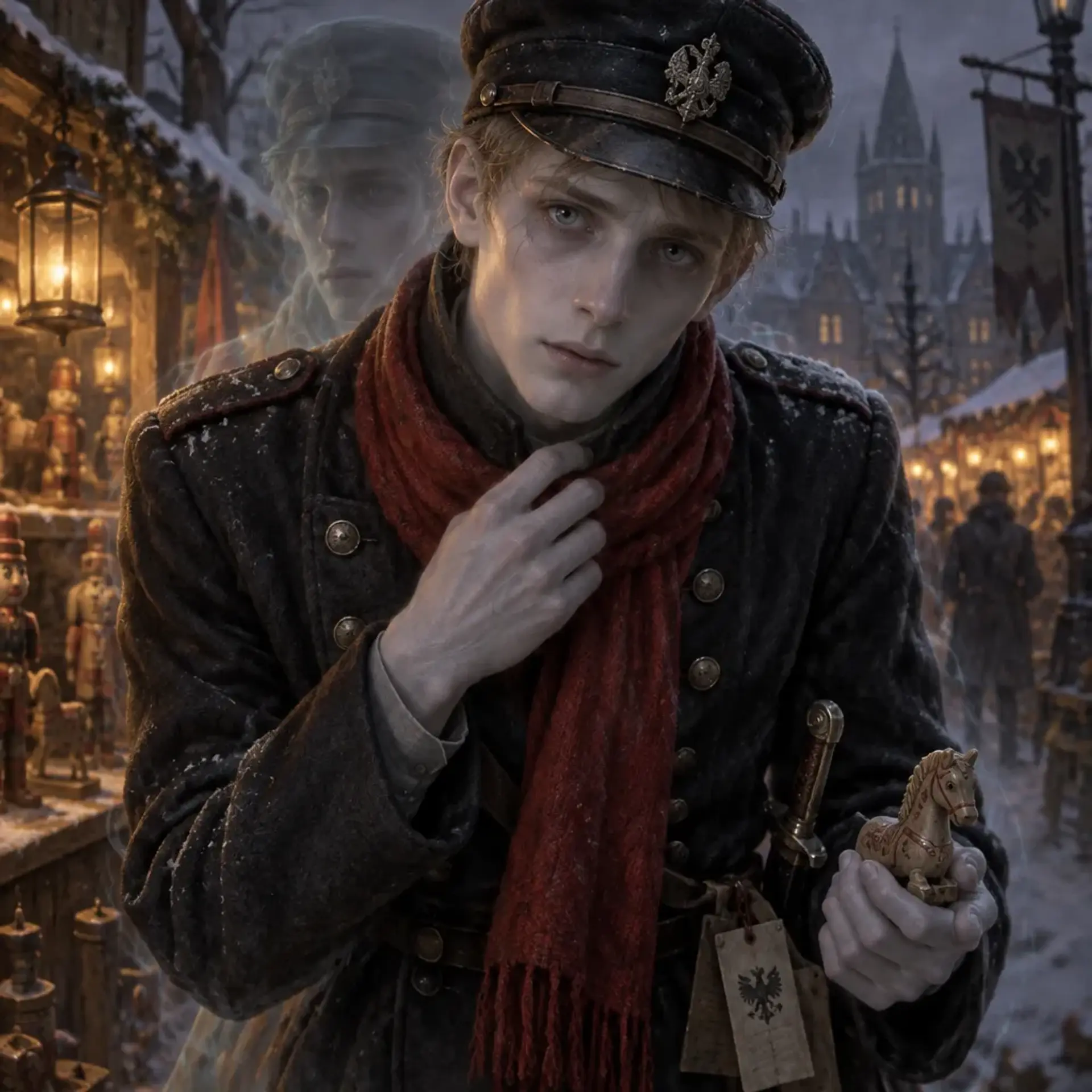
Friedreich usually presents as a narrow-shouldered young man in the severe mold of a Brandenburg Junker: erect posture, chin held as if expecting inspection, and economical movements that become a soldier's precise turns when he is anxious. His true wraithly presence is difficult to focus on, like a person glimpsed through winter glass. On days when the boundary loosens, the impression resolves into a pale, youthful face with the drained stillness of someone who has forgotten how to breathe. He borrows faces most often from young German men with military, police, noble, or other service backgrounds, favoring features close to the face he suspects was his own. His most noticeable possession is a small, old-fashioned field notebook. Its leather is polished almost smooth specifically at the lower right corner, where his thumb rubs while he waits to be seen. He occupies more room than his slight frame suggests, placing himself at the head of a table or beside a doorway as if he still commands a household. He does not realize how often others shift to make room. The unexpected detail: he is tenderly fascinated by cheap seasonal sweets and will spend ages discussing which Christmas-market stall gives the fairest price.
Clothing
A carefully maintained dark wool coat with a high collar, plain shirt, and old-fashioned neatness. His clothes are sometimes only an impression in the Shadowlands; when embodied, he favors garments that fit the face and era he is borrowing. He keeps the notebook regardless of appearance.
Body language
He stands unusually straight and angles his shoulders to claim a place in a room. When unsettled, his thumb worries one precise worn patch of leather; when angry, he becomes still before his words become formal and sharp. In a borrowed body, he occasionally checks his hands as though they might have changed without permission.
- Height
- About 173 cm when clearly embodied; otherwise his outline shifts with the face and conditions of manifestation.
- Build
- Slender and close-set, with the disciplined posture of a young man trained to be inspected rather than the physique of a seasoned soldier.
- Eyes
- Uncertain. Wilhelm says Friedreich had grey eyes; the clearest face he remembers from before the Caul has clear blue eyes. Borrowed faces vary.
- Hair
- Usually dark or fair according to the face he borrows; Wilhelm's claim that Friedreich was blond is one of his few concrete clues.
- Skin
- A pale, cool cast in his clearest unborrowed manifestation; a borrowed face retains its own complexion.
- Age
- Appears 17 or 18; died at that age. His actual years among the dead span the twentieth century and beyond.
- Gender
- Male
- Size
- Average human silhouette when embodied; otherwise variable and difficult to judge
Distinguishing features
Personality
20 traits and drivesFriedreich is at once an earnest young man and a self-appointed officer of a household whose details he can no longer prove existed. He values discipline because it gives shape to uncertainty, yet he is secretly sentimental about small comforts: a hot drink, a fair price, a crowded market, a familiar match watched with friends. He can be ceremonious with strangers and boyishly animated with the coven. His manners are not simply politeness; they are scaffolding. When someone treats him as real without requiring a borrowed face, he becomes warmer and less guarded, though he may overcompensate by offering advice nobody asked for. His affection for Wilhelm is deep enough to survive anger but not strong enough to erase it. Friedreich regards Wilhelm as a brother, and that bond makes Wilhelm's silences feel like a personal betrayal. He is furious about Wilhelm's desertion in the First World War and the crimes he committed in the Second, but he is also drawn to the scraps of history Wilhelm provides. He wants an explanation and fears that an explanation might make the past worse. Wilhelm's shame and occasional apology soften Friedreich without satisfying him. He can spend an evening joking with Wilhelm and then ask, with formal severity, why he ran. The contrast is not a trick; both responses are honest. Friedreich's temperament has been worn down by long periods of being unseen. Earlier in his existence he was more explosive, trying to force the living to notice him. Now his temper often burns out before it can become a sustained rage. Still, the old anger surfaces when a person ignores him, when Wilhelm evades a question, or when a borrowed face makes him feel that the living possess everything he was denied. At those times he can become coldly accusatory, then ashamed of having made loneliness someone else's fault. He enjoys company but wants to control the terms of being known. He keeps a list of favorite faces that resemble his suspected former self: young German men, military or police personnel, and young nobles. He tells himself this is a practical preference, but it is also a way to test the few clues he has. Wearing a face lets him speak, touch, drink, eat, sleep, and share ordinary pleasures. It also makes him vulnerable to envy and identity drift. After extended use, he may catch himself preferring a face's habits, reacting to its memories as if they were his, or resenting the living person whose appearance has given him a temporary life. He is not proud of this and does not like being asked whether it is normal among wraiths, because he does not know. His curiosity about possession began with love and a wish to repair what death had taken. He hoped that sharing Wilhelm's body might give his brother access to emotions he seemed unable to feel, or return a memory they had both lost. The first attempt taught him that intimacy is not the same as unity. Wilhelm's hunger, restraint, and shame filled the shared body with conflicting impulses; Friedreich could feel a desire to move and speak that was not his, while Wilhelm had to confront the pressure of Friedreich's affection and wartime accusation. Their bodies did not become a harmonious meeting place. They became contested ground. The failure embarrassed Friedreich, but it also made their bond more concrete: Wilhelm had allowed him close, and Friedreich had experienced how much of Wilhelm remained inaccessible. The attempt with Gunther challenged a different assumption. Friedreich expected another person behind a door. Instead, Gunther's changeling nature and experience of Arcadia made the interior encounter feel unstable, story-shaped, and resistant to ordinary boundaries. Friedreich felt less like a brother entering a familiar room and more like an intruder trying to grasp a path that changed whenever he named it. Gunther's curiosity did not erase the violation. Friedreich withdrew and declared never again. His later final attempt with Wilhelm was meant to be conclusive. It produced no lost memory and no certainty, only an intimate collision of hunger, shame, and anger. Friedreich now sees these experiments as acts that began with care but could have become selfish if he had continued. With Klaus, Friedreich is unusually patient. Klaus's passive-aggressive cruelty would normally provoke a pointed rebuke, but Friedreich notices the hesitation beneath it. He suspects Klaus recognizes the spirit connected to his Caul and is waiting for a reason to tell him. Friedreich alternates between pressing him and letting the silence stand, afraid that a direct answer might confirm he was never free to choose his own life. With Gunther, he is curious and apologetic, and he makes an effort not to turn every conversation into a question about Arcadia or the nature of the self. With Mila, he is openly delighted by her ability to see and touch him without a borrowed face. He becomes more relaxed around her, though he can grow childishly insistent about Christmas-market visits and bargains. The coven's ordinary rituals matter to him precisely because they are ordinary. Cards, fishing, drinking, football, and holiday visits make him feel less like a mystery and more like someone's friend. Friedreich is not gentle in every circumstance, nor is he merely tragic. He can be vain about his borrowed appearance, competitive at cards, stubborn about protocol, and unfair when wounded. But he remains capable of revising his opinion, apologizing awkwardly, and showing care through practical acts. He remembers who likes which drink, who needs a seat near the fire, and which friend should not be left alone after a difficult evening. He wants to be a brother, not a haunting. The fear that he may become a Spectre is real, but so is the effort he makes to remain himself.
- Alignment
- Protective of his chosen family, resentful of injustice, and capable of frightening self-absorption when his identity frays.
Quirks
Habits
Traits · 5
Flaws · 5
Fears · 5
Wants and needs · 5
Combat
HP 7 · Normal human pace while embodied; otherwise governed by the Storyteller's Wraith rules and relevant ArcanoiFriedreich avoids a stand-up fight. He uses cover, confusion, and the possibility of changing his apparent identity to escape or reposition, then resorts to a desperate strike only if cornered. Puppetry is a risky last resort, not a casual combat trick. Resolve all Arcanoi with the Wraith rules and Storyteller judgment; the Borrowed Visage ability is explicitly custom.
Friedreich
Actions
Reactions
Services they sell
Rewards they can give
Equipment
- Field notebook (personal memento)A worn notebook listing favored faces, scraps of uncertain memories, and reminders distinguishing his own preferences from those acquired during prolonged Borrowed Visage use.
- Market notes (keepsake)A collection of small remembered details about Christmas-market prices, gifts, and stalls. Mostly useful as conversation and as a reminder of pleasures he still values.
Possessions
Background
Friedreich's recollections begin in Brandenburg, but they do not begin reliably. He remembers the habits of a young man raised among old Junker expectations: formal address, a family name that opened doors, horses or their stories, and the conviction that a uniform could make a person honorable. He cannot supply a complete family tree or a secure account of his death. There are flashes of a house with a cold corridor, an adult voice correcting his posture, and a young man with clear blue eyes and fair hair. The last image is not quite a memory. It may belong to the spirit that opened his Caul, or to someone the spirit wanted him to remember. His Caul was opened by no ordinary wraith, mage, or human occultist. Klaus once described the agent in cryptic Garou terms: a spirit of the land and of humanity, marked by the Wyld, born of the Weaver's blessed adopted children, and bearing the Wyrm's spoils with a trace of Luna. That account sounds like a deliberate mixture of truths and evasions. Friedreich remembers a presence that concealed its purpose and a pale, indistinct image of a blond young man with clear blue eyes. When he woke from the Caul, the old repetition that had marched through his mind was gone. In its place remained a will-o'-the-wisp, a small, elusive light that seemed to know a road he could not follow. Friedreich has never decided whether he was freed, recruited, or simply abandoned. In the Shadowlands, he learned the difference between being dead and being absent. He could see the living world and still fail to be noticed by it. His first attempts to speak to strangers ended with them walking through the place where he stood. The humiliation became a kind of cold anger, then a more distant weariness. In time he discovered that certain faces could bridge the gap. His custom Borrowed Visage lets him make a living face his own for a while, with touch, appetite, sleep, speech, and the small bodily pleasures he had thought death had denied him. Friedreich has no idea whether this is unusual among wraiths. He treats it as a personal gift, not a rule of the dead. The gift has a price. A borrowed face can feel so complete that he begins to mistake its habits for his own. He keeps a list of favorites, chosen for resemblance to his possible former self: young German men, soldiers, police officers, servants of the state, and descendants of noble houses. He sometimes chooses a face because he wants to be seen as a particular kind of person, not because he has a practical reason. After long use he experiences a deep, sour envy of the person whose face he wears. His Shadow has learned to feed that envy, whispering that the living man has stolen the life Friedreich deserved. He has begun marking the notebook with small corrections, reminders of which memories and preferences belong to him. He does not always trust the corrections. Wilhelm is the nearest thing Friedreich has to a brother. Wilhelm is a Tzimisce vampire from Mecklenburg, an odd and difficult man who also cannot remember his life before death. Friedreich does not know why the bond feels older than either of them can explain. They spent parts of both world wars together as circumstances allowed. Friedreich sometimes remembers a breath during the First World War, a bodily sensation so vivid it makes him doubt the order of events. He is furious with Wilhelm for deserting in that war and for the crimes Wilhelm committed in the Second. Wilhelm does not discuss the latter and is deeply ashamed of the former. It is the one subject on which he has apologized to Friedreich. Wilhelm sometimes offers fragments of his earlier life, including the blunt assertion that Friedreich had blond hair and grey eyes. Friedreich clings to such fragments, while resenting that Wilhelm seems to ration them. Their experiments with possession began as curiosity and an attempt at intimacy. Friedreich wanted Wilhelm to feel emotions he believed the vampire had lost, and hoped that sharing a body might return a memory. Wilhelm agreed. During the first attempt, Friedreich used Puppetry to force his way in while Wilhelm actively resisted, then let him farther in than was wise. They did not become one person. They became two wills making claims on one body. Friedreich felt Wilhelm's hunger and the unnerving, bloodless discipline with which he held it. Wilhelm felt Friedreich's bafflement at having a heartbeat only by proxy, his fierce affection, and the old wartime anger that Friedreich could not keep out. Wilhelm's body moved in starts: a hand reached for Friedreich's notebook, then stopped; his jaw tightened against words neither man wanted to say. They ended the attempt shaken, exhausted, and without a recovered memory. Klaus was alarmed and watched for signs that Wilhelm had been lost to the intrusion. Gunther's response was to ask several more questions about where a person's self ended. Friedreich was embarrassed by how much he had wanted the attempt to work. Later he tried with Gunther, the changeling who had spent much of his life in Arcadia before returning to the real world and now sells moss-based clothes. Gunther was curious about what separated their lives and whether they could share memories. The attempt was worse in a different way. Friedreich could not make sense of the shifting, story-shaped impressions that met him. Gunther's inner life did not feel like a locked room with a person inside; it seemed to have doors that opened onto paths that refused to stay in the same place. Gunther felt the intrusion as a violation of his boundaries and as an eerie pressure on the stories that held him together. Friedreich withdrew, shaken by how quickly curiosity had become trespass. His verdict afterward was: never again. He later tried once more with Wilhelm under a solemn last-time agreement. It again brought no useful memory, only a painful overlap of hunger, shame, brotherly attachment, and old resentment. They stopped, and neither has suggested repeating it. Friedreich's chosen family is a loose group they call a coven, though its members are not all witches and do not pretend that the word explains them. They gather for cards, hunting, fishing, drinking, and football. Klaus, a ronin Get of Fenris or possibly a skin-dancer, refuses to say which. He is passive-aggressively cruel to most people, but hesitates around Friedreich as if he knows a truth that might injure them both. Friedreich suspects Klaus knows more about the Caul-opening spirit than he admits. Gunther remains a friend, a seller of moss-grown garments, and the person most likely to ask a question no one else considered. Mila, a mage from Bremen, can see and touch Friedreich without a borrowed face. Her ordinary ability to acknowledge him excites him more than he is willing to confess. Holidays matter to the coven, and their gatherings around Mila are often larger than their ordinary circle. Christmas markets are among Friedreich's happiest places. He advises friends on bargains, recommends gifts, and sometimes urges someone to buy the very thing he wants but cannot keep. He also tries church services from time to time, though the reasons vary: hope, habit, curiosity, or the wish to stand in a crowd without needing to steal a face. Stygia remains both a distant authority and a threat. He has encountered the machinery of the dead and the social pressure to treat a wraith as a resource or a record. He avoids becoming indebted to powers there, while knowing that avoidance is not the same as safety. Spectres are a more immediate horror: they make his fear of losing himself feel less like metaphor and more like a forecast. He has survived no grand, celebrated Harrowing that he can name with certainty. Instead, the small repetitions of being unseen, the weakening of his sense of self after a borrowed face, and the pull of his Shadow feel like an ongoing private Harrowing. His current problem is to decide whether a face that lets him live is helping him remain Friedreich, or teaching him how to disappear.
Role in the story
A ghostly companion, witness to twentieth-century supernatural history, and emotional counterweight to Wilhelm. Friedreich can help the characters navigate a mixed supernatural social circle, but his uncertain identity and the mystery of his Caul may draw them toward dangerous truths.
“He cannot supply a complete family tree or a secure account of his death.”
- Faction
- The mixed supernatural coven of Wilhelm, Klaus, Gunther, Mila, and their wider circle. No formal allegiance to Stygia; he knows its influence and fears becoming entangled in its institutions.
Known connections
Media
0 imagesNo images yet.
Turn Friedreich into a sheet
A high-res, share-ready sheet you can post or print.