Friedreich
Friedreich
At the table
Voice
A strong German accent shaped by Prussian formality and a military upbringing, with clipped consonants and careful enunciation. In his unborrowed form, speech has a hollow, faintly delayed quality. Borrowed faces alter the physical resonance but not his precise phrasing. He uses military vocabulary when anxious; anger brings out blunt, exact grievances.
A strong German accent shaped by Prussian formality and a military upbringing, with clipped consonants and careful enunciation. His voice seems to come from the chest and throat of whichever body he occupies; in his unborrowed form it carries a faint hollow delay, as though the sound has crossed a room before reaching the listener. He speaks in measured, practical sentences, uses old-fashioned forms of address, and slips into military phrasing under stress. Anger makes him more direct and more specific, not quieter or more polite. His name, Friedreich, is spoken with a dense cluster of German consonants and a deliberate final sound.
Speech patterns
How to play them
Treat him as a person, not a mask or a historical relic. Ask before touching his face list or proposing possession. He responds well to practical inclusion, such as inviting him to a match, meal, hobby group, or job discussion. If he becomes defensive, acknowledge the specific grievance rather than offering vague reassurance.
Goal
Build a life in his new body without abandoning his Wraith identity, learn what the spirit intended when it opened his Caul, and get Wilhelm to speak honestly about both wars.
Motivation
Belonging, self-discovery, and the desire to experience ordinary living sensations without borrowing another person's identity.
Appearance
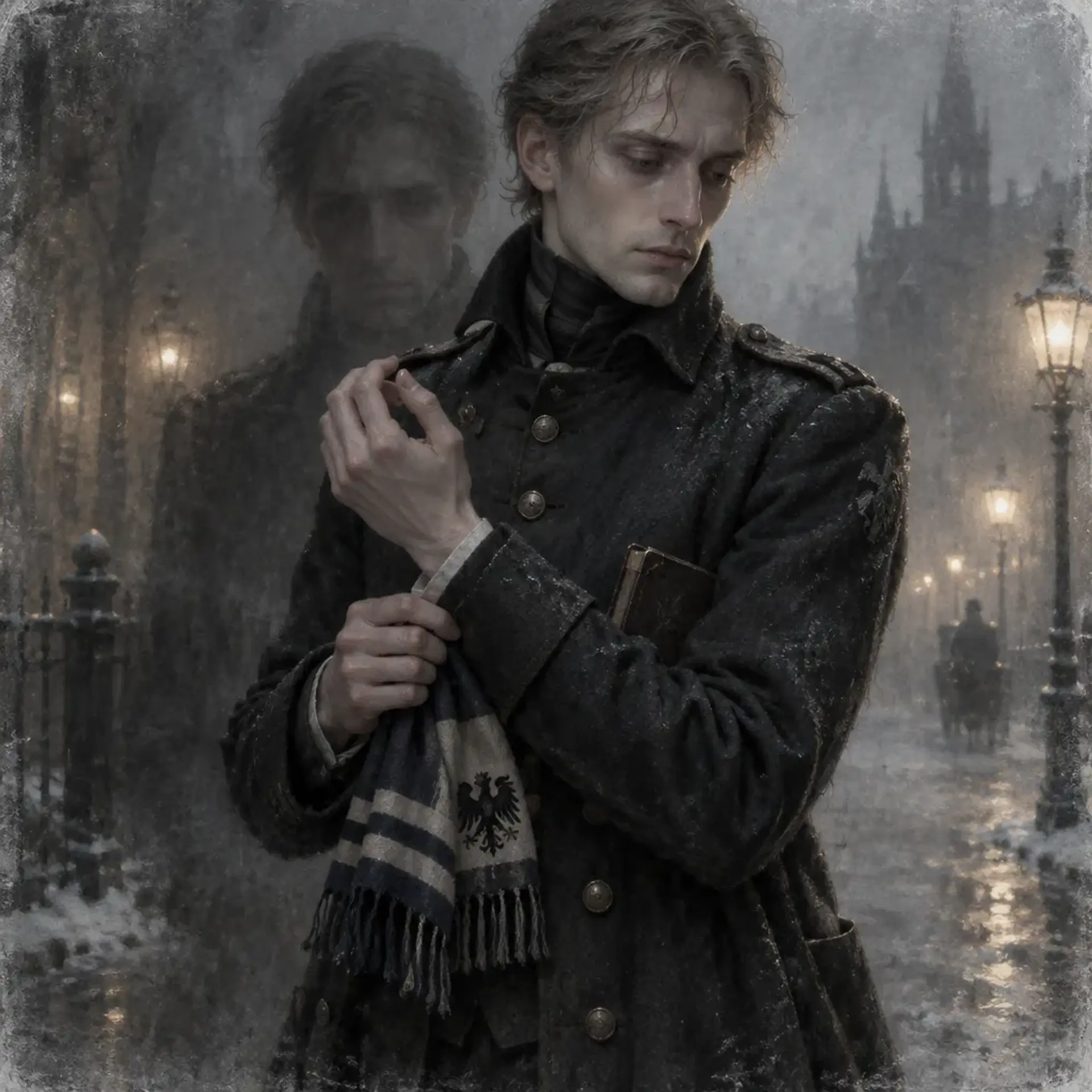
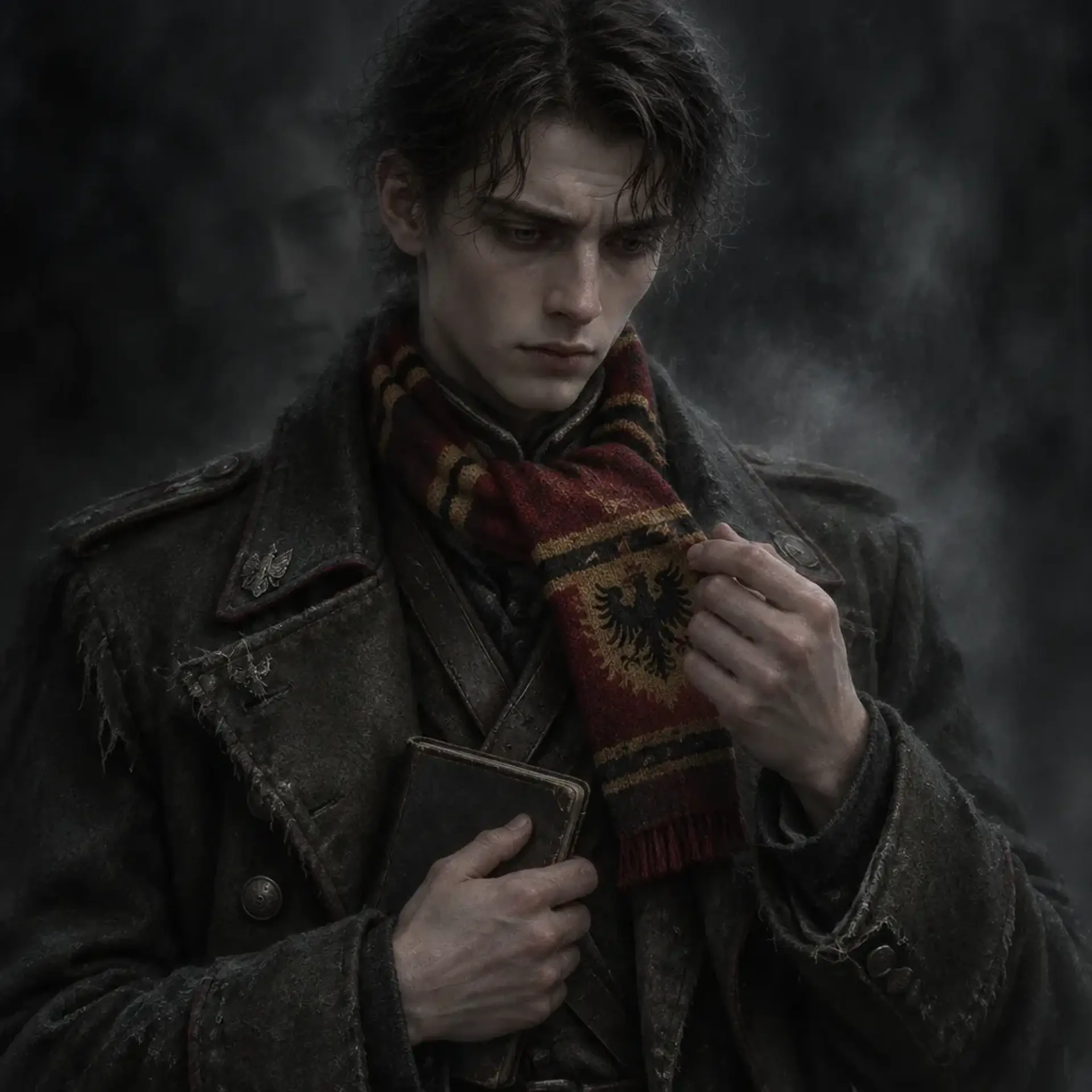
In his unborrowed form, Friedreich is the blurred suggestion of a young Prussian man in a worn officer's coat, his features incomplete as if seen through breath-clouded glass. On rare days when the boundary between worlds loosens, he resolves into a pale, narrow-faced youth with a straight nose, severe brow, and the grave expression of an old portrait. He moves with a precise, heel-first marching step, then stops so completely that people mistake him for a coat on a stand. When unsettled, his next breath arrives a fraction late, like an echo. His coat is brushed with excessive care despite its frayed seams, and he folds football scarves into exact squares, fussing over their stitching with unexpected domestic concentration. When he borrows a face, his body has convincing warmth and texture; he still watches his hands as if checking they belong to him.
Clothing
A carefully brushed, old-cut officer-style coat over dark trousers, with boots that seem damp at the seams. The coat is repaired neatly but poorly fitted, as if copied from a memory. In his living body he favors practical civilian layers and a football scarf folded with near-ceremonial precision.
Body language
His unborrowed posture is rigid and parade-straight, with exact heel-first steps and abrupt stillness. In a borrowed body, he keeps glancing at his hands and overcorrects his posture to match the face. When worried, he squares a scarf or aligns cards with the table edge.
- Height
- Appears around 175 cm in his usual borrowed faces; the unborrowed form has no consistently measurable height.
- Build
- Narrow-framed and youthful in his unborrowed manifestation; the body made for him on Walpurgis Night has a more stable, living weight, though its precise limits remain uncertain.
- Eyes
- Unborrowed: indistinct gray suggestion when he is clearly manifested. Wilhelm claims his living eyes were gray; Friedreich is not sure he believes him. Borrowed faces retain their apparent eyes.
- Hair
- Unborrowed: a wavering suggestion of light hair. Wilhelm says he was blond. Borrowed faces retain their apparent hair.
- Skin
- Unborrowed: pallid and indistinct, like a face seen through mist. His newly made body has a convincing living complexion, though its exact nature is still being discovered.
- Age
- Appears 17 or 18; his actual age at death and the span of his existence are uncertain to him.
- Gender
- Male
- Size
- Medium
Distinguishing features
Personality
21 traits and drivesFriedreich is disciplined enough to fold a football scarf into a perfect square and impulsive enough to put himself between a friend and a lethal threat without checking whether he can survive it. He has the bearing of an old Junker ideal, but the ideal is partly remembered and partly borrowed from Wilhelm's hints. That uncertainty makes him proud and self-doubting at once. Around strangers he favors stiff courtesy, formal phrasing, and observation. With the coven he becomes wry, competitive, and unexpectedly domestic, fussing over cards, food, and football. He wants to be useful, but dislikes being treated as a tool or a haunting to be managed. His protectiveness is sincere, not gentle. He has killed hunters who pursued Wilhelm or his friends, killed a Get of Fenris to protect Klaus, and fought supernatural enemies to defend Gunther. He does not celebrate these acts; he carries them as proof that his loyalty can become monstrous. He is especially protective of Mila, whom he regards as a little sister, though he knows she is capable and long-lived. He will stand guard for her, then listen to her instructions when she makes him. His anger has been worn down by the distance of the Shadowlands, but it has not vanished. It flares when people cannot see or hear him, when friends are threatened, or when Wilhelm refuses to explain the wars. Friedreich resents Wilhelm for deserting in the First World War and for undisclosed actions in the Second. He also knows Wilhelm is ashamed of at least one wartime choice, and that the apology he offered for the First World War was real. The contradiction keeps Friedreich close to him: he judges Wilhelm, depends on him, and hopes that the brother he remembers is not an invention. He is curious about ordinary human experience with an intensity that can seem childish or unsettling. He wants to eat, sleep, bathe, smell, drink, flirt, work, and attend a hobby group as himself. Borrowed Visage gives him these sensations and makes social contact possible, but it also invites envy and identity confusion. He can enjoy a meal and grieve that the face belongs to someone else. He can flirt with someone he finds attractive and then wonder whether the response was meant for him or the borrowed man. After the body-making on Walpurgis Night, that curiosity has become more hopeful and more frightening: he can now attempt a life without borrowing a face, but does not know what parts of that life are truly his. Possession taught him that curiosity is not permission to disregard another person's boundaries. The attempt with Wilhelm was tender, tense, and incomplete; the attempts with Gunther and Wilhelm again made the risks undeniable. Friedreich had hoped to lend Wilhelm human emotions or recover a shared memory. Instead he found a complicated interior that could not be reduced to a simple missing feeling. He still wants to understand, but now asks before reaching. Underneath his military bearing is a young man who wants a family, a name, and a face that will not disappear when the room changes.
- Alignment
- Protective and loyal, but burdened by wartime guilt and capable of lethal violence when he believes his chosen family is in danger.
Quirks
Habits
Traits · 6
Flaws · 5
Fears · 5
Wants and needs · 5
Combat
HP 0 · Use the movement rules for Wraith: The Oblivion and the current body's condition. No D&D speed value applies.Avoids a fair fight. Uses surprise, positioning, and environmental cover, then protects an ally's escape. Before gaining a body, he relies on wraith abilities and the peculiar advantages of manifestation; now he is still learning how his constructed body handles injury and exertion. Treat all combat outcomes using Wraith: The Oblivion rules and Storyteller judgment, not D&D defenses.
Friedreich
Actions
Reactions
Services they sell
Rewards they can give
Equipment
- Face list (personal record)A private record of borrowed faces, their aliases, uses, and dates, with reminders to avoid the original people and their local acquaintances.
- Football scarf (keepsake)A carefully folded scarf from the coven's football gatherings; he cares for it as if it were a uniform item.
- Old coat (clothing)A worn officer-style coat, brushed and repaired with more care than its condition warrants.
Possessions
Background
Friedreich remembers Brandenburg as a landscape of wet fields, church bells, disciplined footsteps, and a home whose rooms he can no longer place on a map. He believes he died at seventeen or eighteen, but the date and circumstances are lost behind the Caul. His memories of life arrive as fragments: a drill yard, the smell of damp wool, a man's hand correcting his posture, and the conviction that he was expected to become an officer. Wilhelm, a German Tzimisce from Mecklenburg who also has no reliable memory of his life before death, has told him that he had blond hair and gray eyes. Friedreich distrusts the detail because it comes from Wilhelm, but the image feels plausible enough to hurt. His first clear memory after death was not of a ferryman or a welcoming guide. It was the sensation of being drawn through a rupture in the Caul by a spirit of land and humanity acting with hidden purpose. Klaus later described the spirit in a Garou cosmology: touched by the Wyld, born among the Weaver's blessed adopted children, carrying the Wyrm's spoils and a trace of Luna. Klaus's account is cryptic, and Friedreich now suspects he knows more than he admits. The spirit vanished after Friedreich woke in the Shadowlands, leaving behind only a will-o'-the-wisp and the ghost of the repetitive marching that had occupied his existence before the Caul opened. Friedreich has never decided whether the spirit freed him, used him, or both. He learned quickly that the living could overlook him. His first face theft began in desperation after he followed a young man through a station and realized people reacted to the stranger but not to him. The man was away from the district, and Friedreich had confirmed that he was not present to see what happened. Friedreich touched the impression of his face, tried to hold it in his mind, and found himself suddenly able to feel the cold railing, smell wet stone, and speak aloud. He ate a station pastry and cried at its sweetness, then spent hours checking his borrowed reflection. It was not the original man's memories that came with the face, only a convincing body and the terrible temptation to keep it. He now maintains a list of faces, changing the names he gives them to protect himself and avoid drawing attention to the people they resemble. His favored entries include a young Brandenburg reservist, used for errands and practice; a police cadet from another city, used when he needs to look composed in public; a dead young man whose face he uses for private visits with the coven; and an absent Junker descendant whose bearing resembles the noble officer Friedreich thinks he might once have been. He selects men close to his apparent age, especially German men with military, police, or noble associations. He checks that a face's owner is dead or far from the area before using it. He records the occasion, duration, and emotional aftertaste. He is experimenting with ordinary routines: joining a hobby group, applying for part-time work, eating a meal without rushing, and flirting with women he finds pretty. He wants these things as experiences, not merely disguises. Wilhelm became a brother by repetition rather than explanation. Friedreich was with him as much as he could be during both world wars, fighting with whatever means the Shadowlands allowed. In the First World War, Friedreich sometimes remembers a breath, a brief living sensation that makes no sense to him. Wilhelm deserted in that war, and Friedreich is angry about it. During the Second World War, Friedreich killed three hunters who sought Wilhelm or the others. He also defended Wilhelm from hostile vampires and Gunther from hostile changelings. He has killed to protect Klaus, too, including a Get of Fenris who tried to kill him. He does not tell these stories as boasts. He remembers the moment after each act, when the danger stopped and he was left with the knowledge that he had chosen who was allowed to go on living. The coven is not an organization with a formal name or oath. It is the circle of friends who gather for cards, fishing, hunting, drinking, holidays, and football. Gunther is a changeling who spent much of his time in Arcadia before returning to the mortal world; he sells clothing made with moss and other natural materials. Klaus is a ronin Get of Fenris, or perhaps a skin-dancer, and refuses to clarify. His passive-aggressive manner softens around Friedreich in ways he does not explain. Mila, a mage from Bremen, has always been able to see and touch Friedreich even when he is unmanifested. He thinks of her as a little sister and guards her out of instinct, not because he doubts her ability. Holidays matter to him. He visits Mila and the others, goes to Christmas markets, advises on bargains, and sometimes recommends a purchase simply because he envies the person who can enjoy it. He has also tried church services, drawn by half-remembered ritual and by a memory of a cathedral fight on Walpurgis Night, April 30. He cannot tell whether that memory belongs to his mortal life, his afterlife, or a later battle. His experiments with possession began as curiosity and compassion. He wondered if Wilhelm could experience the emotions of a living person, and whether shared sensation might loosen either man's missing memories. Wilhelm agreed after they established terms. They sat down for cards with Klaus and Gunther present, treating the game as an anchor: Friedreich would attempt Puppetry, Wilhelm would resist only if asked, and they would stop at the first sign of danger. Friedreich entered the vampire's body and found no simple human warmth waiting inside. Wilhelm's body felt like a sealed room: appetite without ordinary hunger, sensation filtered through undeath, and emotions buried under a practiced stillness. Friedreich tried to guide Wilhelm's hand to the cards, then tried to make him taste alcohol. The body registered the drink, but not as Friedreich expected. The cards became a focus and a test, yet the possession blurred who was choosing each move. Wilhelm's shame surfaced in fragments, and Friedreich's anger about the wars came with it. Klaus watched for a threat; Gunther asked questions at exactly the wrong moments. They ended the attempt by agreement, shaken but still brothers. Friedreich could not give Wilhelm a human life by borrowing his body, and Wilhelm could not explain the missing years. Friedreich later attempted possession with Gunther, who wanted to learn what separated their kinds and whether memories could be shared. It went badly in a different way. Gunther's body carried its own strange rules and a flux of sensation that Friedreich could not parse. Their perceptions crowded together rather than blending cleanly. Gunther remained curious; Friedreich felt as if he were trespassing in a house whose walls kept changing. He withdrew, nauseated by the invasion and alarmed by the degree to which his own identity had begun to imitate Gunther's reactions. His verdict was simple: never again. He tried once more with Wilhelm after they made what they called a final agreement. That attempt was shorter, deliberate, and emotionally harder. It did not recover a lost memory or make Wilhelm feel human. It did let Friedreich understand that Wilhelm's silence was not indifference. The attempt ended with an apology from Wilhelm for deserting in the First World War, the only time he has apologized for it. Friedreich still wants an explanation for the Second World War, and Wilhelm still cannot or will not give one. Long-term use of borrowed faces has consequences. Friedreich can begin to mistake a face's habits for his own, envy its life, or feel an anger that belongs to nobody in particular. His temper used to flare when people could not see or hear him. Now the distance has worn it down, though it can return suddenly when someone dismisses his friends or treats his borrowed body as a toy. Everything changed on April 30, Walpurgis Night, in the Harz Mountains. Mila, Gunther, Wilhelm, and Klaus worked together to make him a body. Wilhelm brought Vicissitude and koldunic sorcery; Mila bent reality through her magic; Gunther contributed Glamour and the gifts by which miracles become possible; Klaus supplied knowledge of spirits, rites, and Garou gifts. At the witching hour, amid old land and old spiritual traffic, they made Friedreich physically alive again. The result is not a simple resurrection and none of them can agree what laws it obeys. He can occupy a body without borrowing a face, but it is a body assembled through several supernatural traditions, not a return to his former mortal life. He has to learn its needs, limits, and relation to his Wraith nature. He remembers the cathedral and the old spirit's trick more sharply now, but still cannot tell whether this new life fulfills the spirit's design or defies it. His immediate problem is practical and existential: how to live without turning every human contact into a disguise, and how to remain Friedreich when friends have made the impossible possible for him. He wants a job or at least a regular hobby, an honest answer from Wilhelm, and a way to use the body without losing the distinctions between his own face and the faces he has borrowed. The list remains in his pocket. He has not decided whether to cross out the names.
Role in the story
A loyal, complicated ally whose new physical body turns an old ghost's yearning into a question of identity, consent, and responsibility. His connection to Wilhelm's lost past and the spirit that opened his Caul can draw the characters into wartime mysteries, supernatural politics, and the consequences of making a life out of several powers' gifts.
“He believes he died at seventeen or eighteen, but the date and circumstances are lost behind the Caul.”
- Faction
- No formal faction. A member of an informal supernatural coven of friends. His status in Stygia and relationship to its institutions are unsettled; he has no established office or allegiance there.
Known connections
Media
0 imagesNo images yet.
Turn Friedreich into a sheet
A high-res, share-ready sheet you can post or print.