Friedreich
Friedreich
At the table
Voice
A clear, strongly Prussian-accented voice with clipped consonants and the practiced cadence of someone trained to give and receive orders. It has a dry edge from years of frustration at being unheard, but with friends it becomes quick and warmly animated. His voice does not become softer when angry; it becomes more precise, with each word delivered as if entered into a record.
He speaks German with a strong Prussian accent shaped by a formal, old-fashioned upbringing. His consonants are crisp, his phrasing often sounds like a report or an order, and he occasionally reaches for obsolete forms of address. When comfortable, he loosens into quick, practical chatter about football, bargains, and plans. Under anger his consonants sharpen and he becomes more exact rather than louder. The borrowed face changes what listeners can see, but not the history and disciplined cadence in his voice.
Speech patterns
How to play them
Treat him as a wary young man with a real need for companionship, not as a disguise or a puzzle to solve. Respect the coven's boundaries and do not pressure him to possess anyone. He responds to practical invitations, football, food, and holiday errands more readily than to abstract promises. Ask before discussing Wilhelm's wartime history, and be direct if you have evidence about Friedreich's living identity. A threat to his friends can turn a cautious conversation violent.
Goal
Build a life that is more than borrowed faces: find a sustainable way to participate in the living world, learn the truth of his past without violating Wilhelm's boundaries, and remain himself among the coven.
Motivation
Chosen kinship, the recovery of a truthful identity, and the hope that human sensations can be shared rather than stolen.
Appearance
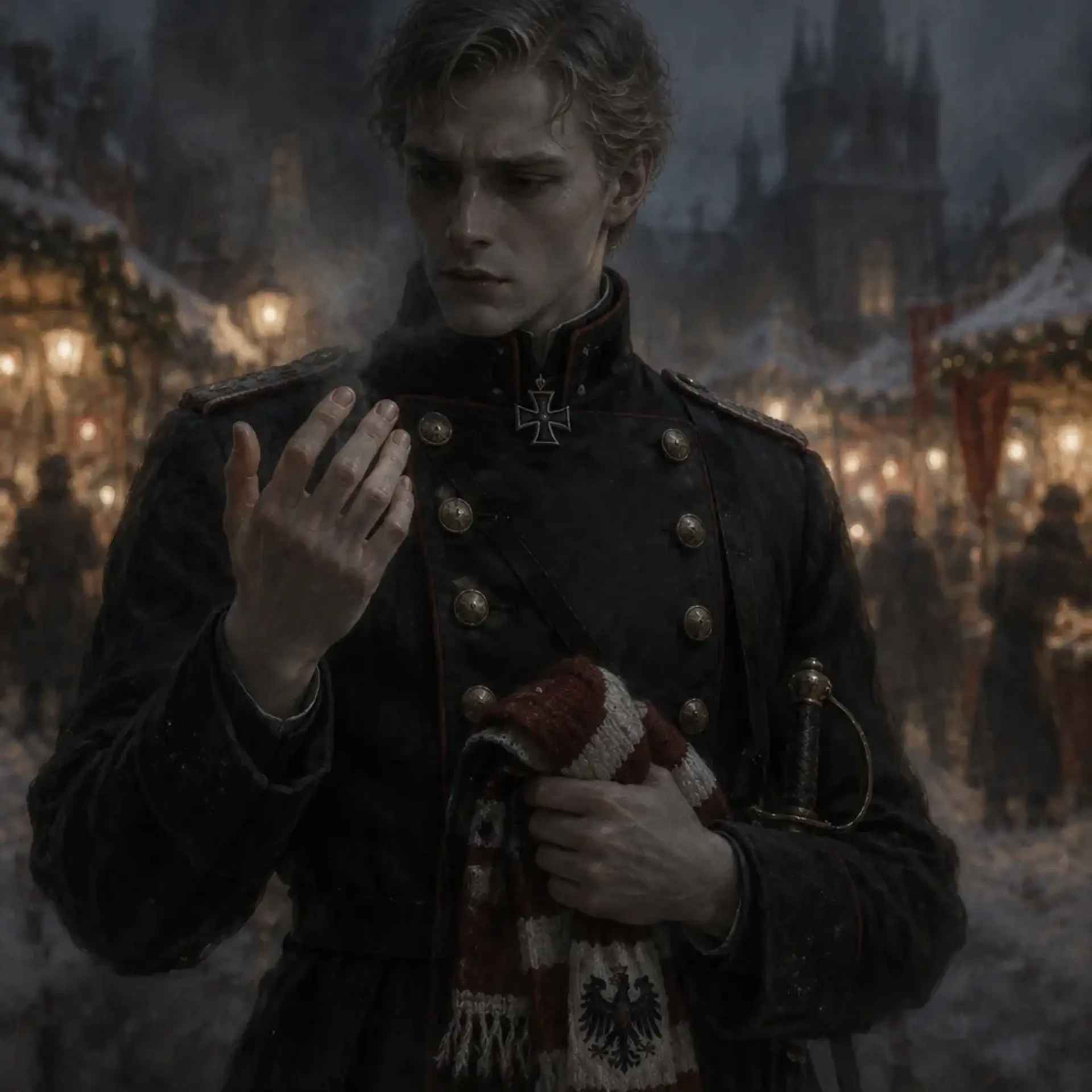
Friedreich's unborrowed form is a blurred suggestion of a young Prussian man in a worn officer's coat, as if someone had breathed on the glass of an old portrait. When the Shroud thins, he resolves into a pale, narrow-faced youth with a straight nose, severe brow, and the fixed expression of a formal photograph. He marches heel-first with unnerving precision, then stops so completely that he can be mistaken for a coat on a stand. His shadow sometimes completes a step after he has stopped. He repeatedly checks the fall of his cuffs and the alignment of his coat buttons, a fussy, visible habit at odds with his martial bearing. When using a borrowed face, he seems convincingly warm and human, but watches his own hands as though waiting for them to betray him. His unexpected domestic preoccupation is football scarves: he folds them into exact squares and critiques their stitching.
Clothing
A carefully brushed, shadow-dark officer-style coat with a plain old cut, dark trousers, and boots that look damp at the seams. In a borrowed face he prefers practical civilian layers, often adding a football scarf folded into an exact square.
Body language
He stands as if awaiting inspection, shoulders squared and chin set, but his hands repeatedly smooth cuffs or test the edge of a borrowed sleeve. In conversation with friends he leans forward with eager attention; when Wilhelm's wartime past comes up, he becomes very still and watches Wilhelm's mouth rather than his eyes.
- Height
- About 5 feet 8 inches when clearly manifested; apparent height varies with the borrowed face.
- Build
- Narrow-shouldered and lean, with a rigid military bearing that makes him seem taller when he stands at attention.
- Eyes
- Unborrowed form: indistinct, pale grey suggestion. Wilhelm says Friedreich's living eyes were grey, but Friedreich does not fully trust the claim.
- Hair
- Unborrowed form: indistinct fair hair. Wilhelm remembers it as blond, but Friedreich doubts him. Borrowed faces retain their own hair.
- Skin
- Unborrowed form: pale and translucent, like a face seen beneath winter fog. Borrowed faces retain their own natural complexion.
- Age
- Appears 17 or 18, the age he believes he had at death; his actual years in the Shadowlands are longer and uncertain.
- Gender
- Male
- Size
- Medium when embodied; otherwise a wraith's apparent size is descriptive rather than a D&D size category.
Distinguishing features
Personality
20 traits and drivesFriedreich is at once formal and hungry for casual company. He can spend an evening correcting the fold of a football scarf, then laugh too loudly at a card-game joke because he is grateful to be included. He values duty, but the wars taught him that obedience and honor are not the same thing. He wants to defend his friends and resents that he sometimes has to defend them from consequences of their own choices. With strangers he is guarded, observant, and stiffly courteous. He measures exits and watches hands. With the coven he becomes more animated: he argues over football, offers market advice, and makes practical plans for fishing or hunting. With Mila he is protective without wanting to patronize her. He understands she is capable, yet feels an old, stubborn responsibility to stand between her and danger. With Gunther he permits curiosity until it crosses into another possession experiment. With Klaus he shows unusual patience, partly because Klaus hesitates around him and partly because Friedreich suspects Klaus knows something about his origins. With Wilhelm, warmth and accusation coexist. He calls him brother, then demands to know why he deserted in the First World War or what he did in the Second. Wilhelm's evasions make Friedreich angry; Wilhelm's rare apology makes him angrier still because it sounds like proof of a shared wound. His temper has not vanished so much as burned down to a banked coal. Years of frustration at being unseen have left him tired, and he often lets small slights pass. But when someone threatens his friends, the coal catches. He can become exact and frightening, speaking in clipped phrases and acting with the old efficiency of a soldier. He does not enjoy violence, but he can justify it too quickly when family is at risk. Afterward he is unsettled by how familiar the decisions felt. Friedreich's borrowed faces complicate his self-control. He selects men near the age he remembers, especially Germans with military, police, or Junker associations. These faces make him feel legible to the living and help him imagine a job, a hobby group, or an ordinary flirtation. They also stir an unsettling envy. At first, a borrowed face feels like a window: he can eat, sleep, drink, bathe, smell, and touch the world. With prolonged use, the window starts to feel like a claim. He may adopt the owner's gestures, grow angry at reminders that the face is not his, or lose track of which memories belong to him. He keeps records and asks friends to use his own name as an anchor, but he knows that a list cannot guarantee a self. His relationship with possession is divided. He wants to give Wilhelm the feelings of being human, and hopes that a shared body might reveal the truth of their past. At the same time, he fears becoming the kind of person who takes another's will for the sake of affection or answers. The experiments with Wilhelm and Gunther taught him that consent is necessary but not enough to make an act safe. Friedreich now treats a clear stop condition as sacred, though his protectiveness can tempt him to ignore that rule in a crisis. He is neither at peace with the Shadowlands nor entirely consumed by them. He longs for the living world's warmth and noise, yet understands that he cannot rebuild his life by wearing other people's lives. His strongest hope is embarrassingly ordinary: a regular place to meet friends, a task people expect him to show up for, and a name that still feels like his when the evening ends.
- Alignment
- Not applicable as a Wraith: The Oblivion statistic. In ordinary terms, protective and loyal, but capable of severe violence when he believes his chosen family is threatened.
Quirks
Habits
Traits · 5
Flaws · 5
Fears · 5
Wants and needs · 5
Combat
HP 0 · No fixed movement rate supplied. Use the chronicle's Wraith rules; while embodied, movement is governed by the active manifestation and scene.He avoids a fair fight if he can. He uses cover, surprise, and the habits of a trained marcher, prioritizing escape routes and the safety of his companions. He will take severe risks to protect the coven, especially Klaus, Gunther, Mila, or Wilhelm. Do not treat him as a D&D-style combatant: resolve attacks, defenses, damage, and Arcanoi using the table's Wraith rules.
Friedreich
Actions
Reactions
Services they sell
Rewards they can give
Equipment
- Face ledger (personal record)A private list of borrowed faces, with assumed names, purposes, and notes on whether the original is dead or away. He avoids using a face when its living owner is likely to be nearby.
- Old coat (clothing)A worn, shadow-stained officer-style coat that anchors his sense of self but offers no special protection.
- Football scarf (keepsake)A football scarf kept folded with exact care; a reminder of ordinary gatherings and a useful conversation starter.
- Marching blade (custom shadow weapon)A shadowy bayonet-like implement sometimes shaped from memory for a desperate fight. It is a narrative description, not a promise of a special weapon statistic.
Possessions
Background
Friedreich remembers Brandenburg as a sequence of hard winters, regimented footsteps, and rooms in which young men learned to keep their faces still. He cannot reliably recall his family name, his exact home, or the event that killed him. He suspects he died young, perhaps at seventeen or eighteen, but even that is an inference from the shape his ghost keeps returning to. Wilhelm, a German Tzimisce from Mecklenburg, has told him that he had blond hair and grey eyes in life. Friedreich presses him for details; Wilhelm becomes solemn or dry, and Friedreich cannot decide whether he is being given a real memory or a story shaped by guilt. His first clear memory after death is not of a battlefield. It is of the Caul opening. A spirit of land and humanity, not a wraith, mage, or occultist, had acted deliberately. Klaus later described the spirit in terms Friedreich still struggles to understand: marked by the Wyld, born of the Weaver's blessed adopted children, gifted the Wyrm's spoils, and carrying Luna's trace. Friedreich now believes Klaus concealed part of the truth. The spirit hid its intentions; when the Caul broke, only a willow-wisp remained, beside the ghost of Friedreich's old, repetitive marching. Whatever the spirit wanted, it left him with an unnatural affinity for changing his appearance and reaching the living world. The first face he took was an accident born of longing. In the Shadowlands he saw a young man with a familiar military bearing among the living, and tried to make himself understood. His face and voice caught on the man's features like a reflection caught in a pane. For a brief, frightening interval Friedreich felt a pulse, warm air in his lungs, the salt of food, and the physical pressure of boots on pavement. He could speak and be heard. He did not know then whether he had stolen a face, borrowed a body, or found a door in the Shroud. He fled when the living man turned and looked at him. Afterward he began to keep a list, recording each face, the name he used, what it was good for, and whether the person was dead or safely away from the area. He favors young German men with military, police, or Junker associations, faces close enough to his imagined self to feel like a return rather than a disguise. He changes the names to protect both himself and the people whose appearance he uses. Friedreich and Wilhelm were together through the World Wars as much as a wraith could be. Their shared history is full of absences. Friedreich remembers a breath during the First World War, though he cannot tell whether it was his, Wilhelm's, or a sensation borrowed through a face. He is furious that Wilhelm deserted in that war and at what Wilhelm did in the Second World War. Wilhelm does not discuss his actions in the latter conflict. About the first, he sometimes apologizes, and that rare apology makes Friedreich angrier because it confirms that there is something real to apologize for. Friedreich feels implicated in Wilhelm's choices without knowing why. He regards Wilhelm as a brother, yet suspects that Wilhelm's silence is a form of betrayal. The group they call their coven is a refuge, not a formal sect: Wilhelm, Klaus, Gunther, Mila, and others who gather for cards, hunting, fishing, drinking, football, and holidays. Gunther is a changeling who spent much of his time in Arcadia before returning to the real world; he now sells clothing made with moss. Klaus is a ronin Get of Fenris, or perhaps a Skin-Dancer; he refuses to say which. He is passive-aggressively cruel to most people, but hesitates around Friedreich. Klaus told him what he knew of the spirit that opened the Caul, and Friedreich has since noticed how carefully Klaus chooses what not to explain. Mila, a mage from Bremen, is kind and can see and touch Friedreich even when he has no face at all. Friedreich thinks of her as a little sister, though he knows she is long-lived and does not need his protection. He guards her because duty is one of the few things his memory has left intact. The holidays matter to him. At Christmas markets, when the Shroud and circumstances permit, he advises his friends on bargains and points out what he wants but cannot keep. Sometimes he encourages someone else to buy the very thing he covets. He has tried attending church services, not from settled faith but because the living gather there and because ritual gives him a place to stand. He particularly remembers a fight in a cathedral during a Walpurgis Night service on April 30. He cannot reconstruct every participant or motive, but remembers the clash of fear, old stone, and sudden violence. It taught him that a sanctuary is not the same thing as safety. He has killed to protect the people he calls family. He killed a Get of Fenris who was trying to kill Klaus, and he has killed three Hunters who were seeking Wilhelm or the others. He has defended Wilhelm from vampires and Gunther from changelings. He does not boast about this. The deaths sit inside him as choices he made, not proof that he is a soldier again. His old military reflexes are useful in a crisis and corrosive afterward. His face experiments have become attempts at ordinary life. One face, a dead young reservist he calls 'Martin' in the list, lets him visit markets without attracting the same recognition twice. A vanished police clerk's face, recorded as 'Erik', is useful for asking practical questions and trying out the idea of a part-time job. A young Junker descendant's likeness, listed under a false name, is for formal occasions and for seeing whether old manners still feel like his. He flirts awkwardly with women he finds pretty, then worries that he has made them part of a theft. He is considering a hobby group, perhaps football supporters or a local history circle, but does not know how to explain why his face may change. He and Wilhelm once tested Puppetry out of curiosity and love. They agreed on terms beforehand: Friedreich would try to enter Wilhelm while the others played cards, stop at the first sign of danger, and make no attempt to take control beyond the experiment. The game gave them a focus. Friedreich found the threshold by following the cadence of the cards and Wilhelm's attention, then pushed against the vampire's will. The first contact was like trying to occupy a locked house whose rooms kept moving. Wilhelm accepted him, but the body remained alien: stillness where Friedreich expected breath, hunger that did not resemble appetite, and sensations filtered through a corpse animated by the Beast. Friedreich tried to make Wilhelm feel the comfort of being human, then realized he could not simply hand over his own sensations. He could only press his awareness against Wilhelm's and make the boundary hurt. They tested alcohol. Wilhelm's body could consume it, but neither the drink nor the act produced the human warmth Friedreich remembered from a borrowed face. Klaus was alarmed and watched for signs of possession turning into a struggle. Gunther asked more questions than anyone could answer. Friedreich withdrew by their agreed signal, exhausted and ashamed that affection had not made the attempt gentle. Wilhelm said he understood the terms; afterward, neither of them called it harmless. Gunther's experiment began with better questions and ended with worse answers. Gunther wanted to know what separated their lives and whether they could share memories. Friedreich entered cautiously, but a changeling's relationship with identity and reality did not offer the firm boundary he had found in Wilhelm. For a few moments, memory arrived sideways: a sensation of impossible distance, a world that would not hold still, and the sense that a thought had been offered as an invitation and a warning at once. Gunther felt Friedreich as an intruder and a companion, then as an echo trying to make a home in someone else's story. Friedreich could not tell which images belonged to Gunther, which were his own, and which were produced by the contact. He pulled out. Gunther was shaken, fascinated, and full of further questions. Friedreich said, 'Never again,' and has kept that promise. He tried once more with Wilhelm, under an explicit 'one last time' agreement. The second attempt was more deliberate and less tender. They used the cards again, but Wilhelm named a stop condition and Friedreich repeated it back before entering. This time Friedreich tried to listen rather than give. He found fragments of restraint and shame, and a closed door where he wanted the history of the Second World War to be. He could not force it open without breaking their agreement. Wilhelm felt the pressure and held his ground. When Friedreich withdrew, both understood that whatever memories Wilhelm carried were not available for the taking. The attempt did not restore Friedreich's past or make Wilhelm human. It did, however, make their silence more honest: Friedreich now knows that Wilhelm is withholding something, but also that love does not give him the right to seize it. Friedreich's Shadow is not a separate character he can safely ignore. In the language of Wraith: The Oblivion, the Shadow is the destructive voice of his own dark impulses, and a Storyteller can use it to tempt him with the promise that a borrowed face can become a permanent self. His envy of the living and his anger at Wilhelm make that temptation potent. He has endured Harrowings that turned his marching into endless pursuit: one forced him to follow a column of faceless soldiers through a battlefield where every order was Wilhelm's voice; another made him watch his friends recognize a face he could no longer remove. He does not know whether Stygia would welcome a wraith with such strange gifts or try to classify, exploit, or bind him. He has encountered Spectres in the Shadowlands and knows they are not merely frightening strangers; their presence feels like the Shadow's worst arguments given hunger and direction. He avoids them when possible and fights when they threaten his family. Now Friedreich is practicing how to enter the living world without making every appearance a crisis. He wants a job, or at least a hobby that does not depend on pretending to be a soldier. He wants to know who he was, but fears the answer might make Wilhelm's guilt his own. Most of all, he wants to keep his friends without losing the part of himself that recognizes them.
Role in the story
A companion and uneasy witness to the coven's history, whose borrowed faces make him useful in the living world while threatening his own identity. He connects the chronicle's supernatural families to unresolved wartime guilt, the mystery of the spirit that opened his Caul, and the ethical danger of possession.
“He cannot reliably recall his family name, his exact home, or the event that killed him.”
- Faction
- A loose supernatural coven of friends, not a formal faction. No confirmed allegiance to Stygia; he has learned to fear both the politics of the Shadowlands and the appetites of Spectres.
Known connections
Media
0 imagesNo images yet.
Turn Friedreich into a sheet
A high-res, share-ready sheet you can post or print.