Mary Bell
Mary Bell
At the table
Voice
Mary's voice carries a small intake of breath before an answer and the quick, practical cadence of someone speaking between chores. It can be warm and reassuring with the little children, but turns blunt when she is tired. Kent's voice is not merely Mary's voice lowered or disguised: it is an unfamiliar, measured sound with careful enunciation, restrained confidence, and a tendency to make ordinary discomfort sound like a matter of propriety.
Mary's voice is clear but often slightly breathless from moving through tasks while she talks. She starts with a small intake through the nose, as if checking the air before speaking, and her words have the clipped practicality of someone accustomed to being interrupted by a child. Kent's voice is unfamiliar, with a more measured, self-conscious diction and an instinctive formality. It sounds like someone trying to belong to a respectable room even when he would rather be home.
Speech patterns
How to play them
Approach Mary with patience and concrete offers of help rather than grand promises. She is more likely to trust someone who notices the needs of the children without treating them as leverage. Do not press her to explain Kent in front of her family. If speaking with Kent, give him room to maintain his dignity and avoid making a spectacle of his appearance or clothes.
Goal
Find out what happened to the heart, keep Henry from using it against her, and give her siblings a safer home without surrendering every piece of her own life.
Motivation
Love for her siblings, a craving for one private choice of her own, and a stubborn wish to understand what is happening before it can hurt anyone.
Appearance
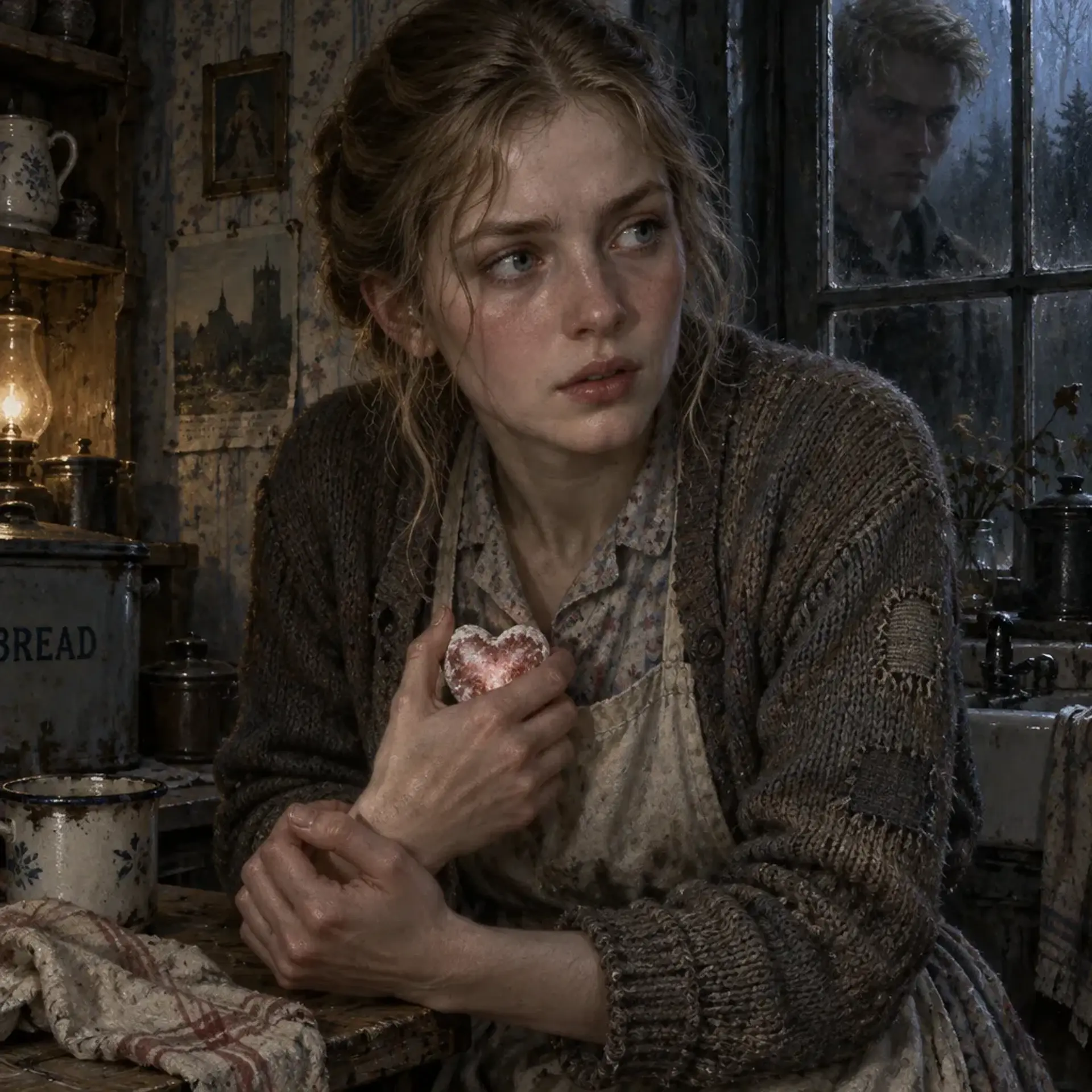
Mary is a young woman with the tired, alert look of someone who has learned to listen for trouble before it reaches a room. Her dark-blond hair is usually pinned back with whatever she can find, and loose strands catch in the damp at her temples. Her blue-grey eyes seem paler when she has not slept. Her clothes are mended, practical, and often faintly creased from work or carrying a child. She moves quickly at home, shoulders angled toward the next task, but becomes still when she hears a sound she cannot place. The first thing many people notice is the smell of cold soap, damp wool, and the faint mineral tang of chalk or seawater that clings to her after the heart has been active. When Kent's appearance takes hold, the change is not a reflection-like copy: a tall young man with short bright-blond hair, malachite-green eyes, and a handsome, unfamiliar face occupies the same place. His shape and clothes never fit Mary's life neatly. The contrast can be startling, like an unexpected guest who has somehow been living in the house for years.
Clothing
Mary wears plain, mended mid-century clothes suited to housework and part-time employment, often with an apron or cardigan close at hand. Kent's appearance brings an immediate clothing problem: he may be left in garments that hang incorrectly, borrowed trousers, or a coat that is too short. Mary keeps spare layers hidden where she can, but they rarely fit well.
Body language
Mary leans forward when listening, as though preparing to move the moment she understands what is needed. She rubs a thumb over the heel of her palm when worried and often keeps one shoulder angled toward the nearest child. Kent's posture is more upright and self-contained; he keeps his elbows in, avoids unnecessary contact, and seems embarrassed by disorder even when he is responsible for it.
- Height
- Mary is of ordinary height; Kent is distinctly taller.
- Build
- Mary is slight and work-worn rather than delicate, with the quick, economical movements of someone used to carrying children and household loads. Kent's body is noticeably taller and broader through the shoulders, making Mary's familiar clothes sit badly on him.
- Eyes
- Blue-grey
- Hair
- Dark blond as Mary; short, bright blond as Kent.
- Skin
- Fair, often made ruddy by cold, work, and lack of sleep.
- Age
- 18
- Gender
- Female; the changes present her as Kent, an eighteen-year-old man.
- Size
- Medium
Distinguishing features
Personality
20 traits and drivesMary is compassionate in the way of someone who has learned to notice needs before they are spoken, but her kindness has an impatient edge when she is exhausted. She can be tender with a frightened child and abruptly harsh with an adult who expects her to carry one more burden. She is naive about some dangers, especially those that arrive dressed as opportunity, yet she is not foolish about people: she knows when a promise is meant to make her easier to use. At home she is brisk, watchful, and managerial; with Trudy she sometimes lets herself complain; alone, she can be curious and impulsive. As Kent, she becomes more formal and self-conscious, with a wish to be treated as respectable and high-class that sits awkwardly beside his discomfort with strangers and preference for home. He is shy, not meek: rudeness can draw a stiff rebuke from him, while a noisy challenge is more likely to make him withdraw. Mary sometimes mistakes his reserve and insistence on propriety for ordinary male behaviour, and neither has a settled explanation for why his manners feel so distinct from hers. She wants freedom but dislikes being watched; she wants help but hates owing people; she is proud of her endurance and quietly furious that endurance is required.
- Alignment
- Not readily described by a game alignment. Protective of her siblings, wary of authority, and capable of selfish escape when overwhelmed.
Quirks
Habits
Traits · 5
Flaws · 5
Fears · 5
Wants and needs · 5
Combat
HP 3Mary avoids a fight and protects others by getting them out of reach, using furniture or a doorway as cover, and drawing attention to the danger. She is not a trained combatant. Kent's more formal self-possession may help him bluff or refuse an invitation to fight, but it does not make him a capable brawler. The mechanics below are explicitly custom, rules-light placeholders, not claimed Secret Histories rules.
Mary Bell
Actions
Reactions
Services they sell
Rewards they can give
Equipment
- Kitchen knife (tool)A small household knife carried for ordinary work, not as a weapon of choice.
- Spare cardigan (clothing)A folded, mended layer kept in case the change leaves Kent exposed or cold. It fits poorly.
- The heart-shaped stone (uncanny object)The strange heart-shaped stone may be missing. Mary cannot reliably summon or control it.
Possessions
Background
Mary Bell is eighteen, the oldest of eight children, and has spent so long keeping the Bell household functioning that she sometimes mistakes exhaustion for her natural state. The family lives in Rochester, Kent, in an isolated, crowded house where money is short and affection arrives unpredictably. Her mother, Malinda, drinks heavily and can be neglectful; her father, Simon, takes work far from home and often treats absence as a solution. They quarrel, reconcile, and quarrel again, while the children learn to read the mood of the house by footsteps and doors. Mary's brothers and sisters are not a tidy unit. Henry, fourteen, has grown sharper and more deliberately difficult as he resents the adults and, at times, Mary herself. Matilda, twelve, is Mary's sweetheart sister and tries to share the work, which Mary refuses to let become a permanent sentence. Olympia, ten, is close to Chrissy, nine, whose father is Jamaican and unknown to the family. Chrissy has tan skin, freckles, and wavy dark hair. Belladonna, five, has black hair and green eyes; her parentage is uncertain. Jonas, five, is Simon's son from elsewhere, with bright blond hair and vivid blue eyes, and his presence has deepened Malinda's resentment. Abigail, four, has red hair and bright green eyes and resembles Simon's grandmother, a resemblance Simon openly favours. Oswald, two, is ashy-blond and steel-eyed; he follows Mary with a blanket and trusts her more than the adults who should be caring for him. Mary loves them fiercely, but she cannot be everywhere at once. That impossible arithmetic is the ordinary pressure beneath every strange event. Mary has a part-time job to help the family. She is not romantic about poverty, and she does not think of herself as brave. Most days, she thinks in lists: food, washing, school, work, who has a cough, who has been left alone too long. Her closest friend outside the family is Trudy, a short, skinny young woman with dirty-blond hair and hazel eyes who calls herself a rebel. Trudy wears alternative clothes that stand out in the cold-war-era town and has a habit of appearing where a respectable person is least expected. She notices Mary's fatigue without demanding a confession. The heart entered Mary's life through a chain of people who did not understand it. Bartholomew Golden, an amateur alchemist, once brought it to the Hush House as payment for entry, wrapped in newspaper. He called it the Heart of England and claimed it could bring servants from man's shadow, born of the chalk cliffs and borderlands to labor for the house. The object looked like a human heart carved from Dover chalk, with barnacles and sea grass lodged in its creases. It was thrown into the sea and came ashore again, coated in salt water and black ooze, with a red-pink light beneath its stone surface. A young man named Abraham Groff picked it up on a journey home. He discovered that it seemed to die in company and wake near the shore, and that it disliked being displayed. The stone's presence brought strange sounds and movements into his house. He eventually sold it to William Windon, a local lad who had once been among the people present when the stone went inert. William hid it in a log after striking it with a hammer and stopping its pulse. Malinda found the curious object there and brought it home as an eighteenth-birthday gift for Mary. Mary did not believe it was jewellery, but she was grateful that her mother had thought of her at all. At first the stone was only an odd keepsake. Then it began beating in time with Mary's heart. She saw an unfamiliar young man's face where she expected her own. She tried to ignore it. She had younger children to feed, work to keep, and no time for a supernatural crisis. The man in the glass sometimes looked away when she looked directly at him. His expression did not feel like a trick of light; it felt like someone caught being watched. Mary's first full night as Kent followed a particularly bad dream. She woke not in her own body but in the body she had seen in the glass: a young man, taller than her, with bright short blond hair, green eyes, and a face unrelated to hers. Her first terror was practical as much as existential. The clothing was wrong, the body was wrong, and her family was asleep all around her. She worked out that she could leave the house without waking anyone, and that by dawn she would be Mary again. She slipped out, found the world startlingly wide, and spent the night walking, climbing, and exploring places she would never have reached while minding the children. It was the first time in years that she had gone somewhere for no purpose except wanting to see it. One early trip nearly ended before it began. Simon came home ahead of his expected return and found Kent trying to get back to the house before anyone noticed the unfamiliar young man. Mary had to keep her face composed, adopt a plausible air of belonging, and get past her own father without being recognised. Simon looked Kent over with a wary, ordinary man's suspicion and asked what he was doing near the house. Kent's poise came more readily than Mary's explanation. Mary used a borrowed confidence and a fragment of local knowledge to claim he was looking for someone. Simon did not believe the story entirely, but he did not know what to do with it. He let Kent pass. Mary carried the fear of that encounter back into her ordinary life, along with the knowledge that the change could happen outside the safety of her bedroom. A later day-change happened at home in the early morning, while the youngest children were awake. Mary was reaching for a cup when the room seemed to tilt around her. In front of Oswald and Abigail, her hands, clothes, and body changed into Kent's. Oswald clutched his blanket and stared. Abigail began to cry. Mary, frightened of frightening them more, crouched down and used Kent's unfamiliar voice to soothe them. The voice worked, but the children did not know the person speaking. Mary managed to keep them from running to wake Malinda, then found a blanket and clothes large enough to cover the obvious mismatch. The episode taught her that the changes were not a night-time convenience. They could happen during a task, in front of anyone, and at the moment when a child needed her most. Malinda's drunken encounter with Mary as Kent was worse in a different way. One evening Malinda had been drinking and was in a volatile, sentimental mood. Mary had changed unexpectedly and was trying to get out of sight before her mother noticed. Malinda did notice. She mistook Kent for a young man who had come into the house and demanded to know what he wanted. Mary tried to answer as herself, but Kent's voice and face made the truth sound like a lie. Malinda moved between suspicion and a drunken attempt at friendliness, asked whether he knew Simon, and complained that Simon brought trouble home in every form. Mary could not tell her who she was without risking a panic, and could not simply leave without abandoning the younger children. She stayed, let Malinda talk, and guided her away from the sleeping children when she became unsteady. By morning, Mary was herself again and Malinda remembered the visitor only in fragments. Mary has never decided whether that was a mercy. The pub adventure began as a night out in Kent's body, an attempt to see a place where Mary could not go alone without questions. The pub was crowded, smoky, and too loud for the delicate life she had imagined beyond the front door. Kent's apparent masculinity opened the door, but he was not a swaggering adventurer. He held himself as though he belonged to a more respectable room, disliked being jostled, and watched the door with the anxious reserve of someone who would rather be home. Mary, using his body, ordered a drink she barely wanted and tried to understand how other people treated him. A man tried to draw him into a boastful argument. Kent's reaction was to stiffen, object to the man's manners, and seek a quiet exit rather than prove himself. Mary learned that being read as a man could be a kind of shelter, but it could also invite demands she had never faced. She left with a story about a stranger's bad jokes, a new understanding of the space Kent occupied, and a strong desire to wash smoke out of the borrowed coat. Trudy became involved after noticing that Mary was too tired to keep pretending nothing was wrong. In one particularly cold evening, Trudy came to the house with food and stayed to help with the children. She found Kent in the kitchen, trying to mend a hem on clothes that did not fit him, and did not shout or run. She asked whether he was one of Mary's cousins. Kent answered with stiff courtesy and an oddly old-fashioned complaint about the draft. Trudy recognised his eyes, not his face, and understood that something impossible was happening. She helped him find a coat, kept Henry from asking too many questions, and later confronted Mary gently: she would help, but Mary had to stop risking her life for the thrill of being elsewhere. Mary was grateful, ashamed, and quietly irritated that Trudy had guessed how much of it was escape. Henry later claimed to have stolen and sold the heart. Mary does not know whether he truly sold it, hid it, or has kept it for himself. She does not know that he may be able to use it to influence Kent and, through Kent, her. That missing object is an active danger rather than a resolved mystery. The changes continue unpredictably. Mary is still trying to keep her family fed, preserve her friendship with Trudy, understand the young man who appears where she should be, and decide whether freedom is still freedom when it comes with a cost she has not yet discovered.
Role in the story
A young caretaker caught between a demanding family life and an uncanny second appearance that offers both freedom and danger. Mary can be a guide to the heart's history, a vulnerable ally, or the center of a mystery about missing objects, changing appearances, and the price of escape.
“The family lives in Rochester, Kent, in an isolated, crowded house where money is short and affection arrives unpredictably.”
- Faction
- None. Her strongest loyalties are to her siblings and Trudy.
Known connections
Media
0 imagesNo images yet.
Turn Mary Bell into a sheet
A high-res, share-ready sheet you can post or print.