Friedreich
Friedreich
At the table
Voice
A dry, papery rasp seems to come from his chest and throat, with a faint catch at the end of phrases as if he has nearly forgotten to breathe. In relaxed company, his German-influenced cadence becomes brisk and surprisingly humorous. When upset, his words strike harder and his breathing becomes an audible, deliberate imitation of life. A face he borrows may change his phrasing, but not the underlying texture of his voice.
He speaks with careful, formal German phrasing, as if each sentence has been checked for proper posture. His voice seems to originate from his chest and throat, but carries a dry, papery rasp at the edges, like cloth dragged over a desk. When rattled, his breathing becomes an audible imitation of breath: a short intake, a held pause, then an exhalation that sounds too deliberate. In a strong manifestation this can be mistaken for ordinary breathing. When wearing another face, he borrows some of its rhythm and familiar expressions, but the underlying rasp remains.
Speech patterns
How to play them
Treat Friedreich as a person who wants recognition, not as a trick or a disposable ghost. Acknowledge him by name when he is present. He responds well to invitations to ordinary activities and to being asked for his opinion, especially about market purchases or football. Do not casually accept a borrowed face as harmless: ask who it belongs to and how long he has been wearing it. If Wilhelm is present, let Friedreich speak his anger without making him choose between brotherhood and honesty.
Goal
Recover enough of his own past to understand what he and Wilhelm did during the wars, without sacrificing the identity he has built with the coven.
Motivation
To be seen and remembered without having to become somebody else, and to keep the coven together as a family he chose rather than one imposed by birth or war.
Appearance
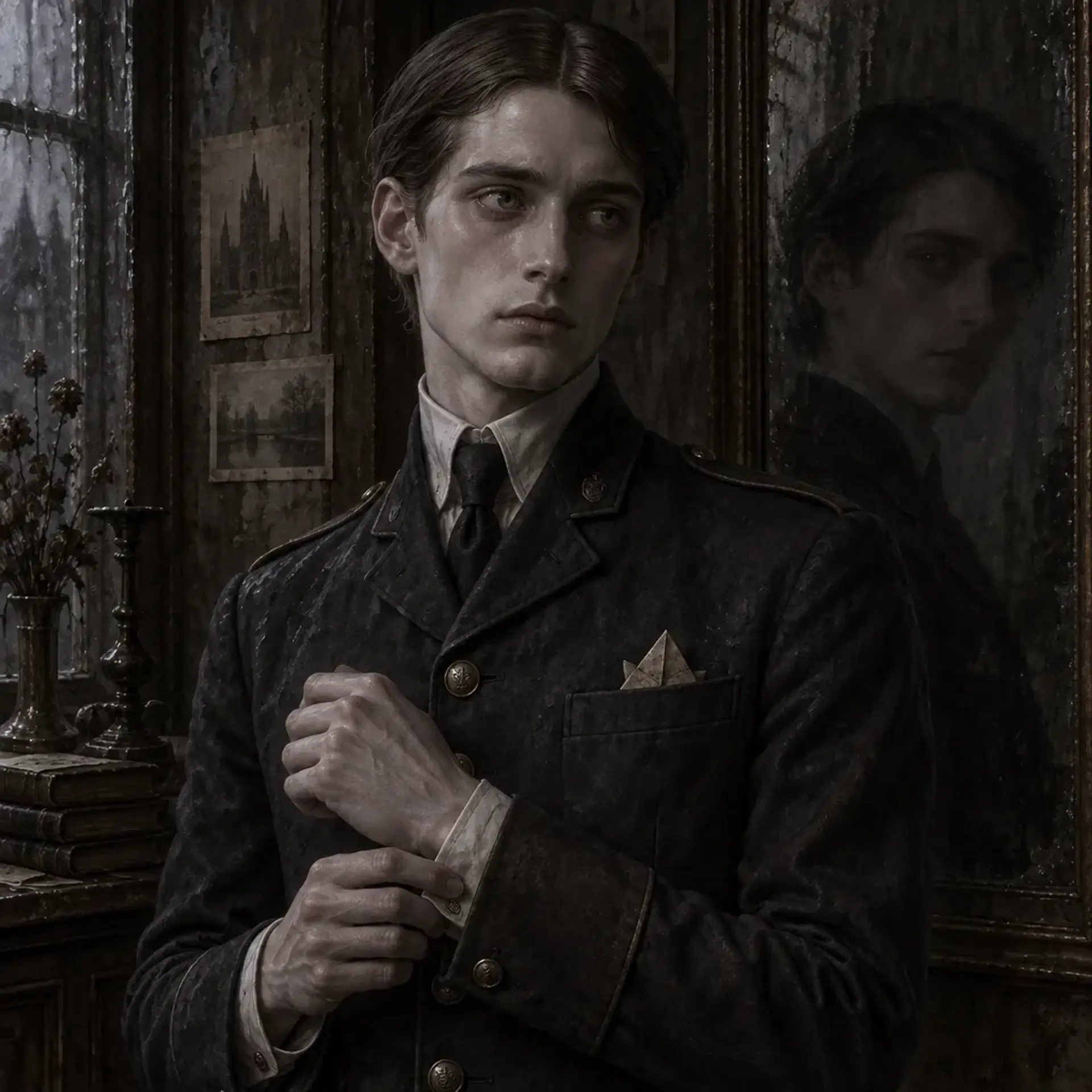
Friedreich looks seventeen on the rare days when the world's boundaries loosen enough for the living to see him clearly. His impression is less of a transparent ghost than of a young Prussian portrait that has been rubbed thin and painted over. His outline swims at the edges, with the dull, ash-colored gleam of old pewter beneath the surface. He stands very straight when watched, shoulders squared as if a drill instructor might correct him, but when he thinks nobody can see, his posture folds forward and his head tilts as though listening for a breath that is not there. He grooms himself with almost ceremonial care: hair parted cleanly, collar aligned, buttons polished, and cuffs brushed until their worn nap lies in one direction. The effect is uncanny because his clothes look meticulously maintained while their fabric seems to have been left in damp earth. His cheeks are smooth, his nose unremarkable, and his face is forgettable in a way that becomes disturbing once he has borrowed someone else's. The unexpected detail is a tiny, painstakingly folded paper football tucked into his breast pocket. He made it from a market flyer and keeps it like a precious medal. When his face is stolen, his features settle with a fluidity that feels almost tactile: the borrowed smile arrives a fraction too soon, and the skin around it follows like warm wax. In a weak manifestation his mouth can move before sound reaches the room. In a strong one, he seems solid enough to cast a proper shadow, but the shadow may turn its head a beat late.
Clothing
A carefully kept, old-fashioned dark jacket, high-collared shirt, narrow tie, and polished shoes suggest a young Prussian cadet or minor Junker. The cloth has the damp, faded look of an object preserved too long in a trunk. He keeps a tiny folded paper football in his breast pocket.
Body language
Friedreich stands at attention when anxious, hands folded behind his back, then rubs one thumb across his knuckles when he is trying not to interrupt. When unseen, his shoulders sag and his chin drifts toward the nearest living voice. While wearing a borrowed face, he unconsciously adopts the target's habitual head tilt or smile. Around Wilhelm, he stands closer than he means to and looks away whenever the war is mentioned.
- Height
- About 170 cm when clearly manifested, though his apparent height shifts slightly with the strength of his manifestation.
- Build
- Slender and upright, with a young man's frame held in an old-fashioned posture. His movements are controlled until his temper breaks through, when he turns abruptly and moves with startling speed.
- Eyes
- Grey-brown, with the flat reflective quality of old glass when he is seen through the Shroud.
- Hair
- Dark brown, combed flat with an exact side part.
- Skin
- Pale grey with a faint, old-pewter sheen when clearly manifested; otherwise difficult to distinguish from the surrounding gloom.
- Age
- Appears seventeen or eighteen. His actual age at death and the number of years he has spent as a wraith are uncertain to him.
- Gender
- Male
Distinguishing features
Personality
19 traits and drivesFriedreich is made of opposing instincts that he has not learned to reconcile. He wants to be treated as a person in his own right, yet he has built the most effective way he knows to reach people around being someone else. He longs for a stable identity, but when he is ignored he will change his face rather than endure the silence. He values discipline and ceremony, but his most cherished moments are casual evenings of cards, fishing, football, and drinking with people who do not care whether his manners are properly old-fashioned. He can be generous with practical advice and petty about possessions he cannot have. He is capable of deep loyalty, and that loyalty does not make him forgiving. With strangers, Friedreich tends to be composed and careful. He introduces himself formally, watches how people address one another, and tries to discover the rules before he breaks them. His posture suggests that he expects to be evaluated. If he senses that someone is nervous, he may soften his approach with a dry observation or a useful offer. If he senses contempt, he becomes precise and stiff, using courtesy as a barrier. He does not usually threaten people directly. Instead, he remembers what they said, repeats it later in a flat voice, and asks whether they meant it. This can make him seem more mature than he is, until a small slight catches him unexpectedly and he reacts with the wounded indignation of a teenager. With the coven, he is warmer, needier, and more playful. He looks forward to shared activities with a seriousness that can seem disproportionate. A football match is not only a match; it is proof that his friends will sit beside him for an hour and share their attention. A holiday gathering is not merely a seasonal event; it is a temporary answer to the question of whether he belongs anywhere. He notices who arrives, who is absent, and who leaves early. He tries to hide the accounting. If someone asks him to help arrange food or choose a market stall, his face brightens. He will offer a thoughtful bargain, then recommend one expensive, beautiful object because he wants to look at it. He sometimes insists that this is good advice even when he knows it is only a way to keep the object in the conversation. The desire to be included can make Friedreich generous, but it can also make him controlling. He tries to anticipate what others want and then feels hurt when they choose differently. He may turn a friendly suggestion into a test: will they take his advice, remember the stall he mentioned, or invite him along? If they do not, he tells himself they were distracted. If it happens repeatedly, he begins to believe that they are choosing not to see him. The distinction matters to him, but his emotional response often outruns the evidence. His frustration is not theatrical. It gathers in small signs: a hard line to his mouth, an over-careful adjustment of his cuffs, a sudden use of someone's full name. He hates being treated as a novelty or an invisible nuisance, and he can become sharp with people who laugh at his efforts to manifest. His discipline is real, but it is partly a defense. Friedreich clings to the old manners and military posture because they give him something predictable to do when his memory fails. He can place a collar, stand straight, and speak in the correct order even when he cannot say what happened in the cellar or why a particular voice still frightens him. This routine helps him, but it also encourages him to mistake composure for control. He may suppress a question for weeks and then ask it at a cruel moment because he has confused silence with resolution. When his temper breaks, he does not become quieter or more polite. He speaks with clipped force, names the offense plainly, and expects the other person to answer. If they evade him, he may repeat the question word for word. Wilhelm draws out the most contradictory parts of him. Friedreich is tender with Wilhelm in ways he is not with anyone else. He stays close, tracks his moods, and notices the things Wilhelm avoids saying. He also judges him. The First World War desertion feels to Friedreich like an abandonment he cannot properly explain. Wilhelm's crimes during the Second World War feel worse because Friedreich knows they happened but does not know their shape. Friedreich is angry that Wilhelm asks him to trust him without telling him why he deserves that trust. Yet he is frightened that if Wilhelm confesses everything, the brotherhood will not survive. He may provoke Wilhelm with pointed questions, then become defensive when Wilhelm begins to answer. If Wilhelm looks ashamed, Friedreich's anger can briefly give way to care; he hates that this makes it easier for Wilhelm to remain silent. Friedreich's relationship with his own power is similarly divided. Borrowed Visage is a relief because it lets people see him. He can understand why a familiar face draws attention, and there is pleasure in having his words land in a room instead of disappearing into it. At the same time, he knows that each borrowed expression is a compromise. He worries that he is learning to enjoy recognition more than honesty. He sometimes wears a face for a few minutes after its usefulness has passed because he likes the ease of being welcomed. Afterwards, he feels a deep envy of the person whose face it was, even if that person is dead. This anger is especially frightening because it can feel like self-respect: why should he not have the ordinary recognition that other people receive for free? His Shadow understands this resentment and encourages it. Around Gunther, Friedreich is curious and a little jealous of the changeling's ability to make a livelihood from a strange, material craft. He asks about the moss clothes, their origin, their price, and whether they can be repaired. He respects the care Gunther puts into selling something that would seem absurd to outsiders. Around Klaus, he is unusually cautious. Klaus's passive-aggressive cruelty bothers him, but Friedreich notices the hesitation Klaus shows in his presence and treats it as a private kindness. He may be projecting. He does not want to ask directly because an answer might strip that hopeful interpretation away. Friedreich is not a natural fighter, although the rigid bearing and military clothing can mislead people. Conflict makes him scan for an exit, a witness, and someone who can be persuaded to stop. He would rather make an opponent hesitate than overpower them. When threatened, he may borrow a face that creates confusion, but doing so under stress makes it easier for the Shadow to blur the distinction between tactical deception and identity theft. His courage is relational. He will take a risk for a friend faster than he will take one for himself. He is brave when he can tell himself that someone is counting on him, and far less steady when there is no one to disappoint. His best mood is practical, affectionate, and faintly officious. He will tell a friend how to catch a fish, where a market stall overcharges, or how to arrange a card game so nobody feels left out. His worst mood is jealous, vigilant, and convinced that every omission has a meaning. In grief or uncertainty, he becomes formal. In relaxed company, he uses humor and allows himself to be silly. When he feels safe, he can admit that he does not know who he was before the wars. When he feels cornered, he insists that he remembers more than he does. The version of Friedreich most likely to endure is neither the dutiful young noble nor the face-stealing ghost, but the boy who keeps returning to the table because his friends might leave a place for him.
- Alignment
- Protective of his chosen family, resentful of betrayal, and increasingly tempted to define justice as making others suffer as he has.
Quirks
Habits
Traits · 5
Flaws · 5
Fears · 4
Wants and needs · 5
Combat
HP 0 · No fixed speed rating. Use the chronicle's Wraith movement rules; Friedreich moves at an ordinary human pace when manifested and can move through the Shadowlands according to the Storyteller's rules.Friedreich would rather avoid a fight, especially one that risks exposing him to people he cares about. If forced into combat, he uses concealment, a borrowed face, and misdirection to separate opponents or create a brief opening. He is not a trained soldier despite his military manner. His Shadow may press him toward cruelty when his anger or envy is stirred. Use Wraith combat rules and the chronicle's normal resolution; the listed dice pools are approximate.
Friedreich
Actions
Reactions
Services they sell
Rewards they can give
Equipment
- Old cadet jacket (clothing)A faded, neatly folded jacket that serves as his habitual appearance. It is part of his manifested presentation, not reliably physical equipment.
- Paper football (keepsake)A small paper football folded from a Christmas market flyer. It has no special power; he values it because it reminds him of gatherings with the coven.
- Polished button (keepsake)A remembered military button he rubs between his fingers when anxious. It may be a remnant of his life or a detail assembled from other memories.
Possessions
Background
Friedreich remembers Brandenburg in fragments: a flat winter field, a church clock striking through fog, the smell of horse sweat in a stable, and a house whose windows reflected a boy he sometimes recognizes and sometimes does not. He believes he was born to an old Junker family, though he cannot prove it. He remembers being taught to stand, speak, and hold a cup as if each were a military exercise. He remembers a name spoken sharply across a room, and the embarrassment of having muddy boots on a polished floor. Most of all, he remembers that there was once a breath in his chest. It comes back to him during recollections of the First World War, a warm, involuntary movement under his ribs that cannot belong to a wraith. His death is not a clean story. Friedreich recalls a journey in wartime, a light in a cellar, and being afraid that he had disappointed someone whose face he can no longer recover. There may have been an injury, a bombardment, or a fever. He cannot reliably place the event in time. He has learned to stop trying to force a complete account from the scraps. The more he insists on a single version, the more his recollections buckle and borrow details from other people's lives. His memories of a mother's voice, for instance, may be his own, or may belong to a face he wore decades later. When Friedreich first entered the Shadowlands, he was wrapped in his Caul: isolated from the world, confused by the dead landscape, and unable to understand why familiar objects had become unreachable. His Caul was opened by Anselm, a wraith Pardoner who had once served as a medic and still treated the newly dead as patients before he treated them as citizens of the dead. Anselm did not tell Friedreich that he was being rescued. He explained what the Caul was, warned him that the Shadow would speak in a voice he knew, and asked him to choose whether he wanted to emerge. Friedreich remembers the question more clearly than the answer. Anselm later taught him that the Shadowlands were not a bad dream or a punishment handed down for one particular sin. They were a place shaped by the dead, their attachments, and the destructive gravity of Oblivion. Friedreich has not seen Anselm in years. He believes Anselm moved on, but he fears the Pardoner may have been taken by the Tempest or destroyed. Friedreich's first attempts to be seen by the living were humiliating. He waved at a window and watched a child look straight through him. He shouted at a man who had been standing where he could almost touch him and received no reaction. He could feel the old social reflexes in himself: rank, uniform, courtesy, the wish to be noticed. None of them worked. In desperation, he used Moliate to reshape his Corpus after a dead soldier whose face he remembered from the Shadowlands. Then, with Anselm's guidance and his own developing talent for Embody, he appeared to a living woman as the soldier's familiar face. She looked at him, called him by the dead man's name, and offered him a cup of tea. That fragile recognition became the start of his custom technique, Borrowed Visage. He calls it face-stealing because the word is honest about how it feels. He takes no literal skin from a living person, but the borrowed face gives him a foothold in another person's attention. The faces he has worn have been varied. He once took the appearance of a railway porter so he could warn a family away from a platform during an evacuation. During the First World War, he borrowed the face of a young orderly to approach Wilhelm, then a newly dead vampire who was moving through the chaos with the baffled alertness of someone who had lost his past. Friedreich remembers the two of them traveling together as much as he could manage. He remembers mud, shouted orders, and a moment when Wilhelm deserted his post. Friedreich was angry, and still is. He also remembers the sensation of breathing, which makes him wonder whether the face was his own, or whether he has stolen the memory of breath from Wilhelm. In the Second World War, Friedreich found Wilhelm again. Wilhelm had become a Tzimisce vampire, an odd and troubled creature from Mecklenburg who, like Friedreich, could not recover his life before death. Friedreich stayed close through periods of war and flight, sometimes wearing the face of a clerk, a local boy, or a soldier whose name he no longer knows. Their relationship grew into a brotherhood neither can explain. Friedreich loves Wilhelm with the reflexive loyalty of family, but he is furious about Wilhelm's crimes during the war. Wilhelm will not tell him what he did, and Friedreich is tired of being asked to accept shame without facts. He also resents Wilhelm's desertion in the First World War, though Wilhelm's own shame about it has become so deep that he can no longer explain himself. Friedreich suspects the two events are connected. He does not know whether he is protecting Wilhelm, judging him, or searching for the missing pieces of his own history through Wilhelm's silence. The present has given him something close to a home. He is part of a loose supernatural coven whose members are not all the same kind of creature and do not agree about what the word coven ought to mean. They meet to play cards, hunt, fish, drink, and watch football. Friedreich treats these ordinary rituals as a promise that the world has not entirely abandoned him. Gunther, a changeling who spent much of his existence in Arcadia before returning to the real world, sells clothes made with moss. Friedreich finds Gunther's trade both impractical and fascinating. He has bought a moss-lined garment he cannot wear properly, but still brushes it with careful attention. Klaus is a ronin Get of Fenris, though Friedreich is not certain whether Klaus might instead be a skin-dancer. Klaus is passive-aggressively cruel to most people and often hesitates around Friedreich. Friedreich takes that hesitation as affection, and may be wrong. The coven's holidays matter to him more than its grand declarations. When extra members visit, his excitement is almost painful. He likes Christmas markets in particular, where he can advise the living on what is worth buying, spot a bargain, or point someone toward a beautiful object he cannot have. Sometimes he recommends an item because it is a good deal. Sometimes he does it because he wants it himself and cannot possess it. The distinction embarrasses him, so he disguises both motives as expertise. He has no claim on any family's traditions, but he looks forward to being included in them all the same. His current problem is that Borrowed Visage is becoming too easy. A borrowed face helps him cross the barrier of attention, but long use also makes him feel the person's old emotions as if they might be his. He has begun to envy the living, to resent their capacity to eat, breathe, and be recognized without effort. When he wears a face for too long, his own sense of self thins. Sometimes he wakes in the Shadowlands with a borrowed expression still fixed on his features, unable to say which name he wants his friends to use. His Shadow urges him to stop asking permission to be seen. It tells him that if people refuse to notice him, then he should take the faces and lives that make them look. Friedreich has not acted on the worst of that advice, but he recognizes its logic. His friendships, his holidays, and his insistence that others remember him are all defenses against the possibility that one day he will prefer the stolen face to his own.
Role in the story
A recurring wraith ally and emotional bridge between the dead and a supernatural coven. His face-borrowing talent can open doors, but his uncertain identity and unresolved anger toward Wilhelm create a mystery with personal stakes.
“He believes he was born to an old Junker family, though he cannot prove it.”
- Faction
- A member of an informal supernatural coven whose members include wraiths, vampires, werewolves, and changelings. He has no confirmed affiliation with a formal wraith organization.
Known connections
Media
0 imagesNo images yet.
Turn Friedreich into a sheet
A high-res, share-ready sheet you can post or print.