Dr. Veyt
Dr. Veyt
At the table
Voice
A dry, clear voice with a faint rasp from cold roads and strong medicinal teas. It carries easily without becoming loud, shaped by the habit of giving calm instructions in crowded rooms. When upset, Veyt's consonants sharpen and their pace accelerates; they do not soften their volume.
Their speech is shaped by years of giving instructions over the clatter of hospice kitchens and roadside wagons: direct, well-enunciated, and economical. Veyt favors concrete descriptions over grand terminology, but their phrasing grows technical when they are nervous. They often turn a question into a sequence of practical options.
Speech patterns
How to play them
Veyt offers practical help before asking personal questions and makes clear that Eber may refuse any examination. They are candid about what they do not know, though they may press too hard once a promising symptom emerges. If challenged, they respond best to a direct reminder that Eber is a person, not a case file.
Goal
Find reliable evidence about Eber's transformation, offer useful care without treating Eber as a specimen, and return with findings before the hospice trustees end their funding.
Motivation
Veyt wants to understand bodily transformations well enough to protect people from fear, exploitation, and dangerous guesswork. They also need to prove that their past work was not built on a lie.
Appearance
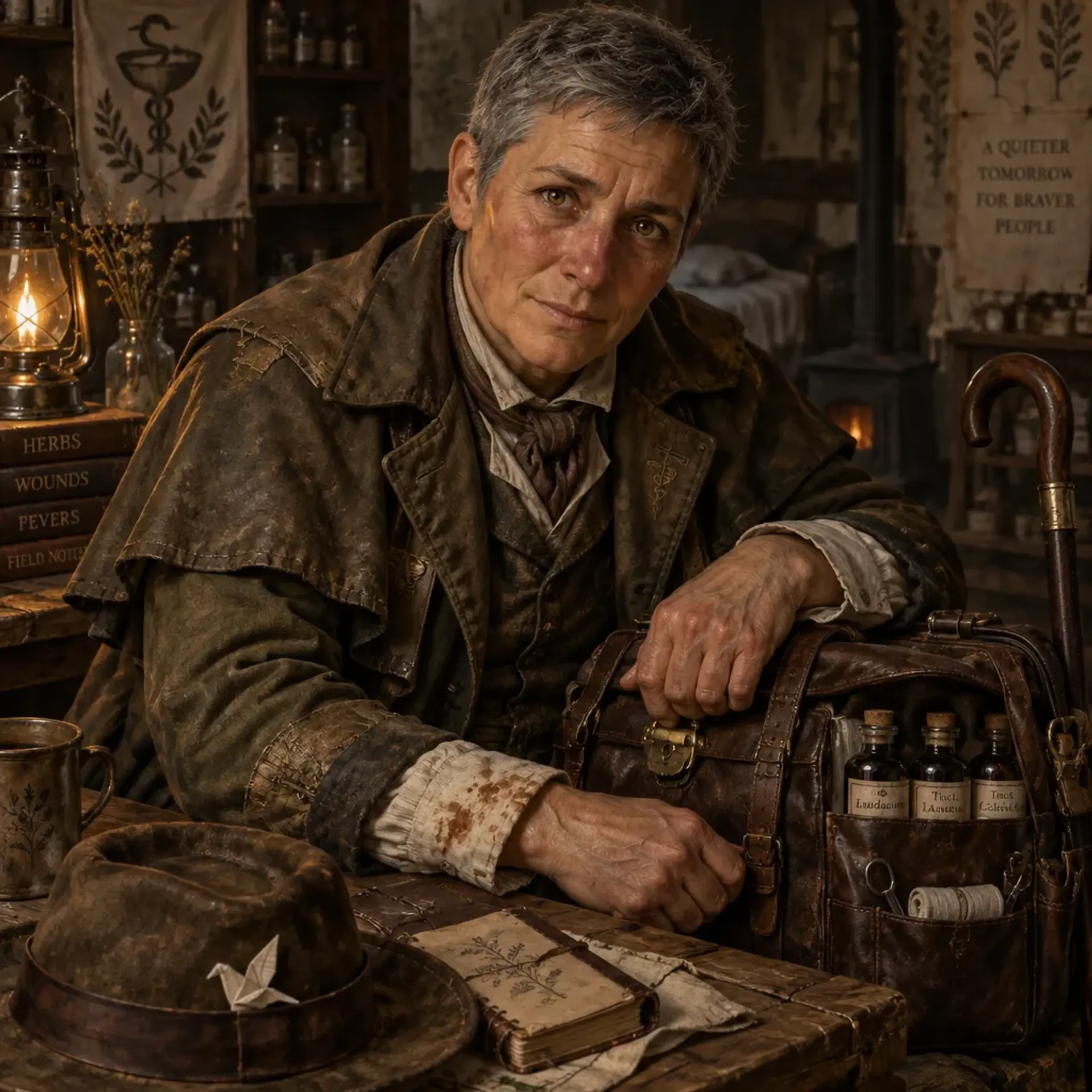
Dr. Veyt is a compact, square-shouldered traveler who occupies more space than their height suggests, setting bags down as if every roadside were already a consulting room. Their movements are measured and practical, with a slight forward lean from years bent over patients. A minute after meeting someone, most people notice Veyt's thumb repeatedly checking the brass clasp on their medical satchel. Their unexpected detail is a tiny, meticulously folded paper bird tucked into the hatband, replaced whenever rain ruins it.
Clothing
A faded moss-brown traveling coat with deep, patched pockets, a high linen collar, a weatherproof shoulder cape, and boots darkened by mud. The cuffs are carefully scrubbed but permanently stained with tincture. A folded paper bird rides in the hatband.
Body language
Veyt leans into conversations as if trying to hear a pulse through the words, but is quick to step aside when they realize they are crowding someone. Their fingers check the satchel clasp whenever a subject feels emotionally dangerous. When considering a diagnosis, they hold still enough that their coat's loose threads stop swaying.
- Height
- 5 feet 4 inches
- Build
- Compact and square-shouldered, with the sturdy frame of someone accustomed to carrying supplies over rough roads
- Eyes
- Hazel brown, with fine amber flecks
- Hair
- Dark iron-gray, clipped close at the sides and usually flattened beneath a travel hat
- Skin
- Warm olive with a weather-reddened nose and pale marks where spectacles rest
- Age
- Fifty-one
- Gender
- Nonbinary
- Size
- Medium
Distinguishing features
Personality
13 traits and drivesVeyt is warmly attentive to pain but impatient with evasions, and takes pride in careful evidence while quietly craving a discovery that will vindicate an old mistake. In a clinic, they are brisk and decisive; among friends, they are unexpectedly playful and make absurdly specific jokes. When frightened, they retreat into clinical language. When confronted with suffering, that armor drops and they act before considering the cost to themselves.
- Alignment
- Neutral good
Quirks
Habits
Traits · 4
Flaws · 3
Fears · 3
Wants and needs · 3
Combat
AC 10 · HP 5 · 30 ft.Veyt avoids combat, takes cover behind sturdy objects, and tries to persuade opponents that nobody needs to be hurt. If cornered, they use the cane to create distance and throw a bitter vial to disrupt an attack, then retreat toward an exit. They will spend their first opportunity stabilizing an injured creature rather than dealing damage.
Dr. Veyt
Actions
Reactions
Services they sell
Rewards they can give
Equipment
- Physician's satchel (medical equipment)A leather case of bandages, clean needles, forceps, herbal dressings, and labeled bottles. It includes enough supplies for several routine treatments.
- Walking cane (tool)A plain ashwood cane with a rounded handle, useful for walking and keeping distance.
- Bitter vials (consumable)Two sealed glass vials of harmless, intensely bitter irritant.
- Case notebook (possession)A stitched notebook containing symptom records, copied testimony, and several pages about Eber's possible transformation.
Possessions
Background
Veyt learned medicine in a cramped riverside hospice, where practical care mattered more than a prestigious lineage. Their turning point came during a winter fever outbreak: Veyt had to choose which of two patients received the hospice's last dose of an experimental treatment. The patient who received it survived, but developed a startling transformation that Veyt could neither explain nor reverse. Years later, Veyt believes the same pattern has appeared in Eber. They have been traveling between small settlements, comparing symptoms and quietly asking for old case notes. Veyt remains in correspondence with their former teacher, Brindle, who insists the transformation was an unrelated illness. Veyt is also behind on payments to the hospice and fears its trustees will seize their research. Their current problem is that the evidence is fragmentary, while their interest in Eber risks making a patient feel like a specimen.
Role in the story
A connection of Eber who offers an extended study of a similar transformation. Veyt can become a useful medical ally, a source of unsettling clues, or a source of conflict if their research begins to outweigh Eber's comfort.
“The patient who received it survived, but developed a startling transformation that Veyt could neither explain nor reverse.”
- Faction
- Independent traveling physician; formerly supported by the trustees of a riverside hospice
Known connections
Media
0 imagesNo images yet.
Turn Dr. Veyt into a sheet
A high-res, share-ready sheet you can post or print.