William Windon
William Windon
At the table
Voice
William's voice is warm-edged and slightly breath-conscious after his heart stoppage, shaped by garden work and local Wiltshire life. Wilt's voice has a deeper, rougher grain, an older Wiltshire cadence, and the clipped certainty of someone accustomed to formal speech. When rattled, their breathing catches and the voice may break between accents; anger does not make either of them uniformly quiet or polite.
William's speech is considerate and locally grounded, with a modern young man's rhythm; he often begins a difficult question indirectly. Wilt's voice comes through with a deeper, older Wiltshire accent, dry wit, and formal phrasing. The two can change cadence mid-sentence. When afraid, William's breath catches and his words crowd together. Wilt may answer sharply or force silence rather than becoming quieter or more polite.
Speech patterns
How to play them
Approach him as a person rather than an object of study. Offer simple choices, give him time to answer, and do not crowd him or surprise him with reflective surfaces. Acknowledge both William and Wilt without insisting that one is a lie. Clare's calm practical kindness works; Hector's interrogation and categorical labels provoke defensiveness. Mentioning Adaline, gardening, or his friends can open conversation, but do not treat Wilt's interest in Adaline as harmless teasing. If his breathing catches or his posture becomes rigid, remove war imagery, reduce noise, and give him physical space.
Goal
Keep his family safe, understand the living heart and the coastal siblings, recover a way to live openly, and decide whether he can be William and Wilt without one erasing the other.
Motivation
William wants to remain connected to his family and ordinary life. Wilt wants safety from the coastal siblings, access to the world he finds fascinating, and recognition as a person rather than a stone's servant. Their motives overlap in protecting the household but diverge over trust, secrecy, and Adaline.
Appearance
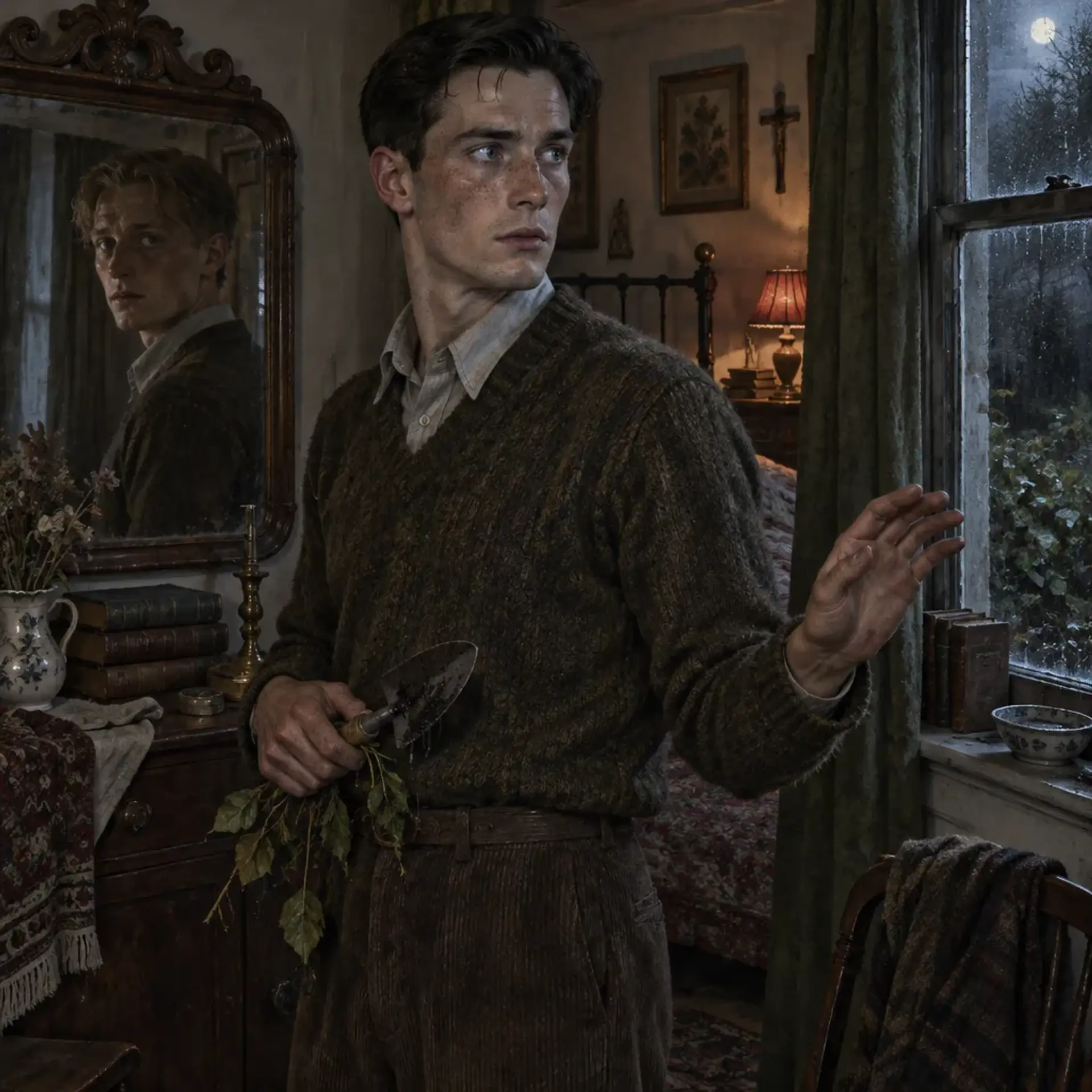
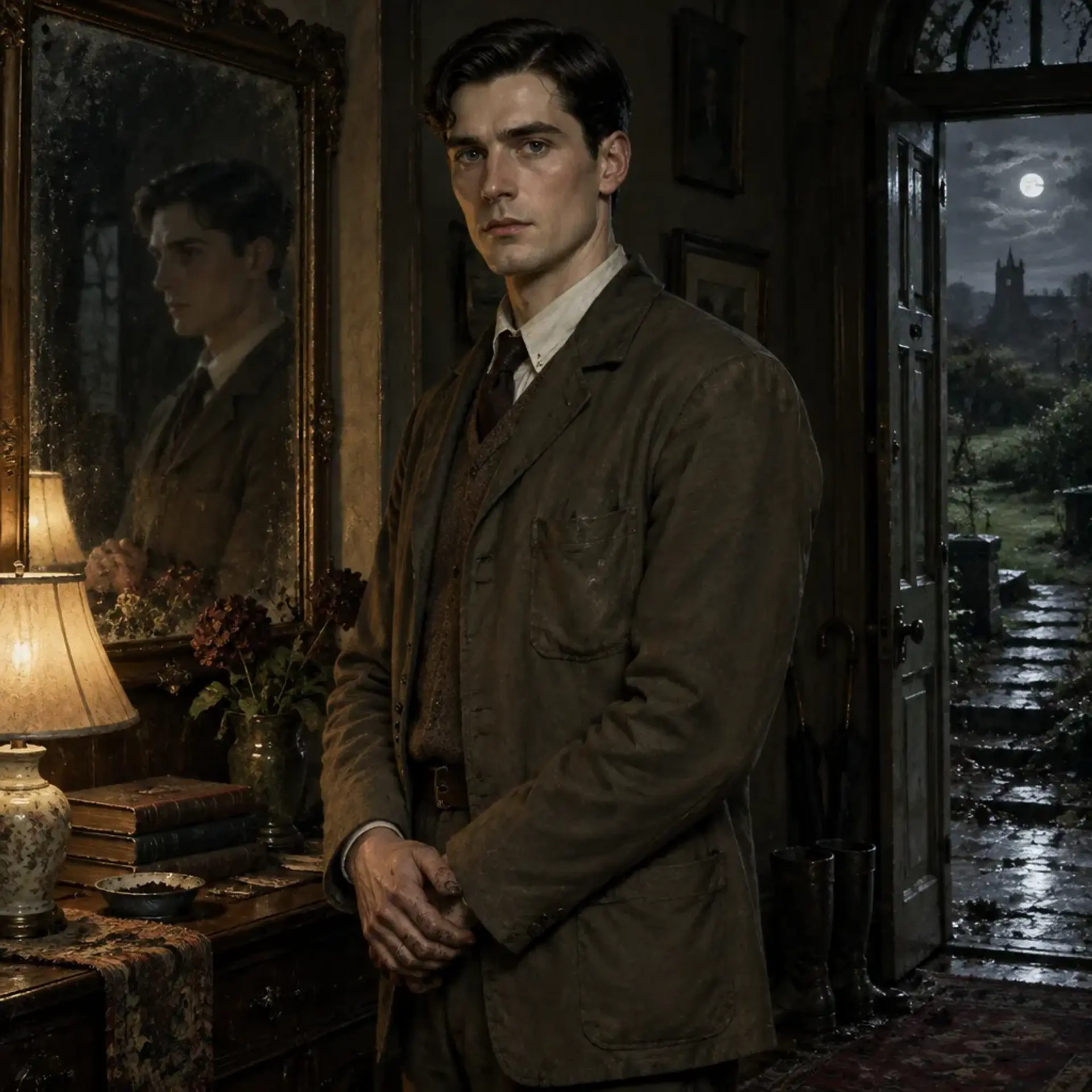
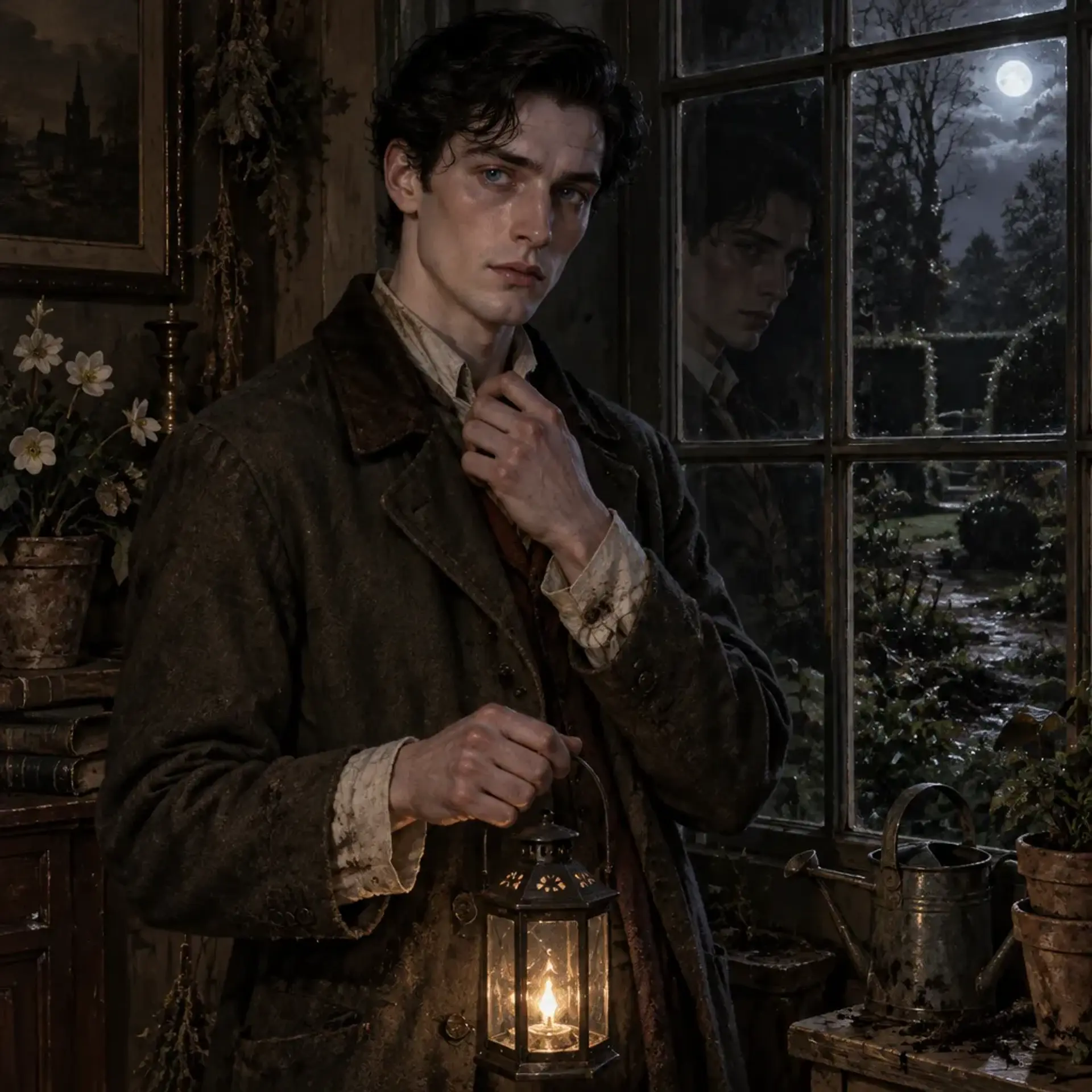
At first meeting, he seems an average-height young Wiltshire man with a soft, attentive face, brown-spotted skin, dark-blond hair, and clear blue eyes that tend to meet a person directly and then drop as if he has noticed he is staring. He moves with the careful economy of someone accustomed to garden paths, wet soil, and carrying tools without knocking plants over. His hands usually smell faintly of crushed leaves, soap, and damp earth. After the change, the person in the room is taller than William was, still dressed in William's clothes but wearing them with a more deliberate fit: collar straight, hair cut short and neatly arranged, shoulders held as if trained by an older and stricter household. Wilt's face is long and handsome by a conventional English standard, black-haired and blue-eyed, with an aloof expression that can look like disdain until the eyes soften. The skin appears cold and faintly luminous in moonlight, as though a rose-pink glimmer were buried beneath pale chalk. His movements are sometimes too smooth, like a reflection correcting itself, then abruptly human when grief or affection catches him. He leaves the impression of a familiar face that has been remembered incorrectly. An unexpected detail for a gardener is his fussy, almost ceremonial attention to table manners and the exact placement of a cup; he can notice a fork set wrongly from across a room while overlooking mud on his own cuffs.
Clothing
Work clothes from the estate when he can wear them: practical trousers, shirt, worn jacket, and shoes marked by soil. Wilt insists on a neat collar, properly arranged hair, and better short hairstyles. After losing his employment, he uses William's ordinary clothes, made uncanny by the way he wears them as if they were chosen for a formal occasion. Keeps a coat close at night for warmth and concealment.
Body language
William's old manner was open but cautious: a slight forward lean when listening, shoulders soft, hands often occupied with a cuff or a leaf. Wilt stands taller and keeps his spine more formally arranged. His gaze can be still enough to seem judgmental, but his eyes flick toward exits and mirrors. When frightened, his breathing catches high in the chest and the jaw works as if holding back a sound; when the old coastal fear takes him, he becomes rigid, then moves with startling force. His fingers repeatedly straighten collars, align cups, or check a latch without noticing.
- Height
- William was average height for a young man in Cold War-era England. Wilt is taller, though still of an apparent age of about eighteen.
- Build
- Average height and build for a young man of his period before the change; Wilt's physical manifestation is taller, more poised, and still appears about eighteen.
- Eyes
- Clear blue; Wilt's eyes look colder and more reflective in dim light.
- Hair
- William's original hair is dark blond. Wilt's hair, now the visible hair, is black and kept in a neat short style.
- Skin
- William's original skin was fair with brown spots. Wilt's changed face is pale, with a subtle chalklike cast and an occasional rose-pink glimmer under moonlight.
- Age
- Young adult; about eighteen in appearance. William's stated age is young adult, and Wilt's face also appears about eighteen.
- Gender
- Male
- Size
- Medium, using ordinary descriptive language rather than a claimed system size category.
Distinguishing features
Personality
25 traits and drivesWilliam and Wilt pull against each other, but neither is a simple opposite of the other. William is tender and observant, yet he can become stubborn when someone treats him as helpless. Wilt is composed and wry, yet beneath the old manners is a frightened being who can become desperate when his sister is near. William tries to make people comfortable and hates causing pain; Wilt considers honesty more important than comfort and sometimes delivers it like a blade. Their shared sensitivity is not gentle in every circumstance. Both notice humiliation, exclusion, and small acts of care. William is more likely to forgive a slight, while Wilt remembers it and files it away. When the household is calm, William's curiosity leads: he wants to read, learn plant names, walk in the garden, and see his friends. Wilt's curiosity is more invasive and immediate. Cars, television, electricity, records, and household mechanisms fascinate him, and he may explore places they have been told not to enter simply to learn how they work. When William is exhausted or afraid, Wilt becomes formal and controlling, convinced that he can keep them alive by managing every movement. When Wilt is relaxed, he can be playful, even giddy, especially with drink, music, or a film he likes. Their drunken evening was not proof that the danger had passed; it showed that Wilt could be merry when he felt safe enough to forget the fear. They each have different kinds of pride. William is proud of being useful and dislikes being treated as a burden. He would rather prune a hedge badly with one arm aching than be watched from a chair. Wilt is proud of his manners, appearance, and ability to recognize what others overlook. He is also insecure about how little he knows of the current world. William may take correction personally when it sounds like Hector's disappointment. Wilt may take it as an insult to his right to exist. They both dislike being called stupid, but for different reasons: William fears that his education and ambitions have not been enough, while Wilt has learned that people use strange as a synonym for disposable. Their moods do not always follow the same weather. William can be cheerful in the garden while Wilt remains watchful for salt air. Wilt can enjoy a television comedy while William worries about what the next family argument will be. Sometimes William is angry and Wilt is frightened; sometimes Wilt is furious and William feels the bodily panic that comes with it. The heart's connection makes emotions bleed through, not neatly alternate. A person speaking kindly to Clare can make them both soften. Hector's suspicion can make them both bristle, although William wants reconciliation and Wilt wants a door locked. Elizabeth can tease them into laughter, then suddenly remind them that she is frightened too. Their emotional life has become a negotiation without a reliable boundary. William is gentler with his mother than with anyone else. He lets Clare read while he gardens and takes the tea she makes even when he is not thirsty. Her steadiness helps him believe his altered face has not made him unlovable. He is protective of Elizabeth, but he dislikes her spying and sometimes snaps at her for watching him as though he were a puzzle. He regrets it afterward. He wants to be patient with Hector, whose history and anxieties he understands better than he used to, yet Hector's habit of withholding information makes trust difficult. William knows his father once hoped he would become an intellectual like him. Part of William still wants to prove that he can study, think, and make something of his life. Another part resents being measured against Hector's ambitions when all he had wanted was to become a botanist. Wilt does not know how to be a brother in the usual sense. He calls the coastal being his sister, but speaks of her as weather that has become personal. He fears her pursuit and misses her at the same time. He may insist that William stay under the bed and keep silent, then become visibly unsettled when she stops calling. His old-fashioned manners are not a mask he puts on to impress the family. They seem to be part of the structure of his being, an inherited idea of how people should arrange themselves around a table, how a collar should sit, or what counts as a proper apology. Yet he can be startlingly modern in his appetite for television, films, music, and machines. He likes alcohol and the release it gives him, but the morning after leaves William with guilt and the family with one more reason to worry. He is not reliably polite. Wilt has made inappropriate remarks about neighbors and judged William's clothes out loud. He can be cruel when he thinks someone deserves it, as when he insulted Hector after Hector dismissed country people. The incident with the Welsh neighbor's child remains a point of shame. The child had run into William with a toy wagon; a girl was crying and the child apologized. Wilt answered with a slur. William cannot excuse it as a mere accident of possession, because the word came through his own mouth and caused real harm. He served the stable chore, avoided repeating the word, and still feels anger at Wilt and himself. Wilt's ability to stop William from speaking when he thinks something improper can look like conscience, but it can also be a way to control him. William resents that control even when he agrees with the judgment. Their attraction to Adaline exposes a harder conflict. William cares about her as a person and wants to see her again, but he is unsure how to meet her after the face change. Wilt's attention began as fascination and became possessive. He calls her interesting, watches William's reactions, and has made it clear that he wants her. There is vanity in it, curiosity, and perhaps a desire to prove that this body can be wanted. William is jealous, but his jealousy is complicated by the fact that Wilt is not an outside rival. He cannot simply walk away. He also fears that if Wilt succeeds in drawing Adaline close, she will be misled about who is speaking. He wants Wilt to respect her choices; Wilt thinks William's hesitation is an excuse to avoid rejection. The changed face has made them both more self-conscious. William was already sensitive about grooming and appearance, but Wilt's insistence on a neat short haircut and correctly arranged collar has turned the mirror into a negotiation. Wilt comments on William's shaving and will remind him to do it later if he does not do it in the morning. He sometimes takes the lead in washing when William feels too embarrassed to look at the reflection. This is not always tender. Wilt may make a sarcastic comment about their body, then blush when William points out that he is embarrassed too. The shared body has ordinary needs and private discomforts, and they are both too proud to talk about them without a joke. When frightened, William wants to ask questions. Wilt wants to stop the conversation. William wants to turn on a light, find his parents, and establish what is happening. Wilt wants to check the exits and conceal them. The moonlit night under the bed showed this difference clearly. William fought when Wilt controlled his mouth, then heard the fear in Wilt's voice and chose not to force the issue. This was not submission. He was making a decision with incomplete knowledge. In the morning he still demanded an explanation. He can cooperate without agreeing, and Wilt is slowly learning that protecting William by controlling him may destroy the trust he needs. William's sensitivity can make him brave, but it can also trap him in guilt. He thinks about the stable chore, the neighbors, the way Hector looked at him after the war film, and the shock on Tommy's face. He worries that his family is rearranging its life around him. He wants to work again, see Adaline, and walk beyond the garden without someone watching. He has lost his job not because he lacked skill but because his changed appearance and the family's secrecy make ordinary employment impossible. He is grieving that loss while trying to tell himself it is temporary. When he is most discouraged, he may become quiet and agreeable, then later lash out at a small question because he has been swallowing too much. Wilt's fear takes a different shape. He is alert, controlling, and sometimes almost cold. He listens for voices through walls, measures the wind at the sealed window, and feels the presence of his sister before William does. He avoids paranormal manifestations when he can, despite being one himself. He does not want to be examined, summoned, or taken apart as an explanation. His fear can look like arrogance because he refuses to answer questions. He gives fragments instead: a father, more siblings, a memory of a forge, a smell of salt, a command to go back to bed. He may speak as if these are ordinary facts because the emotional scale of them is difficult to translate. He is not withholding every detail to manipulate William. Some memories are not available to him as stories. Their shared love is most visible in small behavior. William still notices whether Clare has eaten. Wilt answers her Bible passages with passages of his own, not to mock her but because the words matter to him. William tries to keep Elizabeth from feeling responsible for the haunting. Wilt will make fun of her questions, but he responds when he believes she is speaking to him rather than to William. He and William both care about the house, though Wilt sees it as shelter and William sees it as home. They both want the family safe. Neither will admit how much the other's presence has become a comfort. Wilt is the only one who knows what the coastal call sounds like from inside the body. William is the only person who can remember school, gardening, and Clare's voice as his own lived history. They need each other and resent needing each other. The longer they share a life, the less useful it becomes to ask which one is speaking. William's memories have begun to mix with Wilt's impressions. The old accent can arrive in a sentence before either recognizes it. Wilt's habits can appear in William's decisions, and William's warmth can soften Wilt's response to a frightened person. He may say, "I remember," then pause because he cannot say who remembers. This is not an excuse for every action. It is a source of uncertainty that makes responsibility harder, not irrelevant. They must decide together what to do with the consequences of the slur, the hidden knife, the lies told to Clare, and the danger Hector's papers may bring. The transformed young man can be harsh and sharp, but remains capable of affection. He can be formal at tea and then laugh at a silly television program. He can resent Hector and still worry when he hears his father moving around the study at night. He can fear the sister outside and feel lonely when she no longer calls. He can want Adaline and fear what Wilt wants from her. He can mourn William's face while gradually feeling at ease in Wilt's. This contradiction is not a puzzle he can solve by selecting one identity. It is the life he has now, and he wants the right to choose how it continues.
- Alignment
- Not supplied as a Secret Histories rule or category. In ordinary terms, protective and compassionate, with a growing capacity for cold, uncompromising choices.
Quirks
Habits
Traits · 7
Flaws · 6
Fears · 6
Wants and needs · 6
Combat
HP 5 · Ordinary human walking and running; no special movement rate asserted. Wilt's reflection can appear to move independently in suitable reflective surfaces as a custom supernatural effect.Avoids fighting whenever possible. William prefers to retreat, talk, or get between danger and a family member. Wilt can take over in a sudden threat, using surprise, a shove, a grapple, or an improvised household object, then withdrawing. He is not a trained fighter. War imagery and being physically restrained can trigger a severe, uncontrolled response rather than a tactical advantage. Protecting the family and escaping are more important to him than winning.
William Windon
Actions
Reactions
Services they sell
Rewards they can give
Equipment
- Hand lamp (household)A small shaded lamp or torch used during night checks of the house.
- Gardener's kit (work equipment)Gardening tools and worn work clothes, kept from his estate employment even after losing the job.
- Secret food cache (supplies)A few hidden tins, sweets, cheese, and other food Wilt has stashed under the bed or in a cupboard.
- Occult notes, partial (research)Hector's occult papers, some burned and some concealed; William has found fragments but does not possess the full collection.
- Hidden household knife (improvised weapon)A knife once stolen and hidden by Wilt. William does not like that it is there and has not decided whether to dispose of it.
Possessions
Background
William Windon was born in Wiltshire to a family that had stayed in the county long enough to speak of fields and neighbors as if they were relatives. He grew into a warm, observant young man, average in height and build, with dark-blond hair, blue eyes, and brown spots across his skin. He was more sensitive than his father considered useful. A crying child, a neglected border of flowers, or a bird trapped in a shed could stop him in the middle of whatever he was doing. He was not timid, exactly; rather, he took other people's feelings seriously and often needed time to decide what to do with them. He worked as a gardener on an estate and was training himself toward botany, finding in plants a patient order that human arguments rarely offered. His father, Hector, was a historian, intellectually restless and suspicious of inherited authority. Hector's own father, known as Bobby, had been a fierce veteran of the Second World War. Hector rejected much of Bobby's martial certainty and preferred liberal politics, contemporary art, and arguments about the damage done by rigid social systems. He could be affectionate and stimulating when William was studious, but he grew dismissive when his son seemed to choose soil, routine, and ordinary local concerns over the kind of intellectual life Hector imagined for him. Hector's impatience was not simple cruelty. It was a mixture of fear, disappointment, and an old, unresolved struggle with his own father. He had hoped William would become a scholar who could inherit his curiosity without inheriting his bitterness. Hector concealed an additional life. He belonged to an occult circle and had studied forces he did not fully understand. He had not told Clare, William, or Elizabeth the whole truth. He knew enough to recognize that something was wrong when William brought a strange object into the family's orbit, but not enough to name its origin or purpose. His father's wartime history had left Hector wary of secretive institutions and the violence that comes when officials decide a person is a problem to be managed. He nevertheless kept papers, notes, and records, telling himself that knowledge was safer when written down. That habit would later become a danger to his son. The object that altered William's life began as a gift left at Hush House. An amateur alchemist, Bartholomew Golden, had called it the Heart of England and claimed it could bring servants from man's shadow, made from the hearts of chalk cliffs and borderlands. Golden left it wrapped in newspaper as payment for entry. He was never permitted near Brancrug again. The object looked like a stone from the cliffs of Dover carved in the shape of a human heart. Barnacles and sea grass clung to it. It had been thrown into the sea, only to return to the shore, wet with saltwater and black ooze. Beneath the rock, a red-pink hue appeared, like light or blood returning to a dead thing. Abraham Groff, a young man from London, picked it up and carried it home. It beat beneath his coat after his train journey. He was repulsed by it and drawn to it in equal measure. When he showed it to neighbors, it seemed to die in their presence. When he returned it to the shore in Hampshire and let seawater touch it, the pink color returned. Abraham decided it was special and belonged to him. He did not keep it hidden from greed alone; the stone seemed not to like visitors. Strange sounds followed: voices, moving doors, footsteps in empty halls. At last he sold it to a seventeen-year-old local boy, William, one of the people who had seen it before it went cold. William prized the curious stone, then began to feel its beating in his chest as though his own heart had been copied. After tasting the sea, blood, and soil in his mouth, he tried to break it with a hammer. The pain moved through him rather than the rock. He fell, groaning and spitting blood, and glimpsed a muscle twitch under the stone before his own body gave out. His mother Clare found him, and the family believed his heart had stopped. He survived. The stone was left in a hollow log, apparently pristine despite the hammer blow. William tried to put the episode behind him, but the mirrors in his home began to return a stranger. The stranger was a young man of William's apparent age, long-faced, handsome, black-haired, and blue-eyed. He wore what William wore, but held himself with an aloof, old-fashioned poise. At first he only moved wrong: a fraction late, or in a direction William had not chosen. William was cautious when grooming because the face was not his. One bedtime, while William was going through his usual routine, the reflection spoke with William's mouth: "Well, it's not often you use that one." The voice had an older local accent and a deeper, more settled sound than William's. It made dry observations about William's clothes, his hair, his family, and his neighbors. It sometimes stopped him from saying something it considered improper. William tried to ignore it, but windows and dark surfaces began to show the stranger even when there was no mirror nearby. William's sister Elizabeth discovered that changing the wording of a question could make her brother stumble into the stranger's manner. She called it brain damage, partly from worry and partly because making William flustered amused her. She also understood that there was something more than an illness involved. Her brother's friends Tommy DeHare, John Mollask, and Ryan O'Leary came to visit and learned that the reflection could react to people, not just to William. The stranger developed opinions about them and began speaking through William's body. William's father Hector made a dismissive remark about country people. The reflection cut back sharply, and William got into trouble for it. Another time it insulted a Welsh neighbor's child with a slur after the child accidentally hit William with a toy wagon and made a girl cry. William was made to muck out the neighbor's stables. He refuses to repeat the word. The incident left him ashamed, angry at the reflection, and privately disturbed that the insult had seemed to come so easily. The reflection had a life, or something like one, beyond William. It spoke of siblings and a father as if describing weather, an ache, or a pattern in the sea. It called itself Wilt when William finally asked directly. It liked television, books, alcohol, well-made clothing, and the novelty of cars and electronics. It disliked certain war films. Once, after a war movie triggered it, William lost control of his body. He screamed, cursed, and fought as though trapped inside a memory of shell shock. Hector restrained him while Elizabeth changed the channel. When William came back to himself, Hector looked at him differently. That night the voice apologized, awkwardly, and offered a fragment of memory as consolation. It could not explain the memory in a sensible sequence. It had the texture of salt, hot metal, dark woods, and fear. Wilt's opinions made ordinary family life strange. It took tea manners seriously and could annoy Hector by insisting on an old custom. It reminded William to shave, criticized his hair, and sometimes took the lead in washing when William was embarrassed. Bathing was especially difficult: the water reflected Wilt, and both of them were prudish enough to resent being seen. Wilt once blushed, which William found more unsettling than any insult. During a night of drinking, after Hector had left scotch and bourbon for William's health, Wilt took over in a giddy, uncharacteristically merry mood. It teased, argued, smiled, sang, and nearly removed William's shirt as a gesture of rebellion. When William asked if it was the stone, Wilt scoffed, "Dad isn't here." In the morning Clare found the empty bottle. Hector yelled, then shifted into offering William chores around the house, an awkward effort at care. Clare established regular gardening walks with her son, reading from a book or the Bible while he worked and making him tea and snacks. Wilt answered some Bible passages with others William did not know. He did not insult her. The most frightening night came when William woke cold and unable to move. He heard a woman's voice outside, calling for Wilt. Wilt clamped William's mouth shut and turned their body toward the floor. William felt the wrong hands touch his face and heard a thick Wiltshire accent come through his throat. "My sister is outside. They're looking for me. Go back to bed." William fought him, demanding to know about the siblings. Wilt said she was trying to draw him out and that every word gave her another chance to find him. He insisted they stay quiet. William could hear something beyond the walls, a voice trying to make a name out of a sound. He felt Wilt's fear as well as his own, and that frightened him more than being controlled. Under the bed, the moonlight made the room seem to breathe. A pale strip of light crossed the floorboards, then thinned as a cloud passed. The old furniture cast long, bent shadows. A damp smell entered the room, saltwater, wet grass, and something dark and iron-rich like blood or the black ooze on the heart. The air felt colder near the window, though the curtains did not move. William was furious at Wilt, then realized the body had stopped fighting him. They were not in agreement, but Wilt was trying to protect them both. The two listened until the night seemed to have lasted for hours. At some point the fear drained away and William fell asleep, folded beneath the bed with his cheek against dust and cold floorboards. In the morning, William crawled out and went straight to the bathroom mirror. Wilt's face remained there. William touched his own cheek and felt his familiar skin, then the reflection gave him a small, oddly plaintive gesture. "See, you're fine now." William was not fine. He argued with Wilt, then went outside to inspect the ground. There was a trace of salt on the grass and the smell of damp meadow, brine, and black ooze. Wilt was tense, wanting to hide. William made himself look around. He began locking doors and windows, including his upstairs bedroom window. He knew the study had a damaged window hidden behind a bookcase, one Hector had sealed. The cellar was bricked up, though it had been that way before Hector bought the house. Sometimes a breeze came from those places carrying salt, blood, or meadow scents. William began to understand that the house had old openings, and that the coast was not as far away as the map claimed. After his heart episode, William spent months recovering, then returned to the estate's garden work. The work steadied the two of them. Wilt was fascinated by machinery and television, and the walking routes through town and woods gave it an ordinary world to examine. William remained hopeful of becoming a botanist. He wanted to see Adaline again. She had auburn hair and soft brown eyes, and Wilt became instantly possessive in a way that was both ridiculous and frightening. William had thought his hardest competition would be another young man. Instead it was the face inside every pane of glass. Wilt called Adaline interesting, then made it clear that he wanted her attention. William's tenderness toward her and his jealousy of Wilt tangled together. He does not know whether the feeling is entirely his, entirely Wilt's, or shared. Wilt's sister returned to the edges of the house. William could sense her searching at night, and Wilt could hear her more clearly. Wilt called her his sister but would not describe how many others there were, only saying, "More." He avoided the supernatural when he could, yet the presence outside brought out a fear that had no human shape. William began studying Hector's occult writings in the study, trying to find an explanation without waking his family. He found scraps that suggested Hector had encountered a group or bureau concerned with anomalous events, though Hector's notes were incomplete and sometimes burned. William could not tell which passages were genuine research and which were Hector's theories. He and Wilt started working in silence to keep the house from being trespassed. William would close doors, check the window, and watch the garden; Wilt could sometimes feel the approaching coastal presence through William's skin. Hector grew suspicious. He noticed William's conversations with empty rooms, his avoidance of windows, the missing food and household objects, and the shifts in voice. He knew his son had suffered something extraordinary but did not know whether the occult had caused it or merely given it a name. Elizabeth's spying changed from amusement to concern. She could tell when William was answering her and when Wilt was answering through him. Romy Brock, Elizabeth's boyfriend, was an artist who played rock and roll on his guitar. He went along with Elizabeth's plans because they were lively and new, blissfully unaware of the danger. Their ordinary presence mattered to William: it made the family feel like a home rather than a house under siege. Then, three months after the night before Christmas, William's old face came away. It was not a clean transformation or a burst of magic. He woke with cold skin and a sense that his face no longer fit. In the dimness, his hands found a smoothness and structure that belonged to Wilt. The old features seemed to have been shed, like a layer of skin, without blood or wound. The mirror showed the long face, dark hair, and blue eyes. His clothes remained William's; his memories did not. William remembered the estate garden and Wilt remembered dark woods, a forge, salt, and a family calling from beyond the walls. He could no longer reliably tell which memory belonged to whom. Their emotions also mixed: William's love for his mother, Wilt's fear of his sister, William's shame at losing control, Wilt's bitterness at being hunted. The person who rose from bed was not simply William or simply Wilt. He thought of himself as William, then as Wilt, and sometimes said both names as if correcting a sentence. Clare was the first to see the changed face. She stopped in the doorway with a folded towel in her hands. She looked at the young man who had her son's clothes, posture, and familiar habit of worrying at a cuff, but not her son's features. Her first response was not a scream. She asked if he was cold, then crossed the room and touched his cheek as though tenderness could confirm what her eyes could not. When he said, "Mum," in a voice that was William's and Wilt's at once, she held him. She stayed warm and practical, but there was fear in the way she kept one hand on his shoulder. She understood that she might lose him if she treated him as a monster, and that she might put the whole family in danger if she pretended nothing had changed. Hector reacted worse. He studied the face, the altered voice, and the way his son seemed to hold himself. He looked at the old occult notes, then at William, and called him a changeling. The word hit like a slap. William and Wilt argued with him, both speaking through one mouth. Hector tried to explain that he meant a being from the old stories, not a replacement sent to harm them, but the explanation made it worse. He had said the thing William feared most: that the real William was gone. Hector had to leave the room when his son began to shake. Later he burned papers and hid notes, not because he had solved the mystery but because he expected someone to come asking. He feared that the suppression bureau, or whatever remained of it, would knock on the door and take the anomaly away. He also feared that his own occult circle had made the family visible to people who could not be reasoned with. Elizabeth tried to keep treating her brother as her brother. She tested him with old jokes, then apologized when she saw that his reaction was not merely Wilt's. She was frightened, angry at Hector, and embarrassed by her own earlier amusement. She began leaving food in his room and sitting on the floor outside the door when he wanted company but could not bear to be watched. She noticed that he still smiled at her when she talked about clothes, boys, and whether Romy's music was any good. That smile kept her from believing he had vanished. Romy saw the tension and did not press. He offered a record, a cigarette, or a ridiculous story, never quite understanding how much his ordinary kindness mattered. William's friends provided the next test. On an outing with Clare, he encountered Tommy DeHare near a local shop. Tommy greeted him before seeing his face properly. When he did, he froze. William tried to say his name, but the sound came out in Wilt's older, rougher accent. He told Tommy a shared schoolyard story, a detail that only William would know, and Tommy's expression changed from alarm to uncertain recognition. Tommy did not accept the explanation, but he did not run. He asked whether William was ill. William answered honestly that he did not know. Wilt wanted to leave, both to avoid questions and to keep the coastal siblings from finding them. William insisted on staying long enough to tell Tommy that he was alive. They parted with no promise to meet again. That small encounter left William both relieved and devastated: a friend had recognized him, but only after being given evidence. The estate could not keep him employed once the changed face became impossible to conceal. His work was lost under a practical excuse that no one said plainly. The family kept him at home, curtains partly drawn and visitors limited. He took the loss hard. He missed the garden's predictable chores, the estate's paths, and the chance to become a botanist. He missed Adaline and his friends. He also resented being hidden, even while understanding that exposure could bring the bureau, Hector's occult acquaintances, or the coastal siblings to the door. At night he sometimes moves through the house in Wilt's face, keeping to the shadowed hallways to check the sealed study window and the bricked cellar. He has become a haunting in his own home: a tall, handsome figure in borrowed clothes, carrying a shaded lamp, pausing at the top of the stairs to listen for saltwater where there should only be wind. The sister outside has stopped calling. Her absence should be a relief, but it leaves William lonelier. Wilt misses her in a way he cannot explain and refuses to say so directly. William has started to feel more at ease in Wilt's body, though he does not understand what that ease means. The principles that shape Wilt are Scale and Nectar, with Forge as a major solar aspect and Moon as a minor lunar one. Scale and Nectar invert through each other. Their effects are not known to either of them in full. In time, the human soul anchored in William may mingle with a changeling of Wiltshire, a glimmering rather than a human in the ordinary sense, until the stranger's nature settles into the life William has made. Neither calls it that. Neither can say where William ends or Wilt begins. The heart is still unknown. No one living knows the name or intended purpose Bartholomew Golden gave it, and the stone itself has not returned to William's hands. Hector's guilt sharpens into suspicion. He watches the way William avoids the damaged study window and notices when food, cigarettes, knives, or tinned fish disappear from the kitchen. Wilt hides objects in William's room, sometimes as supplies, sometimes because he likes them. Hector catches his son looking through occult papers and cannot decide whether William is searching for help or gathering evidence. He burns some notes, hides others, and lies badly about it. William catches him in the act. Their argument nearly breaks Hector: William asks why his father would destroy the only material that might explain what happened, and Hector answers that the wrong people might understand it first. He does not tell William everything about his circle. William cannot trust him fully, but he can see the fear in his father's hands. Can William stay home? For now, yes, but not comfortably and not without conditions. Clare is determined to keep him in the family, and Elizabeth has become an ally who watches the doors and helps him preserve the ordinary pieces of life. Hector is the deciding risk. If he can stop treating the face as proof that his son is gone, the family can make a fragile refuge: no unannounced visitors, the study kept locked, the old window and cellar checked, and the neighbors told only that William is recovering from a severe illness. If Hector panics, calls in his occult contacts, or tries to surrender William to an institution or bureau, the house will split against itself. The suppression bureau may come regardless. The coastal siblings may come back. William's safest route is not to vanish from his family but to persuade them that he remains capable of choosing, loving, remembering, and refusing. Each is true, though none is simple. At the present moment, he is a young man with a gardener's patience and a reflection's unease, living under the same roof as the people he wants to protect. He is not a solved mystery or a disguised monster. He is William Windon and Wilt, both names still used, both histories incomplete. He wants the heart found, the family safe, and the chance to see his friends and Adaline again. He also wants to know whether wanting those things is still his own desire. When he passes a dark window, he checks the reflection. When it looks back, he checks the room as well.
Role in the story
A sympathetic, unstable ally and living mystery. William/Wilt gives the players a human stake in the Heart of England, the coastal siblings, Hector's occult investigations, and the possible return of a suppression bureau. He can offer clues and local knowledge, but his identity is actively changing and the family home is under pressure.
“He grew into a warm, observant young man, average in height and build, with dark-blond hair, blue eyes, and brown spots across his skin.”
- Faction
- No confirmed faction. Hector belongs to a concealed occult circle. A suppression bureau, or whatever remains of it, may investigate. Wilt's ties to the coastal siblings are real but poorly understood.
Known connections
Media
0 imagesNo images yet.
Turn William Windon into a sheet
A high-res, share-ready sheet you can post or print.