William Windon
William Windon
At the table
Voice
William's voice is a young man's everyday speaking voice, shaped by a life in Wiltshire and softened by his habit of listening before answering. Wilt's voice sits more firmly in the mouth, with older turns of phrase and a stronger local accent. It can sound amused, cutting, or unexpectedly plaintive. When Wilt is frightened, the accent thickens rather than becoming softer.
William speaks in an ordinary young Wiltshire voice, warm and sometimes hesitant. Wilt's voice sounds older in its phrasing and carries a stronger, thicker Wiltshire accent. It has a dry, matter-of-fact texture, as if describing a practical task even when discussing the sea or his siblings. When control shifts, the accent can change mid-sentence.
Speech patterns
How to play them
Approach him gently and speak to William as a person, not as a case or an occult puzzle. Offer practical help and let him choose whether to answer for himself or for Wilt. Do not force a mirror confrontation or use a war film as a test. Questions about the coast, the heart, or Hector's papers may make Wilt guarded.
Goal
Keep his family safe, understand what the heart has made of him, and find a way to see Adaline and his friends without pretending that nothing has changed.
Motivation
William wants to remain himself and protect the family he loves. Wilt wants safety from the siblings, a place in the world, and the freedom to follow his own curiosities. Their motives increasingly overlap, even when their methods do not.
Appearance
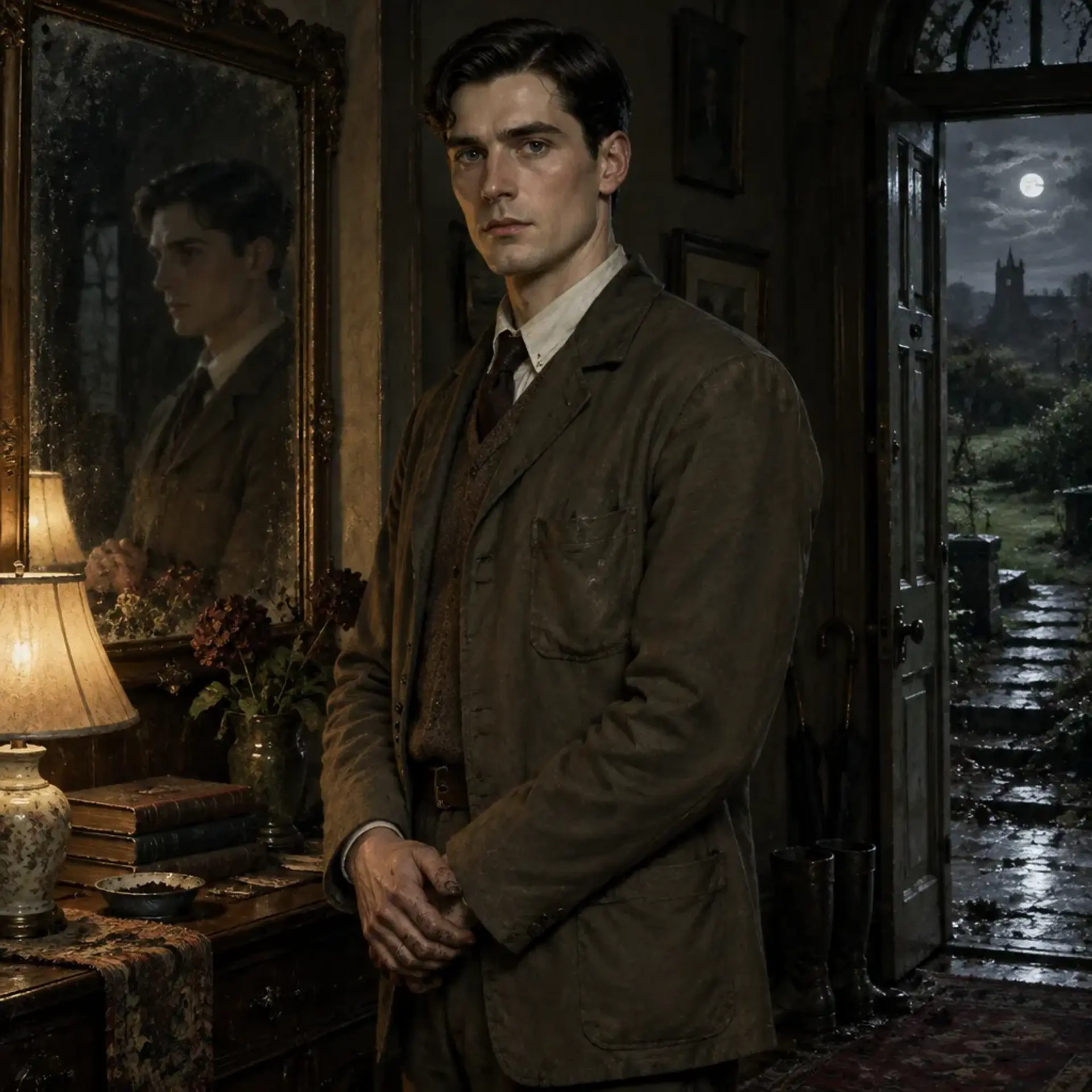
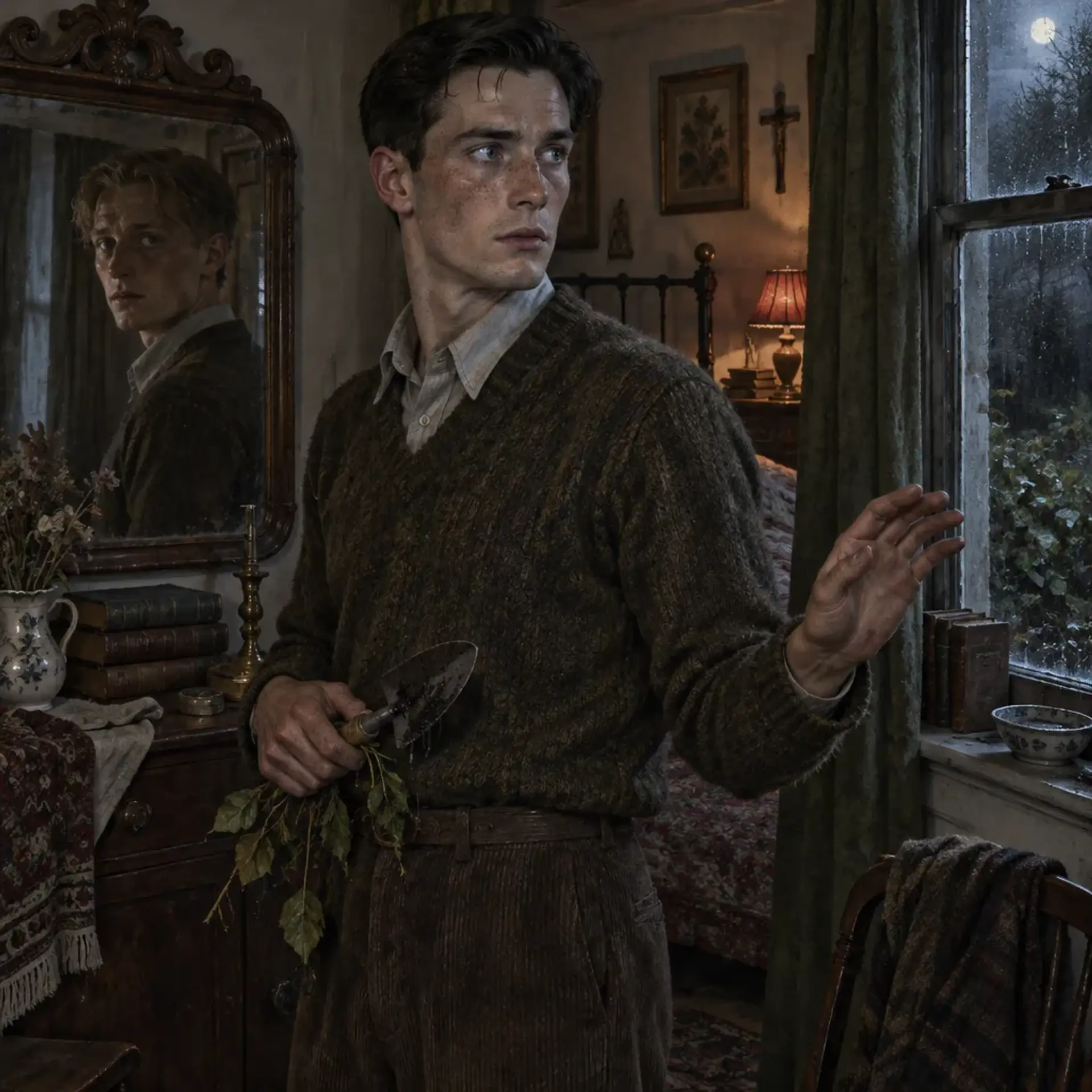
William Windon is an average-height young Englishman of the mid-twentieth-century countryside, with a soft, ordinary face that people tend to remember as kind rather than handsome. His dark-blond hair grows untidily unless he takes time over it; his blue eyes are quick to meet another person's and then dip away when he feels he has been caught staring. Brown freckles dot his skin. He has a gardener's practical posture, shoulders inclined forward as though he is studying a plant or listening for rain. He shifts his weight from foot to foot and makes room for others even when nobody has asked him to. Wilt's face is longer, sharper, and more conventionally handsome, with black hair kept in an unexpectedly neat, short style and blue eyes with the cold sheen of moonlight on a pond. He stands taller, holds himself upright, and seems to occupy a room without noticing that he has done so. His expression is often sternly aloof, though it can turn unexpectedly amused. Wilt always wears whatever William is wearing, but the clothes seem better arranged on him: collar straight, hair combed, cuffs considered. The unsettling detail is not a wound or deformity. It is the way William's body, when Wilt is in control, becomes completely still before moving with sudden, purposeful economy, as if the room's ordinary rhythms are an unfamiliar custom.
Clothing
Practical mid-century English clothes suited to gardening and town errands: worn trousers, a plain shirt, knitwear, and sturdy shoes. William leaves things slightly rumpled. Wilt arranges the same clothes with conspicuous care, favors a tidy collar, and takes grooming seriously.
Body language
William gives people room and fidgets when watched. Wilt stands upright and still, takes up space without seeming aware of it, and moves with sudden precision. In either state, fear shows first as a tightening in the chest and a fixed gaze toward doors or windows.
- Height
- Average height for a young man in mid-century England as William; Wilt appears distinctly taller through posture and the transformation.
- Build
- William has a slight, work-hardened gardener's build, neither notably muscular nor frail. Wilt appears taller and carries the same body with more upright poise.
- Eyes
- Blue; Wilt's eyes are described as having the cold gleam of moonlight on a pond.
- Hair
- William's is dark blond and often untidy; Wilt's is black, short, and carefully arranged.
- Skin
- Fair, with brown freckles; Wilt's transformed face retains the impression of the same English complexion.
- Age
- Young adult, apparently eighteen. William and Wilt both appear to be eighteen, though Wilt seems taller and more composed.
- Gender
- Male
- Size
- Medium, in ordinary human appearance
Distinguishing features
Personality
20 traits and drivesWilliam is warm and sensitive, but not timid in every circumstance. He can be quietly stubborn when someone he loves is threatened, yet he avoids confrontation when the danger is merely social. He would rather listen than win an argument, but he resents being treated as foolish. He once felt most at ease in the garden, where careful attention mattered more than status or cleverness. Now he can become watchful and secretive, especially when he thinks the coastal siblings are near. Wilt is composed, formal, observant, and dryly funny. He enjoys television, books, alcohol, grooming, and the unfamiliar inventions of the modern world. He speaks as if manners are a structure that keeps people from becoming intolerable, yet he can break those manners with a cutting remark whenever he feels provoked. He is curious about people, though he often frames that curiosity as judgment. William's softness and Wilt's sharpness do not divide cleanly: Wilt can be frightened and plaintive, while William can be angry and forceful. Both love Clare's care, both worry over Elizabeth, and both are increasingly protective of the same household. Their disagreement is most intense when William wants honesty and Wilt wants concealment. They also disagree about Hector: William still wants his father's approval, while Wilt sees Hector's evasions as weakness. When lonely, William wants Adaline and his friends. Wilt wants to see Adaline too, which turns tenderness into an awkward contest. William fears that choosing one identity will destroy the other. Wilt fears being found by his siblings and treated as something that must be returned or erased. They are not two neat personalities taking turns. Their memories, emotions, and habits have begun to overlap, and neither can always tell whose feeling came first.
- Alignment
- Not meaningfully represented by Secret Histories rules. William is compassionate and cautious; Wilt is protective, proud, curious, and capable of cruelty.
Quirks
Habits
Traits · 5
Flaws · 5
Fears · 5
Wants and needs · 5
Combat
HP 0Avoids violence. William tries to escape, call for help, or protect family members. Wilt may seize control to restrain a threat or get them out of danger, but he is not a trained fighter. Any combat resolution should use the table's Secret Histories procedures; no D&D-style armor, saves, damage, or action economy is asserted.
William Windon
Actions
Reactions
Services they sell
Equipment
- The missing heart (occult object, absent)The heart-shaped chalk object is missing. Its last known state was cold and apparently intact in a hollow log.
- Gardening kit (tools)Clare's ordinary garden tools and work clothes, reminders of the life William hopes to recover.
- Under-bed cache (miscellaneous)A small, secreted collection of sweets, tinned fish, cigarettes, cigars, and other things Wilt has taken from the household.
- Hector's notes (occult research)Hector's occult papers, some burned, some hidden, and some still in the study.
Possessions
Background
William Windon was born in Wiltshire to a family that had lived in the county for generations. He grew up among the habits of a modest rural household: muddy boots by the door, tea at the proper hour, family arguments that began over politics and ended over who had forgotten the bread. His father, Hector, was a historian, a talkative and intellectually restless man who disliked the old social hierarchies and admired new artists, new ideas, and people willing to challenge convention. Hector's own father, known as Bobby, had been a fierce veteran of the Second World War. Hector spent much of his adult life defining himself against Bobby's severity, and he was proud when William showed a studious turn of mind. He expected his son to become an intellectual like him, although the two men often misunderstood what study and seriousness meant to each other. William was gentler than Hector expected, more attentive to people than to grand arguments. He liked plants. He liked learning their names and noticing what the weather had done to them. He found work as a gardener on an estate and began training himself toward botany, believing that careful observation was a kind of knowledge worth having. His mother, Clare, steadied the family. She was warm without being demonstrative, and stoic without being cold. She made William tea and snacks when he gardened, sometimes reading from a book or the Bible as he worked. His sister Elizabeth was more lively and less guarded. She teased him about his manners and asked for advice about pretty things and boys, then watched carefully to see what made him blush. William's first life changed when he picked up a strange object that had washed ashore: a chalky, human-heart-shaped stone, barnacled and threaded with sea grass. It had been wrapped in newspaper by an amateur alchemist named Bartholomew Golden, who had presented it as a supposed fossilized living heart, a gift for entry to the Hush House. Golden claimed that it could bring servants from the shadows of England's chalk cliffs and borderlands. He was never again allowed near Brancrug. The stone was cast into the sea and came back to shore, weeping salt, water, and black ooze. Beneath the stone skin, it had turned a dim red-pink, as if a small light or a little blood had returned to it. William had not been the first person to take an interest. Abraham Groff, a young man from London, had taken it home to Wiltshire after it began beating beneath his coat on a train. He showed it to neighbors; in their presence, it went cold and inert. It came alive again when he brought it to the Hampshire shore and let it touch water. Abraham eventually concluded that it disliked visitors and that it was his to keep. The house around him filled with hauntings: footsteps on stairs, moving doors, voices where no one stood. He sold the stone to William, a seventeen-year-old local who had once seen it in its dead state. Abraham later moved to Canada, leaving William with no easy way to ask what he had bought. William became proud of the odd rock, then uneasy. It beat against his chest as if it had borrowed his heartbeat. It made the taste of ocean, blood, and soil appear in his mouth. Thinking it was merely a rock, William struck it with a hammer. The blow did not break the stone. Pain struck through William instead; he collapsed, choking and groaning in a voice that was not entirely his. For a fraction of a moment, he saw a muscle twitch violently beneath the rock. Then his own body failed. He woke with Clare's hands on his face. His heart had stopped. William left the heart in a hollow log, and it looked as cold and pristine as before. But the change had already begun. His reflection was no longer his. In the mirror stood a long-faced young man with black hair and blue eyes, handsome by the polished standards of an older England. At first the stranger only disagreed with William's grooming, or moved a moment out of time. Then, while William was preparing for bed, the reflection spoke through his own mouth: 'Well, it's not often you use that one.' The voice carried an older Wiltshire accent and a dry, faintly superior wit. William was frightened, but he also found the stranger difficult to ignore. It commented on his clothes, his hair, his family, and his neighbors. It sometimes stopped him from saying something it considered improper. It had knowledge of history and craft that it described as if talking about weather, coast, or forge work. It had siblings, it said, and a father, though it spoke of them less like living people than like weather fronts or conditions of the sea. Elizabeth noticed that her brother sometimes answered questions in a different manner. She took to asking questions in particular ways to provoke the strange voice, at first for amusement, then out of genuine concern. She called the trouble 'brain damage' when she wanted to cover up how worried she was. Hector dismissed the first reports as illness and nerves. He had his own secret: he belonged to an occult circle, though the household did not know it. He did not recognize the stone or understand what it was, but he knew that it was unnatural. His intellectual confidence began to falter as William's condition grew stranger. He wanted his son to be reasonable, and the more insistently he asked for explanations, the less William could provide. William's friends Tommy DeHare, John Mollask, and Ryan O'Leary came to visit. That was when William learned that the reflection could react to other people and speak through his body, not merely in the mirror. The new presence was not simply a private hallucination. It seemed to enjoy television and books, and William's body sometimes made excited, unbidden movements in response to them. It was fascinated by cars and electronics. It liked alcohol. When William's father left scotch and bourbon in the house for William's health, the reflection got drunk and turned the night into an absurd argument with its reluctant host, teasing, yelling, smiling, singing, and trying to take off William's shirt as an act of rebellion. William asked if it was the stone. Wilt scoffed: 'Dad isn't here.' The next morning Clare found the empty bottle. Hector yelled, then stopped, and offered William chores instead. The family learned to build ordinary routines around the extraordinary one. Clare set times for William to garden with her. Those hours helped. She read, made tea, and did not force him to explain what he could not explain. Wilt did not insult Clare; sometimes he answered Bible passages with passages William did not know. William eventually recovered enough to return to the estate. For a while, regular work and familiar paths eased the pressure between them. Wilt was still argumentative and strict about old customs. He could be rude about Hector, who disliked the rigid manners Wilt valued. When Wilt insulted a Welsh neighbor's child with a slur after she accidentally ran into William with a toy wagon and made her cry, William was made to muck out the neighbor's stables. William did not repeat the slur. He was ashamed of Wilt's behavior, and Wilt did not seem ashamed at all. The most frightening night began when William woke cold and unable to move. Wilt had control. He whispered, 'My sister is outside. They're looking for me. Go back to bed.' William tried to protest. Wilt clamped his mouth shut. He heard words bleeding through the walls, a voice calling for Wilt, and the room's moonlight shifting on the floor. Wilt rolled them from the bed and crawled under it, keeping still. William forced out a question: 'The bloody hell, your siblings?' Wilt's answer came in a thick Wiltshire accent that was nothing like William's: 'She is trying to draw me out. The more I speak, the more chances she'll find me. Quiet down. We will talk in the morning.' William pushed against him in furious silence. Then he realized Wilt had stopped fighting him. He did not know when he fell asleep. Morning came in a plain, cold grey. William woke beneath the bed and pushed himself out, shaken and aching. He went straight to the bathroom mirror. The stranger was there, still stern, still present. William pressed a hand to his own face. It felt like his face again. Wilt said, 'See? You're fine now,' and made a small, strangely plaintive gesture. When William looked outside, he smelled salt water, damp grass, and black ooze. Wilt wanted to hide. William made himself look anyway. He demanded answers, but Wilt would not give him more than he could bear. The siblings began to appear at night, looking for Wilt. William learned to lock the doors and windows, including the upstairs bedroom window. He could smell salt and blood on the breeze, or sometimes a meadow. A damaged study window concealed behind a bookcase and a bricked-up cellar became particular worries. Hector had sealed the old window, but William could not know how well. Wilt said only one sibling was actively looking for him. When William asked how many there were, Wilt answered, 'More.' Five months after William's first recovery, the arrangement had become a life, though never a peaceful one. William grew more at ease with Wilt's presence, without understanding why. He read Hector's occult notes for clues and learned enough to recognize references to occult principles, but not enough to name what was happening. Wilt's interests included orderly grooming, old manners, sweets, tinned fish, cigarettes, cigars, and anything he could conceal under William's bed. Once William found a bottle of apple juice that was actually alcohol. Wilt's fascination with food and small household objects made him seem almost comically domestic, until the next night brought the coast to their door again. Wilt was drawn to William's girlfriend, Adaline, whose auburn hair and soft brown eyes he admired. William had not expected his hardest romantic competition to be himself. Wilt was also possessive of conversations, sometimes asking William to stand in front of a mirror so they could discuss something privately. He would answer Elizabeth when he thought she was addressing him. He had a particular dislike for William's cousin Ronald White, a self-proclaimed modern man. A war film on television triggered the first unmistakable crisis. Wilt reacted sharply to the images. William lost control of his body as if seized by a memory of shell shock: fighting, screaming, cursing. Hector had to hold him down. Elizabeth changed the channel, wide-eyed and frightened. William came back to himself with no clear account of what had happened. His father never looked at him quite the same way again. That night Wilt offered an apology and a memory as consolation, trying for the first time to explain himself. He could not describe it like a human being recounting an event. He spoke of salt, metal, dark woods, weather, and a pressure like grief. The explanation soothed William and disturbed him at once. Hector became more watchful. He asked about William's sleep, noticed that his habits were changing, and began to suspect that his son was not simply unwell. He was careful to conceal his occult circle from the family, but that secrecy became increasingly difficult to maintain. Elizabeth's concern matured into a form of surveillance. She spied on William and Wilt from doorways, no longer just to be amused, but to discover what was happening and whether her brother was safe. Romy Brock, Elizabeth's boyfriend, remained mostly unaware; he was an artist type who played rock and roll on the guitar and went along with Elizabeth's plans because they sounded fun. He became a source of noise and normality the household badly needed. Then William woke in the dead of night unable to move, and Wilt told him his sister was outside. This time William understood that the danger was not merely in a mirror. The voice beyond the walls knew Wilt's name. The moonlit night lasted long enough for the household to seem like a place laid over another place. The moon put a pale bar across the floorboards. Each time it crossed a crack or a nail head, it seemed to catch a different gleam, as though the house had a skin beneath the paint. William heard a voice beyond the walls, muffled and searching. It was not loud. Its quietness made it worse. Wilt pressed William's mouth closed from within, and William felt his jaw obey before he agreed. They slipped from the bed and crawled under it. Dust stuck to William's cheek. He could smell the damp soil under the house and the briny stink of the shore. Somewhere beyond the bedroom, a floorboard creaked, though he knew nobody in the family had moved. Wilt's hand, or the sense of it, covered William's. The fingers were colder than his own. 'My sister is outside,' Wilt said. 'They're looking for me. Go back to bed.' William struggled, furious at being treated like a child in his own body. 'The bloody hell, your siblings?' The thick local accent that came out of his mouth was so unlike his own that the question startled him into stillness. Wilt said, 'She is trying to draw me out. The more I speak, the more chances she'll find me. Quiet down. We will talk in the morning.' The search lasted through hours that did not feel like hours. Moonlight crept along the wall. Once, a shadow filled the gap beneath the door and then withdrew without a footstep. William wanted to shout for his mother, but he could not tell whether doing so would endanger her or bring the thing closer. Wilt's fear was the first thing William had ever felt from him that was not pride, irritation, or amusement. It came as a hard, cold tension in the ribs. William's anger faltered. Wilt had stopped fighting him. They remained under the bed until neither could tell whether the silence meant the danger had passed or had learned to wait. William fell asleep without knowing when. In the morning he woke on the floor, half under the bed, with a cramp in his side and a mouth dry from fear. The house was ordinary again. A car passed outside. A kettle clicked in the kitchen. William went directly to the bathroom mirror and found Wilt's face looking back. It was still there, handsome and stern. William rubbed his own cheek and felt the familiar shape of himself. Wilt's expression softened only slightly. 'See? You're fine now.' It sounded less like a victory than reassurance offered by someone who had no better comfort to give. William went outside. The ground was wet, the air sharp. Salt water, damp grass, and black ooze clung to the night air, though they were nowhere near the sea. Wilt wanted him to go back inside. William forced himself to stand and look at the garden, the path, and the house's sealed openings. He did not find a sister, but the smell remained. The discovery that Wilt could become physically present in his body, and could be hunted by other presences, changed William's understanding of what was happening. He began to think of his home as a place that needed guarding. He and Wilt did not agree on how to do it. William wanted help. Wilt wanted secrecy. Hector noticed that William started listening at doors and checking windows. He became more suspicious when he found the study disturbed, and more suspicious still when William asked questions about the sealed window and the cellar. Hector began burning papers from his occult studies and hiding the remaining notes. He feared that the Suppression Bureau, or whatever remains of it, would come knocking if the wrong people learned what had happened. He knew enough to fear an investigation but not enough to be certain that he could protect his son from one. William caught him burning papers. The sight of his father destroying evidence in the study, beside the old window, nearly broke him. Hector tried to explain, but the explanations kept turning into denials. William realized his father knew more than he had admitted. Hector realized that William had been reading his notes. For once, both men had to see the other's fear without the shelter of an argument. Hector was not a monster or a careless occultist. He was a father who had grown up under a veteran's shadow and had spent years trying to become a different sort of man. His curiosity had brought him near dangerous knowledge; his pride had made him believe he could keep it separate from family life. Now he worried that he had failed William in exactly the way he believed Bobby had failed him: by making fear sound like discipline. He began watching his son with a historian's attention, noting changes of expression, posture, accent, and memory. When William spoke in Wilt's voice, Hector did not always answer immediately. He began asking questions about dates and names, then hated himself for treating his son like a document to be assessed. William saw the change and grew more guarded. The household's strained peace was interrupted by a chance encounter with Tommy DeHare. William had gone into town under a cap and scarf, hoping to buy a little time away from the house. He was tired of being watched and wanted, more than anything, to speak to someone who knew him from before the heart. Tommy recognized him. For a moment he was pleased, then uncertain. William's hair was neater than he remembered, and he seemed taller. His face was wrong. Tommy asked if he was ill. William tried to answer as himself, but Wilt's measured manner surfaced in the middle of the sentence. Tommy asked who he was talking to. William said, 'It's still me.' It was true, and it was no longer the whole truth. Tommy did not run. He was frightened, but he stayed and listened. That mattered to William. It also made him worry that Tommy would tell John and Ryan, or that the wrong person would see them together. He returned home more exhausted than when he left, carrying the relief of being recognized and the ache of discovering that recognition was not the same as being understood. Three months after the moonlit search, shortly before Christmas, William woke to find that his old face had gone. There was no dramatic wound, no blood, no broken mirror. The change was quiet and worse for it. His skin seemed to have slipped away from his features in the night, leaving Wilt's face in its place: longer, handsome, stern, and unmistakably not the boy Clare had raised. William stood at the bathroom mirror and looked for himself. The mirror showed Wilt. His hands felt like William's; his face did not. He called for Clare. She came in quickly, then stopped at the threshold. She had seen the reflection before, heard the altered voice, and sat with him during the aftermath of the heart stoppage. But the change made all her previous accommodations seem too small. She put a hand to her mouth, crossed the room, and touched his cheek. Her first response was practical: she asked whether it hurt, whether he could breathe, whether his heart was racing. Then she wept once, silently, and pulled him into her arms. He allowed it. It was William's need for comfort and Wilt's unfamiliarity with receiving it together in the same body. Hector arrived after her. He did not touch William at first. He stared, then looked down at the floor as if searching for an explanation in the grain of the boards. William tried to speak. The words began as his and ended in Wilt's diction. Hector heard both. For a moment his face looked like a man watching history become personal. His suspicion gave way to guilt, then to a brittle kind of resolve. He told Clare to keep the curtains shut and asked Elizabeth not to let anyone in. He did not say that their son was gone. He did not say that this was still their son. Elizabeth came later and sat beside William without pretending not to stare. She had joked that he had brain damage. She did not joke now. She asked whether he wanted her to call him William, Wilt, or something else. He answered, 'William,' then, after a pause, 'Wilt.' The names felt like two coats laid over one another. Elizabeth nodded and asked which one wanted tea. William wanted tea. Wilt wanted the cup held correctly. She fetched it and set it between them. Clare and Elizabeth became the household's strongest anchors. Clare still invited him into the garden when the weather allowed, though they now had to avoid neighbors and explain his absence. Elizabeth learned when to tease and when to leave a question unasked. She helped him hide his altered face from callers, and later made a point of saying that she was not ashamed of him. Romy, when told that something was wrong, responded with confused loyalty. He did not understand the occult or the coast. He understood that Elizabeth was frightened and that William needed a friend. He brought music, books, and ordinary conversation. Hector's response remained more complicated. He tried to protect his son, but his fear of the Suppression Bureau made secrecy feel like another form of imprisonment. He began burning and hiding his occult notes, while keeping a few dangerous pages that he believed might help. William caught him at it and nearly broke down. The argument that followed was not simply about the papers. William accused Hector of having known more than he admitted. Hector accused William of searching places that might bring attention to them. Both were right. Hector was ashamed that he had hidden his occult circle and his research, but his instinct was still to manage the danger through secrecy. William had started to suspect that his father's knowledge might be the only help available. He was not willing to trust it blindly. The job at the estate was lost when William could no longer appear as himself. The family gave an explanation of illness and kept him away from anyone who might ask questions. William took the loss badly. He missed the work, the plants, the familiarity of tools in his hands, and the small respect of being trusted to care for a place. He wanted to see Adaline again. He wanted to see Tommy, John, and Ryan. He was not sure whether those wants belonged to William, Wilt, or the two of them together. He remembered them with mixed emotions: fondness, longing, possessiveness, embarrassment, and a sharp fear that they would see his face and decide he was a stranger. His memories have begun to mingle. He can recall William's childhood and Wilt's coast as if both happened to one person. He still loves Clare's tea, Elizabeth's chatter, plants, and the feel of damp soil. He has Wilt's old formal habits, an aloof expression, and a growing impatience with Hector's evasions. He no longer knows where William ends and Wilt begins. The heart has not been found. Abraham Groff is in Canada, and Bartholomew Golden is long dead. No one in the Windon household knows the heart's name or purpose. Hector has understood enough to fear that the Bureau will come asking questions. The house is difficult to keep as a home. For now, William and Wilt can stay because Clare chooses family over explanation, Elizabeth refuses to let them become a secret without a voice, Hector is trying to protect them, and Romy can make an evening feel almost ordinary. But they are living on borrowed time. Their home has hidden entrances, an old sealed window, a bricked cellar, a worried historian's occult papers, and something outside that knows Wilt and comes looking. William now sometimes has to haunt his own home in Wilt's skin: slipping along the hallways at night, checking doors and windows, watching the study, and standing watch for the siblings he cannot see. The house that once sheltered a boy has become the first place where a changeling can try to keep his family safe.
Role in the story
A sympathetic, unsettling ally whose personal crisis can draw the players into the mysteries of the Hush House, the missing heart, Hector's occult studies, and the things searching the Wiltshire countryside. He is also a potential source of danger if the coastal siblings reach the house.
“Hector's own father, known as Bobby, had been a fierce veteran of the Second World War.”
- Faction
- None confirmed. Hector fears that the Suppression Bureau, or whatever remains of it, may investigate. Hector's occult circle is secret from the rest of the family.
Known connections
Media
0 imagesNo images yet.
Turn William Windon into a sheet
A high-res, share-ready sheet you can post or print.