Oswin Hirst
Oswin Hirst
At the table
Voice
Oswin's voice has the dry rasp of someone accustomed to cold air and long days outdoors, with a slight catch from years of speaking over wind and livestock. His words carry a familiar rural Yorkshire rhythm, but older turns of speech surface when he is exhausted or startled. In human form he sounds reassuringly ordinary. In his headless shape the same voice seems to come from the space around him, as if the room itself had spoken.
His speech is measured and practical, shaped by farm work and a lifetime of listening before he answers. He uses Yorkshire turns of phrase without making a performance of them, and his old-fashioned vocabulary occasionally slips through when he is tired. He tells stories with concrete details about weather, roads, and food, but often skips the most frightening moment. He does not raise his voice when angry; instead, his words become blunt and his sentences shorter.
Speech patterns
How to play them
Begin with Oswin as a useful, hospitable farmer who offers practical help and asks more questions than he answers. Treat his affection for Mary and William as genuine, not a disguise. Players who investigate his age, his iron aversion, or the seasonal disturbances can earn his trust by protecting his family without treating William as a monster. Direct accusations about the wedding night make him defensive, but patient kindness and evidence of Thomas's plans may persuade him to confess.
Goal
Keep his household safe while finding the courage to tell Mary what happened on their wedding night and to learn whether William's nature can be understood without being feared.
Motivation
Love for Mary and William, mixed with the old instinct to survive by keeping his nature unknown.
Appearance
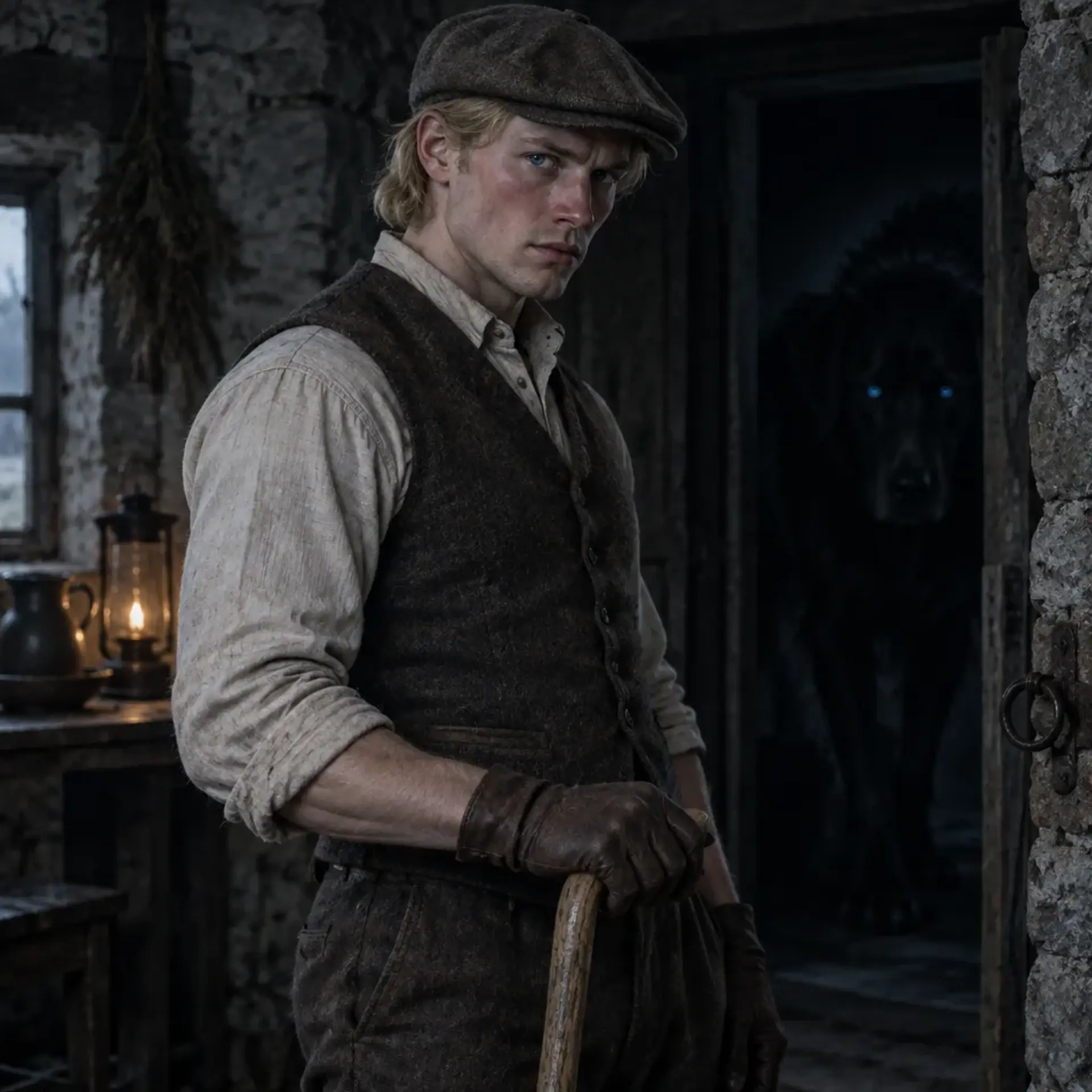
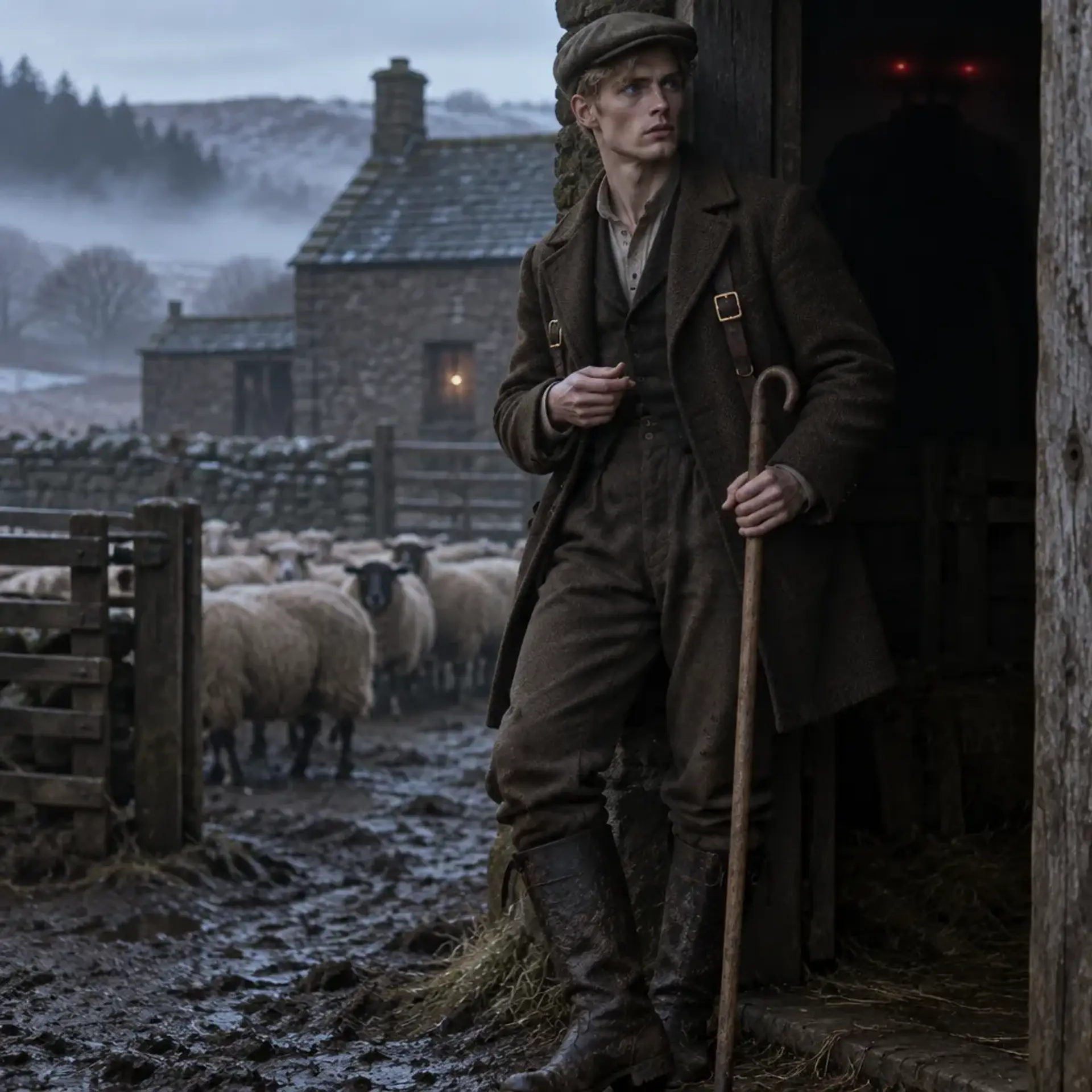
Oswin stands exactly six feet tall, pale as skimmed milk against the weather-darkened village, and carries a handsome, youthful face Mary remembers from their courtship. His straight blond hair lies sleek as combed flax, usually tucked beneath a common flat cap. His blue eyes are strikingly bright, almost feverish when his other nature presses close. He keeps his nails clipped, his collar straight, and the mud off his boots with a farmer's practical care, but his posture betrays him: even while resting he places his weight on the balls of his feet, poised like a hound listening beyond the room. His movements are economical, with a pause before every doorway as if measuring an invisible threshold. In shadow, his silhouette sometimes seems to lack a head; two red saucer-lights hang where a face should be. The unexpected detail is his meticulous habit of polishing the brass buckles on his working harness, despite keeping every piece of iron at a careful distance.
Clothing
A clean but well-worn wool coat, sturdy work trousers, a plain shirt, leather boots, and the familiar flat cap. His buckles are polished brass. He avoids iron fastenings and carries a small wooden tool where others might carry a metal clasp.
Body language
Oswin waits on the balls of his feet and angles himself toward the nearest exit or open window. He rubs his thumb along the base of his forefinger when concealing something. With William, he crouches to the boy's height and keeps still long enough for the child to approach on his own.
- Height
- 6 feet
- Build
- Lean and long-limbed, with the durable shoulders and forearms of a man who works with sheep, gates, and sacks of feed.
- Eyes
- Bright blue, burning more intensely when his Barghest nature stirs.
- Hair
- Pale blond, straight, and carefully kept beneath his flat cap.
- Skin
- Pale, with a cool, almost porcelain cast that reddens slowly even after a long day outdoors.
- Age
- Appears 19 to 22, with no visible aging since meeting Mary. His true age reaches back to the Danelaw, though even he cannot give a reliable count.
- Gender
- Male
- Size
- Medium in human or most animal forms; Small as a rabbit or cat; Large as a bear or giant black hound, at the DM's discretion.
Distinguishing features
Personality
16 traits and drivesOswin's kindness is real, but it is not simple. He can spend an entire afternoon patiently helping William understand how to guide a lamb through a narrow gate, then lie without blinking when Mary asks why he never seems older. He is gentle with people who are frightened, especially children and animals, because he remembers being treated as a danger before he understood what danger meant. Yet he can be ruthless when he decides that a threat must be removed. He does not enjoy cruelty, but he has survived by ending some troubles before they could grow teeth. In public, he is an agreeable man with a practical answer for nearly everything. He knows which ewe is likely to lamb early, which roof needs attention before the next storm, and which neighbor will accept help only if it is offered as a favor in return. He rarely boasts. When someone praises him, he brushes it off with a joke or points to the weather, the flock, or Mary. He is not modest because he thinks himself unworthy; he dislikes attention because attention leads to questions, and questions eventually lead to the years he cannot explain. At home, he is more openly affectionate than he is in company. He makes a point of sitting with Mary after work, even when his mind is elsewhere, and he lets William climb onto his knees despite the mud on the boy's boots. He wants to be dependable. This desire pulls against the part of him that longs for the road, where no one expects him to stay and no one can watch him grow strange. He sometimes resents the limits of ordinary life, then feels ashamed of that resentment because Mary and William are precisely what he once wanted. His strongest instinct is to protect, but protection has become his excuse for withholding truth. He tells himself Mary would be safer if she never knew that the Barguest was her husband. He tells himself William is safer if no one names what is happening to him. He tells himself Thomas cannot hurt the family if Oswin keeps his suspicions to himself. These explanations sound reasonable when he is afraid. They are still lies, and Oswin knows it in the quieter moments when the house is asleep. He is practical rather than pious. He respects old customs when they work, whether or not he believes the story attached to them. A bowl of salt by a threshold may be foolish, but if it reassures Mary, he will not mock her for using it. He watches the weather, the animals, and the changing light for signs of trouble. He trusts what can be observed, but his long life has taught him that the world contains things observation cannot make safe. When he is rested, Oswin has a dry humor and a gift for making a tense room feel ordinary. He can tease a friend without making them feel small. When tired, especially during the seasons that bring his dreams, he grows watchful and abrupt. He checks doors, counts the family, and listens for sounds no one else hears. He dislikes being touched unexpectedly then. He is not angry so much as caught between the human habit of answering and the animal urge to flee or bite. His temper is not loud. When pushed, he becomes unnervingly still. He stops fidgeting, fixes his blue eyes on the person who has crossed a line, and gives them one plain warning. That restraint is not gentleness alone. Oswin knows what he can become, and he has learned to fear the ease with which a fight can turn into a hunt. If someone threatens William, however, the restraint may vanish. He will choose his son over appearances, reputation, or his own safety. Oswin is curious about people but guarded about himself. He asks travelers where they have been and what they saw, not to make conversation but because he genuinely misses the road. He listens for the details others overlook: how a bridge is built, which villages keep their doors open, what a stranger does when a dog approaches. He enjoys a good story, especially one that admits uncertainty. He is less tolerant of people who insist that every strange event has a simple explanation. He does not think of himself as a monster, but he is not sure the distinction matters to those who fear him. Part of him wants Mary to accept the truth and still love him. Another part expects that hope to be foolish. He has lived long enough to see affection turn to terror when someone discovers what he is. That experience has made him slow to trust and quick to leave before rejection can be spoken aloud. His relationship with Mary is the sharpest contradiction in his life. He loves her deeply and has built his home around her happiness, but he deprived her of the truth about the most intimate night of their marriage. He longs to relieve her fear of the dark while continuing to hide the reason she is afraid. When she mentions the headless Barguest, he feels shame, tenderness, and a flicker of resentment that she fears the shape he chose. He knows the resentment is unfair. He does not always know what to do with it. With William, Oswin's patience is almost inexhaustible. He refuses to measure the boy by the speed of his speech or by the color of his hair. He gives him tasks with clear steps, praises effort, and does not hurry him when he needs time. Yet Oswin watches him too closely. Every unusual look, every difficult night, and every strange response to the seasons makes Oswin wonder whether the boy has inherited something dangerous. He fears turning that worry into the same sort of suspicion that has followed him all his life. He dislikes iron, but he is not theatrical about it. He avoids iron nails, tools, and gates by choosing alternatives or asking someone else to handle them. If challenged, he gives practical excuses. His recent contact with the gate latch for Mary's sake revealed that he can endure the pain when he must. He would rather no one know that, because it weakens a defense he has relied on and because it makes the sacrifice feel like evidence in a case against him. Oswin can be shrewd in trade and generous in hardship. He knows the worth of a flock and will not let a buyer cheat him, but he has quietly supplied food to families who could not pay. He does not advertise charity. He dislikes gratitude that turns into obligation. He would rather someone remember that he kept his word than that he gave them a sack of oats. His old wandering self appears in small flashes: a sudden delight at a road he has never taken, a story about a distant market, or the way his eyes follow a cart leaving the village. He misses danger when it was honest and temporary. Farm life offers safety but also repetition, and repetition makes him feel time pressing close despite his unchanging face. He is not looking for an excuse to abandon Mary. He is trying to understand why a part of him still wants to go. When Oswin is afraid, he becomes more helpful. He repairs a hinge, checks a roof, mends a fence, or brings Mary tea. Work gives his hands a purpose and lets him avoid difficult conversation. When he is ashamed, he becomes unusually attentive, anticipating what others need before they ask. His loved ones may read this as tenderness, and it is tenderness, but it is also an attempt to pay for a debt without naming it. He wants to be known and cannot bear the likely consequences. That is the hinge on which his personality turns. He is a husband who wants trust and a liar who is terrified of confession; a farmer who has made a home and a wanderer who still listens to the road; a gentle father whose hidden nature can frighten the people he loves. He is at his best when someone gives him time to choose honesty. He is at his worst when he believes that silence is the only way to keep his family intact.
- Alignment
- Neutral good, with a self-protective streak that can become profoundly selfish when the truth threatens his family.
Quirks
Habits
Traits · 4
Flaws · 4
Fears · 4
Wants and needs · 4
Combat
AC 14 · HP 38 · 30 ft.; hound form 40 ft.; bear form 30 ft. (custom form speeds)Oswin avoids a fight if it risks exposing his nature or endangering his family. He uses Eldritch Blast from cover, frightens an isolated aggressor with Red-Eyed Omen, then closes in with claws or bite if someone threatens Mary or William. He transforms to flee, pursue, or confuse opponents rather than fight to the death. He dislikes touching iron and will withdraw from an iron-armed foe unless protecting someone.
Oswin Hirst
Spells
Actions
Reactions
Services they sell
Rewards they can give
Equipment
- Flat cap (clothing)A common flat cap, worn in all weather and repaired at the seams.
- Shepherd's staff (tool)A plain ash-wood staff used for walking and handling sheep. Oswin prefers it to an iron-shod tool.
- Farm pouch (supplies)A small pouch of salt, twine, and dried herbs for ordinary farm use, not magical components.
- Farm notebook (personal)A worn notebook containing flock counts, weather notes, and a few cryptic records of seasonal dreams.
Possessions
Background
Oswin Hirst was born in the time of the Danelaw, in a settlement whose old name has long since been rubbed away by weather and mouths. His mother was a young woman taken by Viking raiders. She survived, returned, and raised her son among people who knew he was hers but could not agree on what else he might be. Oswin grew too slowly in some ways and not at all in others. He remembers the smell of wet wool in his mother's hut, but the years around it have blurred into a sequence of winters. As a child he could alter his face and voice without understanding what he was doing. His mother called it a gift when it helped him pass unnoticed, and a warning when his shadow moved wrong. His first unmistakable transformation came during a winter journey. Oswin had been sent to find a missing ewe after dusk. He followed its tracks across a slope and woke at dawn among the sheep, his hands raw, his mouth tasting of blood, and no memory of the hours between. The villagers spoke of a black hound seen on the ridge. Afterward, livestock went missing whenever Oswin lost his temper or slept through a season of strange dreams. He learned to be careful before he learned to be afraid. The fear became knowledge by inches. He found pawprints that began and ended in the middle of a field. He heard chains rattling where no chain lay. Once, at a funeral, the village dogs fell in behind him and howled as if following a bier. He began to suspect that the black hound was not a creature possessing him, but a shape his own blood had been trying to remember. He did not know the name Barghest then. He learned it much later from frightened country stories and recognized himself in the tales only after recognition had become a burden. For centuries, he roamed. He served as a drover, guide, hired blade, and occasional rescuer, taking new names when an old face became inconvenient. He saw kingdoms alter their borders and roads outlast the people who built them. He liked the freedom of moving on before anyone could ask what he was. He disliked the loneliness that freedom concealed. His dreams still return to the dales, to long ridges and sheep paths, and to the feeling that there is a place where a person might stay without being discovered. Oswin came to settle into a farmer's life by choice, not accident. He bought a fine house for his station, worked land that could support a flock, and became known as a capable, even-tempered man. He met Mary Pickles and was drawn to her quick intelligence, her plain courage, and the way she could make a home feel like more than a temporary shelter. He told her true stories about his travels, then left out the parts that made him seem inhuman. He believed that omission was a kindness. It was also a lie he kept choosing. On their wedding night, Oswin failed to consummate the marriage in his human form. He was frightened, ashamed, and acutely aware that Mary was waiting for him to be the husband he had promised to be. In panic, he changed. In his headless form, with the red lights burning in the darkness, he consummated the marriage. Mary remembers the Barguest, not Oswin. She has never been told that the monster was her husband. Oswin has never confessed that he found it easier to be intimate in a truer, more frightening shape than in his familiar human one. He loves Mary, and he knows that loving her does not undo the deception. Mary fears the dark creature and suspects that their son is its spawn. Oswin hopes she will stop fearing the dark, but his silence ensures that she has every reason to keep watch. She carries iron scissors and keeps an iron thimble near William. Oswin does not know that Mary has told her father, Thomas Pickles, about the wedding night. Thomas is suspicious of Oswin's unchanging face and his avoidance of iron. He sees an opportunity in what he suspects, and Oswin has not yet understood how dangerous that calculation might become. Their son, William, called Black William or Blackby by locals, was born with black hair despite both parents being blond and with his father's burning blue eyes. He is slow to speak and learn, and Oswin refuses to treat that as a defect or an omen. He takes time each day to be with William, even during the seasons when the supernatural world presses hardest on him. He teaches him to feed lambs, identify birds, and ask for help without shame. Mary watches the two of them with tenderness and fear tangled together. Mary's pregnancies have often failed. One infant was born sickly and died soon afterward. Oswin suspects that his nature makes a living human heir difficult, perhaps impossible, but he does not know whether that suspicion is true. He has concealed the fear from Mary, who already carries grief enough. He avoids iron as a habit and a necessity, though he recently touched it to save her. During a storm, Mary slipped beside a gate where a loose iron latch had caught her sleeve. Oswin seized the latch with his bare hand and tore it free before she fell. The metal burned his palm with a cold, bright pain and left the skin numb for days. He told her the damage came from a splinter. She noticed the lie, but not its meaning. The passing seasons still unsettle him. At certain times of year, old roads seem to bend toward his house, dreams arrive with the taste of earth and blood, and he wakes outside in the shape of a dog. He struggles to sleep and sometimes leaves the bed rather than risk frightening Mary. He thinks often of his roaming days, not because he wants to abandon his family, but because he misses the simpler danger of being alone. His current conflict is not whether he can keep his secret forever. It is whether he will tell the truth before Thomas uses it, before Mary learns it from a worse source, or before William's own changing nature forces the matter into the open.
Role in the story
A loving husband and father whose concealed supernatural identity complicates a family already strained by grief, fear, and suspicion. Oswin can be an ally, a source of folklore, or the center of a painful revelation. His conflict is not simply whether he is a monster, but whether love can survive the truth he has withheld.
“His mother was a young woman taken by Viking raiders.”
- Faction
- No formal faction. He is tied to his household, the local farming community, and the old, unnamed folklore of the dales.
Known connections
Media
0 imagesNo images yet.
Turn Oswin Hirst into a sheet
A high-res, share-ready sheet you can post or print.