Mary Hirst
Mary Hirst
At the table
“the man I know”
Voice
Her voice has the dry edge of someone accustomed to speaking through wind, wool dust, and kitchen smoke. It is clear and steady, with a slight rasp after long days outdoors. When speaking to William, she rounds her words and leaves space for him to answer. When challenging Oswin, her voice stays level but every question lands cleanly, like a stitch pulled tight.
Mary speaks in a clear Yorkshire voice shaped by village life, farm work, and years of making herself heard over weather and animals. Her consonants are firm, her phrasing practical, and her sentences often arrive as questions that ask for a usable answer. She can sound warmly amused when talking about everyday mishaps. When she is afraid, she does not whisper or adopt a ceremonious tone; she becomes exact, speaking each detail as if laying tools in a row.
Speech patterns
How to play them
Treat Mary as perceptive and frightened, not helpless or automatically hostile. She responds to patience, practical help, and respect for William. Do not win her trust by dismissing her fears. If characters offer a safe way to learn the truth without putting her son at risk, she may share what she saw and admit that she spoke to Thomas. If they threaten Oswin, she will defend him and demand an explanation, even while keeping the scissors close.
Goal
Keep William safe, understand what happened on her wedding night, and make Oswin tell her the truth before her father uses his suspicions to endanger them.
Motivation
Love for William and for the remembered Oswin, tempered by a need to know whether either of them is safe with the truth kept hidden.
Appearance
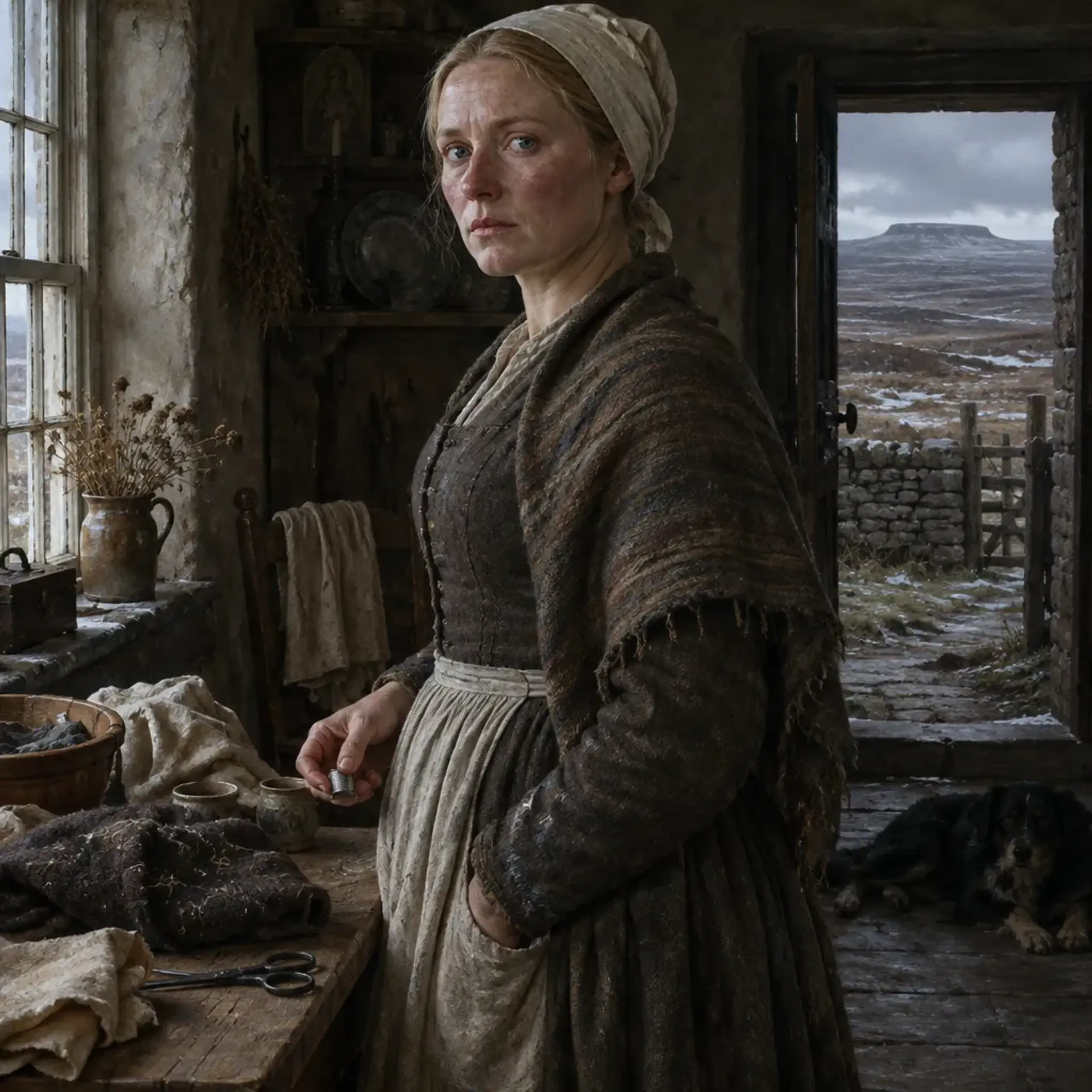
Mary Hirst is a tall, pale Yorkshire woman whose straight blond hair is usually divided into a severe center part and wound beneath a linen cap. Her blue eyes are clear and intent, and when she looks at someone she gives the impression of measuring not their worth but the distance to the nearest door. Her face is open and handsome in an unadorned way, though weariness has begun to settle beneath her eyes. She moves with a farmwife's economy: no wasted steps, no flustered reaching, and a slight sideways turn whenever someone comes too close. Within a minute of meeting her, most people notice that her left thumb keeps checking the iron thimble tucked into her pocket, rubbing its rim as if verifying it is still there. She is unexpectedly good at whistling complicated bird calls, a childhood trick she uses to settle nervous sheep and, sometimes, her son. Her hands are work-roughened and often smell faintly of lanolin, soap, and rosemary. Her stillness can be more arresting than a display of temper.
Clothing
A dark wool dress, practical apron, sturdy shoes, and a linen cap over her straight hair. Her clothing is carefully mended, not fine. A small iron thimble sits in a pocket, and her sewing scissors are usually within reach.
Body language
Mary gives people room until she decides they are safe, then stands close enough to be heard without raising her voice. Her thumb rubs the rim of her iron thimble; her gaze makes quick checks of doors, hands, and windows. She rarely fidgets otherwise. When Oswin tells a story, she watches his face as carefully as she listens.
- Height
- 6 feet
- Build
- Tall and sturdy from household work, carrying herself with controlled, economical movements rather than a soldier's posture.
- Eyes
- Clear blue, similar to William's and Oswin's, though Mary's are steady rather than unnaturally bright.
- Hair
- Straight, pale blond, usually tucked beneath a linen cap.
- Skin
- Pale, with a cool undertone and a wind-reddened flush across her cheeks in winter.
- Age
- Young adult, approximately 24
- Gender
- Female
- Size
- Medium
Distinguishing features
Personality
17 traits and drivesMary is compassionate without being credulous. She will sit beside a frightened child for an hour, but she will not accept “there is nothing to fear” from a man who refuses to explain the thing she saw. She loves Oswin's kindness and resents his secrecy; she longs for the ordinary safety of a settled household and remains alert to every sign that the household is built on an extraordinary danger. Her gentleness is active, not meek. She brings food to a sick neighbor, tends an animal through the night, and can still become sharply practical when someone threatens her family. With William, Mary is patient and deliberately encouraging. She gives him one instruction at a time, lets him learn by doing, and praises the effort rather than the speed. When village people call him Blackby, she may let the nickname pass if it is affectionate, but she steps between him and anyone who uses it as an insult. She is careful not to treat his differences as a curse, though her private fear sometimes makes her study his hair and eyes for signs she cannot name. She wants him to have a childhood that is more than a list of dangers. With Oswin, she shifts between familiar warmth and guarded observation. She knows his habits, can anticipate what will make him laugh, and remembers how he tells a story when he is happy. She also watches him avoid iron, notes that his face has not changed, and measures his silences against what he once promised to tell her. In good moods she leans into their old companionship and asks about his travels. In bad ones she becomes formally courteous, a distance that hurts both of them more than shouting would. She does not want to punish him. She wants to know what he believes he is protecting her from. Mary's fear is not constant panic. Most days she is busy, humorous in a dry fashion, and capable of enjoying a good meal or a story. Fear arrives in specific conditions: a season associated with the fae, a livestock animal refusing a familiar path, a strange sound outside the house, or the sight of Oswin's face unchanged in a reflection. When alarmed, she becomes observant and efficient. She counts the children, checks the latch, and finds her scissors. Only afterward does she shake. This habit makes her appear composed when she is actually frightened. She is proud of her judgment, but knows it can fail. The wedding-night memory is vivid, yet she also knows shock can distort a person's recollection. She has tried to make room for the possibility that grief, darkness, or fear altered what she saw. Then Oswin avoids iron or returns from a walk with the same unaged face, and doubt turns back into suspicion. She dislikes being treated as irrational. She is willing to reconsider a belief when given honest evidence, but not when someone merely insists she should. Mary is protective of her family and vulnerable to being divided between them. She trusts Thomas as her father, but remembers how grief changed him after Alice died. She fears his suspicion may become an excuse to control Oswin or take advantage of him. At the same time, she cannot keep the secret from Thomas entirely, because she needs a witness to the strange facts of her marriage. Her brothers Hugh and Edward evoke the easier loyalties of childhood; she may confide in one of them when she needs help, but she worries that involving them will turn a private crisis into a family feud. Mary's manner changes with her energy. After a good night's sleep she can be brisk, wry, and openly affectionate. After a sleepless night she speaks in clipped questions and watches hands more than faces. In company she is helpful and socially capable, but she rarely volunteers an intimate detail. When someone is kind to William, she softens quickly. When someone calls him devil-spawn or treats his slower development as evidence of evil, she grows cold and direct. She has a stubborn streak disguised as practicality. If she decides a matter affects her son's safety, she will repeat the same question until it is answered. She does not enjoy confrontation and may delay it too long, but once she begins she finds it hard to retreat. She believes promises should be tested against behavior. Oswin's daily care for William matters to her; so does his refusal to explain the wedding night. She cannot erase one fact with the other. Mary wants to believe that love can hold a strange truth without breaking. She is not sure whether that belief is courage or wishful thinking. She wants Oswin to be gentle with her, but not gentle in the way that hides facts. She wants Thomas to protect his daughter, but not to make a weapon of her fear. She wants William to be safe, but also to be allowed to grow without being watched as if he were an omen. These desires pull against one another, and Mary is still learning that no amount of careful household work can guarantee a safe outcome. In a crisis, she may act more boldly than her neighbors expect. She will put herself between William and danger, use a tool as a weapon, or lie to keep someone from discovering where her son is. That does not make her fearless. It means she has decided that fear is not the most important thing in the room. Afterwards, she may be angry with herself for trembling, or angry with anyone who mistakes trembling for surrender. Mary is a loving wife and mother, but she is also a witness who has learned that a pleasant face can conceal the most frightening truth in the house.
- Alignment
- Neutral good
Quirks
Habits
Traits · 4
Flaws · 4
Fears · 5
Wants and needs · 4
Combat
AC 13 · HP 13 · 30 ft.Mary avoids a fair fight. She positions herself near an exit, uses cover, and tries to get William and other vulnerable people away. If cornered, she uses a sling from range or the Help action to create an opening for someone stronger. She does not pursue a fleeing enemy, and she will not knowingly attack Oswin unless she believes William is in immediate danger.
Mary Hirst
Actions
Reactions
Services they sell
Rewards they can give
Equipment
- Iron sewing scissors (tool, improvised weapon)Plain iron sewing scissors, sharp enough for cloth and dangerous as an improvised weapon at close range. Mary keeps them for work and reassurance.
- Iron thimble (household item)A small iron thimble, worn smooth at the rim from frequent touching. It has no magical properties.
- Sling and stones (weapon)A leather sling and a pouch of smooth stones kept near the household supplies.
- Wool shawl (clothing)A plain wool shawl with a hidden pocket containing a few dried herbs, thread, and a small scrap of William's first blanket.
Possessions
Background
Mary Pickles was raised in a Yorkshire household where every winter was counted in stores of peat, oats, and patience. Her father, Thomas Pickles, expected his daughters to learn how to keep a household running before they learned to complain about one. Mary became skilled at reading weather, tending animals, stretching food, and recognizing what a person had not said. She loved her brothers, Hugh and Edward, but was closest to her elder sister Alice, whose laughter could make a cold kitchen feel warm. When Alice died of a fever in winter, grief changed the shape of the family. Thomas became watchful and suspicious, Hugh tried to take on the work of a man grown, and Edward learned to use jokes to keep people from asking how frightened he was. Mary learned that the living still needed meals, firewood, and clean sheets even when the dead were all anyone could think about. Thomas's account of Alice's last winter has never settled in Mary's mind. He saw a black hound near the house before the fever took Alice. He has never told the story in exactly the same way twice. Mary does not know whether the hound was a portent, a coincidence, or something her father saw because grief had already made him afraid. She does know that the family's loss made Thomas determined to find an explanation that could be used. He watches for weakness and opportunity with the same keen attention. Mary met Oswin Hirst through the ordinary business of country life. He was a tall, fair-haired man with a flat cap, a pleasant manner, and the sort of quiet competence that makes neighbors start trusting someone before they know his history. He told stories of roads, strange houses, and distant adventures. Mary loved those stories, though she sometimes thought he looked homesick while telling them. His accounts seemed to belong to a man who had been many places and could leave again at any time. His face, however, remained young and familiar year after year. Mary noticed. She also noticed that Oswin avoided iron. He would find a reason not to carry a tool, shift away from a gate, or ask someone else to handle an iron fitting. Each habit was easy to excuse alone. Together, they began to feel like a private language Mary had not been taught. She married him because she loved him, not because she thought she could solve him. Their wedding night became the wound around which all her later questions gathered. Oswin would not tell her plainly what happened. Mary remembers being afraid and confused, then remembers a headless shape where a man's head should have been, with two red, saucer-like eyes burning in empty space. She remembers the sense of being watched by something that had no right to be in a bedchamber. She remembers reaching for her iron sewing scissors afterward and cutting at the creature. Oswin survived the encounter and has never admitted that the creature was him. He has told himself that a more truthful shape made it possible to consummate the marriage after he failed in human form. He has told himself that it was easier to let Mary fear a Barguest than to face her questions. He has not understood that his silence has become its own terror. Mary loves the man she remembers: the kind husband who can make a dull day bearable, who listens when she speaks, and who gives his time to their child even when he is exhausted. She is frightened of the creature she remembers. These truths coexist, and neither cancels the other. Oswin's tenderness can comfort her at breakfast and make her wonder, by nightfall, whether she has been comforted by a disguise. She watches his hands when he reaches for a tool. She watches his face when a storm or a strange season unsettles the animals. She is embarrassed by how much she watches and refuses to call it spying. Their son William, whom neighbors call Black William or Blackby, has thick black hair despite both parents being blond. His blue eyes resemble Oswin's, but sometimes seem to shine too fiercely in low light. William is slower to speak and learn than other children his age. Mary refuses to let the village turn that difference into a curse. She gives him time, repeats instructions without scolding, and takes him into the yard to learn by touch and imitation. He is her son, not an omen. Yet she fears what his unusual inheritance might mean. She believes, in her worst hours, that he may be the Barguest's child. She does not know that Oswin is the headless presence she fears, nor that the hound feared by locals can be Oswin's shape. Mary has suffered other pregnancies that ended in loss, including a child who was born sickly and died soon afterward. Every failure has left her with less certainty about the future and more attention to the small signs of danger. She does not blame William, but the losses have sharpened her fear that something in her marriage is hostile to the life they try to build. Oswin wants her not to fear the dark or worry about fae and demons. His desire is sincere, but he approaches her fear as a thing to be soothed rather than a truth that deserves an answer. When the seasons turn toward old festivals, strange weather, or nights when the animals will not settle, Mary stays nearer to Oswin and William. She keeps iron scissors in her pocket and an iron thimble near her son. She tells herself these are sensible household objects. She checks the doors, makes a fire, and tries to keep the family together without revealing how frightened she is. Her father lives far enough away that a visit requires planning, but Mary has confided part of the wedding-night story to him. She does not know that Thomas is considering how Oswin's secrets might be used for his own family's advantage. Thomas has not told her his suspicions in full, and she has not told Oswin that she spoke to him. Mary's present life is an ordinary one interrupted by questions that do not stay ordinary. She manages household work, helps with sheep, cares for William, and tries to preserve her marriage without surrendering her judgment. She wants a plain, safe future, but she cannot make herself believe that a safe-looking life is therefore safe. Her conflict is not whether she loves Oswin. It is whether love can survive the truth, and whether Oswin will trust her with it before Thomas turns it into leverage. Mary is not a hunter of monsters or a learned scholar of faerie. She is a woman who has learned to notice what people avoid, to keep a child close, and to make practical choices while afraid. If she is forced to act, she will protect William first, demand an honest answer second, and only then decide what the answer means for the man she married.
Role in the story
Mary is the human heart of the Hirst household and a credible witness to the supernatural secret Oswin has concealed. She is neither a passive victim nor an omniscient investigator. Her testimony can point characters toward the truth, while her love for Oswin and fear for William complicate any attempt to expose him. Thomas's interest in her confession creates a second danger: even if the truth would help Mary, the way it is revealed may put her family at odds.
“Her father, Thomas Pickles, expected his daughters to learn how to keep a household running before they learned to complain about one.”
- Faction
- No formal faction. Her loyalties are to her household and the Pickles family, though she fears those loyalties may be used against one another.
Known connections
Media
0 imagesNo images yet.
Turn Mary Hirst into a sheet
A high-res, share-ready sheet you can post or print.