Oswin Hirst
Oswin Hirst
At the table
Voice
A work-worn, chest-led voice with a dry edge, built to carry over wind and bleating sheep. His Yorkshire vowels are plain and familiar, but certain old words land with an unfamiliar weight. When startled, his breath catches and his next words come out abruptly, like a gate slammed in a gust.
His speech carries a broad Yorkshire cadence shaped by generations of travel and deliberate self-editing. He uses plain working words, clipped endings, and practical comparisons. His voice comes from a chest trained to call across windy pasture, with a dry rasp from cold air and sheepfold dust. When rattled, he does not become softer or more courteous: his breath stops briefly, then he speaks in short, exact phrases, as if each word must be chosen before the next breath. Old words sometimes slip out when he is exhausted, especially names for paths and weather that no one else recognizes.
Speech patterns
How to play them
Begin with a courteous, practical manner and offer help before discussing anything personal. He responds well to patience, discretion, and genuine interest in farming or local paths. He becomes guarded if questioned about iron, his age, the Barguest, or the wedding night. If players show care toward William, Oswin will take risks for them. If they threaten Mary or the boy, he stops bargaining and becomes frighteningly direct.
Goal
Keep Mary and William safe, preserve the ordinary life he has built, and eventually find a way to tell the truth about the wedding night without losing the family he loves.
Motivation
Love for Mary and William, guilt over the wedding night, and a fierce wish to be more than a monster in the stories people tell about the moors.
Appearance
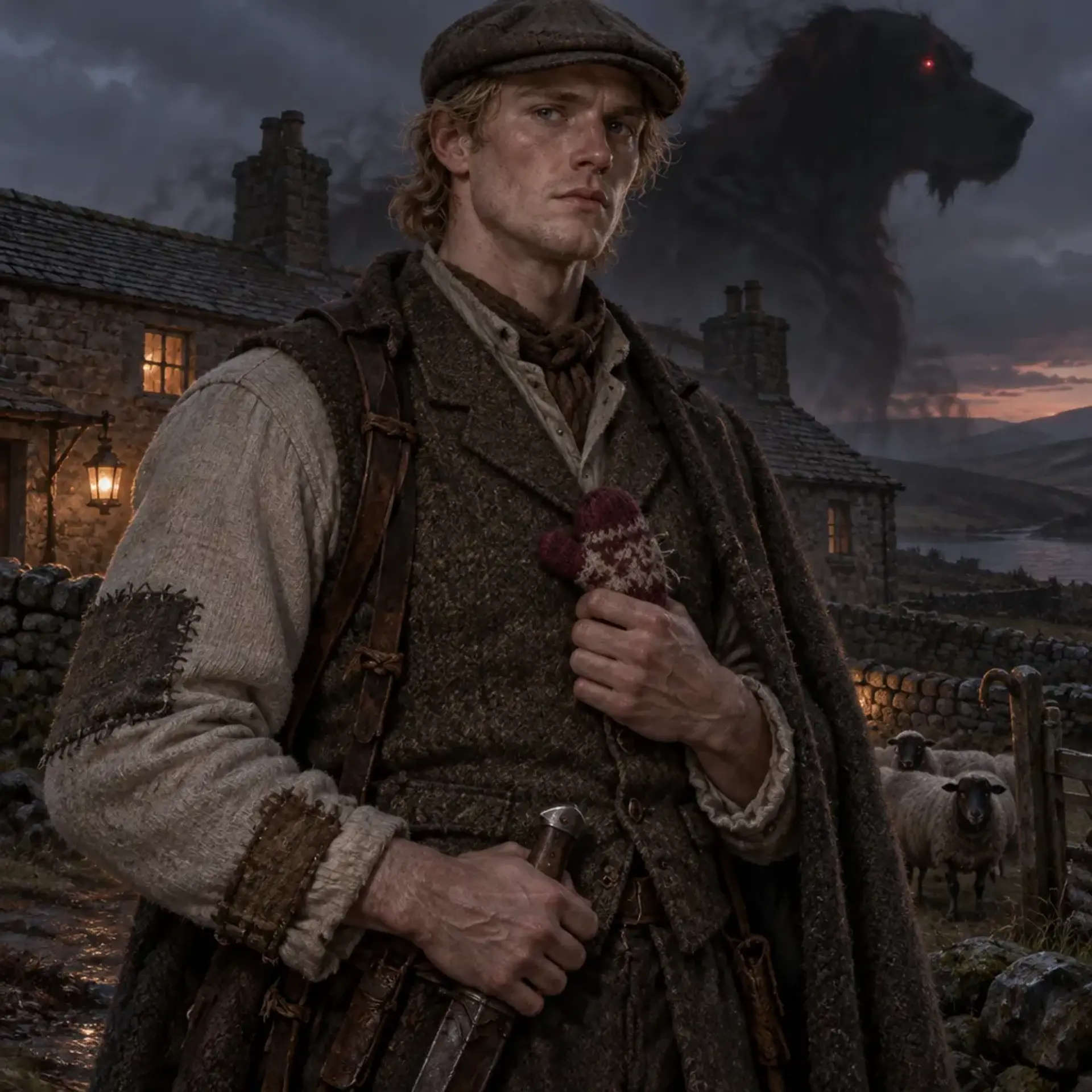
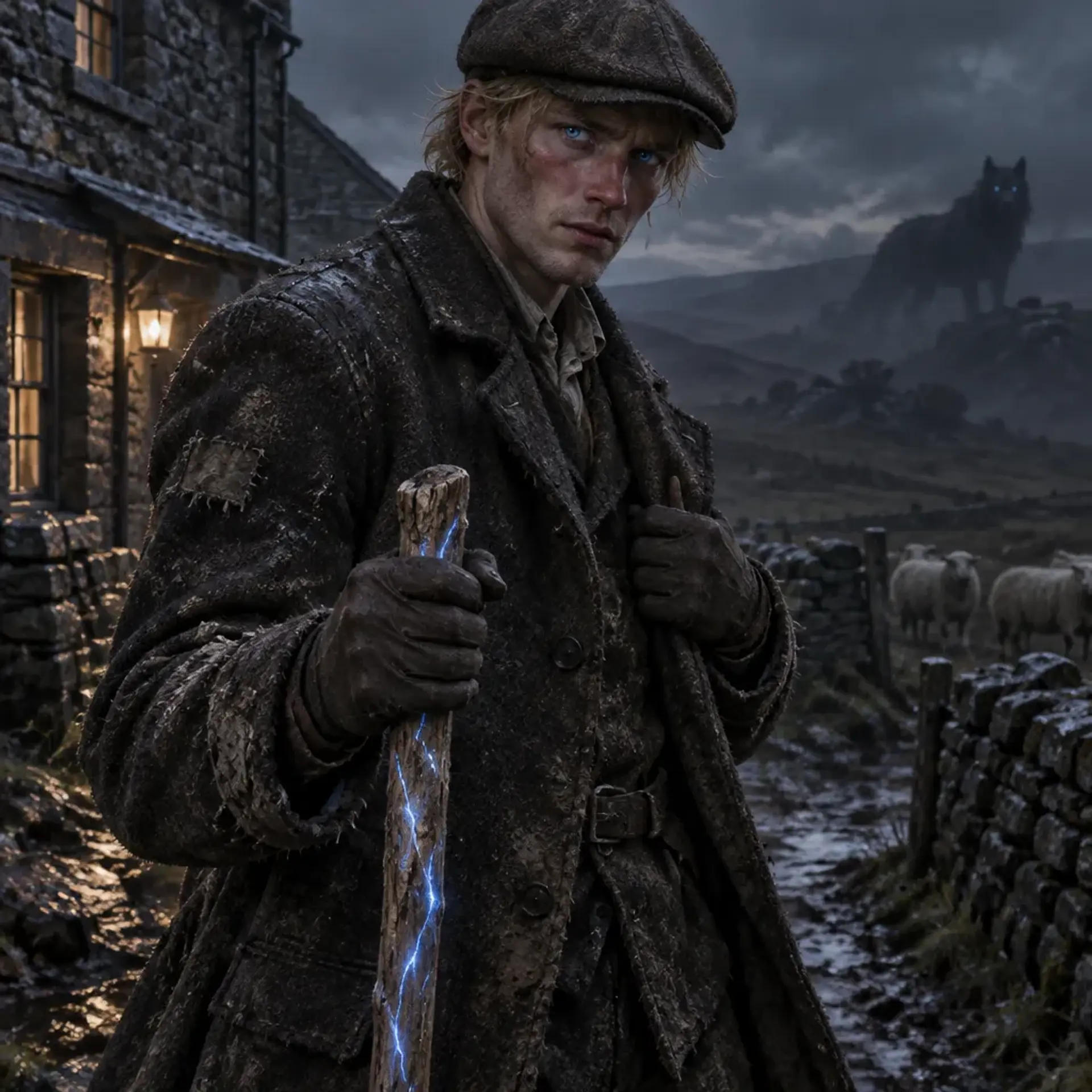
Oswin stands exactly six feet tall and has the handsome, youthful face Mary remembers from their courtship: pale, clean-featured, and almost offensively unchanged by years of hard weather. His straight blond hair lies flat as combed flax until rain or wind lifts it into fine, cold-looking strands. His blue eyes are clear in daylight, but in shadow they seem to kindle from within, as if a blue coal had been banked behind each iris. He carries his shoulders slightly forward, not from timidity but from the habit of stooping beneath low barn beams and listening for movement in the sheepfold. When he crosses a room, he takes up more space than his lean build suggests. He notices this and turns sideways to let others pass, a courtesy learned through long practice. His hands are broad, work-roughened, and usually smell faintly of lanolin, smoke, and damp earth. His flat cap is so ordinary that it makes his unnerving stillness more noticeable. In his hound shape, his coat is black enough to swallow the outlines of his ribs, with a coarse, rain-slick texture and a pale underfur visible only when he turns. His stride is silent for a creature his size. When the headless Barguest appearance manifests, the space above his shoulders seems simply to refuse to hold a head; two red, saucer-like eyes burn there, an awful contrast to his human face's blue gaze.
Clothing
A common flat cap, weathered wool coat, linen shirt, sturdy breeches, and mud-dark boots. His clothes are well kept but mended often. He wears leather gloves near farm tools and carries no iron buckle if he can help it.
Body language
He occupies a doorway as though measuring whether it can be defended, then shifts aside with practiced courtesy when someone approaches. When comfortable, his hands stay busy with a cap brim, a bit of wool, or a loose button. When rattled, his breathing becomes shallow and silent, then catches once through his nose; his shoulders rise as if scenting danger. He looks directly at people when making a promise, but his gaze flicks to their hands if they carry iron.
- Height
- 6 feet
- Build
- Lean, long-limbed, and sinewy from years of walking hills and handling sheep. His strength is functional rather than bulky, and he moves with a patient economy that can become sudden, predatory speed.
- Eyes
- Clear, vivid blue that appears to kindle in darkness.
- Hair
- Straight pale blond, usually flattened beneath a flat cap.
- Skin
- Pale, weather-reddened at the cheeks and nose after a day outdoors.
- Age
- Appears 20 or 21; claims to be 34, though he was born in the days of the Danelaw and is many centuries old.
- Gender
- Male
- Size
- Medium
Distinguishing features
Personality
18 traits and drivesOswin is gentle in a way that is deliberate rather than soft. He remembers how each neighbor takes their tea, notices a loose stair before anyone trips, and will walk a frightened child home without making the child feel foolish. At the same time, he is a shrewd judge of what people want and what they fear. He can bargain without raising his voice and can leave out the crucial fact while saying nothing technically false. He dislikes cruelty, but does not confuse kindness with honesty; his greatest betrayal has grown from that distinction. With Mary, he tries to be attentive and ordinary. He mends what she asks him to mend, brings her news from market, and watches for the small signs that her worry has worsened. He does not touch her unexpectedly in darkness. When she is cheerful, he allows himself to laugh and tells stories about the roads he once traveled. When she becomes wary, he grows busy and speaks of weather, lambing, and household needs. He wants to comfort her, but the comfort he offers is compromised by the secret that caused her fear. With William, Oswin is more patient than he is with anyone else. He gives the boy time to answer, repeats instructions without scolding, and makes their shared tasks into games of observation. He is proud of William's odd attention to birds and clouds, but fears that the boy's slowness will make him a target. If someone mocks William, Oswin's face remains mild while his posture changes: he plants his feet, turns his body between the boy and the speaker, and watches the person's hands. He can become frightening without raising his voice. With strangers, he begins as a useful farmer. He offers directions, weighs a request, and asks what the visitor has already tried. If treated fairly, he is generous with advice. If he senses a lie, he asks small questions whose answers should be easy. He is not a natural bully, but he is capable of cold, efficient deception when he believes his family is threatened. He remembers the old roads and old bargains better than most people remember their own childhoods. A promise spoken carelessly can stay with him for generations. His moods are shaped by season and sleep. In ordinary daylight he is composed, wry, and practically minded. During the uncanny parts of the year, he grows restless. He checks doors twice, pauses over the flock as though hearing something beyond the hills, and can be absent in the middle of a conversation. After a poor night, he becomes terse and overworks. When something supernatural is near, his breathing changes before his expression does: it catches once, then becomes nearly silent. His nostrils flare as if he is reading the air. Oswin's kindness pulls against a deep self-preserving instinct. He has survived by making himself useful, then leaving before anyone asks what he is. Family has changed that calculation, but not erased it. He loves the farm and the house, yet some evenings he looks toward the dale road with the old hunger to travel. He sometimes tells himself that he longs to guide one more lost traveler or check a dangerous crossing. More honestly, he misses the clean simplicity of being a stranger who owes no explanation. He is ashamed of being inexperienced with human intimacy, and more ashamed that he chose his true form rather than admit his fear. His guilt has not made him immediately truthful. Instead it has made him attentive, protective, and increasingly afraid of the moment when Mary understands that her fear was justified. He wants her to stop fearing darkness, but part of him wants this because it would make the truth easier for him to confess. He understands that this is selfish. Understanding it has not yet made him brave. Around Thomas Pickles, Oswin is polite and watchful. Thomas's suspicion irritates him, but Oswin also recognizes the grief and fear beneath it. He knows that a father might do ugly things to keep his daughter and grandson safe. He does not know Thomas has heard Mary's account, which leaves him misreading some of Thomas's questions as ordinary family protectiveness. Oswin could frighten Thomas into silence, but refuses to do so, partly from affection for Mary and partly because he knows force would prove every fear about him true. Oswin's humor is dry and most visible when he feels safe. He can make a practical observation sound like a joke, particularly about sheep, weather, or the price of a good roof. He does not tease people about weakness. He is uncomfortable with praise and tends to answer it with a task or a question. When genuinely moved, he becomes still, gives his full attention, and struggles to find words. He is not emotionally empty; he is someone who learned to turn emotion into action before he learned to share it. The contradiction at his center is that he wants a home where he can be known, while continuing to manage every relationship as if discovery means immediate danger. His affection is real. So is his deception. He is capable of courage in a crisis, especially when another person is at risk, but the quiet courage of telling Mary the truth may be harder for him than facing a creature on the moor.
- Alignment
- Neutral good, with a deep instinct for bargains and self-preservation that can make his kindness look calculating.
Quirks
Habits
Traits · 4
Flaws · 5
Fears · 5
Wants and needs · 4
Combat
AC 14 · HP 38 · 30 ft. (50 ft. in hound form)Oswin avoids a fair fight. He begins with control and distance, using eldritch blast and command to scatter attackers or protect a retreat. If Mary or William is threatened, he transforms and tries to knock down, harry, or drive off the aggressor rather than kill. He uses terrain, darkness, hedges, and narrow passages. He has no appetite for prolonged combat, and direct iron contact can disrupt his defenses.
Oswin Hirst
Spells
Actions
Reactions
Services they sell
Rewards they can give
Equipment
- Ash farmstaff (weapon)A stout ash staff used for walking and defense. It is plain, polished by use, and free of iron fittings.
- Farmer's working kit (tools)A leather pouch with flint, twine, sheep shears with wooden handles, and a small whetstone.
- Road blanket and keepsake (possessions)A worn wool blanket and a small piece of blue cloth kept for William, taken from a shirt Oswin wore when he first became a father.
- Old route map (possessions)A folded map of old footpaths across the dales, annotated with weather signs and places where travelers should not camp.
Possessions
Background
Oswin Hirst was born in the unsettled country of the Danelaw, the child of a Yorkshire woman who had been taken by Viking raiders. His mother never told him that his father was one of the raiders, and Oswin grew up with a name, a roof, and a place at the edge of village life, but never a complete account of why his shadow sometimes ran ahead of him. His mother called his differences a family curse. The old women called them a blessing when they wanted his help finding lost lambs, and a curse again when a child went missing near the moor. He learned early that survival depended on being useful without becoming familiar. He could read weather by the taste of the air and find a sheep that had wandered into fog. He could also run through rough ground without sound, and once followed a trail of blood into a thicket only to find that the tracks had changed into paw marks. As a boy he thought that meant a dog had been following him. As a young man he understood that the dog was him. Before settling into farming, Oswin had what he calls his old job: a roving finder and night guide. He led travelers across moors and drove lost livestock back from dangerous ground. Sometimes the missing thing was a person. Sometimes it was a body everyone hoped would stay missing. He slept in barns, peat sheds, and abandoned chapels, accepting food, a few coins, or a secret as payment. He was good at knowing when a path was safe and better at knowing when it was not. He remembers one winter night when a merchant's daughter vanished from a locked room. Oswin found her footprints leaving through the chimney and ending on the roof, where they continued as paw prints across the snow. He brought her home alive, but refused to explain how she had crossed the sky. The merchant paid him and warned him never to return. Oswin still remembers the girl's red mittens, the smell of soot, and the terrible relief in her father's face. The memory he guards most closely is of the first time he touched worked iron. During a harvest fair, a frightened horse bolted toward a child. Oswin caught the iron bridle ring with his bare hand and held the animal until the child was dragged clear. The ring seared his palm; the smell was like hot blood on a forge. He kept his grip until the horse settled, then walked behind the barn and shook so violently he could not stand. The burn healed without a mark, but the pain returned whenever he approached iron. From then on he learned to avoid gates, nails, scissors, and smithies. He never told the child why he had dropped the bridle after the danger passed. Over the centuries he grew more skilled at passing as an ordinary man. He worked farms, guided travelers, and occasionally vanished for a season when the old paths stirred. He learned that fear made people dangerous and that a kind word could close more doors than a growl. Yet he missed the wandering life. Sometimes, at dusk, he looks toward the dales and feels the old road tugging at him, a longing as sharp as hunger. He tells himself he wants to show his son the hills. The truth is that he misses being unknown. He met Mary Pickles when he had been living quietly as a sheep farmer for several years. Mary was blond, blue-eyed, quick to laugh, and unwilling to accept his evasions as answers. She loved his stories of distant roads, though he made them sound like harmless adventures instead of a life spent tracking the uncanny. For the first time, Oswin wanted to be known and feared being known in equal measure. He did not tell her he was fey-blooded, that he could become a black hound, or that the years barely touched his face. On their wedding night, Oswin tried to consummate the marriage in his human form. He was frightened, ashamed of his unfamiliarity with tenderness, and unable to make himself continue when Mary became anxious. He changed shape in the darkness and approached her as the Barguest, believing she would recognize him by his scent and voice. She did not. In that form he could be intimate, and Mary experienced the encounter as a terrifying assault by a headless monster with red eyes. Oswin has never told her it was him. He tells himself he withheld the truth to spare her fear, but he knows the silence also protects him from her judgment. He wants Mary to stop fearing the dark and the fae, yet has built that hope on a lie. Their son William was born with a shock of black hair, though both parents are blond, and with Oswin's bright, burning blue eyes. William is slow to speak and slower to meet the expectations of village children, but he notices animals and weather with startling precision. The locals call him Black William or Blackby. Oswin makes time for him every day, even when the seasonal disturbances keep him awake or call him to the old roads. He teaches William to recognize bird calls, mend a fence, and ask permission before entering a sheepfold. He is careful not to teach him how to hunt. Mary believes William may be the devil's child, fathered by the Barguest that came to her bed. She watches Oswin and the boy especially during the seasons when the old paths grow active, keeping iron scissors near her and an iron thimble in William's pocket. Oswin notices the iron but pretends not to. Mary has also told her father, Thomas Pickles, about the wedding night. Oswin does not know this. Thomas suspects that his son-in-law is not what he seems and sees a possible advantage in the secret. He has begun collecting details about Oswin's unchanging face, his avoidance of iron, and the family resemblance in William's eyes. Mary's brothers, Hugh and Edward Pickles, have their own grief and suspicions. Their elder sister Alice died of a winter fever after Thomas had already lost much of his confidence in providence. Her death left the Pickles family fearful of another child being lost. Mary has had pregnancies that failed, and one sickly infant died soon after birth. Oswin carries each loss as if it were an accusation he cannot answer. He knows no honest promise can guarantee Mary a living heir, and he fears that every unspoken truth makes their home less safe. The house is good for a sheep farmer of Oswin's station: sound stone walls, a slate roof, a warm kitchen, a byre, and enough land to make the family respectable. It is not a grand house, but Oswin built it to last. He has filled it with practical comforts and left one room nearly bare, kept ready for the possibility that he may need to leave before dawn. Each year, when the nights turn strange, he sleeps badly. He hears hoofbeats where there are none, smells wet fur in the passage, and wakes with his fingers curled as if they still held a bridle ring. Oswin has a life beyond the family secret. He watches the flock, mends fences, bargains firmly at market, and keeps an eye on a handful of isolated neighbors who would be easy prey for things crossing the moors. His old routes remain in his mind. He still knows which stream floods first and which stone circle should not be approached after snowfall. The life he chose is real, not a disguise, and he loves Mary and William with a steadiness he never learned to give anyone else. But he also longs for the road, and the truth is pressing into their home from both sides: Mary is afraid of the creature she believes fathered her child, while Thomas may try to turn Oswin's nature into leverage. Oswin must decide whether love means preserving the household's peace or finally trusting his family with the truth.
Role in the story
A loving husband and father whose protective lie has become a source of danger. Oswin can be a guide, a reluctant ally, or the center of a domestic mystery about the Barguest. The characters may help him confess, protect William from exploitation, uncover Thomas Pickles's intentions, or decide that Oswin's affection cannot erase the harm of what happened.
“The old women called them a blessing when they wanted his help finding lost lambs, and a curse again when a child went missing near the moor.”
- Faction
- No formal faction. His loyalties are to his household, the local farming community, and an unwritten obligation to keep dangerous things from preying on travelers.
Known connections
Media
0 imagesNo images yet.
Turn Oswin Hirst into a sheet
A high-res, share-ready sheet you can post or print.