Wilt
Wilt
At the table
Voice
Wilt's voice comes from a body accustomed to outdoor work, but it sounds older and more carefully shaped than William's. It has a dry, close texture, as if the speaker is choosing each word for its usefulness. The older accent appears most clearly when Wilt is tired or frightened; the thick Wiltshire sound emerges when his siblings are near. His laugh is brief and surprised, except when he drinks, when it can become loud, irreverent, and startlingly youthful.
Wilt speaks with careful diction, dry wit, and the measured cadence of someone who learned manners from an older generation. His ordinary voice is deeper than William's, with an old English quality that can sound oddly formal beside modern references. Under fear, a thicker Wiltshire accent emerges. He does not become quieter when angry: his consonants sharpen, his sentences shorten, and his voice gains a blunt, clipped force. He often describes emotional or supernatural facts as weather, tides, or forge work. William's speech is warmer and less controlled, making the difference obvious to friends who know him.
Speech patterns
How to play them
Treat William and Wilt as two people sharing a life, not as a possessed victim and an expendable monster. Address William directly when he is in control and ask permission before trying to communicate with Wilt through a mirror. Wilt responds to competence, discretion, and practical help. He bristles at being called a stone, a servant, or a parasite. Do not press for the siblings' identities in front of Hector or Elizabeth. If the party earns his trust, Wilt may explain fragments of his past as memories of weather, sea, or metalwork rather than a chronological account. A respectful question about the garden, a book, or an unfamiliar machine can open conversation more readily than a demand for his secret.
Goal
Discover what the Heart of England made him, learn why his siblings are searching for him, and keep them away from William's family without losing his own identity.
Motivation
Wilt wants to remain himself, rather than become a mere echo of William or a servant summoned by the heart. He also wants to keep William alive, though he dislikes admitting that his safety is a personal concern.
Appearance
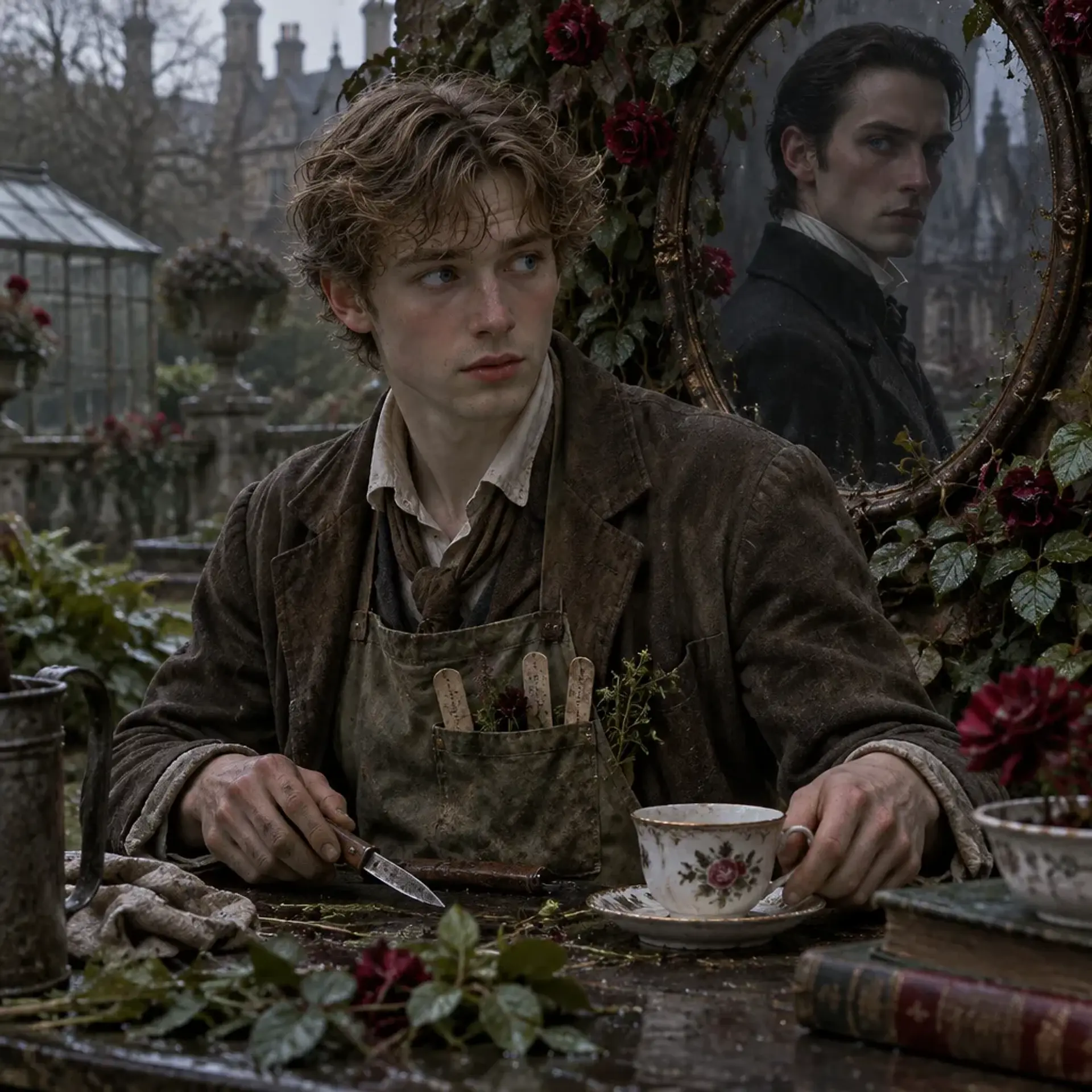
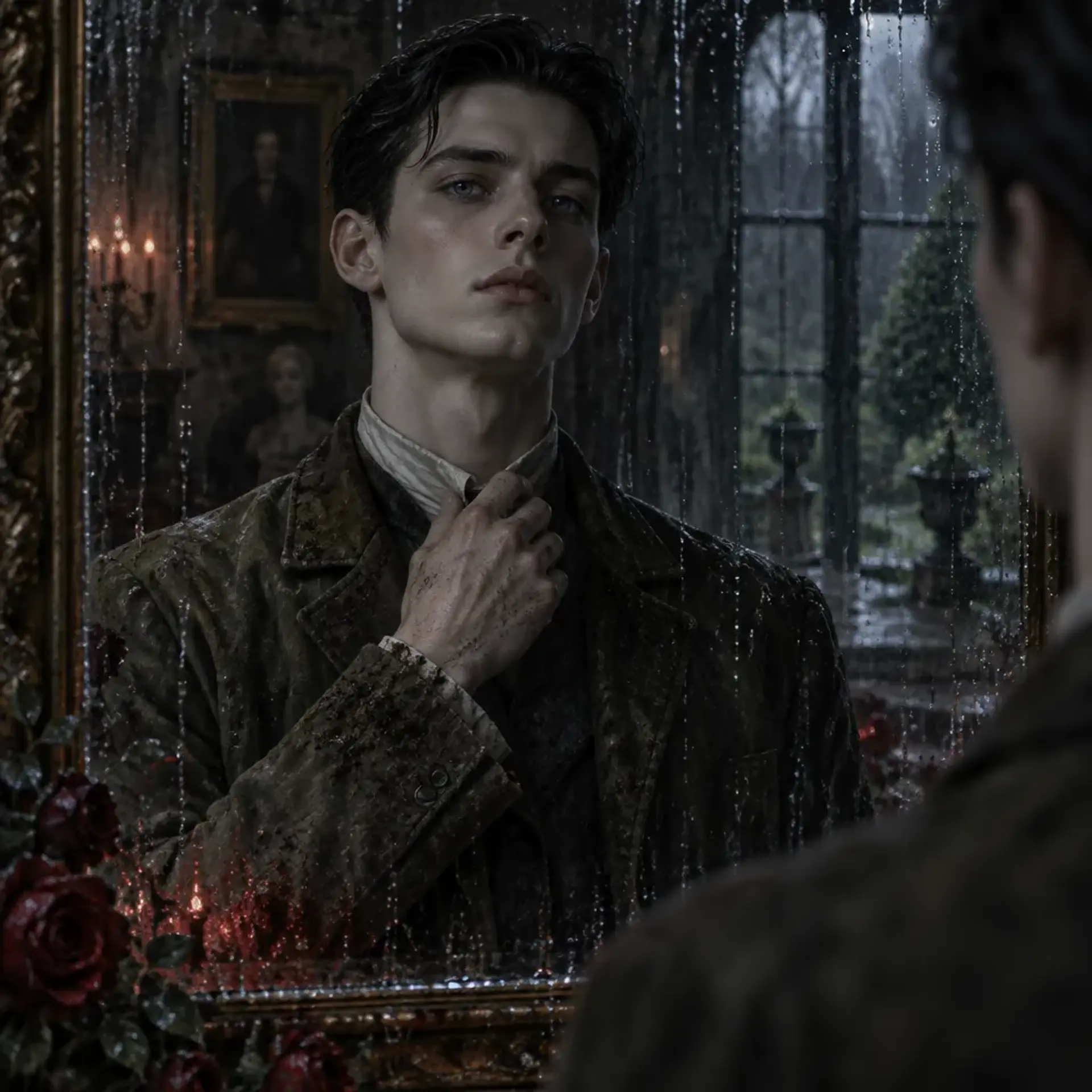
When visible in a mirror, window, still water, or polished metal, Wilt is a tall, strikingly handsome young man with a long, narrow face, moonlit blue eyes, and short black hair combed smooth and trimmed close at the sides. His expression tends toward sober appraisal, as though every room has already disappointed him. He wears whatever William is wearing, but occupies the clothes differently: shoulders squared, chin lifted, and posture arranged with the self-conscious precision of someone raised to mind his manners. When he takes the body, the difference is unsettling rather than theatrical. William's familiar face seems to settle into a longer, more composed shape, and his movements acquire an economical, practiced quality. Wilt is still visibly seventeen, yet his bearing suggests an older world. He is unusually attentive to grooming and notices lint, a crooked collar, and unshaven stubble at a glance. In company he takes up more space than William, standing as if the room ought to make room for him. The unexpected detail is that Wilt is fascinated by modern cars, televisions, and household electronics, studying them with the grave wonder of a country gentleman examining a newly discovered beetle.
Clothing
William usually wears practical estate-gardener clothes: work trousers, sturdy boots, a weathered jacket, shirts with soil at the cuffs, and a simple watch. Wilt mirrors those clothes exactly but wears them as if they were formal attire, frequently adjusting the collar and brushing away imaginary lint. For family meals he tries to impose older standards of dress and table behavior.
Body language
William's ordinary posture is open and slightly self-effacing, with the careful movements of a gardener used to working around fragile plants. Wilt straightens the spine, squares the shoulders, and holds the chin level. When he has control, he looks directly at a person for a beat too long, as if silently deciding whether their manners are adequate. He smooths his hair and cuffs, turns his head toward mirrors even when no one else notices them, and becomes very still when listening for the coastal voices. William rubs his chest when anxious. Wilt notices and sometimes catches the hand before it can reach the sore place.
- Height
- Wilt appears approximately 5 feet 11 inches tall in reflections, several inches taller than William.
- Build
- William is a lean, healthy young gardener with practical strength in his forearms and shoulders. Wilt makes the same body seem taller through posture and controlled, deliberate movement, though when manifested in a reflection he is visibly taller than William.
- Eyes
- Moonlit blue in Wilt's reflection; William's own eyes are blue.
- Hair
- Short, neatly combed black hair in Wilt's reflection; William's hair is dark blond.
- Skin
- Wilt's reflected face is pale with a cool, moonlit cast. When he takes the body, William's ordinary coloring remains, though a faint flush of red-pink can appear across the chest during episodes connected to the heart.
- Age
- Wilt appears seventeen, the same age as William Windon. Wilt's true age is unknown and may predate the stone heart's arrival in England.
- Gender
- Male
- Size
- Medium
Distinguishing features
Personality
20 traits and drivesWilt is not simply stern, old-fashioned, or sarcastic. He is proud of decorum and fascinated by novelty, dismissive of ordinary people and unexpectedly respectful toward anyone who tends living things with patience. He can be a snob about tea, clothing, and table manners, yet steal a bottle from a neighbor and hide it under William's bed. He mocks William's self-consciousness but becomes embarrassed when William turns the same scrutiny on him. Wilt has a sharp instinct for hypocrisy, especially in Hector, but his own judgments can be cruel and narrow. He dislikes being told what he is, though he sometimes behaves exactly like the servant or haunting he fears others will see. In a calm mood, Wilt is observant and almost companionable. He comments on William's grooming, points out the age of a building, studies a car, or asks how a television produces moving images. He likes routines because a routine gives him a predictable place in William's life. Gardening suits him: plants respond to care without demanding explanations, and the work leaves room for silence. He does not praise William openly, but may quietly correct a tool's position or take a difficult task off his hands. When irritated, Wilt becomes cutting rather than loud. His remarks often sound composed, which makes them sting more. He considers bad manners a failure of self-command and is especially contemptuous of people who claim to be modern while treating others carelessly. Yet he can be unexpectedly protective of children and people who apologize sincerely. He was wrong to insult the Welsh neighbor's child, and the consequence of William mucking out the stable taught him that a clever insult can create a real burden for someone else. He rarely admits a lesson in those terms. He simply avoids repeating that particular kind of insult in front of William. Wilt and William pull against each other in the most intimate ways. William is warmer, more sensitive, and more willing to give others the benefit of the doubt. Wilt thinks this leaves him vulnerable. William wants to study plants and build a life in the open air. Wilt wants to know what the heart is and whether the figures outside the house can be stopped. William resents Wilt's control of their body, but he has come to understand that Wilt sometimes acts from fear rather than malice. Wilt resents William's ability to return to ordinary life, but he depends on the ordinary life William has built: the garden, the family, the estate, the books, and the friends who can say his name without fear. His interest in Adaline reveals an emotional immaturity he covers with confidence. Wilt believes he understands attraction because he can identify beauty and desire, but he does not understand the trust and reciprocity that make a relationship. He wants Adaline to notice him, then becomes defensive when William reminds him that she is William's girlfriend. Wilt has not decided whether his desire is a genuine separate feeling or an echo of William's attachment. The uncertainty makes him jealous, embarrassed, and fascinated in turns. Wilt's family life is complicated by his feelings about Hector and Clare. He respects Clare because she is consistent and does not ask him to perform. Her readings from the Bible give him a place to answer without explaining himself. Hector troubles him. Wilt sees the historian's contempt for rural people and hears the tension between Hector's stated dislike of rigid hierarchy and his expectations of his son. Wilt's criticism of Hector is sometimes deserved and sometimes self-serving. Hector's occult activity frightens Wilt because it may give the family a language for naming him, studying him, or trying to remove him. Under stress, Wilt's composure fractures. A war film caused a violent, involuntary reaction that was neither ordinary anger nor a deliberate performance. He fought, screamed, and cursed while William was trapped behind his own eyes. Afterwards Wilt mumbled an apology and offered a memory in place of a proper explanation. He avoids similar images now, sometimes changing the channel or moving William away before he can explain why. The response makes Wilt afraid of his own memories. He would rather call the reaction weather than admit he does not know what happened to him. The moonlit night under the bed made his fear visible. Wilt took control because he believed his siblings were outside. He ordered William to be quiet, pushed their shared body beneath the bed, and listened to voices seeping through the walls. He did not comfort William with a lie that nothing was wrong. He said only that the visitors were trying to draw him out and that speaking might help them find him. William's defiance and the thick Wiltshire accent that emerged from Wilt showed that this was not a clever act of manipulation. It was an old terror breaking through. Wilt let William drink the hidden sloe gin, and in the morning gave him the small, almost pleading reassurance that he was fine. He then refused to explain the voices. The refusal is part fear, part shame, and part an attempt to keep William from becoming a target. Now Wilt has begun to describe himself more often, though never neatly. He talks about a father and siblings as if describing changes in the sea or the behavior of metal in a forge. He may say that a sibling is “looking for a dry place” or that his father “turns the weather in a room,” leaving William to guess what the words mean. Wilt's attachment to the heart is still uncertain. He may be its child, its prisoner, or something that woke when William touched it. He is a person with opinions and appetites, but a person whose earliest memories do not fit a human life. Wilt's most difficult contradiction is that he wants freedom while treating William's body as a refuge he has a right to defend. He wants to be recognized as a person but takes control without asking. He wants William to trust him, but withholds the information that would make trust possible. He tries to behave as though he has all the answers, then listens anxiously at a dark window for a voice he cannot bear to name. He may become an ally, a dangerous friend, or a genuine threat if cornered. What decides the outcome is not whether he is good, but whether he can learn to share his life without making William pay for every fear he has ever carried.
- Alignment
- Neutral, with a protective streak and a severe dislike of cruelty. Wilt's conduct is shaped by old-fashioned rules, personal loyalties, and instincts he does not fully understand.
Quirks
Habits
Traits · 5
Flaws · 5
Fears · 5
Wants and needs · 5
Combat
AC 13 · HP 32 · 30 ft.Wilt is not a trained soldier. He uses cover, doors, darkness, and the shared body's knowledge of the house. He prefers to frighten, distract, or disable a threat rather than kill it. He uses Salt-Black Thought at range, then retreats behind furniture or into a narrow passage. If William is threatened, Wilt may take control despite William's objections. Against the searching siblings, Wilt prioritizes keeping them away from reflective surfaces, the sealed study window, and the rest of the family. He avoids battle scenes and war imagery, which can provoke a distressing loss of control.
Wilt
Spells
Actions
Reactions
Services they sell
Rewards they can give
Equipment
- Pruning knife (tool and improvised weapon)A gardening knife kept for pruning and ordinary estate work. Wilt has hidden it before, claiming it was prudent to have something sharp nearby.
- Pocket torch (adventuring gear)A small torch used for moving around the house at night without waking the family.
- Botany notebook (personal item)A notebook containing William's plant observations, odd dreams, and a few notes Wilt has added in a different hand.
- Under-bed stores (food and miscellaneous)A small, concealed cache of sweets, tinned fish, and questionable bottles. Wilt insists this is sensible preparation.
Possessions
Background
The object that set everything in motion was first presented as a curiosity. Bartholomew Golden, an amateur alchemist with more confidence than sense, arrived at the Hush House carrying a supposed fossilized living heart. He described it as the Heart of England, a thing of heart and scale able to bring servants from man's shadow, born to give the laborers of the house workers who were not human but born of them. It looked like a lump of Dover chalk carved into a human heart, crusted with barnacles and sea grass. Golden had brought it wrapped in newspaper as payment for entry. He was never allowed near Brancrug again. The heart was thrown into the sea. It returned to shore looking worse for the indignity: wet with salt water and black ooze, its chalk surface newly tinged a faint red-pink beneath the crust. A young man named Abraham Groff found it and carried it home to Wiltshire. He was drawn to it and repelled by it in equal measure. When he showed it to neighbors, the heart seemed to die. When he brought it back to the Hampshire shore and let it touch water, its color returned. Abraham decided the thing was special, and that it belonged to him. He did not keep it from others out of greed so much as a growing sense that the heart disliked company. The house changed around it. Voices moved through empty rooms. Doors shifted, footsteps crossed the landing, and Abraham heard sounds he could not locate. The heart wept salt water. Eventually he sold it to a seventeen-year-old local boy, William Windon, one of the people who had seen the object before it went inert. William was proud of his strange treasure until its beat began to answer the beat in his chest. He tasted sea water, blood, and soil without having put any of them in his mouth. Terrified, he struck the stone with a hammer. Pain seized him as if the blow had landed inside his ribs. He collapsed, groaning in a voice that was not quite his, and glimpsed a muscle twitch violently beneath the stone. His mother, Clare, found him after his heart had stopped. William left the heart in a hollow log. Days later it looked untouched, cold, and pristine. The first sign that something remained was his reflection. It was not his face. It was a handsome, long-faced boy with short, practical black hair, pale blue eyes, and a stern expression. William was cautious while grooming, then learned to ignore it. The reflection had its own timing. It could jerk its head when William did not, or keep a disapproving expression after William had smiled. One night, while William went through his ordinary bedtime routine, the reflection spoke through his moving mouth: “Well, it's not often you use that one.” Its accent sounded older than William's, and its voice carried a dry, assured gravity. At first the strange presence was mostly a nuisance. It commented on William's clothes, his hair, and his manners. It occasionally stopped him from speaking when it considered a remark improper, then made a sharper remark of its own. It insulted neighbors, once using a slur against a Welsh child who had accidentally knocked William over with a toy wagon. The child's apology and tears did not soften the insult. William was made to muck out a neighbor's stables as a consequence. The reflection was not sorry in the ordinary sense, but it remembered the incident and learned that its words could make William pay for them. William's father, Hector, is a historian, a liberal man who dislikes rigid class customs and prides himself on being more modern than his own father, the fierce veteran known as Bobby. Hector wanted William to pursue intellectual work that Hector considered interesting. William instead loved gardening and was training to become a botanist. Hector dismissed the boy's ambitions as insufficiently serious. The contradiction in Hector's character is plain to his son: he mocks old social rules while expecting his family to admire his own opinions. William absorbed his father's impatience with rigid systems, but not his certainty that he knows better than everyone else. Hector is also part of an occult circle. He has never told his family, and he did not know what the heart was, though he recognized it as unnatural. William's mother, Clare, is steadier. During his recovery, she kept him company in the garden, reading from a book or the Bible while he worked and bringing tea and snacks. Wilt does not insult her. When she quotes scripture, Wilt sometimes answers with passages William does not know, speaking as if the lines are familiar from another century. William's sister Elizabeth has learned that changing the way she phrases a question can make her brother respond in Wilt's voice. She calls the condition “brain damage,” partly to tease him and partly because she has no better explanation. She enjoys provoking the switch, but she has begun to recognize when the joke is no longer harmless. William's friends Tommy DeHare, John Mollask, and Ryan O'Leary saw that the reflection could react physically to people and speak through William without the mirror. William's girlfriend, Adaline, with auburn hair and soft brown eyes, brought out an unexpectedly possessive side of Wilt. Wilt decided he wanted her, though he has no simple understanding of what that desire means. William's sister has since started seeing Romy Brock, an artist who plays rock and roll on the guitar. Wilt finds the music and the looseness of the young people around him bewildering, though he has begun to enjoy the television and books William brings into the room. The heart's old associations surfaced most brutally during a war film. William's body reacted as though it had been thrown into a battlefield. He lost control, screamed, cursed, and fought against Hector, who held him down while Elizabeth changed the channel. His family thought the heart trouble had returned. When William came back to himself, Hector looked at him differently. Later, Wilt offered an apology in a mumble and shared a strange memory as consolation. The memory did not explain everything, but it made clear that the violent reaction was not William's own. Wilt carries fear and pain connected to war, though he avoids naming the source. He avoids paranormal phenomena as well, despite being one. A drunken evening offered a different kind of revelation. Hector had left scotch and bourbon for William's health, and Wilt found them. He laughed, argued, teased, sang, and nearly took off William's shirt in an act of rebellion. When William asked whether he was the stone, Wilt scoffed and answered, “Dad isn't here.” The next morning Clare found the empty bottle. Hector began by yelling and then, abruptly, offered William chores around the house instead. The family took the evening as a lapse in judgment. William understood it as evidence that Wilt could enjoy, regret, and make choices of his own. Five months after the heart stoppage, William returned to work as a gardener on an estate. The routine helped both of them. Wilt likes the stable work, the wandering through town and woods, and the chance to examine cars and electronics. He still steals things and hides them in William's room: cigarettes, cigars, cheese, sweets, tinned fish, and a bottle labelled apple juice that turned out to be sloe gin. He treats tea as a ceremony with strict rules and irritates Hector by insisting on customs Hector considers ridiculous. Bathing has become awkward. Still water shows Wilt's face, and both young men are Englishly embarrassed by the situation. Sometimes Wilt takes over the task of grooming, with an insulting commentary on William's body. At other times he blushes, which is more unsettling than the sarcasm. The haunting has become more dangerous. One cold night William woke unable to move. Wilt had taken control and whispered that his siblings were outside, looking for him. He said that the more he spoke, the more likely they were to find him. William heard faint voices bleeding through the walls, words that seemed to include “Wilt” and the name of a place in Wiltshire. Wilt clamped William's mouth shut and rolled their body from the bed, then dragged them under it. William forced out a question: “Your siblings?” Wilt answered in a thick Wiltshire accent, not the older voice William knew from the mirror. He claimed they were trying to draw him out and ordered William to be quiet. They crouched beneath the bed while moonlight edged the room. William could smell salt water, damp grass, and the heart's black ooze. Wilt held their body rigid, listening. The moon made a pale rectangle on the floor and turned the mirror into a dark square where no face could be seen. William reached for a bottle he thought was apple juice and found the stolen sloe gin. He drank, partly to steady himself and partly to prove he could still choose something. Wilt did not fight him. At some point the fear and exhaustion gave way to sleep. In the morning William pushed himself out from beneath the bed and went straight to the bathroom mirror. Wilt was there, composed and familiar, and William's own face felt like his own again. “See, you're fine now,” Wilt said, giving him an oddly plaintive gesture. William demanded an explanation. Wilt gave only scraps. He admitted his name was Wilt, then resisted questions about what the voices had said or why they had come. William found the smell of sea water, damp grass, and black ooze outside. Wilt wanted him to hide, but William made himself look around. That was a turning point: William no longer treated Wilt as a possession to endure or a problem to be cured. He began treating him as a frightened, difficult person with a history of his own. The visitors have returned at night. Wilt says only five of his siblings are actively searching, and that there are more. William has begun locking doors and windows, including the second-floor bedroom window. The visitors seem to know how to wake Wilt into a more tangible state. On those nights William may lose his face and walk the halls in Wilt's form. He calls this haunting his own home, though he does it to keep the intruders from reaching his family. He avoids windows and keeps doors firmly shut. Their father's study has become the center of the danger. A damaged old window, hidden behind a bookcase and supposedly sealed by Hector, admits a breeze that sometimes smells of salt and blood, sometimes meadow grass. William has found fragments of Hector's occult papers there and is careful not to wake his family as he searches them. Hector is growing suspicious. He notices that William moves differently during the night, that the study door is sometimes not quite shut, and that objects are moved without explanation. He asks questions disguised as casual conversation, watches William's face when certain old books or war stories are mentioned, and has begun to check the windows himself. Hector is not yet sure whether his son is lying, sick, or involved in something connected to Hector's own hidden circle. His disappointment has become anxiety, and his anxiety has begun to look like scrutiny. William is afraid his father will discover the occult notes and see Wilt as a threat to be cut out. Wilt, who knows more history than he can explain, insists Hector must not be allowed to open the sealed window. The current problem is therefore twofold. William must discover what the Heart of England has made of him and Wilt before the five searching siblings get inside, while keeping his family from learning how much danger is in their home. Wilt wants to survive and to understand his scattered memories, but he is reluctant to say what his siblings are or what they want. William needs the truth and resents being told to trust a voice that has stolen his body. They are bound together by fear, routine, affection they will not admit, and an increasingly practical division of labor. William handles daylight, gardening, and family life. Wilt watches the mirrors, the study, and the darkened windows. Neither can manage the house alone.
Role in the story
A dual-identity ally and potential antagonist whose private struggle connects an English family, a missing alchemical artifact, a hidden occult history, and a group of coastal entities searching for one of their own. Wilt gives the party a personal mystery rather than a simple quest-giver: protecting him may mean protecting William, while discovering the truth may require exposing Hector's secrets and confronting Wilt's siblings.
“Bartholomew Golden, an amateur alchemist with more confidence than sense, arrived at the Hush House carrying a supposed fossilized living heart.”
- Faction
- No formal faction. Wilt is bound to the Heart of England and is concealing his presence from Hector Windon's occult circle and from the coastal siblings searching for him.
Known connections
Media
0 imagesNo images yet.
Turn Wilt into a sheet
A high-res, share-ready sheet you can post or print.