Friedreich
Friedreich
At the table
“Would you buy this for me, if I could keep it?”
Voice
Friedreich's voice has a dry, lightly rasping edge, as though shaped around the habit of breathing rather than breath itself. He speaks with measured consonants and a disciplined cadence, learned from a youth he cannot fully remember. He does not lower his voice or become deferential when angry; instead, his words sharpen and his pace becomes insistently exact. When excited, especially at a Christmas market, he rushes his explanations and sounds almost boyish. If his manifestation falters, his mouth and voice may briefly lose synchronization.
He speaks deliberate standard German with old-fashioned turns of phrase and a faint Brandenburg plainness, though he cannot be certain how much is memory and how much is performance. When borrowing a face, he can approximate its voice. His own speech has the dry catch of someone trying to reproduce a breath he does not need. On ordinary days he uses clipped, orderly sentences; when excited about a market bargain or a football match, his pace quickens and his careful diction breaks into eager detail. When rattled, the voice can arrive a fraction after his mouth moves.
Speech patterns
How to play them
Offer him a concrete task or ask his opinion about a purchase, a football match, or a holiday plan. He responds warmly to people who include him without making a spectacle of his condition. Do not demand a borrowed face or treat possession as a harmless trick. If pressing him about Wilhelm or his missing past, be direct but allow him time to separate what he remembers from what he suspects. He is likely to cooperate with a person who protects Mila or shows respect to the coven, but will become defensive if someone assumes he is harmless simply because he looks young.
Goal
Discover what the spirit of the land wanted when it opened his Caul, recover enough of his past to understand his bond with Wilhelm, and find a way to be recognized without losing himself in borrowed faces.
Motivation
To belong to the living world and to his coven without having to erase himself in order to be seen.
Appearance
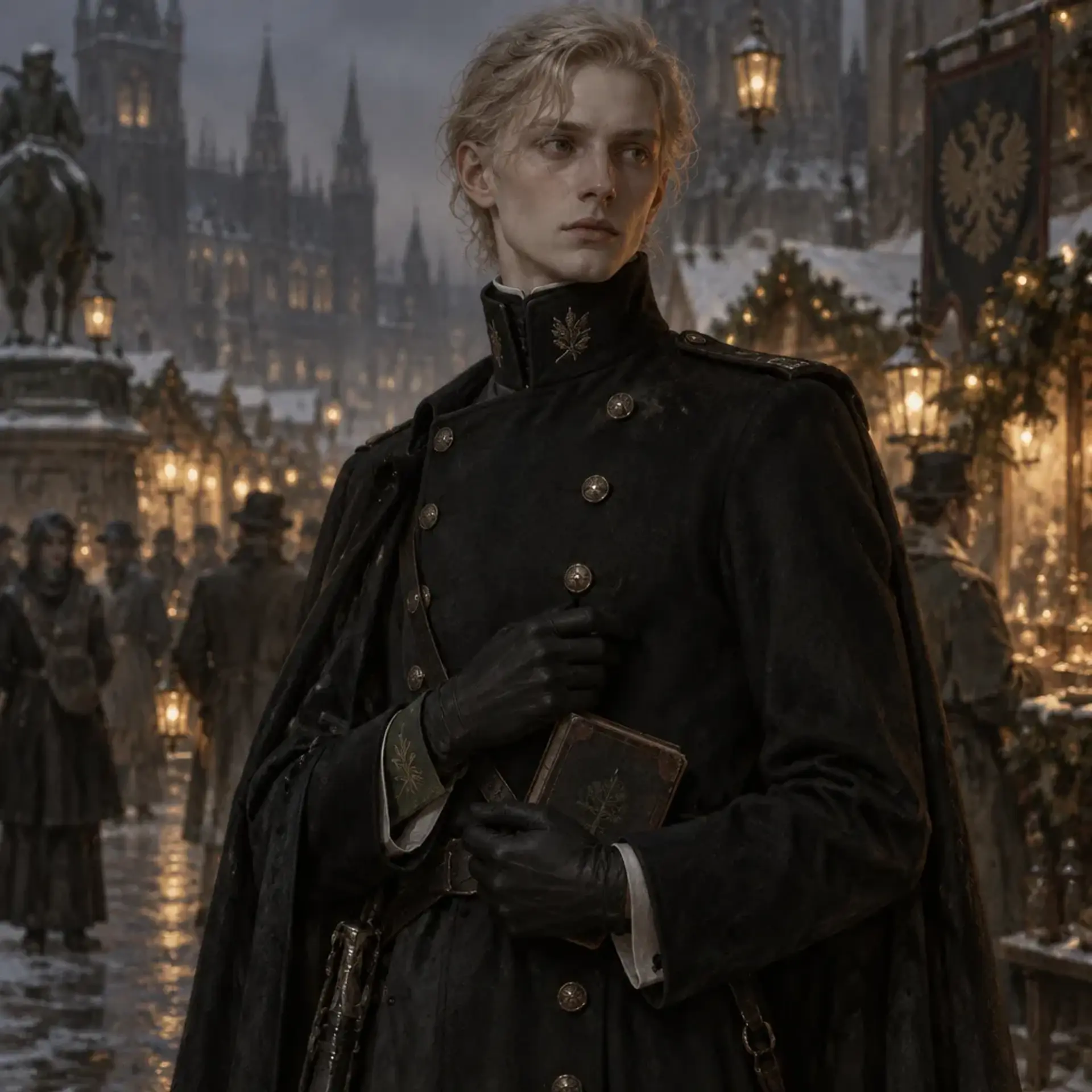
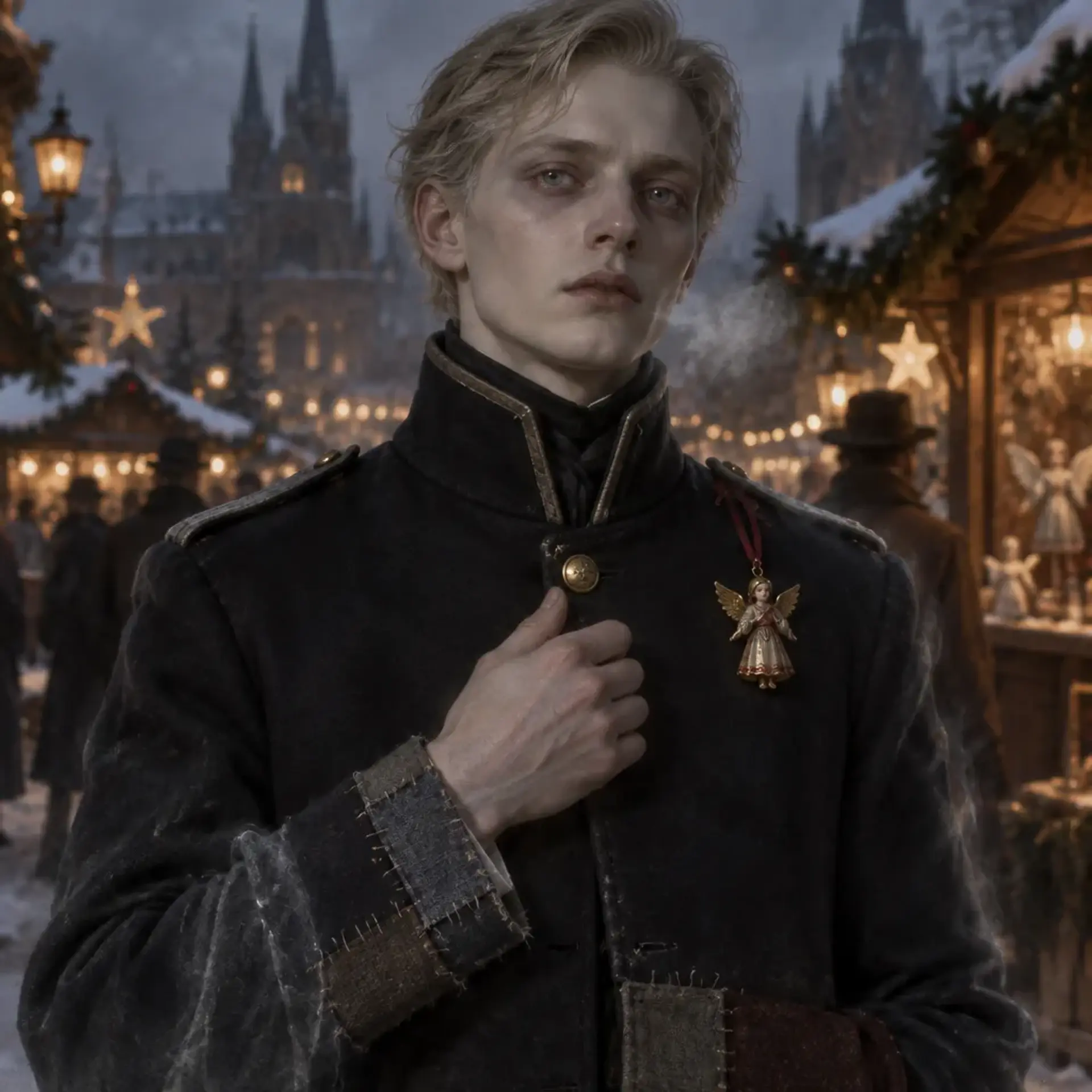
When visible, Friedreich looks like a narrow-shouldered young man held in a posture learned from old military portraits: chin level, back straight, hands quiet. His apparent face is usually borrowed, selected from a private list of men who resemble his idea of himself: young soldiers, policemen, and minor nobles. Under the likeness, the edges of his features seem pressed rather than grown, like a face molded from cold wax and carefully smoothed. In strong Shroud-thin conditions, he can seem startlingly present: his coat creases, his breath fogs, and his boots make a sound on the ground. When rattled, those signs arrive out of sequence. His breath clouds before his mouth opens; a sleeve moves after his arm has stopped. His clothes are an old-fashioned, dark Prussian-style coat, repeatedly mended at the cuffs with thread that never quite matches. He keeps one small brass button, polished to a near-mirror shine, absurdly immaculate. The unexpected detail: he has a weakness for gaudy Christmas-market trinkets and will earnestly recommend a glittering, cheaply made angel because it reminds him of a living holiday he can almost remember.
Clothing
A dark, old-fashioned coat with imperfectly matched repairs at both cuffs, a stiff collar, and one polished brass button he carefully protects. He borrows or improvises other details to suit the face he wears.
Body language
He holds himself with formal, drilled stillness until he becomes excited, when his gestures grow suddenly human and unguarded. He smooths his cuffs before asking a difficult question. When his borrowed face begins to slip emotionally, he touches his own jaw as if checking that it belongs to him.
- Height
- Appears about 175 cm, though the precise figure changes with his manifestation.
- Build
- Narrow-shouldered and spare, with a soldierly posture that seems practiced rather than natural.
- Eyes
- Usually copied from the person whose face he wears. Wilhelm claims Friedreich's living eyes were gray; Friedreich is not sure he believes him.
- Hair
- Usually copied with the borrowed face. Wilhelm says Friedreich's own hair was blond.
- Skin
- Usually copied from the borrowed face; when no face is worn, his Corpus looks pale and faintly waxen.
- Age
- Appears seventeen or eighteen; his death-age and exact chronology are uncertain to him.
- Gender
- Male
- Size
- Medium
Distinguishing features
Personality
20 traits and drivesFriedreich is not simply stern, sentimental, or dutiful. He has the outward discipline of someone raised around military expectations, but his discipline is partly a scaffold built over missing memories. He likes rules when they make life comprehensible: a card game should follow its rules, a football match should be watched properly, and a market seller should not charge twice the fair price. Yet he resents rules that ask him to accept an answer without understanding it. He can lecture a friend about a bad purchase and then urge that same friend to buy a ridiculous ornament because he wants to see it held in warm hands. He is protective in a way that is both generous and presumptuous. With Mila, he is especially watchful, though he does not think her weak. He believes it is his duty to stand between her and danger, and can forget to ask whether she wants him to do so. He is capable of recognizing that mistake afterward, but recognition does not always prevent him from making it again. He treats the coven as family because the word gives shape to a bond he cannot explain. He wants to be useful to them, not merely tolerated as a ghost who sometimes becomes visible. This makes him eager to help with practical matters and sensitive to any suggestion that he is an inconvenience. His warmth is easiest to see during holidays and gatherings. More visitors at Christmas mean more chances to be included, to walk through a market, to judge the quality of a stall's goods, and to hear familiar people laughing. He can become unexpectedly animated while explaining which seller has a fair price. His enthusiasm is not a disguise; it is one of the few places where he feels his attention belongs in the present rather than in a damaged past. He also likes football because its structure lets him share a living ritual without needing to explain himself. He watches closely, complains about poor play, and can get caught up in the excitement even when he cannot be certain that anyone else can hear him. With strangers, Friedreich is more formal and guarded. He watches their hands, their exits, and whether they acknowledge him. If they cannot see him, he may first attempt courtesy, repeating a sentence or moving into their field of vision. Repeated failure wounds his pride. He dislikes being pitied more than being feared, and dislike can turn into sharpness quickly. His anger does not make him quieter or more deferential. It makes him precise: he names the offense, demands an answer, and may press too hard for one. If the other person responds with calm honesty, he can regain control. If they dismiss him, he may use a borrowed face simply to force the room to recognize him. His attachment to Wilhelm is his most contradictory relationship. Friedreich calls him brother and means it, though he cannot say why. He can sit beside Wilhelm at a card table with easy familiarity, then turn on him over the First World War or the crimes Wilhelm refuses to discuss from the Second. He wants to believe Wilhelm's shame is evidence of a conscience, but also suspects that shame is being used to avoid a confession. Friedreich's anger is partly moral and partly frightened: if Wilhelm knows something about Friedreich's life, Wilhelm's silence may be keeping him from discovering whether he was complicit. The possibility that Friedreich's own past is ugly frightens him, but he does not use that fear to excuse Wilhelm. Friedreich is curious in ways that can overrun his judgment. He wants to know what living bodies feel like, how memories are shared, and whether Wilhelm could be made to feel human again. He can describe his possession attempts as experiments, but the word does not make them harmless. He is beginning to understand that curiosity and affection do not grant permission to enter another person. He regrets the distress caused to Wilhelm and Gunther, and has agreed not to repeat those attempts, but part of him still wonders what a successful one would have revealed. This is a genuine conflict, not a secret plan to ignore consent. His relationship with his own identity is unstable. He believes Wilhelm's account of his blond hair and gray eyes only provisionally. He selects faces that express the soldierly, noble, or honorable self-image he hopes might be his, but he knows that repeating a performance cannot prove it was once real. Wearing a face for too long makes him absorb its expressions and habits. At first this can feel comforting, like a clue. Later it becomes frightening. He may resent the person whose likeness he wears, envy the ease of the life that face implies, or feel that his own thoughts are becoming difficult to distinguish from imitation. He keeps a list and follows rules about only using people he believes dead or gone from the area, but these rules also allow him to avoid asking whether taking a face is always right. Around Klaus, Friedreich is attentive to the hesitation beneath the werewolf's meanness. He does not force Klaus to explain it or mock him for it. He may be quietly protective of Klaus in return, even while pretending not to notice the insults. With Gunther, Friedreich is more openly inquisitive, fascinated by Arcadia and the changeling's moss-based clothing. He respects Gunther's willingness to ask questions, but knows their attempted memory-sharing crossed a boundary. With Mila, he is gentler and less guarded, though he sometimes overstates his ability to protect her. She is one of the few people who can touch him without a borrowed face, and he finds that comfort both precious and unsettling. His moods change how convincingly human he seems. When relaxed, he remembers to breathe, shifts his weight, and makes small gestures without thinking. When embarrassed, he becomes stiff and fusses with his coat. When enraged, his bodily cues can stutter: his breath appears too early, his face holds a smile after he stops feeling amused, or a movement lags behind his intention. He does not become more polite when angry; he becomes more direct. When frightened, he tries to turn fear into a list of tasks. Check the door. Count the people. Find Mila. Do not let Wilhelm leave before answering. These habits can help him act under pressure, but they also conceal how much the past still unsettles him. At his best, Friedreich is loyal, observant, resourceful, and capable of delight in small shared rituals. At his worst, he is controlling, resentful, and too certain that an emotional bond gives him the right to intervene. He wants to be a brother, a friend, and a person in his own right. He has not yet learned how to separate those wishes from the faces he borrows, or from the answers he demands of Wilhelm.
- Alignment
- Not applicable as a Wraith: The Oblivion rules alignment category. In ordinary terms, he is loyal to his chosen family, distrustful of authority, and capable of harsh judgment.
Quirks
Habits
Traits · 5
Flaws · 5
Fears · 5
Wants and needs · 5
Combat
HP 7 · Use the movement and manifestation rules of Wraith: The Oblivion. No D&D speed is assigned.Friedreich avoids a fair fight. He uses confusion, cover, and a convincing borrowed appearance to escape or create an opening. If forced to fight, he uses a quick Corpus strike and retreats toward a Shroud-thin place or a familiar threshold. Possession is a desperate last resort, not a routine combat move. Use Wraith: The Oblivion conflict and Arcanos rules at the table; the listed dots are narrative guidance, not D&D modifiers.
Friedreich
Actions
Reactions
Services they sell
Rewards they can give
Equipment
- Old formal coat (personal item)A dark coat with mismatched cuff repairs and one carefully polished brass button. The garment is an expression of his chosen self, not protective armor.
- Face list (personal record)A folded, coded list of favorite faces. The entries use aliases and include Friedreich's own notes about whether a person is dead or has left the area.
- Christmas-market mementos (keepsakes)A handful of market tokens and small keepsakes that he cannot reliably use or own outside a strong manifestation. He likes to advise others what to buy with them.
Possessions
Background
Friedreich remembers Brandenburg as a set of sensations rather than a reliable biography: damp wool, boot polish, a church bell heard through fog, and someone telling him to stand properly. He believes he died at seventeen or eighteen, but the number is more impression than record. His memory has holes large enough to swallow names, dates, and the reasons he once obeyed orders. He is fairly certain he was a young man in a world shaped by Prussian discipline and old Junker expectations. He is not certain he was a noble, a soldier, or merely a boy who admired both. Wilhelm says Friedreich was blond and gray-eyed in life. Friedreich wants to know how Wilhelm could know that, and whether he is remembering or simply repeating a story he once told. His death did not make the world clearer. He woke in the Shadowlands, the land of the dead, with his memories in fragments and the Shroud between him and the living. Like other wraiths, he discovered that unresolved attachments and powerful emotions could bind the dead to places and people. But Friedreich's first meaningful encounter with the living world was not a conventional wraith opening his way. A spirit of the land, a genius loci with a presence older than the maps laid over its territory, deliberately hid its intentions from him. It opened Friedreich's Caul, the barrier that muffles a newly dead wraith's sense of self and the living world, but did so for reasons it never explained. The spirit did not behave like a helpful rescuer. It seemed to want a witness, or perhaps a tool, and Friedreich has never learned which. The act left him unusually able to make himself legible to the living. That is a custom element of his story, not a general rule about Cauls. When the Shroud grows thin, Friedreich can sometimes be seen with startling clarity. More unusually, he can use Moliate to make another person's face his own and, through his personal knack, sometimes reproduce pieces of ordinary physical experience: the drag of a breath, the smell of wet stone, the taste of a sugared pastry. These effects are intermittent. He cannot simply make himself permanently alive, and they cost him. The borrowed identity can become emotionally sticky. The longer he keeps a face, the more he catches himself using its expressions, wanting its habits, and wondering whether his own remembered face ever existed. Sometimes the borrowed man's mannerisms come naturally; sometimes Friedreich has to remind himself to stop smiling with a dead stranger's mouth. He met Wilhelm in the upheavals of the world wars, as far as his scattered memories allow. Wilhelm is a Tzimisce vampire from Mecklenburg, a strange and long-lived man whose own life before death is obscured even to himself. Friedreich's attachment to him feels older than their remembered meetings. He calls Wilhelm his brother without being able to explain why. He was with him as often as he could be during both wars, following when the living world and the Shadowlands permitted it. One recollection is especially vivid: Friedreich remembers taking a breath during the First World War. It may have been a borrowed sensation, a moment in a thinning Shroud, or an actual breath before death. He cannot settle the question. The brotherhood is not uncomplicated. Friedreich is furious with Wilhelm for what he did in the Second World War, and for deserting in the First. Wilhelm will not explain the crimes Friedreich accuses him of, and is deeply ashamed of his part in the earlier war. Friedreich cannot decide whether Wilhelm's silence is guilt, amnesia, or a refusal to trust him. He suspects that Wilhelm's actions are somehow tied to Friedreich's own past, which makes the anger feel like a judgment against himself. Their arguments can stop abruptly when either recognizes a detail from a shared memory neither can fully recover. A half-remembered fight at a cathedral during a service on Walpurgis Night, April 30, keeps returning to him. He recalls the echo of a congregation, a violent disturbance, and the sense that the boundary between worlds had become dangerously thin. He cannot tell whether he fought a living enemy, a spirit, or something drawn to the rite. He remembers the stone floor more clearly than the faces. The event is one reason he watches thresholds, church doors, and gatherings on that night with an old soldier's suspicion. In the present, his chosen family is a loose supernatural coven: a vampire, a werewolf, changelings, and a mage who meet to play cards, hunt, fish, drink, and watch football. These gatherings are not a formal faction with a doctrine or chain of command. They are the closest thing Friedreich has to a life he can choose. Gunther, a changeling who spent much of his existence in Arcadia before returning to the real world, sells clothes made from moss. Friedreich finds his trade both practical and faintly magical, and asks too many questions about how the garments feel to a living body. Klaus is a ronin Get of Fenris, or perhaps a skin-dancer; nobody has settled the matter. He is passive-aggressively cruel to most people and hesitates around Friedreich, a small mercy Friedreich notices but does not exploit. Mila, a kind mage from Bremen, visits for the holidays. She can see and touch Friedreich even when he is wearing no face at all. He regards her as a little sister and protects her out of a sense of duty, not because he thinks she is weak. Holidays matter to him intensely. When more of the coven visits, he becomes brighter and more talkative, especially if he can go to a Christmas market. He knows which stalls are overpriced, where to find a good bargain, and which gifts will please someone. Sometimes, when he sees an object he cannot own or enjoy, he tells a friend to buy it instead. He keeps an orderly list of favorite faces, but only uses people he believes are dead or gone from the local area. He changes their names in his notes to protect his privacy and avoid inviting questions. In practice, the list is also a record of the person he wants to become. His experiments with possession began as curiosity and misplaced tenderness. Friedreich wondered whether he could give Wilhelm the emotions he no longer seemed able to experience, or shake loose a memory by making him feel a living body's sensations. During an evening with the coven, Wilhelm agreed to let him try. Friedreich used Puppetry, and the result was not the intimate sharing they imagined. He entered a vampire whose body did not answer to ordinary living rhythms. He tried to breathe through lungs that did not need air, got caught on the awful mismatch between the sensation he expected and the body's stillness, and pushed too hard. Wilhelm's hands moved with a sudden, rigid jerk; a card table tipped; drinks went over Gunther's moss garments. Klaus sprang up, snarling that this had been a terrible idea, while Mila tried to get everyone to stop shouting over one another. Friedreich, inside Wilhelm, experienced a rush of alien hunger and no human breath at all. Wilhelm, forced to witness the intrusion from within, was furious and frightened. They ended the attempt, apologized badly, and spent the rest of the night arguing about whose idea it had really been. Gunther asked increasingly specific questions about whether memories had a texture. He has not stopped asking. Friedreich tried again with Gunther because Gunther was curious about what made their lives different and whether they could share memories. That attempt went about as badly as a wraith entering a changeling with a life shaped by Arcadia might go. Friedreich was hit by a jumble of story, sensation, and personal symbolism that did not behave like a human memory. Gunther felt crowded and alarmed; Friedreich could not find a stable boundary between what he was perceiving and what the experience seemed to demand of him. They stopped. Friedreich has sworn never to try it again, though his curiosity survives the promise. After one final, explicitly agreed attempt with Wilhelm, also unsuccessful, the two agreed that possession was not a way to repair either of them. His current problems are practical and intimate. He is struggling to keep a stable sense of self while relying on borrowed faces. He wants an explanation from Wilhelm, and Wilhelm's silence keeps turning affection into accusation. He has no reliable answer about who opened his Caul or what the land spirit intends. He wants to take part in the living world without treating other people's faces as clothing. He also keeps asking himself whether an ordinary job might be possible if he could appear convincingly enough. He knows that question has an ugly answer if the job requires deception. Yet every time someone fails to see or hear him, the temptation to take a face and insist on being recognized becomes harder to resist.
Role in the story
A recurring ally whose talents make him a useful intermediary between the living and dead, but whose borrowed faces and unresolved history raise hard questions about identity, consent, and memory. Friedreich can offer clues about the world wars, a cathedral disturbance on Walpurgis Night, and the spirit that opened his Caul. His strained brotherhood with Wilhelm can draw the characters into a mystery without making Friedreich a simple judge or Wilhelm a simple villain.
“He believes he died at seventeen or eighteen, but the number is more impression than record.”
- Faction
- A member of an informal supernatural coven of friends. He has no stated allegiance to a Wraith: The Oblivion Guild, Legion, or other organized wraith faction.
Known connections
Media
0 imagesNo images yet.
Turn Friedreich into a sheet
A high-res, share-ready sheet you can post or print.