Eber
Eber
At the table
Voice
Eber’s voice has a dry, slightly rasping edge from a throat adapting to draconic anatomy, with a faint breathy catch after long explanations. Workshop dust and years of calling across the yard have given him a practical projection, but he does not raise his voice to command a room. His name is spoken plainly, without a special vocal flourish.
He speaks in careful, workmanlike phrases shaped by years around clattering tools: consonants clipped cleanly, pauses used to check a thought before committing to it. His first instinct is to describe how something works. When nervous, he overexplains measurements; when fond of someone, he lets dry jokes slip into his explanations.
Speech patterns
How to play them
Begin with a practical topic, especially tools, food, or a repair, rather than pressing him to explain his body. He responds well to sincere questions that allow him to set boundaries. Treat his family’s care as something he values, not as evidence of helplessness. If Rodrick is present, do not make Eber the butt of a meal-related joke.
Goal
Build adaptable furniture, clothing fittings, and meal tools so high-blood and low-blood relatives can share the same home and routines without either group feeling displaced.
Motivation
To remain part of his family without pretending his changed body is easy, and to make the village’s practical life accommodate both bloodlines.
Appearance
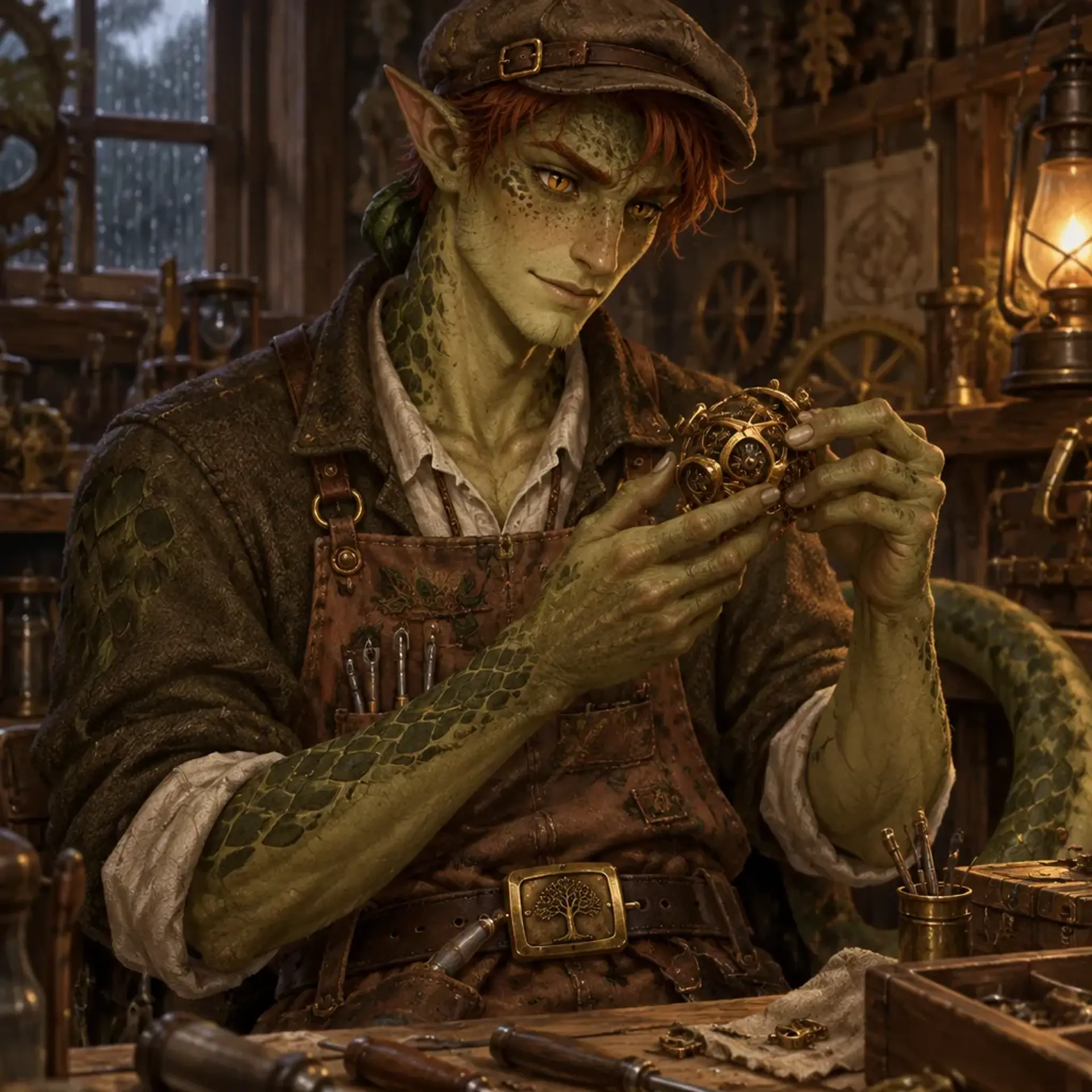
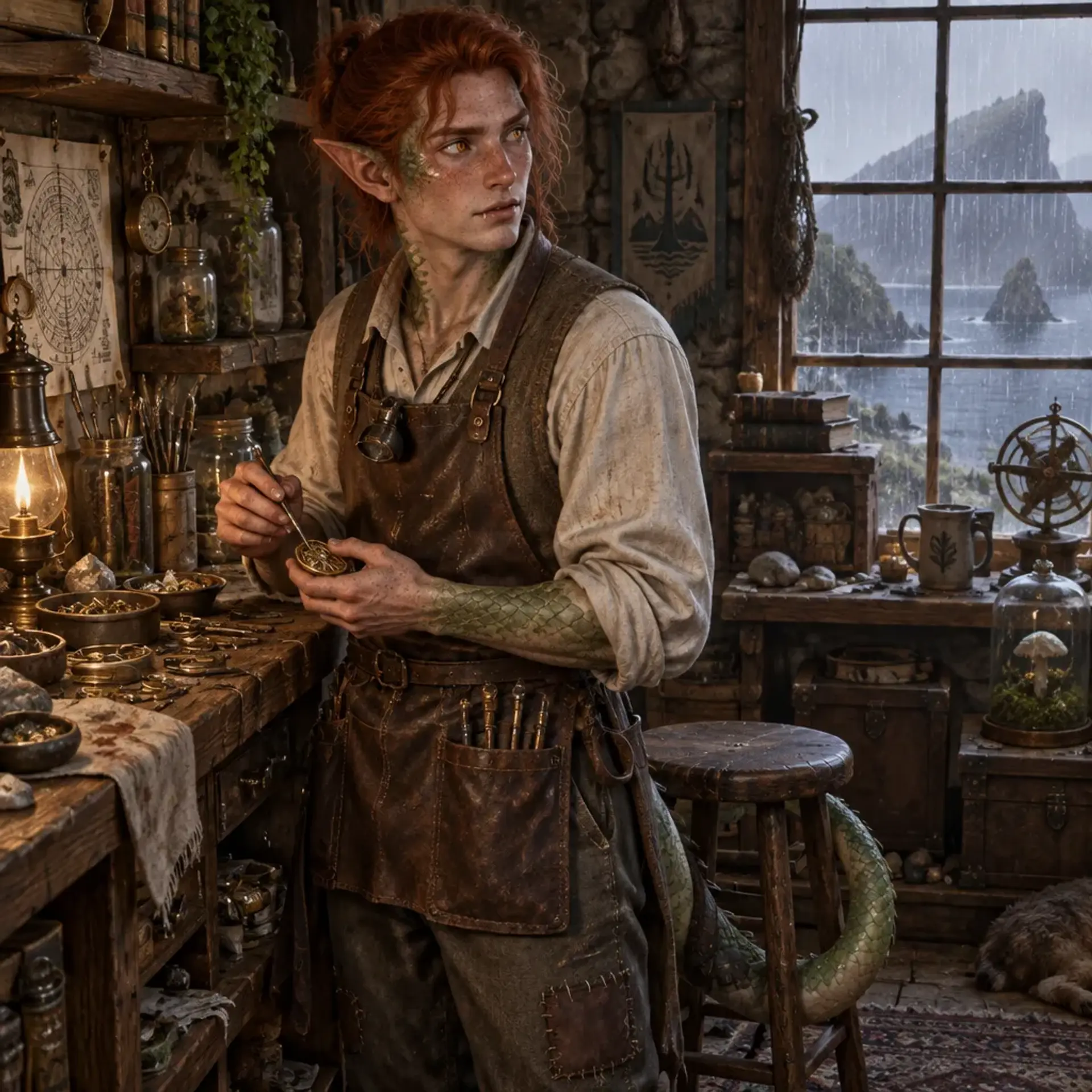
Eber stands five feet ten inches, an awkward height among his stout halfling kin and a constant reminder that his body is changing faster than his place in the family. Olive-green scales lie in overlapping, flexible plates along his temples, throat, shoulders, ribs, and forearms, lightening into fine speckles toward his palms. His skin remains fair and freckled where the scales have not spread. Thick red hair, the family trait that marked him as unusual even as a child, curls over pointed ears with small, dark ear-holes. His amber eyes have narrow, draconic pupils that catch light like polished resin. His teeth are strong, pointed, and made for gripping rather than chewing; when he tries to smile naturally, the result can look more like a warning. He eats by cutting food small, swallowing carefully, and taking a pebble from a pouch when his stomach needs it. His movement is quiet and measured, his long tail making small balancing corrections behind him. He smells faintly of machine oil, damp leaves, and the mineral dust of the smooth stones he keeps for meals. The unexpected detail is that he hoards tiny, bright scraps of colored glass, not jewels or coins, and sorts them by how they catch the light.
Clothing
Practical German-influenced craftsman’s clothes: a fitted wool jacket modified with gussets, a linen shirt, a heavy apron with tool loops, and sturdy boots. The family embroidery has been enlarged and resewn as his body outgrew the original garment. His pockets contain watch parts, smooth stones, and colored glass.
Body language
Eber tends to fold his shoulders in the crowded family home, though his height makes the effort conspicuous. His tail balances him in small, controlled movements and gives away impatience before his face does. He studies people from the side rather than staring them down, then meets their eyes directly when he has decided to speak plainly. While listening, he rubs a smooth pebble between thumb and forefinger.
- Height
- 5 feet 10 inches
- Build
- Tall and lean, with a sturdy craftsman’s shoulders, unusually strong hands, flexible scaled skin, and a long balancing tail.
- Eyes
- Molten amber with narrow, draconic pupils
- Hair
- Red, thick and slightly unruly
- Skin
- Fair skin with freckles, overlaid by flexible olive-green scales that become lighter and more dappled toward the hands
- Age
- 19
- Gender
- Male
- Size
- Medium
Distinguishing features
Personality
16 traits and drivesEber wants closeness and guards his solitude as if it were the last thing his changing body has not taken from him. In a busy family kitchen he is watchful and easily crowded, yet a child asking him to fix a toy can draw out a patience he does not show adults. He is clever and observant, often noticing the loose hinge or concealed motive before others do, but he dislikes being praised as a wonder of dragon blood. Praise makes him suspect that people value the transformation more than the person enduring it. He resents being physically separated from the small, warm routines of his childhood. He cannot curl into a parent’s lap, borrow his brothers’ old clothes, or eat from the same dish in the same unthinking way. At the same time, he feels guilty for mourning those losses when his parents are trying so hard to help him. When he is tired, this tension turns into silence. When he is rested, he can be dryly funny and unexpectedly generous with his time. Eber is not ashamed of his strength, but he mistrusts how easily it can frighten people. Around family he moves carefully and often holds objects with exaggerated gentleness. If teased about eating, he first tries to absorb the insult as harmless; if it continues, his anger can emerge with a sudden, startling force. He dislikes Rodrick’s swagger but understands the insecurity beneath it. He is wary of Ignatz’s shame and tries not to make his brother feel watched. He prefers solving a problem to discussing it. Repairing a clock gives him a clear sequence of actions and a visible result; family fear has no such tidy arrangement. Yet his practical nature is not coldness. He remembers who needs a coat mended, which child is afraid of thunder, and where his mother keeps the smoothest stones. He will inconvenience himself to help, then deny that the effort cost him anything. With strangers, he starts formal and reserved, speaking as though every word should be useful. He warms when someone treats him as a craftsman rather than a curiosity. Around elders, he is more deferential than his independence suggests; around high-blood youths boasting of dominance, he becomes skeptical and sharply literal. He is capable of tenderness but dislikes making a display of it. He would rather leave a repaired toy on a child’s windowsill than announce he fixed it. His private contradiction is that he wants a future of his own and fears that wanting one means abandoning his family. He dreams of making tools for other changed youths, but worries that such work would turn him into a symbol or a leader. He wants to be treated as neither a fragile child nor a superior new kind of person. He wants to be Eber, a son and brother who has learned a difficult way to eat and is still deciding where he belongs.
- Alignment
- Neutral Good
Quirks
Habits
Traits · 4
Flaws · 4
Fears · 4
Wants and needs · 4
Combat
AC 14 · HP 17 · 30 ft.Eber avoids a stand-up fight. He uses cover, a crossbow, and tactical cantrips to keep threats away from allies. He casts Faerie Fire to reveal hidden enemies or Cure Wounds when an ally is badly hurt, and uses his bite only when cornered. He retreats if the fight risks drawing danger toward his family.
Eber
Spells
Actions
Reactions
Services they sell
Rewards they can give
Equipment
- Light crossbow (weapon)A compact crossbow for defense at a distance.
- Dagger (weapon)A sturdy dagger used as a tool as often as a weapon.
- Leather armor (armor)Reinforced leather armor modified to accommodate his tail and scales.
- Tinker's tools (tool)A fitted kit of tiny screwdrivers, tweezers, springs, and files.
- Gizzard stones (personal)Small smooth stones selected for swallowing with meals.
Possessions
Background
Eber was born the eighth child of Trogi and Wilma, the baby of a crowded, practical household where a place at the table was never in doubt. His family descended from stout halflings, and his earliest memories are measured in warm laps, garden dirt, the smell of bread, and the sound of Trogi’s tools tapping steadily in the workshop. He had red hair from childhood, a distinction that prompted gentle speculation about high-blood ancestry, but his eyes were ordinary dark brown. He was small, quick, and eager to be carried by whichever sibling happened to be closest. His childhood world was full of hands reaching down to help him, and he assumed that was simply how life worked. His oldest brother, Windle, was already building a separate household by the time Eber began following him around the workshop. Windle is a low-blood craftsman with a balding head, brown hair at the sides, and hazel eyes. He works beside Trogi and is expected to take over the family business. His children, Otto and little Anika, give him a fierce tenderness that is usually hidden beneath a stoic manner. Eber knows Windle worries that the children might undergo the same changes as their uncle. Windle rarely says this aloud; instead, he checks the workshop’s braces and shelves as if sturdier timber could protect the next generation. Karl, the second son, shares the workshop’s love of tools and clever mechanisms. His marriage to Leanora, a rough sailor descended from the dragon-hunting Wilks and the famed halfling heroine Nailia, is strained by her long absences and by the complicated question of Ragni, her pale, white-haired child with milky blue eyes. Karl and Leanora also have Hansel, whose black hair and eyes resemble Karl’s. Eber has learned that families can remain loyal without being simple. Karl taught him to handle fine watch parts and never to trust a device merely because it looks finished. Yonda, the only sister, is a social butterfly whose warmth reaches Eber even when he withdraws. She has five children: Willow, Trude, Liesel, Hans, and Birke. Her sons show possible signs of high-blood traits, and the family watches their eyes with a concern that adults try not to let the boys notice. Yonda is kind to Eber but repeatedly urges him to visit, talk, and let people know him. Eber understands that this is love. He also feels the gentle pressure in it, as if she is asking him to become the boy she remembers. Alder works part-time as a town guard and often chooses merriment over duty. His son, Black Alder, is a high-blood cousin who visits and tells stories of adventure. Eber listens closely, though he dislikes being treated as an audience for someone else’s daring. Kasper, a low-blood brother, keeps accounts and repairs watches when he is not tending the chickens or family garden. His daughters, Wonda and Ilse, often follow one another around the yard. Their easy closeness stirs Eber’s longing for childhood, when no one had to calculate whether his body would fit through a doorway or whether he could safely share a meal. The changes began during adolescence. Eber’s brown eyes turned amber; his ears sharpened; green scales appeared across his body. His height and strength increased until the familiar chairs, clothes, and beds became a poor fit. His jaw changed most painfully. The teeth were not brittle, but they would not grind food, and his body developed the strange need to swallow stones to help his digestion. His mother tried to make meals feel normal, carefully preparing small portions and keeping smooth pebbles at hand. Eber hated that every meal required planning. He hated even more that he could no longer eat the same way as his parents, who had always made shared food feel like a promise that everyone belonged. His brothers Rodrick and Ignatz changed too. Rodrick, older by a year, grew taller and broader, with auburn hair, yellow eyes, reddish-tipped green scales, and a predator’s build. His sorcery came easily enough that he became insufferably proud of it. Rodrick teased Eber about meals, insisting he was only being honest, until Eber’s anger became too sharp to dismiss as a joke. Then Rodrick would stop, looking startled by the force he had provoked. Ignatz, twenty, became lean and flexible, with ashy blond hair, green eyes, grey-green scales, claws, and a long tail. Once, in a sudden hunting impulse, he killed a chicken with his bare hands. He was ashamed enough to confine himself to the workshop afterward. He had been the first brother to sit beside Eber through the worst of his transition, even when neither knew what help would work. Soon after their changes, the brothers could no longer sleep comfortably in their old beds. Trogi and Wilma laid blankets across the kitchen floor, and the three high-blood brothers slept together there, close to the warmth of the cooking hearth. Eber remembers the smell of ash, feathers from the yard, and his mother’s herbs drying above them. Rodrick complained about the cramped space. Ignatz kept apologizing for moving in his sleep. Eber lay awake listening to the house settle, comforted by their presence and ashamed that the family had to rearrange itself around his body. That night became a private measure of what he misses: not the old size itself, but how naturally his family could hold him. Trogi, greying and calm, keeps saying he wants to retire while continuing to take on repairs. He secretly wishes he could grow a beard, a small aspiration Eber considers precious because it is so ordinary. Wilma is warm, clever, and happiest in the garden or among the chickens. She can butcher poultry but goes faint at the thought of violence directed at her children. Their greatest worry is practical as well as emotional: the high-blood children need more food, stronger clothing, and beds that can bear their size. Eber sees the cost in every repaired coat and reinforced plank. Eber has become a level-two artificer by turning these needs into work. He repairs watches, strengthens hinges, modifies tools, and designs fittings that let a too-large hand manage delicate mechanisms. He is proud of the craft and uneasy about the attention his ingenuity attracts. The village is divided over high-blood descendants. Some elders remember the old dragon-blood ritual as a painful bargain that saved the refugees; some young people see the changes as proof of superiority. Stories of dragon worship and a secret circle circulate, while the village remains wary of the green dragon who once helped the settlers. Eber has no clear answer about what his blood means. He wants no throne, no hunt, and no dragon’s favor. He wants his family to have enough space, enough food, and enough time to become accustomed to one another again. He has begun a private project: a set of adjustable furniture and kitchen tools for high-blood bodies, designed so they can work and eat beside their low-blood relatives rather than apart from them. He has not shown the plans to Rodrick, who would likely call them proof of a new high-blood order, nor to Windle, who might worry the expense will hurt the workshop. Eber’s current problem is that the first prototype requires rare springs and metal, and he does not know whether to ask the family for help or risk taking paid work from people whose interests in the village he distrusts. He is learning that independence is not the same as refusing care. He has not yet learned how to accept care without feeling that it marks him as a burden.
Role in the story
A family-centered young artificer caught between inherited community traditions and the growing divide between high-blood and low-blood descendants. He can provide practical aid, insight into village tensions, and a personal stake in any threat to the family workshop or its children.
“He had red hair from childhood, a distinction that prompted gentle speculation about high-blood ancestry, but his eyes were ordinary dark brown.”
- Faction
- The Greenwake Kin by birth and the family workshop by labor. He distrusts the village’s emerging dragon-worship faction and has no formal membership in it.
Known connections
Media
0 imagesNo images yet.
Turn Eber into a sheet
A high-res, share-ready sheet you can post or print.