Eber
Eber
At the table
“I can fix that”
Voice
Eber's voice has a dry, slightly rasped edge from workshop dust and the effort of speaking over hammers and gears. Its texture is grounded and unshowy, with occasional roughness when he has been working for hours. He clips explanations into clear steps, but his humor emerges in a low, matter-of-fact cadence. When angry, he becomes sharper and more emphatic rather than quieter or more polite.
His words are measured and practical, shaped by years of workshop noise and the habit of making himself understood over clattering tools. He tends to give exact descriptions, then add a wry aside once he knows someone is listening in good faith. He sometimes pauses before speaking about food, family, or his changed body, not from embarrassment alone but because he is choosing how much explanation the moment deserves.
Speech patterns
How to play them
Begin with practical matters: a repair, a meal, or a question about the island. Give Eber time to assess whether a stranger is safe before asking about his body or family. Respect his careful eating and do not treat his stones as a joke. He becomes more forthcoming when someone treats his work seriously or shows consideration for his siblings. If pressed about loneliness, he may retreat at first, then offer a small, concrete truth.
Goal
Create practical tools and household adaptations that let high-blood Marshwake live safely and comfortably without having to leave their families or deny what they have become.
Motivation
To prove, first to himself and then to his family, that a changed body can still belong to a loving household and a useful craft.
Appearance
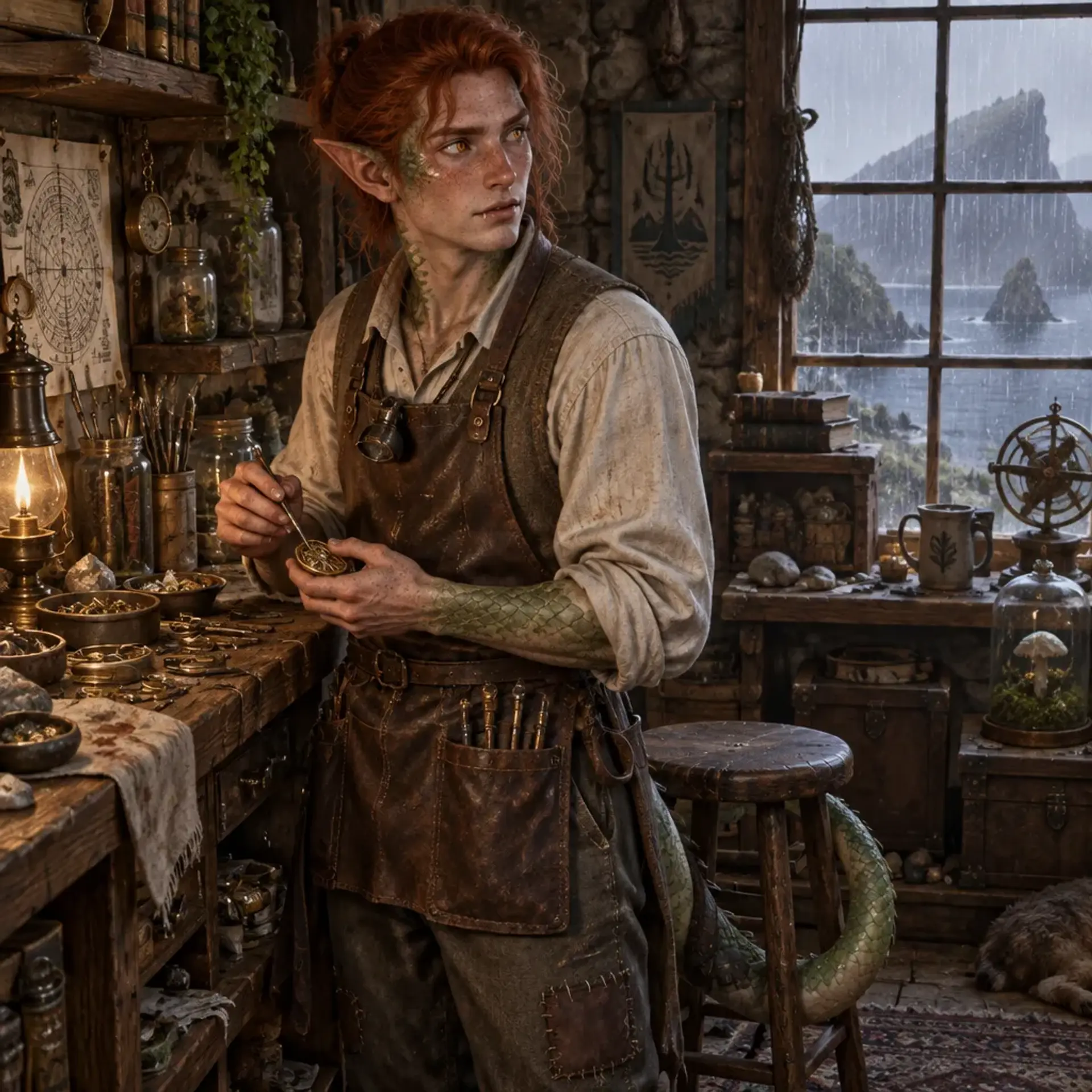
Eber is five feet ten inches tall, startlingly large beside his stout halfling parents and most of the family workshop's benches. Fair skin is freckled across his nose and shoulders, interrupted by flexible green scales that gather in overlapping, leaf-veined patches along his temples, jaw, forearms, ribs, and the length of his tail. The scales are soft-edged rather than armor-hard, with darker green dappling near the joints and a wet-glass sheen after rain. His pointed ears angle back when he concentrates. His molted amber eyes have narrow pupils that catch movement even when he seems not to be looking. His red hair, the one conspicuous feature he has had since childhood, is usually tied away from his face with a scrap of leather. His tail moves with the thoughtful precision of a hand hovering over a tool: it curls around a stool leg when he is anxious and goes still when he is listening. He has a long, flexible neck and a careful, slightly sideways way of turning his head, as if taking in a room from the cover of a tree. He occupies more space than he intends to, and when he remembers, he draws his elbows in and folds his tail close. The unexpected detail is that he keeps a tiny, meticulously groomed garden of moss and pale fungus in a shallow tin beneath his workbench, tending it with the tenderness of a person caring for something much smaller than himself.
Clothing
German-influenced halfling work clothes adapted badly but lovingly for a taller body: sturdy wool trousers, a linen shirt, a leather apron with oversized pockets, and a short fitted vest with hand-replaced buttons. The sleeves and hems have been extended with mismatched cloth. His apron is carefully oiled and neatly patched, the one item he maintains as if it were a prized instrument. He leaves room for his tail with a rough slit at the back.
Body language
Eber tries to fold himself smaller in rooms designed for halflings, but his height, tail, and shoulders keep making that effort conspicuous. His tail curls around furniture when he is uneasy and straightens when he feels cornered. He turns his head slightly to listen, fixes his amber eyes on whoever is speaking, and often studies a person's hands when they discuss a tool or a problem. When comfortable, he leans against a bench and lets his shoulders loosen; when ashamed, he becomes very still.
- Height
- 5 feet 10 inches
- Build
- Tall and lean, with a craftsman's strength in the shoulders and forearms, flexible joints, and a long, muscular tail. His frame is imposing beside his stout halfling relatives, though he moves with deliberate care in their small home.
- Eyes
- Molted amber with narrow draconic pupils
- Hair
- Red
- Skin
- Fair, freckled skin with flexible green scales and a faint green cast around the scaled areas
- Age
- 19
- Gender
- Male
- Size
- Medium
Distinguishing features
Personality
20 traits and drivesEber is both hungry for closeness and frightened by the ways his body makes closeness complicated. At home he can be quietly affectionate, accepting a bowl from Wilma or standing shoulder to shoulder with Ignatz at a bench, but he bristles if anyone acts as though he is still a child who can be managed. He wants Yonda to invite him into family gatherings and then sometimes declines because the dining room is cramped, the meal requires explanation, or he expects to feel watched. He is not ashamed of needing stones to digest food, exactly; he is tired of having to make an ordinary meal into a lesson. He is clever, patient, and unusually good at noticing how separate parts affect one another. In the workshop, his attention is almost generous: he will spend an hour finding why a watch loses time, then explain the failure without making its owner feel foolish. That same attention becomes uncomfortable when directed at people. He notices a pause, a tightened jaw, or a glance at his tail, and can assume he has found the hidden judgment behind it. Sometimes he has. Sometimes he is protecting himself from a kindness he does not know how to receive. Eber's manners change with his mood. When content, he asks detailed questions and makes dry jokes, especially about his height or a piece of equipment that refuses to cooperate. When anxious, he gets quiet in the sense of becoming economical with words, not soft: he answers directly, keeps his eyes on the task, and may arrange objects into careful rows. When angry, he is not genteel. His voice grows rough with effort, his tail goes rigid, and his amber eyes stay fixed on the person who crossed a line. He dislikes that his anger can frighten people and dislikes even more being told that this makes him responsible for every careless remark made to him. He is neither naturally solitary nor naturally sociable. As a child he followed the household's movement from one room to another, content to be included without being the center of attention. Since his changes, he has found that being with people often requires managing his size, his tail, his appetite, and other people's reactions. Solitude is easier, but too much of it leaves him watching the family through doorways, wishing someone would notice that he is waiting. He does not always know how to cross the distance himself. His affection tends to become labor. He repairs a loose hinge, makes a stronger latch for a child's toy chest, or quietly leaves cleaned stones by the bowl of a high-blood cousin who is embarrassed to ask. When someone thanks him, he may wave it away and then remember the gratitude for days. He admires his parents' endurance and resents that they cannot solve the problems his body presents. He loves his siblings and sometimes envies their ability to occupy the family home without measuring every doorway. Eber is attracted to beauty that can be held: polished metal, glass, unusual stones, the brass face of a watch, and bright things caught in rain. He tells himself that these are materials for his craft. That is often true, but not always. He dislikes the suggestion that the habit is a draconic inheritance, because it makes an ordinary pleasure feel like evidence against his own independence. The possibility that his new instincts may be real troubles him more than the instincts themselves. He wants to understand them rather than deny them, but he fears what understanding might require. With strangers, he is reserved but not unfriendly. He offers a useful answer, listens for the other person's purpose, and watches whether they treat his family with respect. He has little patience for mockery disguised as curiosity. He can be unexpectedly warm toward children, animals, and anyone embarrassed by a limitation they did not choose. He also has a stubborn streak: once he believes a problem is his to solve, he may keep working long after he should rest, refusing help because accepting it feels too much like admitting that he has become a burden. Eber's central conflict is not whether he is halfling or draconic, but whether he can live without turning that question into a verdict. He wants the intimate, familiar life his parents have built, yet he is becoming someone who needs more space, more food, larger clothes, and a different kind of care. He can feel the pull of a clever, solitary, watchful inheritance and still choose to be a brother, son, uncle, and craftsman. He is trying to learn that choosing connection does not require pretending the distance is gone.
- Alignment
- Neutral Good. Eber wants to protect his family and make a place for himself, but his instinct to withdraw can make kindness look like indifference.
Quirks
Habits
Traits · 5
Flaws · 5
Fears · 5
Wants and needs · 5
Combat
AC 15 · HP 17 · 30 feetEber avoids a fair fight. He uses Faerie Fire to expose hidden threats, Grease to disrupt a charge, and his crossbow from behind cover. He spends Cure Wounds to keep an ally standing rather than to extend a fight. If his family is threatened, he may use Draconic Menace to create an opening, then withdraw while an ally or the terrain separates the attackers. He has no Extra Attack, infusions do not grant him extra actions, and he is not a trained frontline warrior.
Eber
Spells
Actions
Reactions
Services they sell
Rewards they can give
Equipment
- Light crossbow (weapon)A plain weapon for measured ranged attacks. Eber maintains its string and fittings with workshop care.
- Dagger (weapon)A compact utility blade, kept sharp for cord, leather, and emergency defense.
- Tinker's tools (tools)Includes small files, punches, pliers, a loupe, and carefully wrapped parts for repairs and artificer work.
- Thieves' tools (tools)A practical set used for locks and small mechanisms, most often for repairs rather than theft.
- Work apron and digestive kit (personal gear)A patched leather apron with pockets, a set of smooth gizzard stones, and a tin of clean metal fragments.
- Explorer's pack (adventuring gear)Usually a modest supply of bandages, dried food, chalk, and spare fasteners. Exact contents vary with family needs.
Possessions
Background
Eber was the eighth child of Trogi and Wilma, the little one who could be passed from lap to lap while his older siblings argued over tools and chores. His family is of stout halfling descent, and the workshop, garden, chicken yard, and crowded house were built around the habits of people who expected to remain small, close, and together. As a child, Eber had the red hair that some Marshwake families whisper marks a strong inheritance, but his eyes were dark brown, his face round, and his hands always reaching for someone else's sleeve. He was the baby. His mother could find him by the sound of his feet in the house; his father could tell which of the workshop's drawers he had opened by the way the tools had been put back. The family lived by making useful things and repairing what the islands made difficult to replace. Trogi, a calm low-blood patriarch whose black hair has turned grey, kept the workshop running and claimed every season that he would soon retire. Wilma, warm and clever, preferred her garden and chickens to the clatter of the shop, though she could read a person's mood before most of her children could read a dial. They fished together at a nearby stream. Trogi secretly wanted a beard after seeing one on a traveler, a wish Eber found funny and strangely comforting: his father still had ordinary wants, even with eight children and a household that never stopped needing him. Eber grew up surrounded by distinct older siblings. Windle, the eldest, was already building a life of his own, working in the shop and preparing to inherit its responsibilities. He is a low-blood with hazel eyes, a balding head, and a stoic way of hiding worry. His young son Otto and baby daughter Anika made Eber an uncle before he understood what being grown meant. Karl, the second eldest, loved gears and tools, though his marriage to Leanora, a sailor descended from the famous dragon hunters Wilks and Nailia, was roughened by long absences and old grievances. Their son Hansel grew up beside Ragni, a child of Leanora's from outside the marriage, whose pale hair, strange purplish skin, and milky-blue eyes made the family's complicated affection visible to everyone. Eber learned early that kinship was not always tidy, and that love did not guarantee ease. Yonda, his only sister, was beloved for her beauty and her ease with people. She had five children and a gift for making a room open around her. She loved Eber and tried, gently and persistently, to draw him into company. Her sons Hans and Birke began to show signs of high blood: vivid green eyes in one, hazel eyes that shifted yellow in the light in the other. Her daughters Willow, Trude, and Liesel each carried their own family likeness. Eber was fond of all of them, but his affection often came out as quiet practical help, such as tightening a toy wheel or holding a child steady while Yonda tied a shoe. Alder, a low-blood part-time town guard, had a talent for merriment and an inconvenient tendency to be busy when sensible work needed doing. His son, Black Alder, was a high-blood young man with amber serpent eyes and green scales, a cousin whose visits brought stories of adventure and the possibility that a changed body might still belong in the wider world. Kasper, the family watch repairer, was content with his wife and two daughters, Wonda and Ilse, and with the garden and chickens that gave him a reason to leave the bench. Eber admired Kasper's precise work and often watched him coax a stubborn watch back to life. The first high-blood changes in the household belonged to Rodrick and Ignatz. Rodrick, auburn-haired and yellow-eyed, grew bigger than Eber and developed a predator's build, reddish-tipped green scales, and sorcery from his green-dragon inheritance. He could be blunt to the point of cruelty, especially when teasing Eber about food, and could not understand why honesty did not excuse the hurt it caused. Ignatz, ashy blond, flexible, and increasingly scaled, was Eber's closest brother. He had once believed he would be the best of the high-blood children. Then, during a sudden hunting urge, he killed a chicken with his bare hands. He was ashamed, and afterward stayed close to the workshop, where tools gave his hands a safer purpose. When Eber began to change, Ignatz stayed with him even when he did not know what to say. Eber's adolescence began with pain in his jaw and a slow, frightening alteration of his mouth. His teeth sharpened and shifted, but they were not brittle; they simply could not grind food as a halfling's teeth should. A meal he once ate without thinking became an ordeal. He tried to hide it, swallowing too quickly and making himself ill, until the family realized that he was losing weight and avoiding the table. The discovery that small stones and bits of metal could aid digestion came after a miserable night and a careful examination by a local healer. His body needed a gizzard-like second stomach. He had to learn how to choose smooth, clean stones, swallow them safely, and approach food in measured portions. The stones were not a cure. They were a daily reminder that his body had become something his parents could not fully understand from experience. The night after the change became impossible to pretend away, the high-blood brothers slept together in the kitchen. There were not enough beds, and the old bedrooms could not comfortably fit their new bodies. Rodrick stretched out with arrogant sprawl and made an unkind joke about Eber's cautious supper. He stopped when Eber's anger flashed hard enough to make the room feel too small. Ignatz lay near the hearth, rigid and alert, ready to help without knowing whether help meant a blanket, water, or simply staying awake. Eber's tail kept knocking a chair leg until Rodrick shifted the chair aside without comment. Their parents sat nearby, pretending to sort linens while listening to each breath. In the morning Wilma made broth, Trogi altered a work apron into a loose sleeping wrap, and none of them said that the kitchen had become a bedroom because their sons no longer fit in their own. That night changed Eber. Before it, he assumed that growing older meant gradually becoming more capable of doing what everyone else did. Afterward, he understood that his body would not return to the family's old scale of living. He was too tall for the low doorways, too strong for some delicate fittings, and too different to share meals without preparation. His parents still offered the familiar warmth of a hand on his shoulder or a place at the table, but he could feel the distance his blood had placed between their bodies. He hated that distance and hated himself for sometimes wanting to be left alone. He turned to craft because it was a language the family already shared. He learned to repair watches and small mechanisms from Kasper, to carry materials and measure joints in the workshop, and to adapt tools that had been designed for smaller hands. His mind sharpened as his body changed. He began to notice patterns in the way the island's damp air corroded hinges, how volcanic grit wore down gears, and how a small spring could store more force than its size suggested. As an apprentice artificer, he now uses simple magic through tools, formulae, and careful preparation. He is only beginning to understand what his talent might become. His family remains his world, even when he avoids sitting in the middle of it. Windle worries that his own children may develop high-blood traits. Yonda wants him to be more social, not because she thinks he is broken but because she fears the household will lose him to solitude. Rodrick wants opportunities beyond the workshop and needles Eber partly from arrogance, partly from envy that Eber's quiet competence earns trust. Ignatz supports him with small, wordless acts: leaving smooth stones beside his bowl, moving a tool to the correct height, or keeping watch when Eber has eaten poorly. Trogi and Wilma worry about beds, clothes, food, and the health of their high-blood children in a community whose houses were not built for them. Their love is abundant, but it cannot manufacture space or provisions from nothing. Now Eber is trying to solve practical problems before they become family crises. He wants to design adjustable workstations, stronger household fittings, and a way to make high-blood meals safer and more affordable. He also wants a future that does not require him to choose between being a craftsman and being a son. He collects bright metal scraps and polished stones, ostensibly for experiments, though he likes their gleam more than he admits. His inherited solitude and attraction to shiny things unsettle him: he fears that a dragon's instincts are quietly making decisions on his behalf. The island itself is changing, and the Marshwake are still learning whether their draconic inheritance is merely a legacy or something that might claim them. Eber has no grand theory. He has a crowded kitchen, a family that keeps making room, and a mind that wants to build a better answer.
Role in the story
A young craftsman and family-centered NPC who illustrates the practical and emotional costs of Marshwake transformation. He can provide repairs, insight into high-blood needs, and a personal stake in stories about the island's draconic inheritance. His family gives him a network of allies, worries, and conflicts that can draw the party into community-scale problems.
“The family lived by making useful things and repairing what the islands made difficult to replace.”
- Faction
- The Marshwake community and the family workshop. He has no formal position in a larger faction.
Known connections
Media
0 imagesNo images yet.
Turn Eber into a sheet
A high-res, share-ready sheet you can post or print.