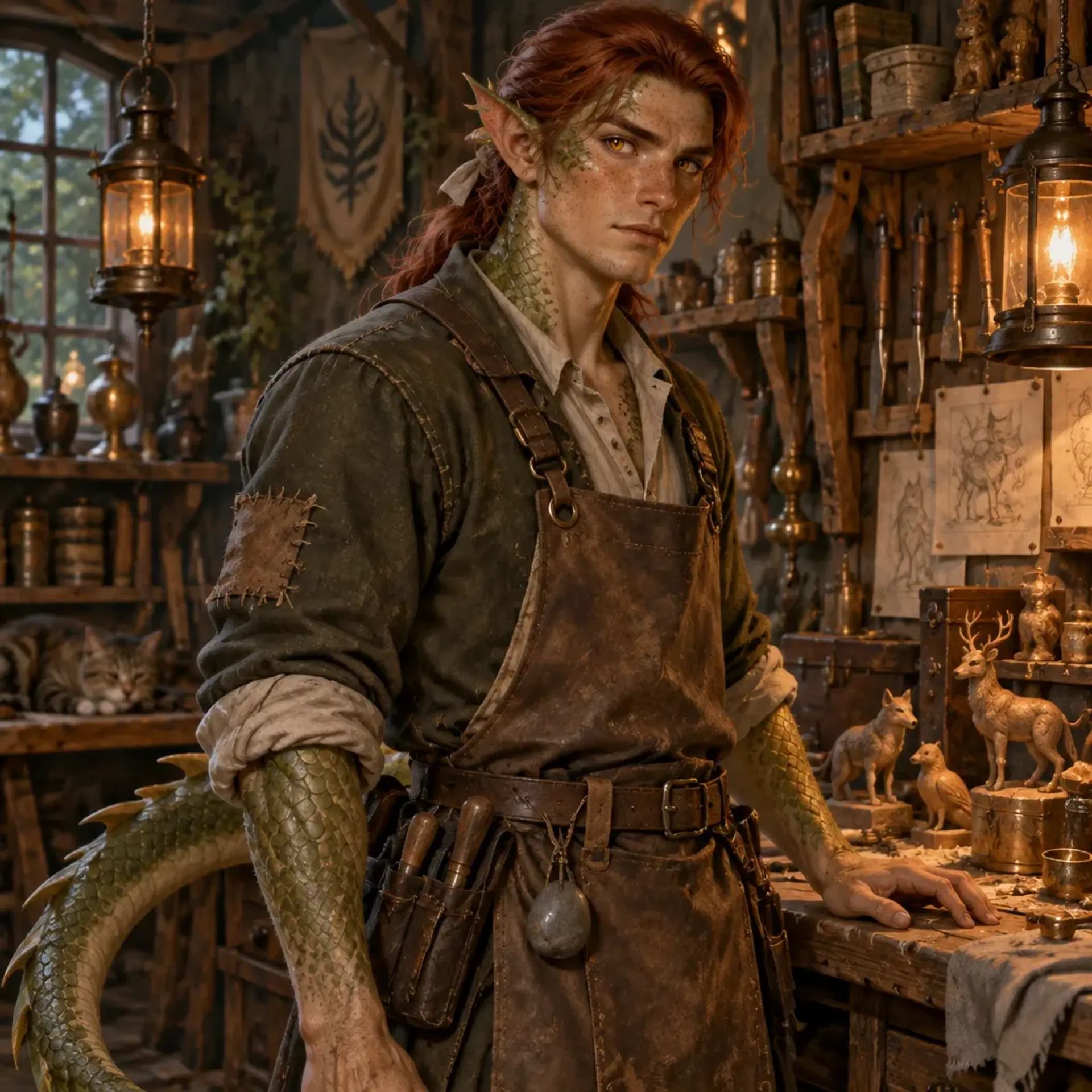
Eber
Eber
At the table
“That story has a loose joint.”
Voice
Eber's voice has a dry, slightly rasping edge from years around sawdust, smoke, and workshop dust. His words carry a faint breathy click when his jaw shifts, especially when he is tired. He speaks with the clipped practicality of someone raised among German-influenced craftsmen and a large, busy family: direct, often matter-of-fact, with a softening warmth when he talks to children or remembers the river.
Eber speaks in practical, measured phrases shaped by workshop instruction and a childhood spent in a busy household. He tends to describe feelings as observations or tasks: "I need to check the latch," may mean he needs a moment to recover. His speech is more animated when discussing tools, gears, materials, or something a child has made. When he is truly angry, he becomes plainspoken and precise, not quiet or courteous. He rarely raises his voice; instead, he stops qualifying what he says.
Speech patterns
How to play them
Give Eber a practical reason to talk: a damaged object, a question about the village, or a task that helps his family. He responds well to patience and directness, but dislikes being treated as a specimen or a symbol of the blood ritual. Show interest in his craft without demanding that he disclose his eating difficulties. Trust grows when someone respects his boundaries and also stays through an awkward silence.
Goal
Keep his family healthy and together while learning what is changing the village and whether the old dragon-blood bargain can be understood without letting the returning green dragon control its meaning.
Motivation
Eber wants to make himself useful without becoming a burden, protect the people who still care for him, and understand his altered body on his own terms. The shine of metal and glass comforts him, but the deeper wish beneath the hoarding is to possess something he can keep safe when everything else seems to change.
Appearance
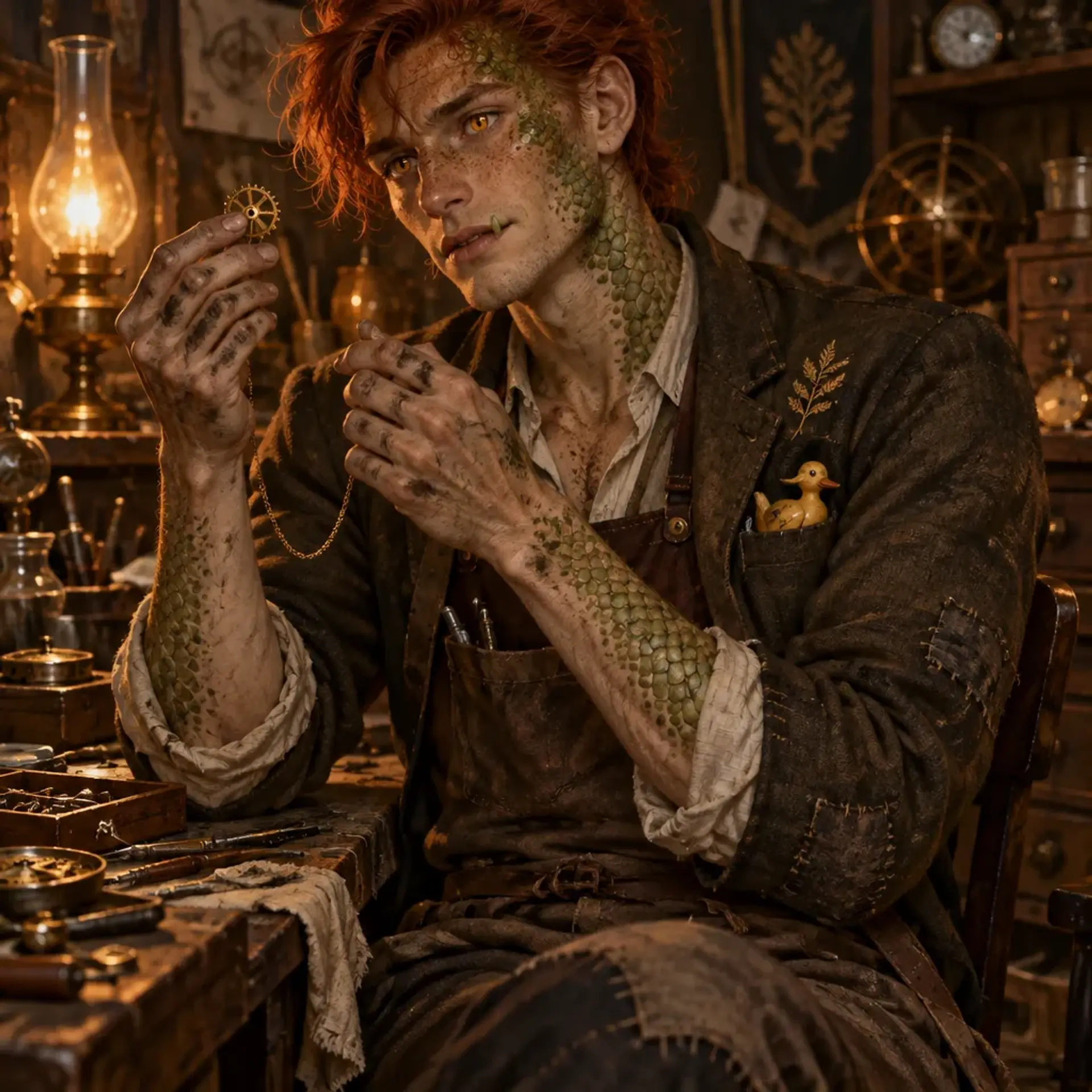
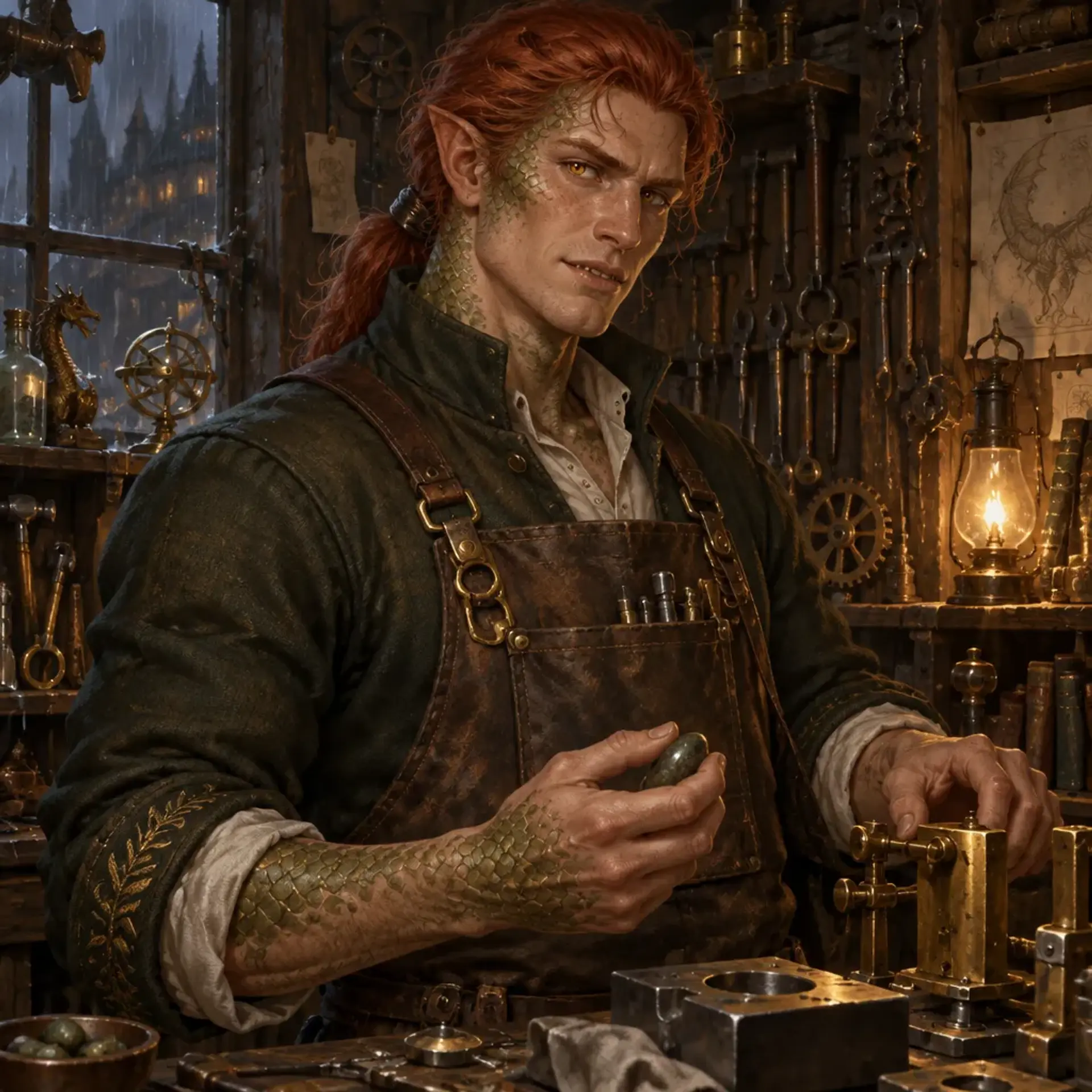
Eber is five feet ten inches tall, startlingly large beside his stout halfling parents and most of his village. Olive-green scales, small and smooth as overlapping leaves, cover his neck, shoulders, forearms, and the planes of his face; they grow denser and darker along his spine and tail. His fair, freckled skin shows between them, especially across his nose and cheeks. His auburn hair turned an unusually vivid, rusty red during adolescence, and he ties it away from his face with a strip of workshop linen. Deep amber eyes, once dark brown, have narrow vertical pupils that catch light like polished resin. His pointed ears have small, movable crests behind them; a low finlike ridge runs from his brow down the back of his head, flattening when he ducks under branches. A long, flexible tail helps him balance among workbenches, though it gives away his irritation by tapping the floor. His jaw changed painfully during adolescence. It opens wide enough to tear food, but its bite cannot grind; Eber must swallow manageable pieces whole. His teeth are green-dragon-like, strong and sharply angled, useful for ripping but awkward for the meals he grew up sharing. He moves with quiet, careful economy, yet continually misjudges how much room his shoulders and tail need in a crowded kitchen. An unexpected detail: despite his solitary manner, Eber collects tiny, ridiculous wooden animals carved by his nieces and nephews, and keeps them arranged on his workbench like a household audience.
Clothing
Practical German-influenced craftsman's clothes: fitted wool jacket, linen shirt, leather apron, sturdy trousers, and boots reinforced for wet ground. He lets out seams himself as he grows, and his cuffs are patched with mismatched cloth. A small pouch of smooth gizzard stones hangs beside his tool roll. He keeps a few polished brass scraps in a hidden inner pocket.
Body language
Eber folds his finlike crest close when entering a cramped room and angles his shoulders to keep his tail from sweeping objects off tables. His gaze tracks hands, exits, and bright metal before returning to a speaker's face. When he feels safe, he leans against doorframes and lets the tail curl around a stool leg. When embarrassed, he becomes very still and checks the stone pouch at his belt.
- Height
- 5 feet 10 inches
- Build
- Tall and lean, with a craftsman's sturdy shoulders, long arms, flexible spine, and a balancing tail. He is stronger than his parents and often forgets how easily he can move a chair or lift a crate.
- Eyes
- Molten amber with narrow vertical pupils
- Hair
- Unusually vivid red, formerly auburn
- Skin
- Fair skin with freckles, overlaid across much of his body with flexible olive-green scales
- Age
- 19
- Gender
- Male
- Size
- Medium
Distinguishing features
Personality
20 traits and drivesEber is clever and cautious, but caution does not make him passive. He notices the weak point in a mechanism, a story, or a person's confidence, and can be startlingly cunning when he thinks someone is cornering him. Yet he dislikes cruelty and is embarrassed by how easily he can imagine using the same manipulations he condemns. With strangers, he is watchful and spare with words. With his nieces and nephews, he becomes patient and unexpectedly playful, letting them hand him scraps to turn into toys. At work, he is focused and exacting; when a repair fails, he curses the mechanism rather than the person who brought it. When family worries about him, he may become sharp and insist he is fine, then later leave a repaired tool or a carefully prepared snack where they will find it. He wants to be independent, but resents being left alone. He dislikes the high-blood instinct toward solitude, yet finds the noise and warmth of a crowded family kitchen painful because he can no longer eat as they do. His love of shiny things is not simply greed: bright objects are beautiful, useful samples, and reassuringly still. He can be generous with his tools and possessive of his tiny collection. He admires Ignatz's steady support and misses their childhood adventures. He resents Rodrick's jokes while holding on to memories of Rodrick's gentleness. When angry, he becomes direct and startlingly honest rather than meek. When afraid, he becomes busier. When ashamed, he withdraws and tells himself he is giving everyone space. When genuinely happy, he shares a discovery immediately, often forgetting that he had planned to keep it secret. He does not believe blood makes anyone good or bad, but fears that the village's new factions are making that belief harder to defend.
- Alignment
- Neutral Good. Eber wants to protect his family and preserve their shared life, though his instincts increasingly favor secrecy, self-reliance, and calculated advantage.
Quirks
Habits
Traits · 5
Flaws · 5
Fears · 5
Wants and needs · 5
Combat
AC 15 · HP 17 · 30 ft.Eber avoids a fair fight. He positions himself behind sturdier allies, uses Fire Bolt from range, and looks for cover, narrow paths, or loose workshop objects to slow pursuit. He spends a spell slot on protection when an ally is exposed, and reserves his tools and hands for escape or rescue when possible. If cornered, he uses his strength to shove through a gap rather than stand and trade blows. He does not willingly use his claws or teeth against people.
Eber
Spells
Actions
Reactions
Services they sell
Rewards they can give
Equipment
- Workshop tool roll (tools)A compact, carefully maintained tool roll containing small files, pliers, a hammer, wire, and measuring calipers.
- Gizzard stones (personal)A pouch of smooth, rounded stones selected for safe swallowing and digestive grinding.
- Hand crossbow (weapon)A hand crossbow with a reinforced stock and a simple leather sling.
- Craftsman's apron (clothing)A plain leather apron with patched pockets and a tiny carved wooden animal tucked into one seam.
- Private bright things (personal)A little tin of polished brass scraps, a few buttons, and a glass bead. Eber claims each is a useful sample.
Possessions
Background
Eber grew up as the youngest of eight children in Trogi and Wilma's crowded household, a family of stout-halfling descent whose timber workshop stood close enough to the kitchen that the smell of sawdust followed everyone to supper. Their village, one of roughly 447 Greenwake Kin, was founded by refugees who survived a massacre, a dangerous crossing, hunger, and a volcanic eruption. Three generations later, the descendants still share labor and food, but the old bargain that saved their ancestors has become a fault line. Some descendants show little outward change and are called low-blood. Others inherit stronger draconic traits and are called high-blood. Eber grew up hearing adults use those terms as if they were tidy categories. He learned that they were not tidy when his own body changed. As a child, Eber had brown eyes, ordinary auburn hair, and the familiar sturdy shape of his family. He was the baby, passed between older siblings and cousins, and was most at home with Ignatz in the woods or by the river. They made boats from bark, guessed at animal tracks, and dared each other to cross slick stones. Ignatz was the brother who waited for Eber to catch up. Rodrick, already forceful and competitive, could be kind then, too; Eber remembers him holding a lantern so the younger boys could finish a crooked little footbridge before dark. The memory matters because the brothers they became are not, to Eber, simply the people they were always meant to be. Adolescence did not arrive gently. Eber's height surged, his skin roughened into green scales, his ears sharpened, and his eyes changed from brown to amber. His hair went from auburn to a brighter, strange red. His jaw altered until he could no longer chew. The first time he tried to eat a familiar piece of bread, his mouth failed him in front of his family. Pain, fear, and embarrassment fused in that kitchen. He began to understand the difference between being loved and being able to participate in the ordinary gestures of love. He could sit with his parents, but not eat as they did. He could embrace his mother, but his new strength made her tense before she remembered he was still her son. The family adapted through practical care, not grand speeches. Trogi built a deep, stable stool and adjusted the kitchen furniture. Wilma learned which foods Eber could tear and swallow safely, then quietly set aside broths, soft fruit, and suitable morsels. His family helped him find smooth pebbles for his stone-gizzard. The high-blood brothers, Rodrick and Ignatz, began sleeping in the kitchen with him soon after the changes. There was not enough room in the old bedrooms for their new size, and no spare beds or proper cloth for everyone. They laid blankets between the table and the hearth. At first the arrangement was an attempt to keep Eber from waking alone, and to make sure his breathing and eating stayed safe. It also became a daily reminder that their family home had been built for smaller bodies and older expectations. Ignatz took the nearest place to Eber, often leaving a hand within reach without touching him. He was uncertain, but he showed up. He tried to learn how the new jaw worked, helped Eber test foods, and remained the companion who could share silence without demanding an explanation. Rodrick was less gentle. He is taller and broader, with auburn hair, yellow eyes, fair skin, reddish-tipped green scales, and a predator's build. He teases Eber about his food and calls his careful habits ridiculous, insisting he is only being honest. When Eber's anger becomes unmistakable, Rodrick stops. That restraint does not erase the sting, but it complicates Eber's resentment: he remembers Rodrick's earlier kindness and still wants to believe it can return. Ignatz's own change frightened him. After a sudden hunting urge led him to kill a chicken with his bare hands, he became ashamed and retreated into workshop tasks where his hands could make things instead of taking life. Eber's parents remain the heart of the household. Trogi, 68, is a calm, black-haired craftsman whose hair is turning gray, a practical patriarch who says he wants to retire while continuing to work. He secretly covets a beard after seeing one on another man. Wilma, with whitening blond hair and hazel eyes, tends the garden and chickens, is warm and perceptive, and can faint at the sight or fear of violence. She can butcher fish or poultry when necessary, though she prefers Trogi to do it. The two still fish together at a local stream. Their tenderness does not stop them worrying: the high-blood children need more food, larger clothes, safer beds, and a future that their modest workshop may not be able to provide. Eber's oldest brother, Windle, is 42, a low-blood craftsman with balding brown hair and hazel eyes. He works in the shop and is expected to take it over. He married later in life and is grateful for his two young children: Otto, his brown-haired, hazel-eyed son, and baby Anika, whose cheerful smile lights up brown eyes. Windle rarely admits it, but he fears his children might change as Eber did. He watches their growth with a care that can feel like a measurement. Eber knows this is fear dressed as responsibility, but sometimes it still feels like being treated as an omen. Karl, 40, is a low-blood son with balding black hair and warm brown eyes, happiest among tools and gears. His marriage to Leanora is rocky; she is a sailor and often away. She descends from the famed dragon hunters Wilks and Nailia, a lightfoot and a strongheart heroine who refused the green dragon's blood in the old days of the castaways. Their son Hansel has black hair and black eyes. Ragni, Leanora's pale-skinned, white-haired child with milky blue eyes, is also in the household, a fact that creates delicate silences and questions Eber has learned not to force. Karl's affection is often expressed through a repaired hinge or a tool left where someone needs it. Yonda, 38, is Eber's only sister, a beautiful low-blood woman with blond hair and hazel eyes. Sociable, sweet, and kind, she has many friends and five children. She is generous with Eber but gently insists he should make more of an effort to join people. Her sons Hans, with blond hair and vivid green eyes, and Birke, with light brown hair and hazel eyes that appear yellow in bright light, show signs of high-blood traits. Her daughters are Willow, whose dark hair frames startling blue eyes; Trude, with auburn hair and soft doe-brown eyes; and Liesel, dark blond with hazel eyes. Yonda's urging to socialize can feel like welcome or pressure depending on Eber's mood. Alder, a low-blood brother with cropped black hair and green eyes, works part time as a town guard and is often occupied with merriment. His clever, high-blood son is called Black Alder. At 22, Black Alder has black hair, amber serpent eyes, and green scales on pale skin. He visits often and tells Eber stories of adventures beyond the village. Eber listens closely, partly because he likes his nephew and partly because Black Alder makes leaving sound possible without making it sound easy. Kasper, 35, is a brown-haired, brown-eyed low-blood brother who keeps accounts, repairs the rare watches that reach the island, and can usually be found tending chickens or the family garden. He and his wife are content with two daughters rather than a large family. Wonda, the older, has light auburn hair and loves the garden and chickens; dark-auburn-haired Ilse follows her everywhere. Their ordinary routines remind Eber that not every family decision has to become a public argument about blood, duty, or the future. Eber learned craft from the whole household. Trogi taught him to measure twice. Karl showed him gears. Kasper made him pay attention to the small failures hidden inside a working mechanism. The shop has no formal artificer tradition, but Eber has made himself one through patient experiments. At level two, he can produce small magical effects, kindle a controlled flame, and use simple protective magic. He approaches magic as another tool: useful, dangerous when misused, and worth understanding before anyone trusts it. The wider village is changing. Low-blood elders preserve household gratitude, shared meals, and remembrance for the dead. High-blood youths are increasingly numerous and do not share one outlook. Some are generous; others prize hierarchy, hunting prestige, dragon identity, and strict gender roles. A few have begun venerating a fivefold dragon goddess in secret rites. The old green dragon benefactor once loved a halfling and tried to save the refugees, but her absent father, a green dragon patriarch, now treats the community as a useful instrument in his revenge. Some elders blame the dragon whose blood altered them. Others suspect one of her daughters, or a ritual that was never completed. The Greenwake Kin avoid the island's golden serpentine beings, uncertain whether they are protectors, rivals, or something stranger. Eber's current problem is both domestic and political. The workshop cannot simply grow larger, and the household is already short of food, cloth, and beds for its high-blood members. He is trying to design a practical sleeping platform and eating vessels that make his own needs less conspicuous, while also studying whether his changing body can be kept healthy. At the same time, he has noticed unfamiliar marks and carefully hidden requests for metal fittings that do not belong to ordinary craftwork. He suspects someone is preparing for a rite, but has not yet decided whether telling his family would protect them or draw danger to the door. He wants to remain the baby brother who can be fussed over, and resents that his body has made him look like a threat or a symbol. He wants independence, yet keeps the carved animals his nieces and nephews leave on his bench. He is drawn to shiny things because they are beautiful, because their surfaces preserve light, and because a small hoard can be arranged, counted, and defended. He is wary of the solitude his draconic instincts seem to invite. His life beyond the party's arrival is full of work: repairs to finish, family meals to negotiate, a secret circle to understand, and brothers who may yet become allies again.
Role in the story
A young family member and apprentice artificer whose bodily transformation makes the Greenwake Kin's historic bargain personal. Eber can connect adventurers to village life, the family workshop, and the strain between low-blood communal traditions and high-blood identity. His investigation into strange ritual materials can lead toward the secret circle and the green dragon patriarch, while his family relationships keep the stakes intimate.
“Three generations later, the descendants still share labor and food, but the old bargain that saved their ancestors has become a fault line.”
- Faction
- The Greenwake Kin by birth and family; no formal membership in the secret dragon-worshipping circle. He is wary of its growing influence and of the returning green dragon patriarch manipulating village divisions.
Known connections
Media
0 imagesNo images yet.
Turn Eber into a sheet
A high-res, share-ready sheet you can post or print.