William Windon
William Windon
At the table
Voice
William's voice is young, clear, and shaped by outdoor work: plain vowels, a little dry throat, and a habit of speaking across a garden rather than performing for a room. When the reflection speaks, William's mouth produces a more measured and older-sounding voice, deeper in texture, with clipped precision and a formal English cadence. The mismatch is immediately noticeable to people who know him.
William speaks in an ordinary Wiltshire English manner, direct and practical, with a slight breathlessness or hesitation when anxious. He explains gardening through concrete examples. The reflection speaks through William's mouth in an older-sounding, deeper voice with an accent that feels like an earlier generation, precise consonants, and a dry, formal cadence. It can turn a casual observation into a reprimand. Its name-specific sound texture does not apply to its voice. When the reflection is frightened, it may evade rather than whisper; when angry, it tends to become blunt and cutting rather than quieter or more polite.
Speech patterns
How to play them
Treat William as an ill young man trying to retain agency, not as a possessed monster or a puzzle. Let him speak for himself when possible. The reflection may answer through him or a reflective surface, but it has its own feelings and is not simply William's hidden personality. Build trust by taking his fear seriously and not demanding that he risk another medical crisis. The reflection can be engaged through careful questions about its memories, but it resists direct interrogation about ghosts, fae, and its family.
Goal
Find Abraham Gorff or the vanished heart, understand the reflection's history, and establish whether William can remain himself without endangering his family and Adaline.
Motivation
William wants a future in botany and ordinary affection with Adaline. The reflection wants experience, access to William's world, and recognition as a person rather than a symptom. Both want the heart's mystery resolved, but neither trusts what resolution might cost.
Appearance
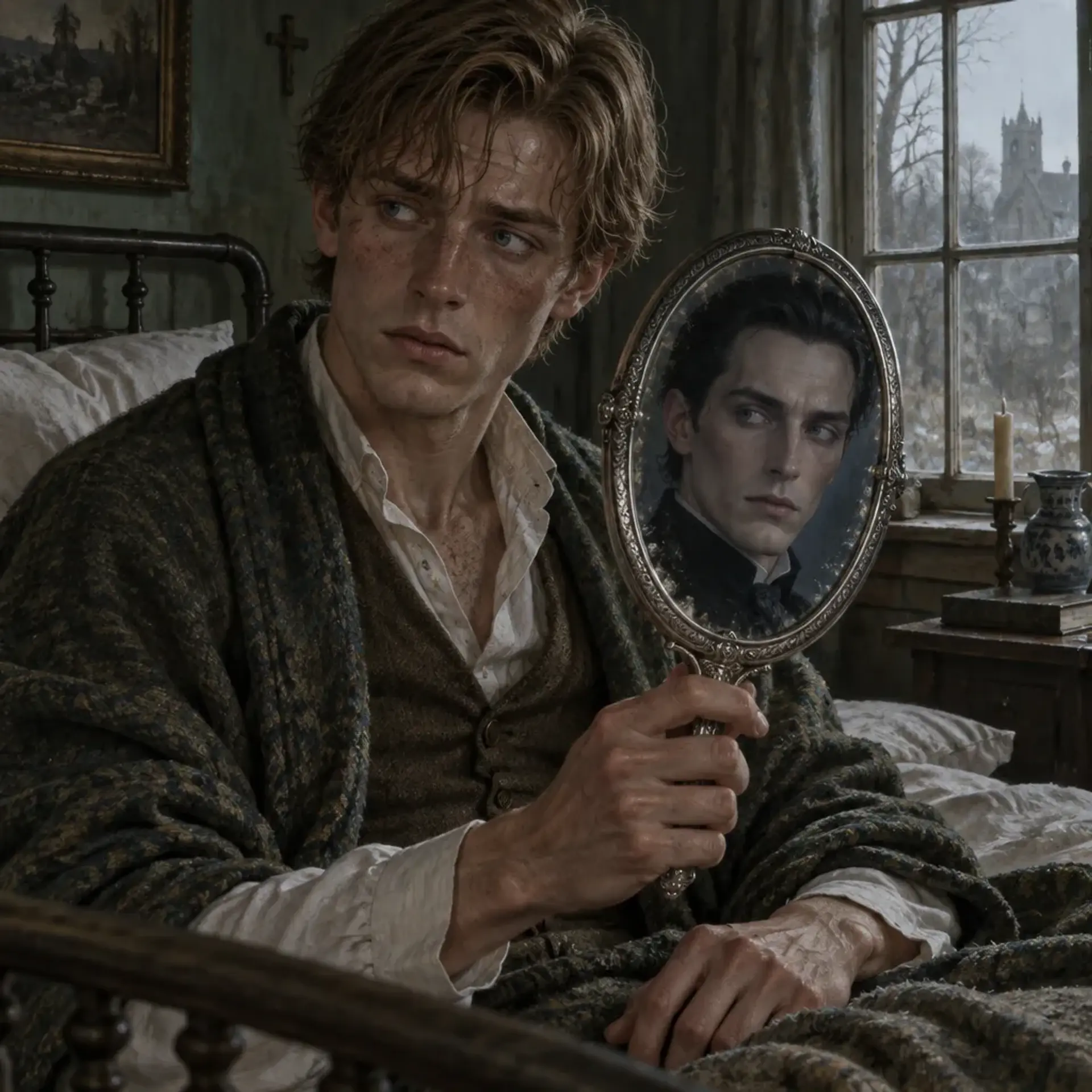
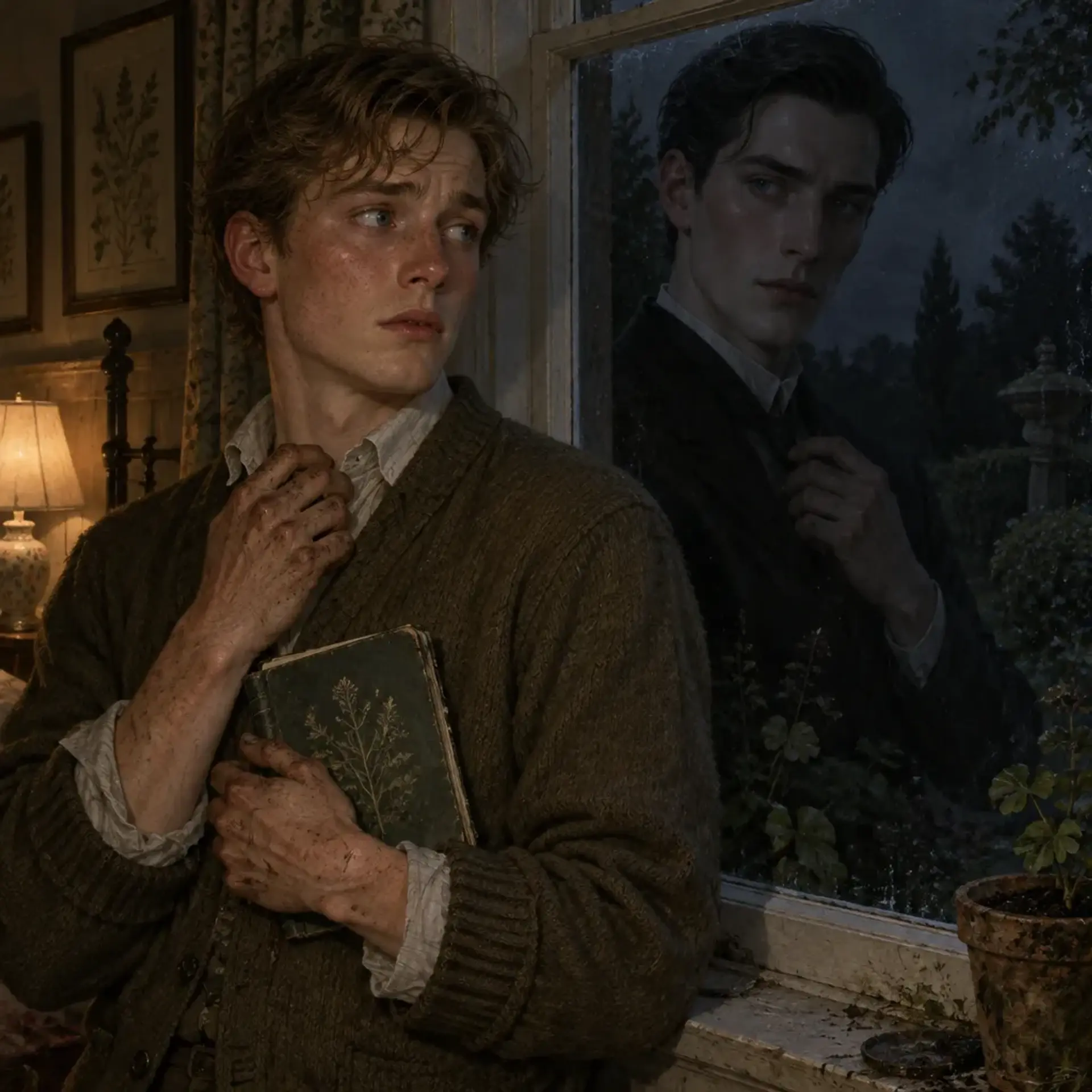
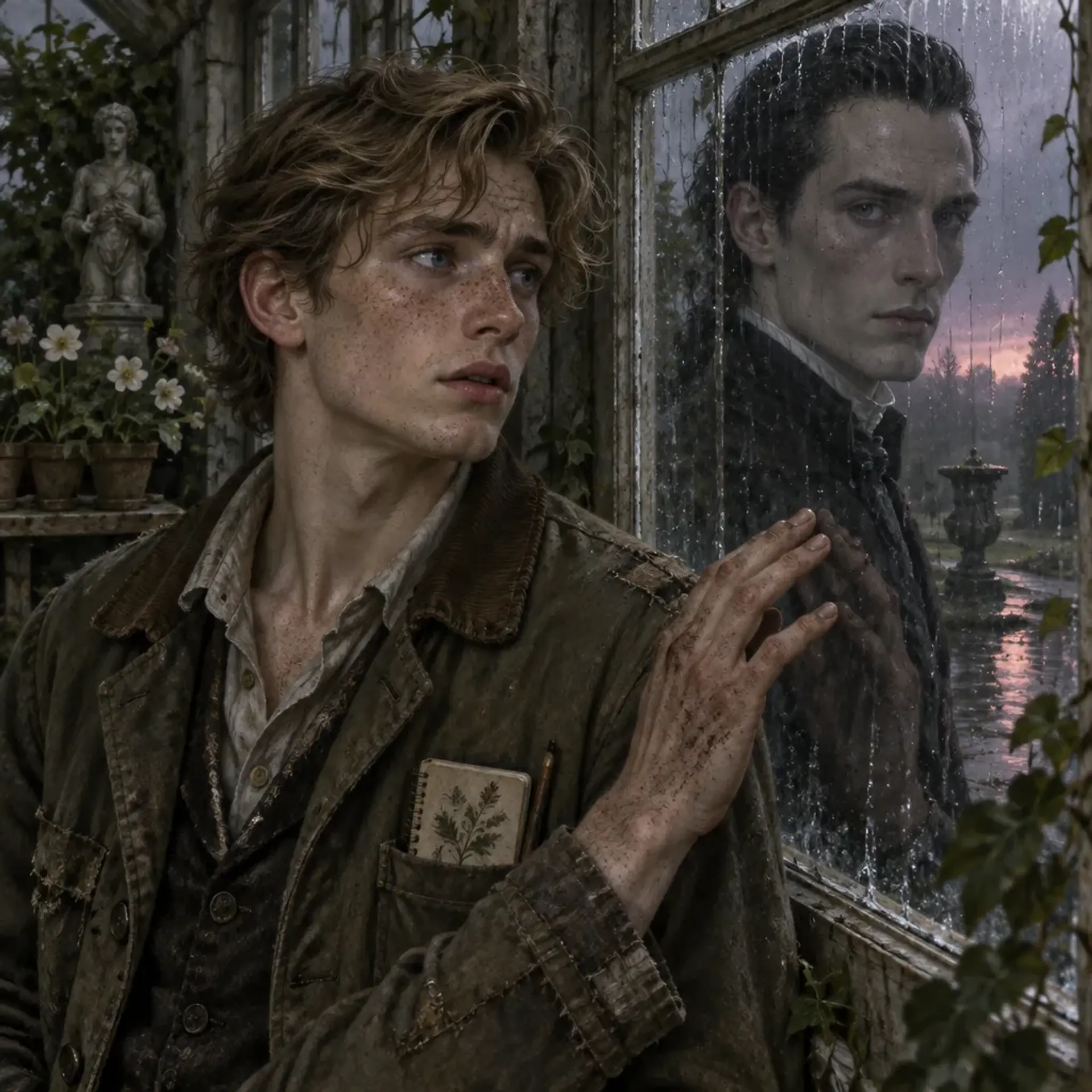
William Windon is a young Wiltshire man with a plainly handsome, open face, blue eyes, and dark-blond hair that refuses to lie flat at the crown. Brown freckles scatter over his nose and cheeks. His garden work has left his nails permanently edged with soil and his palms roughened, with green smudges sometimes surviving his best washing. He moves carefully since his heart stopped, as if each step needs his body's permission. His work clothes are practical and often ill-fitted: sleeves turned back unevenly, knees patched with cloth that does not quite match, and one much-loved gardening jacket brushed clean at the collar even when mud cakes its hem. He leaves the impression of someone trying to look ordinary while listening for an alarm no one else can hear. In glass, water, and polished metal, the person looking back is not William. The stranger is long-faced, clean-featured, sternly handsome, with short, carefully slicked-back black hair trimmed at the sides and blue eyes like moonlight on a still pond. The reflected face is structurally different from William's, not a distorted version of it. Its posture has an older, self-possessed formality; at times it moves a fraction before William does.
Clothing
Practical gardening clothes: patched trousers, work shirt, scuffed boots, and a jacket with a carefully brushed collar. Repairs are useful rather than decorative, and the fit is inconsistent. He keeps one clean shirt aside for Adaline or family visits.
Body language
William is careful and a little guarded, conserving energy since his heart stopped. He rubs soil from his fingertips, checks glass at the edge of his vision, and squares his shoulders when trying to reassure his family. The reflection's posture is upright, composed, and faintly proprietorial. When it exerts influence, William's hands may pause or redirect, his chin lifts, and his expression settles into a sternness unlike his own.
- Height
- About average for a young adult man
- Build
- Lean, young, and made sturdy by garden work, though presently weakened by recovery and bed rest.
- Eyes
- Blue
- Hair
- Dark blond
- Skin
- Fair, with freckles and a little weathering from outdoor work
- Age
- Young adult
- Gender
- Male
- Size
- Medium
Distinguishing features
Personality
21 traits and drivesWilliam is earnest but not meek: he will defer to family or apologize to keep a room calm, then privately resent being treated as fragile. He likes practical work and ordinary conversation, yet the heart has made ordinary mirrors feel dangerous. He is curious enough to study plants and record the stranger's words, but fear makes him hide those notes when someone enters. With friends he tries to joke as before, though his humor is often a shield. With Clare he is grateful and protective, and he edits the truth to spare her. With Hector he becomes defensive when history or local people are dismissed. With Elizabeth he is fond and exasperated, listening to her talk about the boy she likes while trying to prevent the reflection from turning her into an object of fascination. With Adaline he is gentler and more attentive, but his fear of being displaced makes him self-conscious. The reflection has a different temper: formal, observant, proud, and amused by social rules it also insists on enforcing. It criticizes William's grooming, yet it can blush. It makes cutting remarks, yet offered an apology after the war-film episode. It enjoys books and films with a child's immediacy, then describes old memories with unsettling detachment. Its feelings are real, but its boundaries are poor. It is fascinated by William's household, especially Elizabeth, and competitive over Adaline. It avoids the paranormal with a fear it will not explain, despite being an inexplicable presence itself.
- Alignment
- Not applicable as a canonical Secret Histories statistic; William is protective and earnest, while the reflection is proud, curious, and capable of cruelty.
Quirks
Habits
Traits · 6
Flaws · 5
Fears · 5
Wants and needs · 5
Combat
HP 3 · Ordinary walking pace when well; currently limited by recovery. No canonical movement statistic asserted.William is not a trained fighter and should not be treated as a combatant with a conventional RPG combat build. He avoids violence and seeks shelter or help. If directly cornered, the reflection may force one desperate shove or escape attempt, but this risks triggering pain, loss of control, or another medical emergency. Use the custom narrative features above rather than D&D combat assumptions.
William Windon
Actions
Reactions
Services they sell
Equipment
- Gardening jacket (clothing)A repaired, soil-marked jacket kept unusually neat at its collar.
- Botany and incident notebook (possession)A small notebook with plant observations, questions about the heart, and records of the reflection's words.
- Gardener's tools (tools)A hand lens and simple gardening tools, currently used only as his recovery permits.
- The Heart of England (missing object)The missing fossil heart, once shaped like a human heart and crusted with sea growth. It is not currently in William's possession.
Possessions
Background
The beginning of William Windon's trouble was not a ghost story, though his family would later wish it were. It began with an object a visitor left at the Hush House: a stone shaped like a human heart, rough as a piece of Dover cliff and crusted with barnacles and sea grass. Bartholomew Golden, an amateur arcanist, had called it "The Heart of England" and wrapped it in newspaper as payment for being allowed inside. He was never permitted near Brancrug again. The heart was thrown into the sea. It came back to shore looking more ridiculous than ominous, dripping salt water and black ooze, with a reddish-pink light seeming to pulse beneath its stony surface. A young man named Abraham Gorff found it and pocketed it on his way home. He was from London and had come to Wiltshire, carrying the peculiar object as a curiosity. It beat beneath his coat after he boarded the train. At home, he studied it, repulsed by it and drawn to it in equal measure. He showed it to neighbors, and in company it appeared to die: a cold, inert rock. When he took it to a shore in Hampshire and dropped it into the water, its color returned. Abraham decided it was special and belonged to him. This was not simple greed. He became convinced that the heart disliked visitors as much as he did. The house grew strange around it. Voices seemed to speak from empty rooms. Doors moved. Footsteps crossed the hall and climbed the stairs when no one was there. Abraham came to understand that the heart was beating and weeping salt water. It frightened him. He sold it to a local seventeen-year-old, William Windon, one of the people who had seen it appear dead in company. Abraham then moved to Canada. William has never found a reliable way to reach him. William was proud of his new trinket until he felt its pulse echo in his chest. After a spell of tasting the sea, blood, and soil in his mouth, he took a hammer to the rock, thinking it might break. The blow landed on the heart. Pain seemed to leap from the stone into his own chest. He collapsed, groaning and spitting blood. For an instant he saw something like muscle twitch violently inside the stone. Then his own body gave out. He woke with his mother, Clare, holding his face and telling him that his heart had stopped. The event left William alive, frightened, and under medical restrictions. It also left him with a fear that a curiosity can reach back and hurt the person who studies it. William hid the heart in a hollow log. Days later, it looked cold and pristine despite the hammer strike. Then it was gone. He still does not know whether someone took it, whether it moved, or whether its disappearance was part of the same impossible bargain that left something else behind. The first clue was his reflection. When William groomed himself, the mirror showed a young man his own age, but not his own face: long-faced, blue-eyed, handsome by an old-fashioned English standard, with short black hair combed back and trimmed at the sides. The stranger's expression was stern. William became cautious at the washstand, watching the glass as though it might catch him doing something he could not later explain. For a time, the reflection did little beyond irritate him. It did not match his movements perfectly. Its gestures sometimes jerked sideways, as though it wanted to go somewhere William was not going. One night, during William's bedtime routine, the reflection spoke through his moving mouth. "Well, it's not often you use that one." The remark was about a grooming implement. William had not said anything. The voice sounded older than his, deeper and marked by an accent that did not belong to his generation. The reflection paused after speaking, almost as startled as William. That mutual surprise made the incident worse, not better: it suggested this was not an ordinary haunting with a script. William tried to ignore it. The stranger's expression grew stern when William was careless with his hair. It made comments on his clothes, his manners, and the people who passed through the house. It seemed to have opinions rather than merely repeat William's thoughts. Sometimes it stopped him from speaking, especially when it decided his words would be improper. It could be dryly funny, but its humor had sharp edges. It described its own family in fragments, as if talking about the weather, the tides, or a forge. It claimed to have siblings and a father, yet spoke of them less like living people than forces that had once shaped it. The reflections spread beyond the bedroom mirror. William began to catch the stranger in windows, puddles, polished fittings, and the dark glass of the house. The longer it went on, the less often he saw himself. The reflection could alter its posture while William remained still. Sometimes William felt an impulse to move that did not feel like his own. He did not know whether the stranger was learning to act through him or whether the heart had made a place for it inside him. His friends Tommy DeHare, John Mollask, and Ryan O'Leary saw the trouble at close range when they visited the house. William was already on bed rest, and he tried to make the visit feel normal. The three boys crowded into his room with the forced cheer of friends who do not know what to do with illness. They traded school gossip and teased him about the garden work he was missing. William's reflection kept watch from the dark window. When Tommy leaned toward the glass, the stranger turned its head while William did not. John noticed the movement and asked if William had shifted. Ryan went to check, thinking the angle of the light was playing tricks. Then the stranger spoke. William's mouth moved, but William had not chosen the words. It made an uninvited, cutting observation about the boys' manners, then addressed them as though they were guests in a house it had a right to judge. The room went silent. William tried to apologize, but his jaw resisted him for a moment. The reflection's expression was composed and faintly amused. Tommy backed away from the window. John demanded to know if this was a prank; Ryan, pale and more frightened than he wanted to show, asked William whether he could stop it. William could not answer with confidence. His friends did not abandon him, but their visit ended early, leaving behind the dreadful knowledge that the stranger could be witnessed by people who knew him. William's family has its own pressures. His mother, Clare, was the person who found him after the heart stopped. Her hands on his face and her fear remain among his clearest memories. His father, Hector, is a historian, proud of his learning and sometimes dismissive of country people. The reflection once delivered a cutting remark at Hector after he belittled local people. William was punished for the insult, though it had not been entirely his choice. His sister, Elizabeth, often pesters him about the boy she likes, attractive things, and what she considers his poor manners. The reflection finds her "interesting." It observes her too intently, and its comments make William uneasy. William tries to keep their exchanges ordinary, protecting Elizabeth from the stranger's attention without treating her like a child. The reflection may tease her, critique her taste, or answer a question William meant to answer himself. Its interest is not clearly romantic or hostile, which makes it difficult to confront. The reflection also dislikes William's cousin Ronald White, who calls himself a modern man. It has supplied several remarks about Ronald's opinions, each so pointed that William has had to change the subject. A neighbor's child once ran into William with a toy wagon, causing a girl to cry as she apologized. The reflection called the child a slur. William was made to muck out the neighbor's stables as a consequence. He refuses to repeat the word. He resents the stranger for making him answer for a cruelty he did not choose, even though he understands that the reflection's mouth is his own. William works as a gardener on an estate and is eager to train as a botanist. His work gives him practical purpose while illness confines him to bed. He knows the rhythms of plants better than the rhythms of his own strange condition. He is trying to keep his studies going with notes, books, and whatever small tasks his recovery permits. He wants the knowledge to be more than a distraction: if the heart is tied to living things, soil, and the sea, then botany might give him a vocabulary for it. Adaline, his girlfriend, has auburn hair and soft brown eyes. William likes her without needing to make her into an answer to his troubles. The reflection saw her once and became interested at once. Its attitude was unmistakably competitive: it watched her in glass and began commenting on her appearance, her manner, and what William ought to say to her. It calls her pleasing to the eye with a dryness that makes the compliment feel like a claim. William is afraid that she will mistake the stranger's attention for his own, or worse, that the reflection may use his face to test how much influence it has over her. He wants to be honest with Adaline without making her responsible for saving him. When she visits, William tries to remain present and attentive. The reflection may interrupt with an arch remark, try to improve his hair, or make a suggestion that sounds like a flirt and feels like theft. William's worst fear is not that Adaline will prefer the stranger; it is that he will stop knowing which of them she is answering. Bathing has become another negotiation. Water shows the stranger's face, not William's, and both of them possess an old-fashioned English prudishness. Sometimes the reflection takes charge of washing or grooming when William is too embarrassed, making sarcastic comments about his body or his shaving. It treats grooming as a serious duty. If William skips shaving, it reminds him to do it later or the next morning. Once William felt it blush, an unexpected embarrassment that suggested the stranger had a private emotional life. That moment softened William toward it, though not enough to trust it. One night William woke cold and shivering and went into the hall with a small light. Elizabeth saw him and looked at him strangely. When he spoke, the voice and accent were not his. The reflection had taken the words, and perhaps the body's manner, without asking. It was not a performance William could easily reproduce. His family heard a different person speaking from his face. They did not understand what had happened, and William did not know how to explain it. The memory makes him wonder whether the stranger can occupy his body while he sleeps. On another night, he felt better than he had in weeks but strangely cold. He went to the study, where a more private fireplace might warm him, and fell asleep on the lounge. His dreams were of salt, forges, and dark woods. Hector woke him with a strange look. William could not tell how long he had been asleep or whether he had said anything. The image of fire did not comfort him. The reflection's memories seemed to treat fire and metal as familiar elements, but its fear of ghosts and fae was just as real. It has a particular dread of the paranormal, despite being itself an impossible presence. It avoids naming what frightens it and can become evasive when William asks about the unseen. A war movie on television produced the clearest rupture yet. The reflection reacted sharply, and William lost control of his body as if caught in an episode of shell shock. His family thought he was having another heart attack. He fought, not as a deliberate choice but as someone trapped in a memory. Elizabeth changed the channel, wide-eyed and worried. When William went to bed, his mouth mumbled an apology. The reflection offered a strange memory in consolation and attempted an explanation. It seemed to recognize the terror it had caused, though it could not fully describe why the images had hurt it. Since then it has tried, haltingly, to explain itself. It is more conversational during William's bedtime ritual and when he is lying in bed, but its accounts are fragmented, impersonal, and full of references to things William has never seen. The reflection loves movies and books through William's body. Excitement can make his hands move on their own. It also likes exploration and sneaking into places where neither of them should be. William has had to resist sudden urges to inspect rooms, corridors, and private belongings. The stranger's historical knowledge is often startling, but it describes history as weather or forge-work, not as dates and named events. It may identify a tool or custom, then explain it as pressure, heat, or a coming storm. The strangest night involved alcohol. Hector had left scotch and bourbon for William's health, not realizing what might happen. The reflection became drunk through the shared body. It argued with William, teased him, smiled, sang, yelled, and wandered into the yard to show him something. When William asked whether it was the stone, the reflection scoffed, "Da isn't here." William could not tell what that meant. He had to stop himself from going farther into the yard, unsure where the reflection intended to lead him. In the morning, the memory was part comedy and part warning: the stranger could become reckless, and William's body could be its vehicle. Now William is on bed rest, trying to recover, study, and locate either the missing heart or Abraham Gorff. He wants the reflection to explain what it is, what happened to the heart, and whether it intends to take his body. He also fears that finding the heart might make the bond worse. The reflection wants things of its own, although it rarely states them plainly. It wants access to experience: books, films, conversation, and the chance to explore. It wants Adaline's attention and seems to regard William's family as an intriguing household. It speaks of a father and siblings as if describing an old climate. William wants to protect his family and keep his relationship his own. The two of them share a body, but they have not agreed to share a life.
Role in the story
A sympathetic, unsettling ally whose condition turns domestic scenes into encounters with an unknown history. William can offer botanical knowledge, a human connection to the missing heart, and a perspective on the difference between possession and personhood. His family, friends, and girlfriend create stakes beyond the mystery.
“Bartholomew Golden, an amateur arcanist, had called it "The Heart of England" and wrapped it in newspaper as payment for being allowed inside.”
- Faction
- None known. William works on an estate as a gardener and hopes to train as a botanist.
Known connections
Media
0 imagesNo images yet.
Turn William Windon into a sheet
A high-res, share-ready sheet you can post or print.