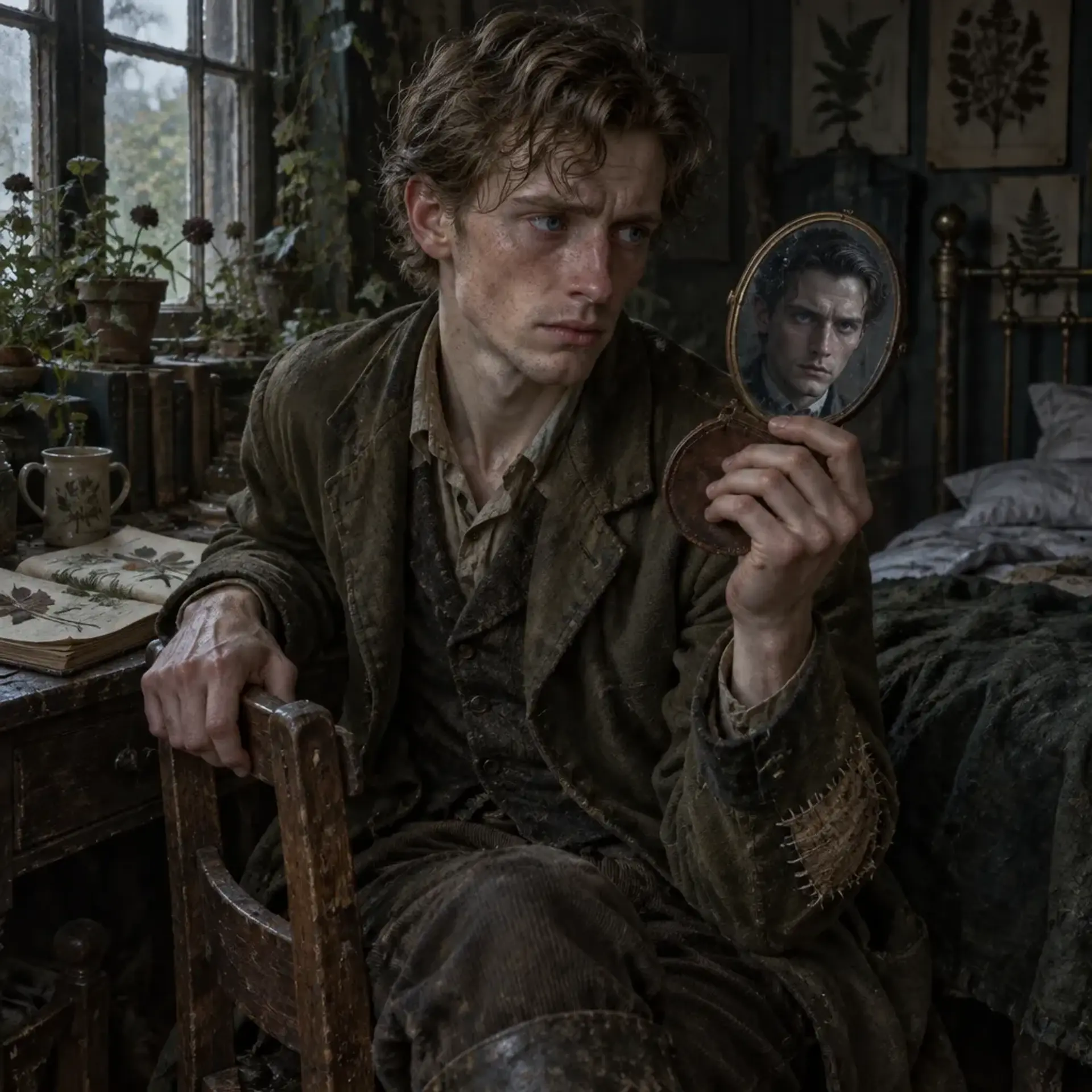
William Windon
William Windon
At the table
Voice
William's breath carries a faint rasp after long days outdoors, and he speaks with the measured directness of someone used to giving instructions over the noise of work. His voice catches when he is frightened, especially if he sees the reflection move first. The reflection's voice has the same physical source but a different rhythm: its words are crisply shaped, faintly old-fashioned, and edged with dry amusement. It does not become softer or more courteous when angry; it tends instead to choose a more exacting insult.
William's voice is a clear, work-worn young man's voice, shaped by outdoor labor and ordinary Wiltshire conversation. He speaks plainly, with a slight hesitation when trying to decide whether a thought is his to say. Around plants, his sentences become more precise and animated. The reflection uses William's mouth but sounds older: its consonants are carefully placed, its phrasing formal without being grand, and its dry remarks arrive with the certainty of someone who expects the room to catch up.
Speech patterns
How to play them
Treat William as a frightened but capable young man, not as a vessel to be interrogated. He responds best to concrete offers of help, especially research, practical errands, or company that does not demand immediate explanations. Avoid surprising him with mirrors or insisting that the reflection is either harmless or evil. If the reflection speaks, address William first and give him time to regain control. His trust grows when someone respects his desire to pursue ordinary work and affection as well as occult answers.
Goal
Find the missing Heart of England and discover who or what speaks through his reflections, while keeping his relationships and his future in horticulture intact.
Motivation
To recover a sense of ownership over his body and voice without giving up the people and work he loves.
Appearance
William Windon is a young Wiltshire man with dark-blond hair that refuses to lie flat after a day outdoors, blue eyes, and a lightly freckled face. His skin is weathered pink across the nose and cheeks from work in open gardens. He is taller than he was before the heart's influence began, though the change is slight and unnerving rather than dramatic; his clothes have started to fit as if he has grown into them too quickly. He holds himself with his weight tipped forward onto the balls of his feet, as if about to step into a flowerbed to correct a crooked row. When waiting, he leaves a careful gap between himself and other people, but seems unaware that he watches every pane of glass in that gap. He moves with a gardener's economy, turning sideways through crowded rooms to avoid brushing people or furniture. The unexpected detail is that he keeps a childishly neat collection of pressed leaves tucked into a schoolbook, arranging each specimen by the shape of its edge rather than by species. His reflection is not his: it shows a handsome, long-faced young man with carefully combed dark hair, moonlit-blue eyes, and an expression of stern, practiced composure.
Clothing
Practical work clothes: a worn jacket, sturdy trousers, and boots carrying traces of soil even after cleaning. While on bed rest he wears a soft shirt and keeps a cardigan or blanket close, but still lays out his clothes carefully for the next day. He dislikes how the reflection seems to improve his grooming without permission.
Body language
He leans forward slightly, as if ready to tend to something that needs attention. When alarmed, he plants both feet and goes very still, watching glass rather than the person speaking to him. He gives people room but has a habit of standing where he can see the nearest window.
- Height
- Tall for his age, though his recent growth is difficult to measure
- Build
- Lean and work-hardened, with the strength of someone accustomed to digging, lifting pots, and walking estate grounds.
- Eyes
- Blue
- Hair
- Dark blond
- Skin
- Fair, with a weather-reddened nose and cheeks and a light scatter of brown freckles
- Age
- Young adult
- Gender
- Male
- Size
- Medium
Distinguishing features
Personality
19 traits and drivesWilliam is practical and curious, but his curiosity has become inseparable from fear. He would rather learn how a plant survives a hard frost than hear a grand theory about destiny, yet he cannot stop trying to understand the presence in his reflection. He is proud of being useful and dislikes being treated as fragile. Since his heart stopped, that pride has become a liability: he insists he can manage, then hides how tired or frightened he is until Clare notices. With strangers, he is cautious and civil. He watches their hands, their faces, and the nearest reflective surface, then makes an effort to appear as though he is listening normally. With friends he becomes more animated, especially when talking about plants or work. He can be funny in a self-deprecating way, but the joke usually arrives after he has tested whether the room is safe. In a quiet moment with Adaline, he wants to be sincere, yet fears that any confident or clever thing he says might belong to the reflection. He can retreat into practical talk rather than admit how much he wants her reassurance. His pride pulls against his need for help. He wants to find Abraham Gorff and the missing heart on his own because the event began with his choice to keep the stone. At the same time, he knows that secrecy has allowed the reflection to become more frightening. He is especially reluctant to tell Hector the full story. Hector's historical training might help, but William remembers how the reflection used his voice to insult him and fears the next family argument will become another public loss of control. The reflection is not simply a villain in William's mind. Its sarcasm can be cruel, but its attention can also feel like company during long, sick days. It notices William's habits, offers observations he would never make aloud, and speaks as if it expects to be listened to. William resents its interference and sometimes enjoys its wit. That contradiction makes him feel complicit. He has begun asking it questions when alone, then denying that he did so if anyone asks. When the reflection criticizes his clothing or combing, William reacts first with irritation, then with an involuntary check of his appearance. He hates that it can make him self-conscious in his own room. If it comments on Elizabeth, he becomes protective and abrupt. He will interrupt, close a door, or leave the room rather than let the exchange develop. Its repeated description of her as “interesting” makes him suspect a meaning he cannot yet define. He does not tell Elizabeth because he does not want her to fear her own brother's face. With Adaline, William is unusually attentive but not possessive. He remembers small things she says and tries to make her comfortable. The reflection makes this harder by treating their relationship like a game it expects to win. It comments on her auburn hair, her soft brown eyes, and the way she looks at William when he is nervous. Sometimes it offers him a polished remark before he can answer her. William may repeat the remark, stumble over it, or reject it out loud. He worries that Adaline will think he is mocking her or playing a part. His deepest wish is to speak to her in his own imperfect voice and trust that it is enough. The visit from Tommy DeHare, John Mollask, and Ryan O'Leary changed how William thinks about concealment. Until then, the reflection's most disturbing actions had happened in private. In front of his mates it spoke through him, answered questions, and seemed to move his body against his will. Their fear hurt him, but their refusal to abandon him also mattered. He is now torn between wanting them close and wanting to spare them another encounter. He may make a joke about their visit, then fall silent if they ask what happened. William responds to emergencies by trying to make a plan. He will identify exits, ask who is hurt, and look for something useful to do. If the threat is intimate or supernatural, his focus can fracture: he watches windows, loses track of a sentence, and may become angry when someone touches him unexpectedly. When he feels safe, he is gentle and patient. When he is exhausted, the same patience turns into stubborn silence. When frightened, he can sound ungrateful to people trying to help. Later, once the danger has passed, he usually apologizes with more honesty than grace. He wants a future that is not defined by the heart. A life in botany is not an escape from the strange; it is the life he chose before the strange arrived. He still imagines learning plants, earning steady respect, and building a home where his family can speak without listening for another voice. His fear is that the reflection has already altered that future, but his hope is that its attention means it can be understood. He is neither convinced that the stranger is malicious nor willing to trust it. He wants evidence, companionship, and the right to decide what happens to his own body.
Quirks
Habits
Traits · 5
Flaws · 4
Fears · 5
Wants and needs · 5
Combat
HP 8William avoids violence and is physically recovering. He will try to retreat, call for help, or put furniture between himself and an aggressor. If cornered, he uses whatever is at hand and fights only long enough to escape. The reflection's interventions are unreliable and should be treated as custom narrative complications, not a dependable combat power.
William Windon
Actions
Reactions
Services they sell
Equipment
- Pruning knife (tool)A practical gardener's tool, kept close while he is recovering but not carried as a weapon by choice.
- Field notebook (personal item)A schoolbook holding pressed leaves, handwritten plant notes, and scraps of observations about the reflection.
- Comb (personal item)A small, carefully kept grooming comb. The reflection often comments on how William uses it.
Possessions
Background
William Windon was born in Wiltshire to a family that had lived in the county for generations. His father, Hector, works as a historian and has taught William to respect records, dates, and the difference between a story people repeat and an event anyone can prove. William never inherited Hector's taste for arguments about the past. He preferred the living evidence of gardens: a root finding water, a hedge recovering after a hard cut, the way damp soil smells different after rain. He works as a gardener on an estate and hopes to train as a botanist. He takes pride in being useful, and would rather mend a broken frame or carry a heavy pot than announce that he is clever. The object that changed his life first came to Wiltshire through Abraham Gorff. Abraham was from London, an amateur arcanist who had once gained entry to the Hush House by presenting a supposed relic as payment: a stone shaped like a human heart, wrapped in newspaper and described as the Heart of England. It looked like a piece of the cliffs of Dover carved into a crude anatomical shape. Barnacles and sea grass clung to it. Its surface was rock-hard, its outline grotesquely tender, and a cold, sad saltiness seemed to gather around it. Abraham was never allowed near Brancrug again. The heart had been thrown into the sea and returned to shore, washed in salt water and black ooze. Beneath the stone a red-pink hue showed as if blood or a light had returned. A young man picked it up and took it home in his pocket. On the train, it beat beneath his coat. That young man was Abraham. In Wiltshire he studied the object, both repelled by it and drawn toward it. When he showed it to neighbors, it appeared dead in their presence. When he took it to a shore in Hampshire after weeks of stillness, water brought back its reddish color. Abraham concluded that the heart was peculiar, perhaps even responsive, and decided it should belong to him. He did not let other people see it because the stone seemed to dislike company as much as he did. Over time, Abraham's house became difficult to inhabit. Voices came from empty rooms. Doors shifted. Footsteps sounded on the stairs when nobody was there. Abraham came to understand that the heart was beating and weeping salt water. The haunting frightened him more than he could admit. He eventually sold it to a seventeen-year-old local boy, William, who had been among the neighbors to see the object appear lifeless. Abraham's sale was not a clean escape. He moved away and later emigrated to Canada, leaving William with an object whose history he knew only in fragments. William was proud of the strange trinket. He displayed it, talked about it, and liked the attention it brought. Then the beat began to feel like his own heartbeat, only slightly out of time. After a spell of tasting ocean water, blood, and soil in his mouth, William took a hammer to the stone, believing that a rock could be broken by force. The instant the hammer struck, pain entered his chest. He fell, groaning and weeping, while a voice unlike his own sputtered through his mouth. He saw the heart's surface twitch as though a muscle moved under stone. His own body seemed to fail with it. William woke with his mother, Clare, holding his face and telling him that his heart had stopped. He hid the heart in a hollow log, hoping distance would settle the matter. Days later it looked cold and pristine, despite the blow. Then it vanished. William searched the log and its surroundings but could not find it. He has never learned whether someone took it, whether it returned to the sea, or whether it was never truly there in a way an ordinary search could resolve. He has also never forgotten the brief moment when he saw it move. The first change he could not dismiss happened while grooming himself. His reflection was not his face. It showed a handsome, long-faced young man, with short dark hair combed back, blue eyes like moonlight on a pond, and a stern expression. At first it only differed from him. Then it began to want different movements. William would raise his hand and the reflected hand would jerk elsewhere. He tried to ignore it, telling himself that illness, worry, or poor sleep could explain what he saw. It was easier to believe that than to accept that the image had its own preferences. One night, during his ordinary bedtime routine, the reflected face held its stern expression and spoke with William's moving mouth: “Well, it’s not often you use that one.” The voice sounded older than William's, with the dry certainty of someone who had already decided the matter. William froze. The reflection paused too, as if surprised that its remark had been heard. Afterward it began commenting on William's hair, his clothes, and the way he addressed people. Sometimes the comments were pointedly practical; sometimes they were an attempt at conversation. It has told him that it has siblings and a father, though it describes them as if speaking of a tide, a taste, or a pressure in the air rather than people who might have ordinary lives. William's reflections have since spread beyond his looking glass. He has passed windows and found the stranger looking back. The image has begun to rearrange small things in William's room while he sleeps. He cannot tell whether the reflection moves objects, whether he does so without remembering, or whether some third presence shares the house. It occasionally comments when William thinks it is alone. Its humor is sharp and its manners are old-fashioned. When it thinks William is about to say something improper, it can catch his words at the back of his throat, leaving him embarrassed and apparently tongue-tied. The clearest proof that the phenomenon is not confined to private grooming came when William's schoolmates Tommy DeHare, John Mollask, and Ryan O'Leary visited him at home. William was on bed rest after his heart stopped, and he tried to make their visit ordinary. They brought talk, jokes, and the awkward energy of boys unsure whether to treat a near-death illness seriously. They noticed William looking at the glass over the mantel, but he tried to steer the conversation elsewhere. The reflection did not cooperate. It made William's mouth deliver a cutting observation about one of the boys' muddy boots, then answered a question that had not been addressed to it. The room went quiet. Tommy asked William whether he had rehearsed the joke. John moved closer to the window to see who might be outside. Ryan, usually the quickest to laugh, watched William's face rather than the glass. William tried to explain that he was tired and taking medicine, but his reflection interrupted with another dry remark. For a few seconds William's face and the image seemed to be in argument: his shoulders stiffened, his mouth opened, and the reflected mouth continued after his had stopped. The boys were frightened, though none of them ran. Tommy told William to look away from the mirror. John checked the window and found no one outside. Ryan stayed close enough to offer William a hand, then backed away when William's right hand lifted without his intention. The visit ended with the three of them promising not to repeat what they had seen. Their promise has made William grateful and ashamed in equal measure. He knows they are trying to protect him, but their careful silences make him feel like a story they are afraid to finish. William's family provides no simple refuge. His mother Clare watched his heart stop and now checks his breathing more often than she admits. His father Hector cares for him, but his habit of dismissing country people as provincial has drawn the reflection's contempt. Once, after Hector made such a remark, the reflection used William's voice to answer with a cutting insult. Hector punished William for it, believing he had spoken deliberately. William could not explain the truth without making the situation worse. His sister Elizabeth pesters him about a boy she likes, the clothes she thinks look nice, and whether William is being rude. The reflection finds Elizabeth “interesting.” It watches her with a seriousness William dislikes, and makes comments that sound almost approving until their exact meaning slips away. William has learned to interrupt those remarks, change the subject, or leave the room. Elizabeth thinks he is being an overprotective brother or an impossible listener. She does not know that he is trying to keep a second presence from studying her. At work, William is a gardener, not a scholar of the occult. He can identify the difference between healthy growth and a plant merely surviving, and he knows that patience is not the same thing as passivity. Being put on bed rest has made him feel useless. He is trying to keep learning from books and notes, but the long hours also give the reflection more chances to speak. His plans to become a botanist now share space with the urgent search for the heart, Abraham, or anyone who can explain what has attached itself to him. He has learned that Abraham moved to Canada. That knowledge gives him a direction but not a path. William's friends, his sister, and his girlfriend Adaline are the parts of his life he most wants to keep ordinary. Adaline has auburn hair, soft brown eyes, and a steadiness that makes William feel seen without feeling inspected. The reflection noticed her immediately. It called her “interesting,” then made a series of observations about the way she listened, the way her hair caught the light, and whether she would notice if William changed his parting. William has never thought of himself as competing with his own reflection, yet it seems to enjoy making him feel that way. When Adaline visits, the reflected face becomes more attentive. It sometimes offers William a smooth, confident reply just as he is fumbling for words. That help is unwelcome. William fears that if Adaline likes the confidence, she might come to prefer the speaker behind his face. His current problem is not only to find the missing heart. He needs to know whether the reflection is a trapped person, a remnant of the heart, a visitor from some history he does not understand, or something that has simply decided to live in the shape of his face. He is afraid that the heart is still somewhere near the sea, and equally afraid that finding it will bring back the pain that stopped his heart. Bed rest has given him time to search, but little privacy. Every mirror is a possible conversation. Every family meal risks an unintended remark. Every ordinary kindness from Adaline or his friends becomes something the reflection can comment on. William has not become a monster or an occult expert. He is a young man who wanted a curious stone, then tried to break it when it frightened him. He still wants to work among plants, make a life with Adaline, and be able to talk with his family without having to wonder which part of himself is speaking. He is looking for answers because he wants his own life back, not because he thinks the strange thing inside his reflections is wicked. That uncertainty is the most frightening part. The reflection is not always cruel. Sometimes it is funny, observant, even helpful. It has spoken of its family as if it misses them. William cannot tell whether those moments are a plea, a lure, or simply the only honest conversation it knows how to make.
Role in the story
A sympathetic witness and possible ally whose private haunting gives the characters a human route into the mystery of the Heart of England. William can connect them to Abraham Gorff, the Hush House, local memories of the stone, and the personal cost of approaching occult knowledge without understanding it.
“William never inherited Hector's taste for arguments about the past.”
Known connections
Media
0 imagesNo images yet.
Turn William Windon into a sheet
A high-res, share-ready sheet you can post or print.