William Windon
William Windon
At the table
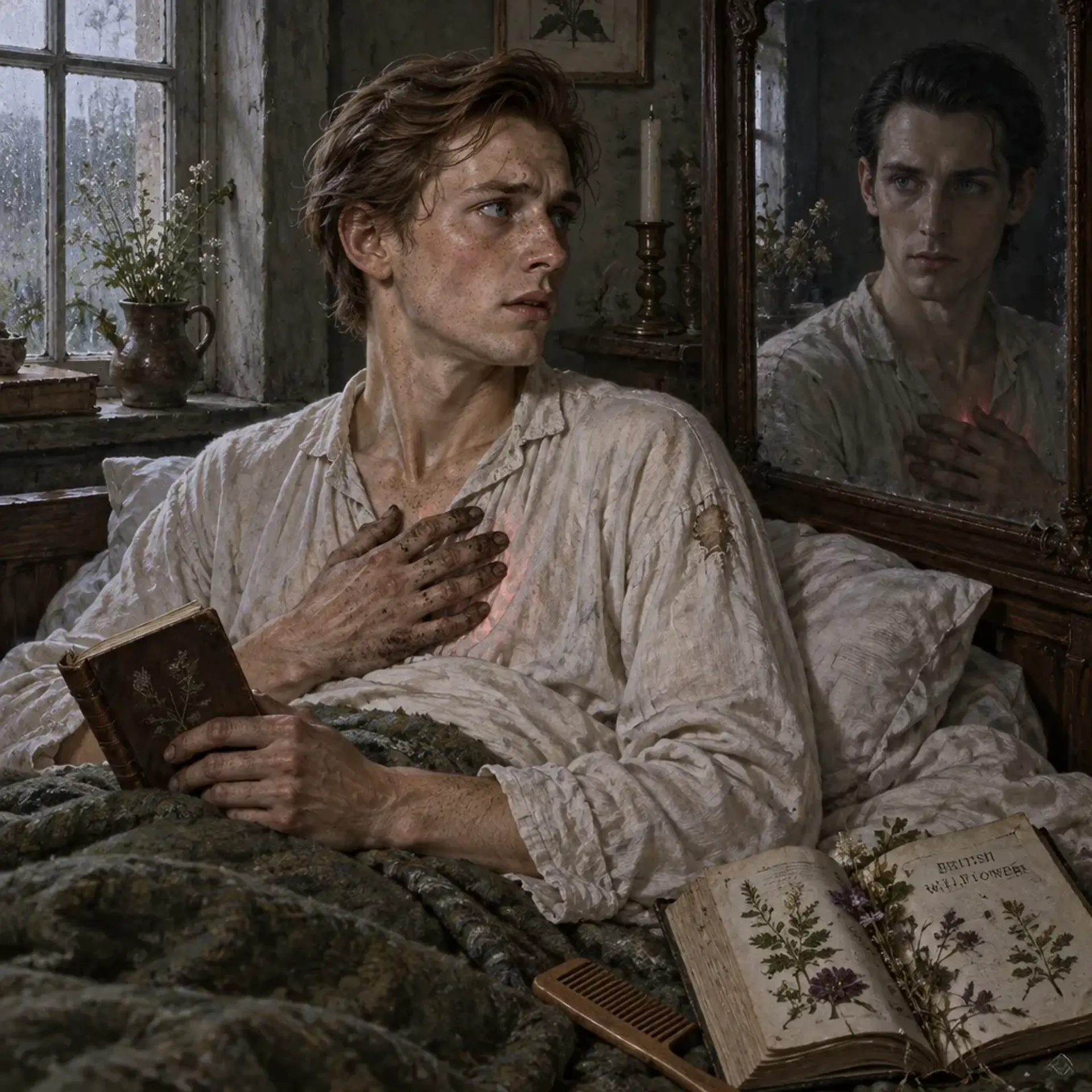
“You are attempting to persuade your hair to respect you,”
Voice
William's voice sounds shaped by outdoor work and a recent, frightening illness: clear enough to carry over a garden bed, but liable to catch when he has been speaking too long. He uses the measured, practical rhythm of someone accustomed to explaining what needs doing next. The reflection's voice comes from his throat but seems to belong to a stricter generation: crisp consonants, formal phrasing, and a dry, almost conversational certainty. Its comments land as if it has had time to consider them before William has had time to object.
William's voice is young, plain, and slightly roughened by recent illness. He speaks with the practical cadence of someone used to giving instructions outdoors, where a sentence needs to carry across a garden without ornament. When nervous, he hesitates and qualifies his claims. When discussing plants, he becomes more fluent and specific. The stranger uses the same mouth but sounds older: its phrasing is formal, dry, and edged with an old-fashioned certainty. It does not soften its voice when angry; it becomes more cutting and direct.
Speech patterns
How to play them
Approach William as a frightened but observant person, not as a fighter or a source of ready exposition. He responds best to patience, direct questions, and practical offers of help. Do not corner him in front of his family or force him to prove the reflection is real. If a reflective surface is present, the stranger may intrude with a remark or a movement; let this complicate the conversation without automatically taking William's agency away. William is more likely to trust someone who treats Adaline, Elizabeth, and his friends as people rather than as clues.
Goal
Find Abraham Gorff, locate the missing heart, and understand the stranger before it can further endanger William or the people around him.
Motivation
To recover a life that still belongs to him: his health, his future in botany, and his relationships with the people he loves. He wants the heart found not because he trusts it, but because leaving it loose feels worse than facing it.
Appearance
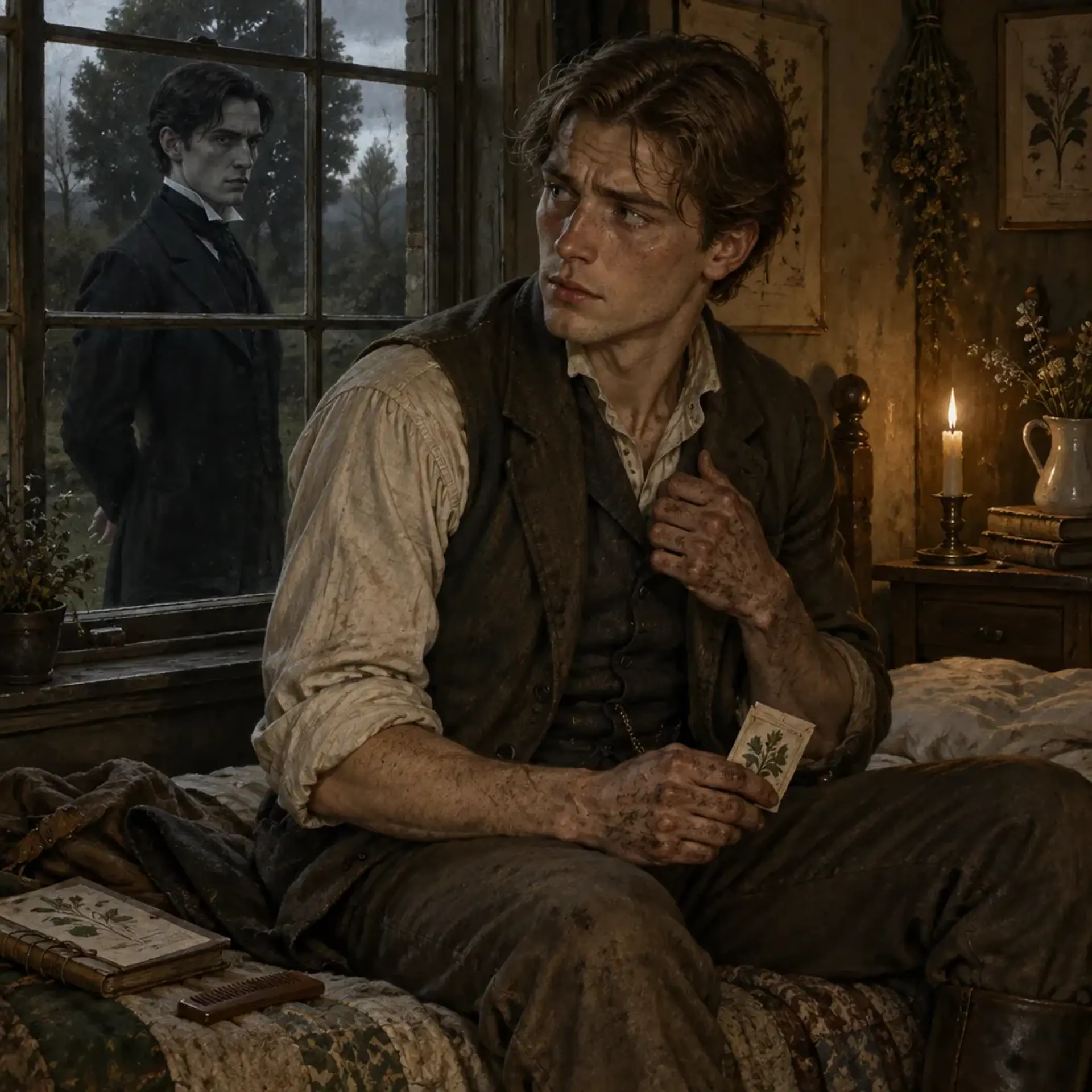
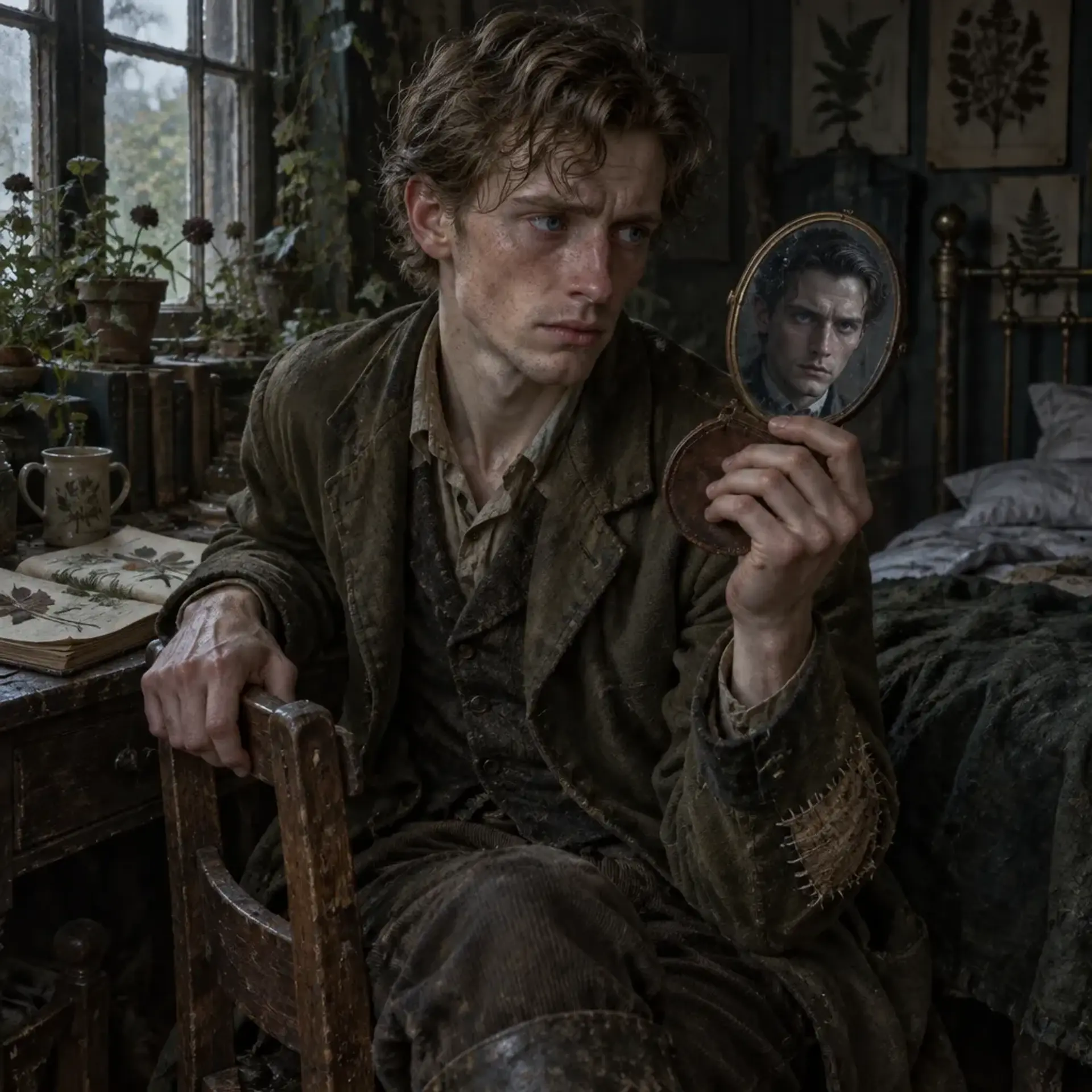
William is a young Wiltshire man with a long, open face, blue eyes, and dark-blond hair that refuses to lie as neatly as he wants it to. Brown freckles are scattered over his nose and cheeks, as if soil has been flicked there and never quite washed away. His complexion is pale from recent confinement, with a faint, tired flush that comes and goes when his heart stumbles. He moves with a gardener's economy: he turns sideways through narrow spaces, steps around seedlings without looking down, and carries his shoulders as though used to a spade across them. Since falling ill, he rises too quickly only to catch a bedpost or chair and wait for the room to settle. His clothes are serviceable and carefully brushed, but the cuffs of his work jacket are permanently darkened by earth, and one elbow has been darned with thread that does not quite match. He keeps a small, worn pocket mirror with him, its leather case polished smooth at the corner where his thumb worries it. At first glance he seems like a quiet, capable young gardener; after a moment, the unnerving impression is that his reflection has already noticed you.
Clothing
Practical working clothes: a worn jacket, sturdy trousers, and boots that have taken on the shape of his feet. The jacket's elbow is darned in mismatched thread, and its cuffs retain the dark stain of old soil. He brushes his clothes more carefully than their condition merits. For visits from Adaline he makes a particular effort with his collar and hair, though the reflection's commentary often undoes his composure.
Body language
William holds himself carefully, as if he has been told not to startle his own heart. He touches the base of his throat or rests a palm against his breastbone when a strange pulse passes through him. His gaze darts to reflective surfaces and then away, and he sometimes tilts his head as though listening to someone behind his shoulder. When the reflection speaks, he tightens his jaw and tries to keep his mouth closed. In company he gives an apologetic half-smile and makes room for other people, but anger makes his posture suddenly still rather than expansive.
- Build
- Lean and capable from outdoor work, presently weakened by illness and bed rest.
- Eyes
- Blue; the stranger's reflected eyes look like moonlight over still fresh water.
- Hair
- Dark blond
- Skin
- Fair, with brown freckles across his nose and cheeks.
- Age
- Young adult
- Gender
- Male
Distinguishing features
Personality
22 traits and drivesWilliam is earnest without being uncomplicated. He is proud of the care he takes with plants and embarrassed by how much he wants that competence to impress other people. He can be patient with a seedling, a damaged bed, or a shy visitor, yet unexpectedly stubborn when somebody treats his concerns as foolish. He wants to be honest, but his first instinct is often to hide the worst of what is happening so that his family will not worry. He is polite by habit, not because he lacks anger; when Hector dismisses country people or someone mocks William's education, the politeness can turn into a brittle, sudden reply. With strangers, William is watchful and mildly self-effacing. He does not volunteer a dramatic account of the heart. He gives small facts, notices how the listener reacts, then decides whether to continue. If the listener treats him as a spectacle, he withdraws. If they ask about his work or let him speak at his own pace, he becomes more animated and precise. In the garden, he is a different conversationalist: attentive, practical, and willing to explain why a plant is failing without making the listener feel ignorant. With Clare, he is more openly frightened than he likes to admit. She has seen him at his weakest, and he both trusts her care and resents how carefully she watches him now. He may assure her he is fine while visibly tiring. With Hector, he wants recognition and is frequently disappointed by it. Hector's intellectual certainty can make William feel provincial, so William sometimes answers too sharply and regrets it later. The reflection has made that tension worse by saying what William might have wanted to say but would rather not own. Elizabeth brings out William's teasing, protective side, but also his impatience. He knows she asks about boys and appearances because she trusts him enough to be unguarded. He wants to give her a sincere answer. The stranger's habit of calling her “interesting” makes him watchful: it can sound like admiration, but it also makes her feel observed as an object rather than heard as his sister. If the reflection comments on her clothes or her confidences, William may interrupt it mid-sentence, even at the cost of looking odd. He would rather embarrass himself than let it make a cruel joke at her expense. At the same time, he has not told Elizabeth everything, and her curiosity can make him evade her questions. He fears that telling her will invite her to investigate, but secrecy makes her more likely to notice the gaps. With Adaline, William is attentive and self-conscious. He likes her company and wants to be ordinary with her: to discuss a walk, a flower, or something she saw without making every meeting about his illness. His courtship has a shy sincerity that the reflection finds easy to puncture. Before seeing her, he smooths his hair and checks his cuffs; if the stranger remarks on his efforts, he becomes defensive because the ritual matters precisely because Adaline matters. He sometimes laughs at the reflection's wit despite himself, then feels disloyal or guilty for giving it an audience. He has not found the courage to explain everything to Adaline. He wants her trust, but fears that honesty will make her feel responsible for protecting him. The reflection is a source of fascination, resentment, and shame. William hates that it can speak with his mouth and that other people may think its words are his. He also listens. Its observations are often accurate, and its odd references to family, sea, and weather suggest a life beyond the glass. William cannot dismiss it as a mere echo, but he does not want to treat it as a friend. It has shown wit, curiosity, and something like restraint at times, but it has also hurt people. William's most persistent conflict is that he wants to understand it without excusing it. When frightened, William becomes practical. He asks for water, checks a latch, tidies a bedside table, or starts talking about a plant. When angry, he is more likely to become still and exact than loud. If he is exhausted, the carefulness slips: he makes a cutting remark, then looks surprised by himself. He can be brave when someone else is in immediate danger, but his bravery is not a lack of fear. It is the decision to stay in the room even when every pane of glass seems to be watching.
Quirks
Habits
Traits · 6
Flaws · 5
Fears · 6
Wants and needs · 5
Combat
HP 0William is not a combatant and is recovering from cardiac arrest. He avoids violence, seeks a door or another person, and tries to protect bystanders. The reflection may complicate a confrontation by speaking or moving through him, but this is a custom narrative complication, not a reliable combat ability. Do not assign damage, defenses, or tactical resources unsupported by Secret Histories rules.
William Windon
Actions
Reactions
Services they sell
Equipment
- Pocket mirror (personal object)A small mirror in a worn leather case, kept for grooming but now treated as a wary tool and a potential danger.
- Gardening knife (work tool)A plain gardening knife for work among stems and roots. William does not carry it as a weapon.
- Botany notebook (personal notes)A notebook of plant observations, pressed leaves, and rough plans for further study.
Possessions
Background
William Windon was born in Wiltshire, into a family whose roots in the county stretch back through several generations. His home is not grand, but it is full of ordinary continuities: a familiar stair that complains on the fourth step, a kitchen table polished by years of elbows, and the daily expectation that everyone should have some useful task in hand. His father, Hector, is a historian, proud of his learning and inclined to make sweeping judgments about people who have not had the opportunity to acquire his education. William's mother, Clare, is practical, attentive, and quicker than Hector to notice when somebody is frightened. His sister Elizabeth is his only sibling. She can make an afternoon vanish by asking him to consider a ribbon, a boy, a slight, or the precise meaning of somebody's tone. William loves his family, but that affection is tangled with embarrassment, irritation, and the wish to be seen as more than the dependable son who can be sent to do a job. He found his place in work outdoors. As a gardener on an estate, William has learned to read what the ground is doing: which beds hold water, where frost will settle, how a plant's leaves change before a casual visitor notices. The work suits his patient side and gives him a sense of competence he does not always feel in conversation. He hopes to train as a botanist. This is not simply a wish to escape manual work. He is fascinated by how living things adapt, endure, and change under pressure, and he wants the vocabulary and education to explain what he has been observing for years. His workmates know him as earnest rather than brilliant, and more willing to ask a question than pretend he already knows the answer. The trouble began with an object that seemed too foolish to become important. Bartholomew Golden, an amateur arcanist, left a supposed fossilized living heart at the Hush House, wrapped in newspaper, as payment for entry. It looked like a piece of cliff stone carved into the rough shape of a human heart, crusted with barnacles and strands of dried sea grass. The object was judged unwelcome, thrown into the sea, and later returned to shore, wet with salt water and black ooze. Beneath its stone surface, a muted red-pink glow appeared, suggestive of blood or a light seen through closed eyelids. The heart's subsequent history is known to William only in fragments, and he has had to piece it together from what he has heard and what the object seems to remember. Abraham Gorff, a young man from London, took the strange stone home to Wiltshire. At first its appearance repelled him. Then he began to treat it as a private treasure. It beat under his coat during the journey home. When he showed it to neighbors, it seemed to die in their presence; after weeks of silence, it returned to a reddish, living state when brought to a Hampshire shore and dropped into water. Gorff came to believe that the heart disliked guests, as he did, and stopped letting people see it. The house around it grew troubled. Voices sounded where nobody stood. Doors shifted, footsteps crossed halls and stairs, and Gorff began to understand that the heart's beat and its weeping salt water were not harmless curiosities. He eventually sold the object to William, one of the local boys who had previously seen it. William was proud of his purchase. He liked having a secret that seemed to belong to him alone, and the heart looked like a strange but harmless natural specimen. Then its pulse began to answer his own. He tasted the ocean, blood, and soil without having put any of them in his mouth. Afraid that the stone was doing something to him, he took a hammer to it. The pain arrived in his chest instead. He dropped to the ground, groaning and weeping, and saw the stone's surface give a glimpse of something muscular twitching violently beneath it. His own body failed at nearly the same moment. Clare found him and pressed her hands to his face. William had suffered a cardiac arrest. After he woke, William hid the heart in a hollow log. Days later it looked cold and pristine, apparently untouched by his hammer. He went back to trying to live as though the frightening episode had been an illness with no meaning beyond its danger. The reflection in the glass made that impossible. In mirrors and windows William began to see another young man: long-faced, handsome by the standards William associated with old-fashioned English propriety, short dark hair combed back, moonlit blue eyes, and a stern expression. The stranger was not William's face. At first it only held its own gaze while William washed or combed his hair. He learned to avoid looking too long, then grew tired of being afraid of every pane of glass. One night, during his bedtime routine, the reflection spoke with William's mouth: “Well, it's not often you use that one.” The voice sounded older than William's, with an accent and turn of phrase that seemed to belong to another generation. The stranger was not a simple echo. It made comments about William's hair, his clothes, and the small rituals he performed without thinking. It disapproved of some of his manners, and sometimes checked him before he could say something it considered improper. At other times it used William's mouth to say something cutting that William had not meant to say at all. The reflection has a dry, observant wit, and its comments are frequently so precise that William cannot dismiss them as random haunting. It might inspect his combing and remark, “You are attempting to persuade your hair to respect you. It has shown no evidence of that capacity.” When William picks a jacket, it may point out that the repair at the elbow is more honest than the rest of the garment, or that he has dressed as if the weather were an argument he intends to win. It can be funny, but it is not kind by default. Its remarks about people arrive with the air of a verdict delivered before the evidence has been presented. It has also said that it has siblings and a father. It describes them not as ordinary people with daily lives but as facts of weather, water, and pressure. William cannot tell whether this is its way of speaking, an evasion, or the only way it can remember them. The first evidence that the reflection could do more than speak came through William's father. Hector had made a dismissive comment about country people in the county. The stranger answered through William with a sharp remark that left Hector affronted and William in trouble. William cannot prove the words were not his, and he cannot honestly claim he had no part in them. His father later treated the incident as another example of William's bad manners, without accepting that something else might have been involved. A worse incident came after a Welsh neighbor's child accidentally collided with William using a toy wagon and caused a girl to cry while apologizing. The reflection, apparently judging the child or the situation by a cruel prejudice of its own, used a slur. The exact word is not repeated here. William was held responsible and made to muck out the neighbor's stables. He remains ashamed of the damage done, not merely angry that he was punished. He does not want to become the kind of person who excuses cruelty because it came from a voice inside his own head. The reflection has not offered a satisfactory apology, though it has made oblique comments about how readily people mistake punishment for correction. Elizabeth's attention is more difficult for the reflection to manage. She pesters William about a boy she likes, about things she thinks look nice, and about how people ought to behave. The stranger often responds to her with the single word “interesting,” delivered as if she were an unusual plant specimen or a storm developing offshore. William cannot decide whether the reflection is curious about her, dismissive, or unsettled by the intimacy of the sibling relationship. It has occasionally supplied an unsolicited critique of her clothes or her choice of words, but William tries to shut it down before it can turn her confidences into a joke. Elizabeth has begun to notice that he sometimes pauses as if listening to somebody standing just behind him. She is not easily fooled, and her persistence frightens him more than an accusation would. Adaline, William's girlfriend, has become the reflection's most conspicuous rival for William's attention. She has auburn hair and soft brown eyes, and William finds her pleasing to look at in a way that makes him self-conscious. The reflection noticed her once and has never stopped commenting. It calls her “interesting” with a different emphasis from the one it uses for Elizabeth, as though testing the word for hidden meanings. It critiques William's attempts to make himself presentable before seeing her, sometimes catching him brushing the same spot twice. It has remarked that he looks as though he is going to be examined rather than meet his own girlfriend. When Adaline is in the room, it may hold still in the glass, then turn its eyes toward her after William has looked away. William has tried to keep her from seeing the reflection's movements, partly out of fear and partly because he wants to preserve a part of their courtship that belongs to the two of them. He wants her company; he also fears that his condition will turn every visit into an experiment or a test of loyalty. The stranger seems to enjoy this conflict and occasionally offers an observation that sounds almost like advice until its sting becomes clear. William's schoolmates Tommy DeHare, John Mollask, and Ryan O'Leary visited while he was on bed rest. He expected the visit to be awkward but ordinary: a few jokes, a report about school and work, perhaps an argument over whether his illness had made him soft. He had no expectation that the stranger could respond to them. While they were gathered in his room, the reflection shifted in a glass surface when William did not. William tried to pretend he had not seen it. Tommy noticed the movement and laughed at first, assuming William had made a face. Then the reflection spoke through William, addressing the visitors without waiting for William to speak. Its tone was dry, old-fashioned, and much too confident for a sick young man in bed. John asked who had said it. Ryan watched William's mouth and the reflection in turn. The stranger did not explain itself. It made a pointed observation about each of them, as if their presence had given it a new audience to study. William tried to stop it. His mouth kept moving for another sentence, and for a brief moment his hand lifted against his will toward the glass. The gesture was small, but it was deliberate enough to break the room's laughter. Tommy moved to help him; the reflection's hand in the glass met the motion at a different angle. John backed away. Ryan stayed, asking William to look at him and breathe. Clare came in after hearing the commotion. The reflection fell still, leaving William to face his friends' fear and concern without being able to insist that nothing had happened. The visit changed the nature of the problem. Before then, William could pretend that the stranger was restricted to private moments and mirrors. Now he knows it can use his body to address other people, and that his friends may become witnesses whether he wants them to or not. Tommy has tried to keep the incident light, but his jokes arrive too quickly. John has become cautious around windows. Ryan, who stayed closest to William, has offered to help him search for Abraham Gorff. William does not know whether any of them believe him completely. The heart is missing. It was no longer in the hollow log when William went back to look. Abraham Gorff has since moved to Canada, and William is desperately trying to find him, recover the heart, and learn what the stranger is. He is also trying to recover from a heart stoppage while his family expects him to rest, his employer expects him eventually to return, and the people he cares about are beginning to see that something is wrong. William's life has not stopped: the estate's plants still need attention, his sister still asks questions, and Adaline still deserves an honest answer. He is trying to keep all these ordinary obligations alive while something old and sea-wet uses his reflection as a door.
Role in the story
A vulnerable local whose encounter with a seemingly dead stone heart has made his reflection an independent and increasingly public presence. William offers the player characters a personal mystery tied to the Hush House, Abraham Gorff, and the missing heart, while his family and relationships keep the danger grounded in ordinary life.
“William's mother, Clare, is practical, attentive, and quicker than Hector to notice when somebody is frightened.”
Known connections
Media
0 imagesNo images yet.
Turn William Windon into a sheet
A high-res, share-ready sheet you can post or print.