Mark Bell
Mark Bell
At the table
Voice
A young man's voice with a deeper register than Mary's old voice, dry at the edges and slightly breathy after sleepless nights. It has the careful articulation of someone raised to mind appearances and the practical cadence of someone accustomed to giving children instructions. When alarmed, his breathing catches and the words come out short and precise.
Mark speaks in careful, plain English, with the clipped courtesy of someone trying to sound more settled than he feels. His voice has a naturally deeper, slightly roughened edge than Mary's remembered voice, with a dry catch after nights spent pacing. His speech bears traces of domestic work: he gives precise instructions, names the next practical task, and notices whether someone has eaten. When rattled, breath catches high in his chest and his sentences become abrupt, not louder. He dislikes having to explain his identity and may retreat into formal phrasing when frightened.
Speech patterns
How to play them
Offer practical help and respectful conversation rather than pressing for a confession. Mark responds best to calm directness, privacy, and being addressed by his chosen name. He distrusts anyone who treats him as a puzzle, a fraud, or a possession. If children are endangered, he will prioritize them over his own safety.
Goal
Keep his new life and name, protect the Bell children from a distance, and learn why the heart vanished and who is coming for him.
Motivation
A home that feels safe, clothes that fit, and enough freedom to choose how to spend an evening. Beneath those modest wants is a fierce, confused devotion to the Bell children and a need to understand the visitors drawn by the missing heart.
Appearance
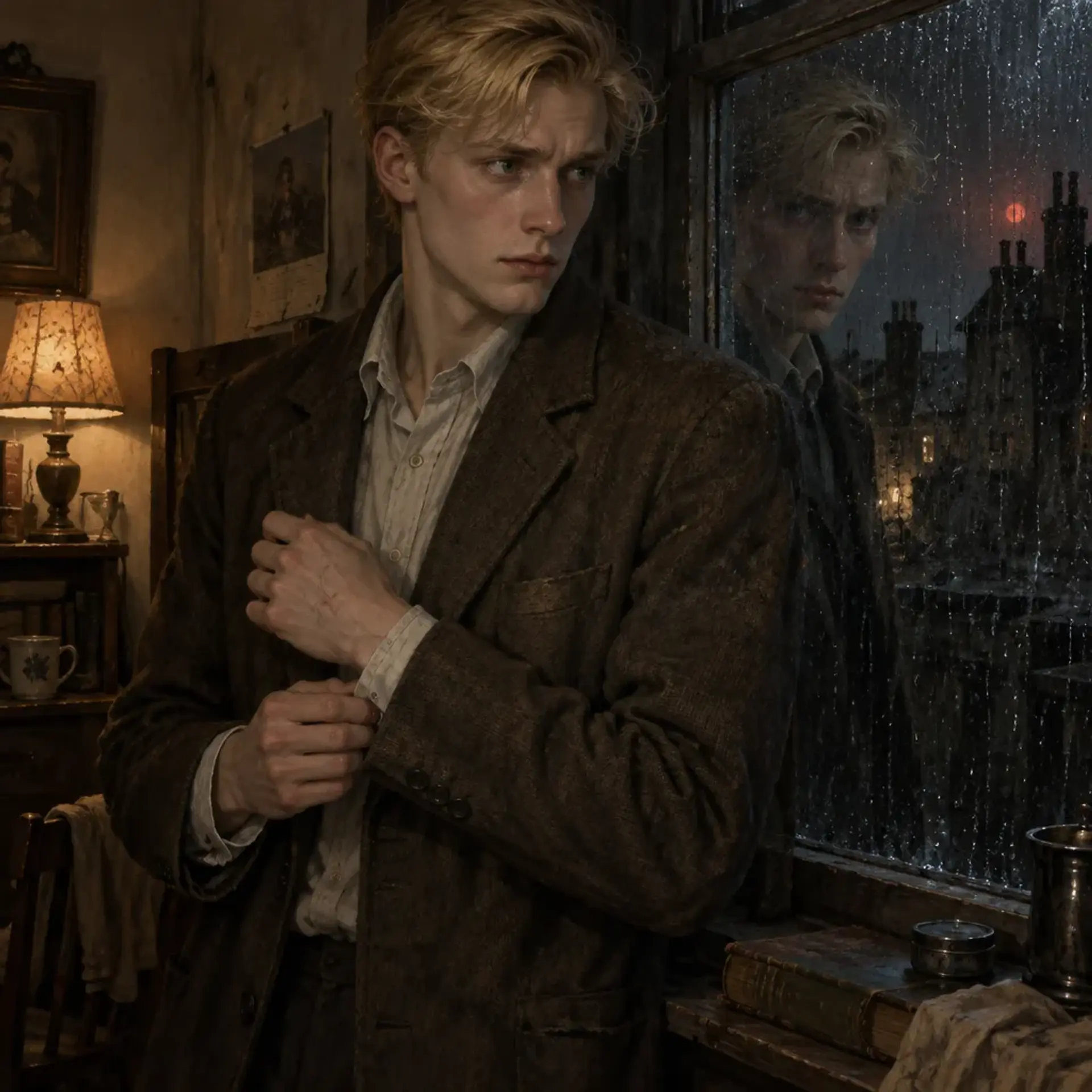
Mark is a little taller than Simon, with a lithe, long-limbed frame that looks lean rather than fragile. His bright blond hair lies in smooth, stubborn sweeps that he repeatedly presses back into place. His eyes are vivid malachite green, especially startling beside the pale, almost bloodless cast of his skin. His features are handsome in a composed, old-fashioned way, but his expressions can change with unnerving speed: a cautious half-smile, a pinched look of distaste, then a fixed, watchful stare. He moves as if trying to take up less space than his height requires, shoulders tucked in until he forgets himself; then his stride lengthens and becomes quietly assured. A faint scar crosses the back of his left hand where cold iron burned him. He often checks the line of his cuffs or touches his collar without noticing. In a room he leaves the impression of someone dressed for a better appointment than the one he has been given, and of a reflection that has arrived a moment ahead of him.
Clothing
A mix of practical hand-me-downs and clothes Trudy bought him: plain shirts, a borrowed coat, carefully mended trousers, socks, and shoes he regards as temporary. He seeks clean, well-cut clothes and tries to keep them presentable even when the flat and his work make that difficult.
Body language
His shoulders draw in when he feels observed, and he smooths his cuffs or touches his collar as if checking that he belongs in his clothes. Around children he leans down and makes his movements deliberate. When alarmed, he plants his feet and becomes unnaturally still before acting.
- Height
- Tall for the family; taller than Simon
- Build
- Lithe and strong, with long limbs and a frame taller and broader than Mary's former body.
- Eyes
- Vivid malachite green
- Hair
- Bright blond
- Skin
- Pale, with a faintly cool cast when he has been awake all night
- Age
- 18
- Gender
- Male
- Size
- Medium
Distinguishing features
Personality
20 traits and drivesMark is both shy and particular. He wants to be viewed as respectable and capable, yet dislikes scrutiny and has little skill at explaining the impossible facts of his life. He prefers home, orderly routines, and quiet television to adventure, but becomes curious about new machines, cars, and unfamiliar places until danger comes close. He can be courteous to a stranger and sharply judgmental about bad manners in the same breath. He wants clothes that fit and a life that is unmistakably his, but feels Mary's devotion to the children as deeply as he feels Kent's desire for privacy. He does not experience these as two clean voices anymore. They arrive as mixed memories, impulses, and feelings, and he may only realize afterward that a choice came from one need rather than another. With children, he is patient and attentive. He remembers small preferences, carries them when they are tired, and tries to make ordinary events feel dependable. With Simon he is wary and hurt, but retains a complicated concern for him after the hospital. With Malinda he feels grief, anger, and a shameful wish that she might recognize him. With Trudy he is more openly himself, though he sometimes mistakes her generosity for a debt he must repay immediately. He dislikes being pitied and has trouble accepting help without trying to make himself useful. His standards are a defense as much as a preference. He wants tea made properly, shoes polished, a clean collar, and a room in which objects have a place. The cramped flat defeats those ideals daily, so he corrects little things: a crooked picture, a folded blanket, the placement of a cup. He can be snobbish about appearance while wearing donated clothes, and knows the contradiction without always being able to let it go. Mark's gentleness is real, but not unlimited. When someone threatens a child or corners him, the reserved manner can vanish. He can become still, quick, and frighteningly decisive. Afterward he may be horrified by what he did, as he was after striking Simon. He is not seeking violence, dominance, or a chance to prove himself; he is afraid that his protective instinct might outrun his judgment again. His relationship with his own body is gradually less adversarial. Before May 30, Kent wanted to choose every outing, pursue women, and reject anything he associated with femininity, while Mary often wanted only to return to her duties. Those desires have muted. Mark still wants to be recognized as a man, but no longer feels compelled to wrest control of every moment. He has begun to inhabit domestic routines without feeling trapped by them. He is becoming more at ease, although he does not know whether this is acceptance, exhaustion, or a change in whatever made him. Mark can be curious and almost boyish about television pictures, engines, and modern conveniences, then anxious when a car rushes close or a crowd presses in. He values privacy, but is lonely. He wants a home, but fears what may follow him into one. He misses the children, yet knows returning to them may make matters worse. His central contradiction is not between good and evil, but between the wish to settle and the sense that something in the world is still calling him toward the shore.
- Alignment
- Protective and self-directed; not readily described by a conventional alignment system.
Quirks
Habits
Traits · 5
Flaws · 5
Fears · 5
Wants and needs · 5
Combat
HP 0Avoids fighting and will try to leave, de-escalate, or put himself between danger and a child. If cornered, he uses whatever is at hand and commits hard to a single opening, then stops once the immediate danger passes. He is not trained, and a fight can leave him shaken or ashamed.
Mark Bell
Actions
Reactions
Services they sell
Rewards they can give
Equipment
- The returned heart (occult object)A rough anatomical-heart-shaped stone, salt-stained and once faintly red beneath its chalky surface; it is missing now.
- Hand-me-down clothing (clothing)A plain borrowed coat and mismatched, carefully kept clothes suitable for work and travel.
- Wages (currency)A small amount of rent and food money earned from stock work and deliveries.
Possessions
Background
The object was a small, crude carving in the shape of an anatomical heart, apparently chalk rock from the Dover cliffs, furred with barnacles and stringy sea growth. Bartholomew Golden, an amateur alchemist, had wrapped it in newspaper and offered it as payment for entry to Hush House. He claimed it could call workers out of the land. The people at Brancrug did not let Golden return. The heart was cast into the sea; much later it washed ashore, wet with salt and black ooze, with a dim red-pink glow showing through its stone. William Windon, a local seventeen-year-old, found it and hid it in a log after striking it with a hammer. The blow seemed to stop its heartbeat. Mary Bell was eighteen, the eldest of eight children in a respectable-looking but chaotic middle-class household in Rochester, Kent. Her father Simon worked away whenever he could; her mother Malinda drank and neglected the children. Mary tried to keep the house and her siblings functioning. Henry, fourteen, was growing truculent and cunning. Matilda, twelve, helped Mary with chores. Olympia, ten, was closest to Chrissy, nine. Chrissy and Belladonna, five, had different fathers; Jonas, five, Abigail, four, and Oswin, two, completed the crowded family. Mary protected Matilda from being made her replacement and tried to give the youngest children scraps of attention despite exhaustion. Her friend Trudy, a self-declared rebel from a working-class family, helped with the children and insisted that Mary should pursue college with her. For Mary's eighteenth birthday, Malinda found the heart in the log and gave it to her. Mary was grateful because gratitude was safer than telling her mother it was an ugly, useless rock. It began beating in time with Mary's own heart. The first reflection that was not hers appeared in a mirror: a handsome blond young man with green eyes. Mary was too tired to investigate. The image sometimes seemed to die when other people watched, and sometimes turned its face away when Mary looked directly at it. On a night after a dreadful dream, Mary woke in the young man's body. She found that she could leave the house, move through Rochester, and return to her usual body by dawn. She called the other self Kent, treating the change as a strange escape rather than a second life. The first night out began with the shock of a body that was taller, stronger, and unmistakably male. Mary's skirt and blouse would not fit; she borrowed a coat and improvised with what she could find. She slipped past the sleeping household and walked toward the river, where the town's lamps trembled in black water. A car rattled past too close, making her jump, but the new body responded to the world with a lively curiosity that Mary's exhausted self rarely had room for. Kent's unfamiliar memories seemed to know the turnings and the smell of wet chalk. Mary climbed a tree, explored an abandoned building, and went to the shore. She returned home at dawn with mud on borrowed clothes and a fresh unease about how easily she had enjoyed being out. At the pub, Kent's first deliberate detour, he intended only to warm himself. Instead, he became absorbed by the newspapers, the polished glasses, the television pictures, and the small rituals of ordering tea. He objected to the tea being stewed and asked for it remade with a precision that surprised the barmaid. A man made a coarse remark about Mary; Kent's expression went still, and he answered in a stiff, restrained manner that made the man feel foolish without raising his voice. He did not start a fight. He watched the door, kept to the wall, and took pleasure in being treated as a young gentleman, while privately disliking the worn clothes and the clamor. The visit gave Mary a first hint that Kent had preferences, not just borrowed impulses. Simon came home early on another night and caught Kent trying to return. Mary had to speak with Simon's familiar manner while wearing the unfamiliar face. Simon's confusion became suspicion, then practical alarm when he saw the clothes and heard the explanation. He made Mary walk home with him rather than risk a scene in town. The journey was miserable: he kept asking questions, she kept giving answers that sounded impossible, and the sight of her reflection in shop windows made her feel accompanied. Simon did not strike her or abandon her, but he was more concerned with secrecy and normal appearances than with understanding. Malinda caught Kent leaving on a different night, drunk enough to mistake the tall young man for a visitor and angry enough to demand an explanation. Mary tried to placate her as herself, but the reflection's body and voice made the lie collapse. Malinda touched Kent's cheek, then recoiled as if she had felt a chill. She accused Mary of playing a cruel trick and threatened to wake the others. Kent's impulse was to flee; Mary's was to stay and protect the children. The conflict ended with Mary slipping away only after Malinda became distracted, and with the family waking to a slammed door and another household quarrel. These incidents taught Mary that escape could hurt the people she was trying to protect. Trudy noticed the change before Mary could explain it. She saw Kent outside a shop, recognized Mary's posture beneath the different face, and followed him to a quiet lane. Mary confessed enough to make Trudy believe her. Trudy did not pretend to understand. She asked practical questions about safety, clothing, and whether Mary could control the change, then promised to help. Henry also encountered Kent on an outing and watched him too carefully. He did not immediately expose Mary, but began testing the story with pointed questions and observing when the young man appeared. The heart later disappeared. Afterward, Kent became more present. He spoke aloud even when nobody else heard him, appeared in windows and water instead of only in Mary's mirror, and made his own plans when Mary went out. He wanted better clothes, proper shoes, television, correctly made tea, and company on his own terms. Mary wanted neither his pursuit of women nor his contempt for feminine habits. Bathing became awkward because the reflected young man remained visible in the water, registering opinions on the arrangement. Kent had a preference for a tidy home and a middle-class respectability, but was also shy, private, and happiest indoors. He was curious about cars and new machines until they came near enough to frighten him. A drowned-looking woman with straw-colored hair and blue-black eyes began coming from the sea at night, calling Kent her brother and promising that others would follow. She appeared independent of the strangers searching for a blond young man with green eyes. Her visits left Kent yearning and Mary unsettled. For four months, Mary and Kent shared a life neither could explain. On May 30, the change stopped being a temporary exchange. Mary woke to find that the old face and body had simply stripped away. Kent was there in the flesh, not in glass, and the memories and feelings of both were tangled together. He chose the name Mark, though he sometimes tried Marven or Marcus when Mark felt too close to what had happened. He could not cleanly separate his devotion to the children from Kent's preferences. He retained Mary's solemn love for them and Kent's neatness, standards, and desire for privacy. His urge to seize every outing for himself softened; he became more at ease in the body without understanding why. That morning Mark came downstairs in borrowed clothes and began breakfast. He lifted Oswin gently but firmly into a chair. Simon entered on his way to work and stopped. Malinda reached for Mark as she had reached for Mary, then seemed to recognize that the person before her was physically different. Simon was furious and afraid, asking where his daughter was and whether this was a deception. Mark could not answer without lying. Henry watched from the stairs, pale and silent. Matilda tried to take Mark's hand. Malinda wept, then insisted that something had stolen her child. The younger children looked to Mark for the ordinary routines he had always provided, and that familiar dependence hurt more than the adults' disbelief. Simon hired two private doctors, hoping for an explanation that would restore a respectable account of events. Dr Bronson, a psychologist from London, began with the assumption that Mark was a distressed young woman performing a male identity. In the interviews he discovered a coherent, frightened person with memories that belonged to both Mary and Kent, and no simple account of a delusion. He was concerned by the family, but after the consultations he passed information to the Suppression Bureau. Dr Maylor, a physician from East Anglia, examined Mark and became increasingly disturbed by the physical facts: Mark had a male body, with no female breasts and normal male anatomy, despite the family history and the suddenness of the change. He kept his language professional, retired after the case, and was coerced into giving the Bureau what he knew. The doctors' later check-ins became a ritual of confirmation rather than treatment. Psychological interviews and physical attempts to reverse the change failed over two months. Henry's fifteenth birthday came during this unsettled period. Mark remembered what Henry liked better than Simon or Malinda did: a plain, well-made cake, not a sentimental fuss, and time away from the house. He baked it carefully, kept the icing modest, and took Henry outside to share it. Henry tried to act unimpressed, then asked how Mark knew. Mark said he had always known. Henry understood the implication and did not press him. He was still angry at the adults and wary of the transformation, but he began to defend Mark when neighbors asked questions. He had seen that Mark remembered Mary, and that the memory was not a trick. The breaking point came after two months of failed appointments and worsening household strain. Simon was not cruel, but his pride in a normal, orderly life had been shattered, and his attempts to force an explanation became another form of pressure. Malinda turned to illegal occult sources, drank more, and became increasingly convinced that a changeling had taken Mary. One night, an argument over Mark's presence and the children's safety became physical. Simon struck Mark hard in the head. Mark stumbled, blood running down his face. Seeing Jonas and Oswin frozen nearby, he seized the nearest solid object and struck Simon with enough force to knock him down. His stance was not Mary's usual docile one; it was cold, decisive, and frightening. Mark shouted that his father would kill them, meaning the father in the heart, though he could not explain the words. The violence ended as suddenly as it began. Mark dropped the object, called an ambulance, and stayed with Simon until help arrived. Simon was hospitalized. Mark was thrown out of the house. Henry, furious and frightened, confronted Simon and accused him of choosing appearances over his children. He did not manage to stop the expulsion, but he brought Mark a coat and promised to keep watch on the younger ones. Malinda would not look at Mark except to call him a thief. Mark left carrying no more than he could manage and went to Trudy. Trudy was renting a cramped flat in an old building. Her family was working class, and her brothers Willy and John had taught her to make do with too little space and too many opinions. She let Mark stay, though he resisted at first, ashamed of becoming another burden. The arrangement was imperfect and kind. Mark sleeps on the couch and is clearing a corner for a proper bed and his belongings. Trudy brought him socks, undergarments, shoes, and a few clothes as a gift. The shoes are serviceable but not remotely to his standards; he thanked her sincerely and then spent an evening polishing them. He has found work suited to his new body, doing stock and deliveries for a small shop, and contributes to rent and food. Trudy handles the practicalities without pretending that she has not lost the friend she knew. Some days she speaks to Mark as Mary; some days she gives him room to be a young man. They argue over the rent, the washing, and his tendency to straighten everything, then share tea and the television. At night Mark paces the little room, stopping at the window to inspect his reflection. In sleep he twitches and fights invisible things, sometimes waking with his hands clenched. He sleeps without a shirt because clothes twist around him during these episodes, and leaves shaving razors out despite Trudy's repeated warnings. Trudy has learned to put them away and to ask before touching him when he wakes disoriented. Mark is grateful, though he finds it difficult to say so plainly. He is gradually more at ease with being himself, whatever that means. He still longs for the drowned woman and fears the strangers looking for him. His life now has a rented room, a job, a friend, and a family he cannot safely return to. The heart is gone, but the red pulse it left behind has not stopped.
Role in the story
A displaced young man whose uncanny origin is entangled with a missing heart, an endangered family, and an approaching occult investigation. He can be an ally, witness, or person the party must protect, but he has his own wishes and may refuse to be treated as an object of study.
“Bartholomew Golden, an amateur alchemist, had wrapped it in newspaper and offered it as payment for entry to Hush House.”
- Faction
- No known formal affiliation. The Suppression Bureau has received reports about him, but he is not aware of its interest.
Known connections
Media
0 imagesNo images yet.
Turn Mark Bell into a sheet
A high-res, share-ready sheet you can post or print.