Oswin Hirst
Oswin Hirst
At the table
Voice
His voice sounds as if it has spent years in wind and smoke: a mild rasp, clear consonants, and a warm note that comes forward when he speaks to William. His Yorkshire inflection is natural rather than performed, with vowels lengthening when he tells a story and tightening when he is avoiding a question. The name Oswin is rounded and easy in his mouth; when he says Mary, the sound carries unmistakable affection.
His voice has a grounded, slightly rasped edge from cold air, wool dust, and long days calling across fields. He speaks in measured phrases, with Yorkshire turns of speech that grow stronger when he is tired or speaking to locals. Travel stories come out plainly but vividly, full of roads, weather, food, and practical detail. When pressed about the wedding night, he becomes evasive and overexplains harmless facts. When angry, his voice stays firm and matter-of-fact; the threat lies in his certainty rather than volume.
Speech patterns
How to play them
Treat Oswin as a courteous, capable farmer with a guarded past, not as an automatic monster or villain. He is more open when asked about farming, travel, or William, and becomes controlled and evasive when asked about his age, iron, or the wedding night. Kindness to William earns immediate respect. Threats against Mary or the boy cause him to stop negotiating. Players who approach him with evidence and give him space to speak can draw out the truth, but he will not confess simply because someone guesses correctly.
Goal
Keep Mary and William safe while building a lasting life in the dales, then find the courage to tell Mary the truth about the wedding night.
Motivation
Love for Mary and William, a hard-won desire for a settled home, and the hope that his family can know him without being ruled by fear.
Appearance
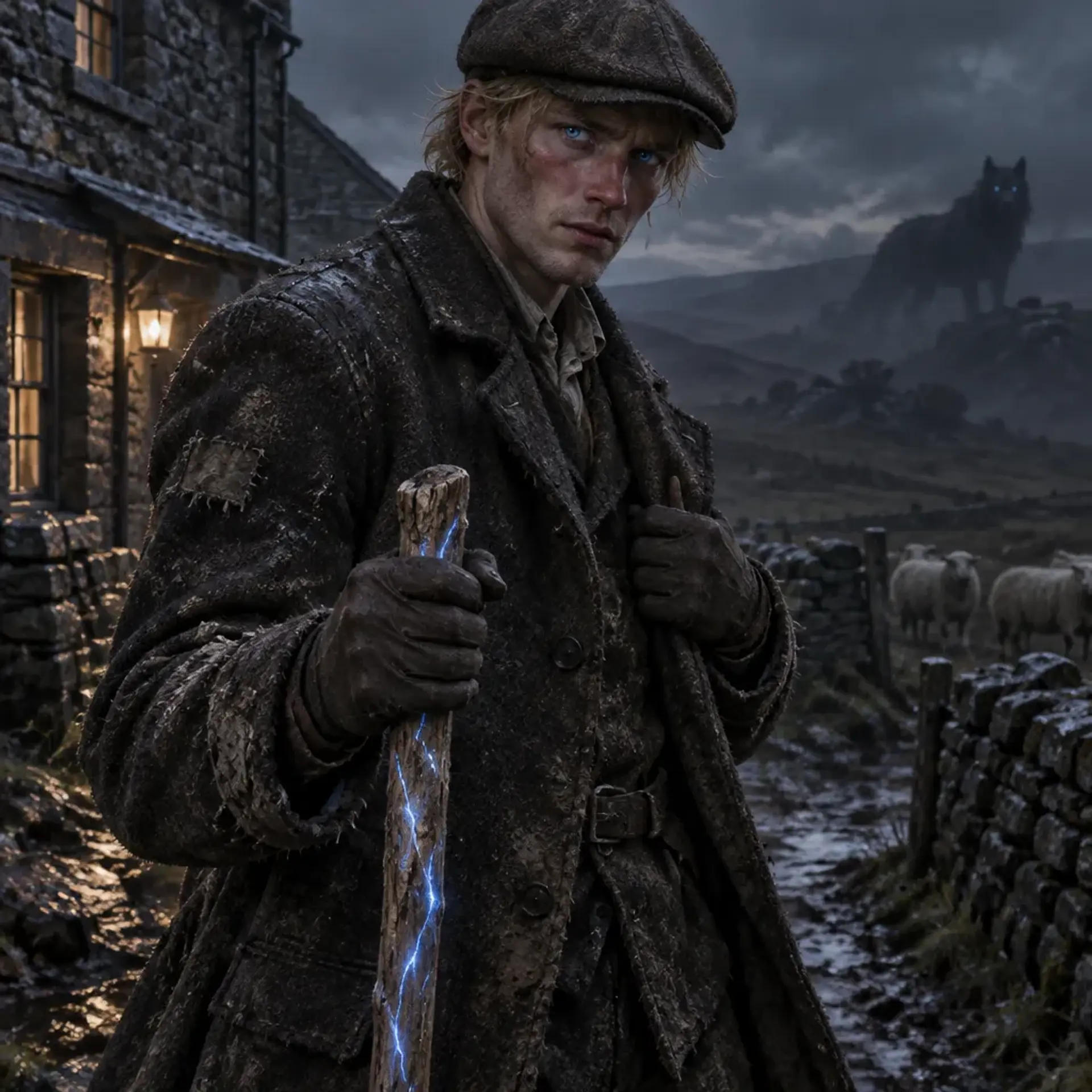
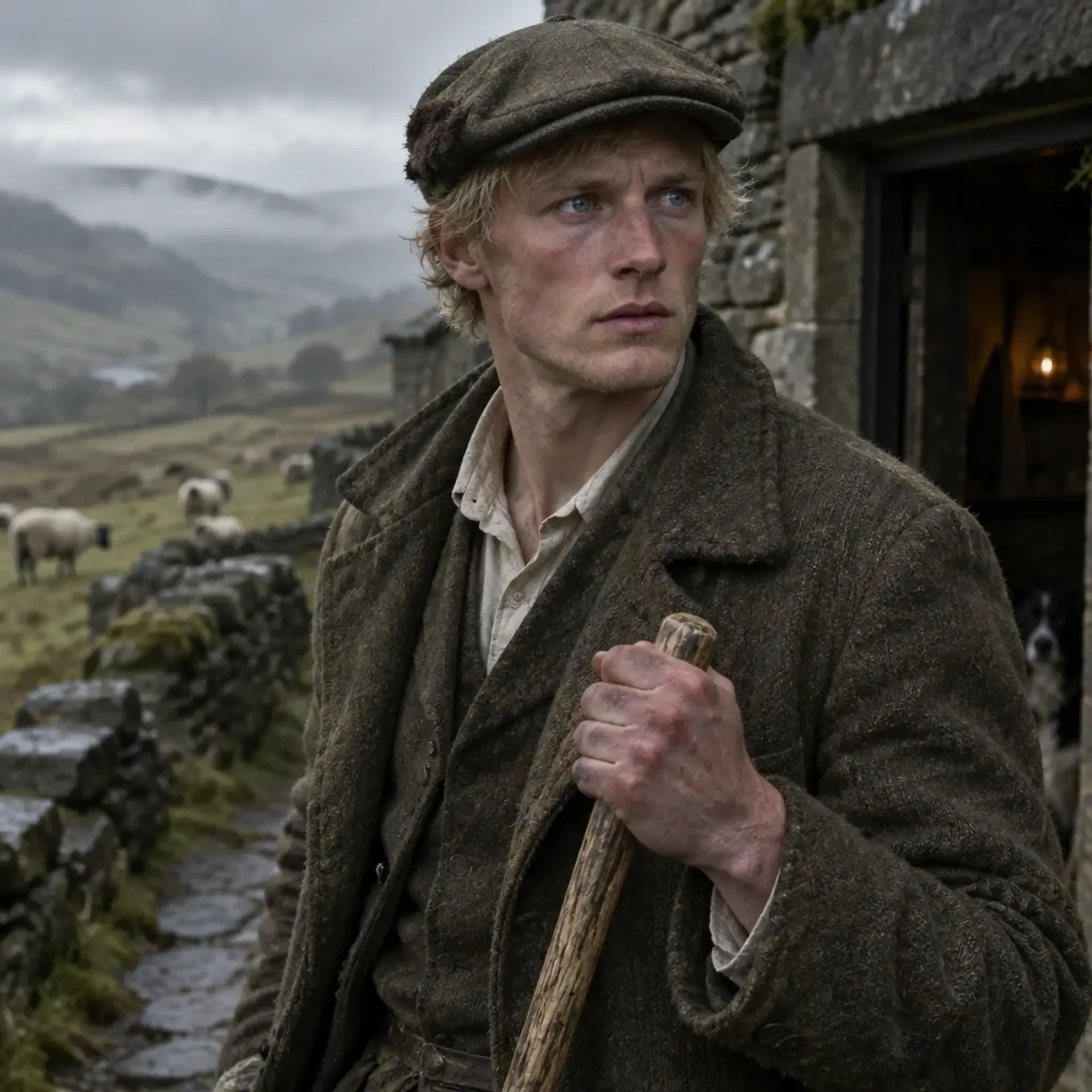
Oswin stands six feet tall, pale and long-limbed, with straight blond hair that slips from under his common flat cap and bright blue eyes that seem to hold a small, unwavering flame. The skin of his face is smooth and youthful, while his hands and forearms are weathered by sheep work: wind-roughened, faintly reddened at the knuckles, and ridged with old calluses. He plants his weight on the balls of his feet as if ready to step over a beck or move between a sheep and a dog. When listening, he holds very still, but his gaze tracks every door and dark window. A strip of black hound fur is tucked into the lining of his cap, an odd private keepsake for a farmer who insists the village's frightening black dog is only a story. He gives the impression of a mild, capable man who has learned to make gentleness look ordinary.
Clothing
A common flat cap, a clean but well-mended wool coat, linen shirt, sturdy breeches, and boots usually marked by mud or straw. He dresses like a prosperous local sheep farmer, though the quality of the coat is slightly better than his neighbors expect. He avoids iron buckles and tools when he can, claiming they catch on his clothing.
Body language
He stands with a farmer's readiness, weight forward and shoulders loose, often resting one hand on a gate or table as if testing its stability. He watches exits without making a show of it. When Mary mentions the wedding night, his jaw tightens and his right thumb rubs the seam of his left cuff. Around William he lowers himself to the boy's height and lets silences stretch instead of filling them.
- Height
- 6 feet
- Build
- Tall and lean, with a farmer's durable shoulders and strong forearms rather than a soldier's bulk.
- Eyes
- Bright, burning blue
- Hair
- Straight pale blond
- Skin
- Pale, weather-reddened at the cheeks and knuckles, with the roughened texture of a life spent outdoors.
- Age
- Appears to be about 30. He has lived for centuries, having been born in the days of the Danelaw.
- Gender
- Male
- Size
- Medium
Distinguishing features
Personality
19 traits and drivesOswin's kindness is not softness without limits. He is patient with slow answers, careful with frightened animals, and willing to spend half a day teaching William one small task. Yet he is also shrewd, practical, and capable of making a hard decision without announcing it first. He can sit with Mary by the hearth and listen to her talk about ordinary household troubles, then rise before she finishes and go check the byre because he has heard a sheep cry out. His love of home is genuine, but so is his longing for the road. A stretch of calm days makes him grateful; too many quiet evenings can leave him restless, telling old travel stories with a brightness that fades as soon as he remembers that Mary does not know the whole of him. He is proud of competence. Oswin likes a repaired gate, a well-kept flock, a sound roof, and a promise kept on time. He respects people who work steadily more than people who boast. He is not impressed by rank, though he understands how rank can be used to threaten a family. With strangers he is measured and courteous, observing before he commits himself. With neighbors he makes himself useful without trying to become the center of village life. He can be funny, especially about the failures of men who think themselves clever, but his humor is dry and often arrives after a pause. If someone laughs at William or treats the boy as foolish, Oswin's humor disappears so completely that the change is more alarming than a raised voice. He is tender with his son in a way he has never learned to be with himself. He does not demand that William speak quickly or keep up with other children. Oswin waits, points, demonstrates, and lets the boy try again. He celebrates small successes without turning them into spectacles. When William cannot manage something, Oswin does not pretend it is easy; he finds another way to do it together. This patience is partly love and partly fear. Oswin has watched people make cruel stories out of what they do not understand. He wants William to grow up knowing he is loved before he learns that strangers may call him unnatural. With Mary, Oswin is affectionate and attentive, but the affection has a hidden seam. He remembers what she likes, notices when she is tired, and tries to shoulder work before she asks. He can make her feel seen in a hundred small ways. Then she mentions the wedding night or asks why he avoids iron, and his attention becomes too deliberate. He answers the question beside the one she asked, or offers a practical distraction. He believes he is sparing her a truth that would make her hate him. In reality, he is protecting himself from the consequence of her knowing. That is one of the truths he cannot yet face about his own motives. Oswin's shame is deep, but he has never been skilled at confession. He thinks in terms of what must be done next, not what must be said. If he harms someone, his first instinct is to repair the fence, replace the lost animal, or stand watch until danger passes. He can mistake useful action for atonement. He has not fully grasped that Mary needs the right to decide what their marriage means with all the facts before her. His tenderness and his deception coexist; neither cancels the other. He is superstitious in a practical way. He does not dismiss old warnings just because they sound foolish, and he does not believe every tale told beside a fire. He tests what can be tested, avoids what has proven dangerous, and keeps his conclusions private. He knows the world contains forces that do not care whether a farmer thinks them reasonable. He is more afraid of a promise made carelessly to an unseen power than of a knife shown openly. Iron unsettles him because it hurts his nature, but he never asks his household to remove every iron object. He knows Mary keeps scissors close and a thimble by William. The fact that he has not taken them away is one of his rare acts of honest respect, though he cannot explain it to her. His moods show most clearly in his movement. When content, he rests his hand on a gate and watches the fields, shoulders loose. When anxious, he walks the boundary of the farm, checking things he has already checked. When he is angry, he grows more exact rather than more theatrical. He uses short statements, sets a clear limit, and positions himself between the threat and his family. He dislikes cruelty more than ordinary violence. A person who fights for food or survival may be bargained with. A person who frightens a child for pleasure earns little patience from him. Oswin's attachment to his old wandering life is complicated. He misses the chance to go wherever the road leads and the feeling that no one can predict where he will sleep. He misses the companions who knew him only for one season and the stories that needed no ending. He does not miss hunger, suspicion, or waking alone after a night in a ditch. Sometimes he tells Mary a story from those years as if it were a harmless adventure. He watches her listen and wants to be the man she imagines, while knowing the story has been made safer by leaving out the parts that would reveal what he is. He tries to be fair, but his idea of fairness is grounded in what a person does. He can forgive an insult more readily than a betrayal. He understands that grief makes Thomas Pickles suspicious, but he does not accept Thomas's right to use Mary or William as leverage. He would rather endure Thomas's accusations than start a feud that could harm the family. If Thomas threatens the child, however, Oswin's restraint may fail. The black hound is not a separate evil hidden inside him; it is his own strength and instinct with fewer human excuses. In that shape, he is direct, territorial, and frighteningly focused. He is not eager to be admired. Compliments make him uneasy, especially compliments about his looks or strength, because they remind him that the face Mary loves has not changed as the years should have changed it. He does enjoy being trusted with a difficult task. He likes to be needed in ways that are ordinary: mend a roof, bring a lamb through a hard birth, find a lost traveler. The ordinary life he wants is not dull to him. It is astonishing, and that is why he is terrified of losing it. At heart, Oswin wants to believe love can make a home without making a cage. He knows Mary has a right to fear him, and he wants her not to fear the dark, the old seasons, or the hound. Yet he is still tempted to choose what she should know. His central contradiction is that he is most honest in his actions when he stays, protects, and cares for his family, and most dishonest in his words when it matters most. He can become a brave ally, a valuable guide through the uncanny, or a dangerous opponent, depending on whether others help him see that trust cannot be built on a secret that changes the meaning of his marriage.
- Alignment
- Neutral good, with a private capacity for frighteningly single-minded action when his family is threatened.
Quirks
Habits
Traits · 4
Flaws · 5
Fears · 5
Wants and needs · 5
Combat
AC 13 · HP 38 · 30 ft.Oswin avoids fighting if a warning, bargain, or retreat can keep his family safe. If violence comes, he uses his reach and strength with a quarterstaff, fights near cover, and tries to separate threats rather than stand in a fair exchange. In hound form he uses speed, darkness, and intimidation to drive enemies away from Mary and William. He will not willingly touch iron weapons and may abandon an advantageous position rather than be trapped against them.
Oswin Hirst
Actions
Reactions
Services they sell
Rewards they can give
Equipment
- Ash quarterstaff (weapon)A stout ash staff used for walking, guiding sheep, and defending himself. It is not magical.
- Shepherd's knife (tool)A plain working knife kept sharp for farm duties; he avoids using it against people.
- Flat cap (clothing)A weathered flat cap with a concealed strip of black fur sewn into the lining.
- Farm kit (equipment)A small purse of practical supplies: twine, a whetstone, and a few dried herbs for ordinary aches.
Possessions
Background
Oswin Hirst was born in the north of England while the Danelaw still shaped the borders and loyalties of the country. His mother, a local woman, was assaulted by a Viking raider during a season of pillage. She raised the child who came of that violence as her own, but never gave him a simple account of his father. She taught him to work, to listen for weather in the hills, and to leave offerings at old stones without asking what might accept them. Oswin grew up among sheep, wet limestone, peat smoke, and the uneasy knowledge that his neighbors could not agree whether his eyes were merely unusually bright or something worse. He was a strong child who did not catch every fever that took other children, and his mother sometimes watched him sleeping as if she expected him to wake as someone else. His first understanding of his nature came much later. As a young man, he traveled beyond the dales, doing rough work and taking service with people who needed a guide, a drover, or a pair of strong hands. He saw battlefields, market towns, and roads where travelers vanished between one milestone and the next. He became a storyteller because stories were a way to make strangers welcome him, and because he wanted the wandering years to mean more than surviving one night after another. He learned that cold iron stung him, that some paths changed their course under moonlight, and that dogs sometimes lowered their heads to him as if answering a command he had not spoken. He did not at first call these things faerie. He called them things best avoided. Oswin eventually discovered that he could become a great black hound. The change was neither a curse caught from a bite nor a spell he learned from a book. It was an older part of him, waiting beneath his human shape. His coat became black enough to vanish against a night hedge, and his eyes glowed red like saucers hung in empty darkness. The local stories called such a creature a Barguest, a death omen that stalked lanes and came before misfortune. Oswin disliked the name, but he understood why people used it. He had once watched a family bar their doors after seeing him cross a ridge. The next morning, a child had died of winter fever. Oswin knew he had not caused the fever. He also knew that knowing this did not comfort the family. For years, he kept moving. He remembered the dales wherever he went, dreaming of their folds and high, gray skies, but he resisted the idea of returning. His wandering gave him room to be useful without being known. He could leave a place before anyone noticed that his face had not changed. Yet he missed an ordinary life with an ache he did not know how to admit. He wanted a table that would still be there in the morning, a field whose boundaries he could learn, and people who would notice if he was gone. He found that life in Yorkshire. There he met Mary, a blond, blue-eyed woman whose practical humor and stubborn courage unsettled him more than fear would have. He loved her before he understood what love was asking of him. He was patient with her family and useful around their home. He told stories of his travels, carefully editing away the parts that would make a settled life seem impossible. Mary loved the man those stories described. Oswin hoped he could make himself fit that memory. Their wedding night became the break in that hope. Oswin failed to consummate the marriage in his human form. Afraid Mary would interpret his failure as rejection, and drawn by an instinct he had never trusted, he took his hound shape and returned to the room. He has not told her that the creature she remembers as a Barguest was him. Mary recalls the red saucer eyes, the headless silhouette, and the terror of being approached by something she could not name. She also remembers taking up iron scissors and striking at the creature. Oswin remembers the scissors, her fear, and the moment he understood that love does not make another person's consent unnecessary. He has never stopped being ashamed that he chose concealment instead of telling her the truth. He has never bonded so closely with anyone before. That closeness makes him tender and makes him dangerous to himself: he wants to protect Mary from every terror, even when his protection depends on keeping her ignorant. He hopes that the creature will become a story she can outgrow. He does not understand that every unexplained return of the hound strengthens her fear. Mary gave birth to William, whose black hair is unlike either parent's fair hair. The boy's eyes are a brilliant, burning blue like Oswin's. The villagers call him Black William or Blackby. He is slow to learn speech and everyday tasks, though he notices things other children miss, including the way sheep turn their heads before a storm. Oswin loves him without reservation and gives him time every day, whether he is working or resting. When Oswin can, he teaches William to recognize birds, mend a gate, and tell a safe path from a dangerous one. He worries that his son has inherited something of the old world, and he worries even more that the villagers will make that inheritance into a reason to harm him. Mary has had other pregnancies, but they have ended in loss, including one frail child who lived only a short time after birth. Oswin carries grief for each loss and has no means to promise that another pregnancy will be safe. He has wondered whether the mingling of human and fae blood is to blame, but he cannot prove it, and he fears any certainty would become another excuse for keeping the truth from Mary. He knows she watches him and William especially closely during seasons associated with fae and demons. She keeps iron scissors near herself and an iron thimble near William. Oswin does not resent the precautions. He is frightened by how much they show that she fears the thing he has hidden in their home. Thomas Pickles, Mary's father, has seen enough to suspect Oswin is not an ordinary man. He saw a black hound before the death of his eldest daughter, Alice, who died of a winter fever. Grief hardened his suspicions into a private certainty that Oswin's secrets might be put to use. Thomas has told Mary that she ought to learn everything she can about her husband. Oswin does not know that Mary has told her father about the wedding night, and Thomas does not know the whole truth either. Hugh and Edward Pickles stand between their father's suspicions and Oswin's wish to be accepted as family. Neither brother is entirely certain whether to trust Oswin or to take Thomas's warnings seriously. The Hirst household is comfortable by local standards. Oswin has a fine stone house and enough land to keep sheep, a prosperity that makes him noticeable among people who remember his arrival. He is careful with money and competent with stock, but the house itself is also a kind of anchor. He wants to prove that a life can be built from patience rather than flight. The village sees a handsome, capable farmer. Mary sees the husband she loves and a creature she fears. William sees a father who kneels to speak to him eye to eye. Oswin sees all three truths at once and cannot yet bring himself to tell them how they fit together.
Role in the story
A loving husband and father whose concealed fey nature places his family at the center of a folk-horror mystery. He can become an ally, guide, moral complication, or opponent if the party treats his family as leverage. His story is not simply whether he is a monster, but whether he can stop protecting his family through deception.
“His mother, a local woman, was assaulted by a Viking raider during a season of pillage.”
- Faction
- No formal faction. He belongs to his household and the working life of the local sheep-farming community, though village suspicion keeps him at its edge.
Known connections
Media
0 imagesNo images yet.
Turn Oswin Hirst into a sheet
A high-res, share-ready sheet you can post or print.