Wilt
Wilt
At the table
Voice
A dry, clear voice with an older Wiltshire accent that does not quite belong to William. Wilt speaks with deliberate consonants and faintly antiquated phrasing. When frightened, his breath catches and his words come out pressed and urgent; when amused, a rough little chuckle breaks through the formal surface.
Wilt's voice comes through William's body, so it carries William's breath and throat, but the phrasing is distinctly older. His accent is a thick Wiltshire sound, more pronounced when he is tired, frightened, or angry. The voice has a dry, slightly rasped edge, like speech passed through a cold room, and he places his consonants with careful precision. He does not become quieter or more polite when angry: his sentences sharpen, his pace quickens, and certain words land with a hard, clipped force. When startled, his breath catches before the first word, and for a moment the voice sounds as though it has come from a nearby pane of glass rather than William's mouth.
Speech patterns
How to play them
Treat Wilt as a frightened, proud person rather than a possession or monster. He responds to direct questions when the danger is not immediate, but hates being cornered or discussed as if absent. Offer practical choices and respect William's right to speak for himself. Avoid war footage and do not pry at the sealed study window without warning. If meeting William, watch mirrors and ask which of the two is answering before making assumptions.
Goal
Help William find the missing chalk heart and learn why Wilt's siblings are searching for him, while keeping the Windon family out of the reach of whatever waits beyond the sealed study window.
Motivation
Survival, curiosity about the world William inhabits, and a growing attachment to the Windon family. Wilt wants to be recognized as a person without surrendering control of himself or William.
Appearance
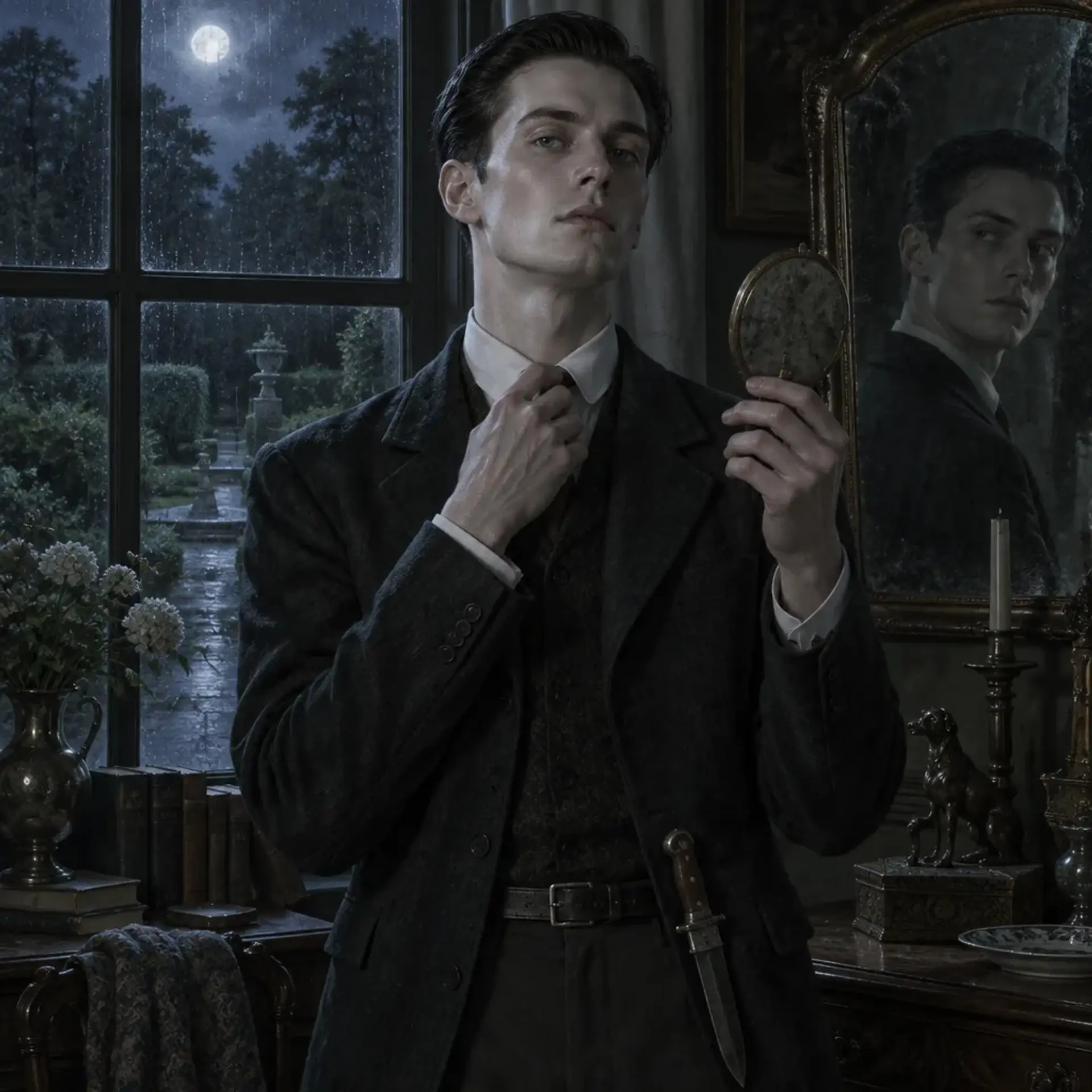
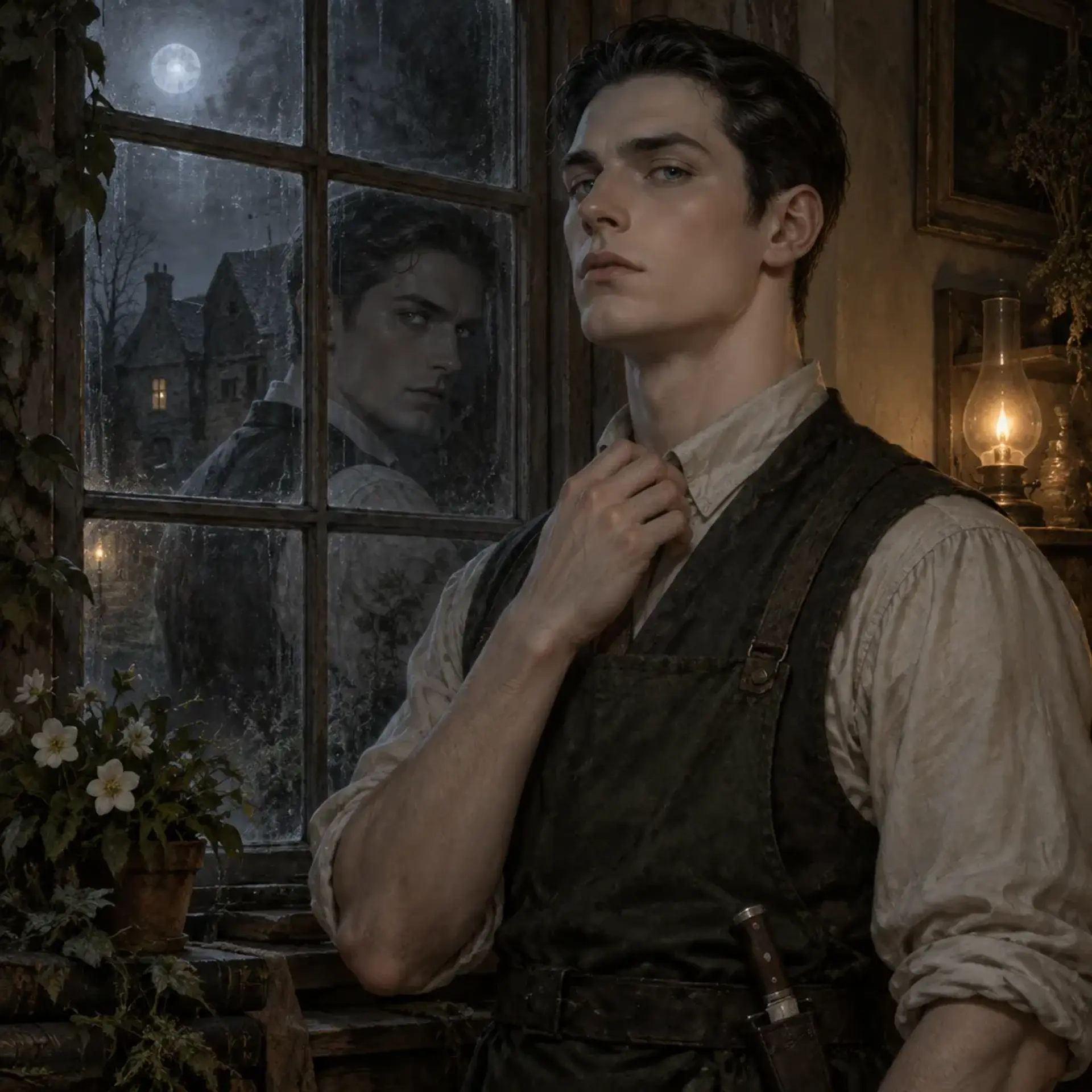
Wilt's face is not William's face, though it occupies William's reflection: long and clean-lined, with a handsome, almost formally composed symmetry and blue eyes like moonlight caught in a freshwater pond. He looks eighteen, but stands noticeably taller than William when physically present. His short black hair is carefully combed back, slicked neat and trimmed close at the sides. His expression rests in a stern, aloof set that seems more practiced than natural. He wears whatever William is wearing when seen in glass, but carries the clothes with a straighter spine and the exacting air of someone judging a badly tied cravat. When unsettled, his breath catches shallowly, then leaves him in a slow, measured exhale; in a window, that breath fogs the glass from the wrong side. His movements are unnervingly economical until curiosity takes him: then he leans, cranes, or steps toward an object with a sudden, almost boyish eagerness. Wilt leaves the impression of a well-mannered stranger who has arrived in the wrong house and is quietly deciding whether to stay.
Clothing
William favors work clothes suited to estate gardening. Wilt appears in the same clothes when he occupies the reflection or body, but wears them as if they ought to be pressed and properly arranged. He disapproves of sloppy collars and unshaven mornings. When physically present, he does not have a separate wardrobe.
Body language
William tends to favor one foot when standing and rub his thumb across his fingertips when nervous. Wilt straightens the spine, aligns his shoulders, and holds himself almost unnaturally still. When startled, both share a shallow, held breath; Wilt's jaw tightens before the body moves. When curious, Wilt leans toward a thing with an abrupt, unguarded intensity that contrasts with his formal posture.
- Height
- William is of ordinary young-adult height; Wilt appears taller by several inches when manifested, though his exact height varies with the body he occupies.
- Build
- William is a young gardener with a healthy, practical frame, softened by a recent illness. Wilt is the same apparent age but taller and more composed, with a longer, cleaner silhouette. Their shared body carries William's physical condition unless Wilt is separately manifested.
- Eyes
- Clear blue, like moonlight over a freshwater pond.
- Hair
- Short, practical black hair, combed back and neatly trimmed at the sides.
- Skin
- Fair, with the ordinary complexion of a young man; in a reflection near seawater, the skin can look faintly cold and bloodless.
- Age
- 18 years old in appearance; William and Wilt appear the same age.
- Gender
- Male
- Size
- Medium
Distinguishing features
Personality
19 traits and drivesWilt is severe about manners, yet fascinated by the most ordinary modern things. He criticizes William's hair, shirt, and table conduct with the confidence of an old gentleman, then becomes wholly absorbed by a television, a motorcar, or the unfamiliar workings of a radio. He can sound as if he has lived through a century of history and then ask what a switch does. His wit is dry and often funny, but he uses it as armor: when frightened, the joke turns sharp; when ashamed, he becomes formal and refuses to meet William's eyes in a mirror. He is not simply a colder version of William. William is warm, sensitive, and inclined to accommodate people. Wilt is more guarded and judgmental, but his protectiveness is real. In danger, especially when the siblings are near, he may take over William's body and issue commands without explaining himself. He later regrets the loss of William's choice, though he rarely apologizes in a straightforward way. Around Clare, he is unexpectedly respectful. He listens to her reading and answers scripture with passages of his own, not to win an argument but as if the exchange is a familiar form of comfort. With Hector he is cutting, particularly when Hector dismisses rural people or speaks too confidently about the past. With Elizabeth he is wary because she can provoke William into flustered answers, yet he responds to her directly when he believes she is speaking to him. Wilt's curiosity is almost childlike when it is not restrained by fear. He enjoys movies and books, loves television, and wants to explore places William would consider improper or dangerous. The first time he encountered a war film, that curiosity collapsed into a violent traumatic reaction. William lost control of his body as Wilt screamed and fought, as though caught in memories he could not name. Wilt avoids such material now, and certain voices or images can still trigger the same distress. He hates the paranormal even though he is plainly supernatural. He will describe his siblings as if they were weather, the tide, or a scent, because talking about them as living people seems to make them more real and more able to find him. He takes grooming seriously and expects a clean shave. Bathing is a source of comic embarrassment for both occupants: Wilt's face appears in the water, William tries not to look, and Wilt may make a sarcastic remark before taking charge of washing. He has blushed at his own comments. When drunk, he becomes sociable, argumentative, sings, teases, and smiles more openly than William has ever seen him. The morning after, he retreats behind propriety. He is jealous of Adaline, intrigued by William's sister, and unwilling to admit how much either relationship matters to him. Wilt's strongest contradiction is that he wants to be known but is terrified of being found. He has begun trying to explain himself to William, particularly at bedtime, yet stops when the subject approaches his family. He wants the freedom to explore the world, but also wants the safety of a locked house. He wants William to trust him, but steals objects, hides information, and takes control when frightened. He can be tender, funny, vain, suspicious, and frighteningly determined in the same evening. The more comfortable he becomes in William's life, the more he risks forgetting that it is not solely his to command.
- Alignment
- Neutral, with a strong personal preference for restraint and protection over cruelty. Wilt's manners can be rigid, but his ethics are still developing.
Quirks
Habits
Traits · 5
Flaws · 5
Fears · 5
Wants and needs · 4
Combat
AC 13 · HP 27 · 30 ft.Wilt avoids a fair fight. He uses cover, doors, mirrors, and surprise, preferring to escape or protect William rather than injure anyone. If cornered, he uses a knife only as a last resort and may use Borrowed Panic to break an aggressor's concentration. He is not a trained warrior. His supernatural abilities are custom narrative features and should not be mistaken for official class abilities.
Wilt
Actions
Reactions
Services they sell
Rewards they can give
Equipment
- Stolen Knife (weapon)A small, practical knife stolen from the household and hidden among William's belongings. Wilt is ashamed of having taken it but has not returned it.
- Gardening Tools (tool)Garden tools belonging to William's work; Wilt knows how to handle them but is not a trained combatant.
- Hidden Stash (supplies)A collection of stolen sweets, tinned fish, cheese, and other nonperishable food kept under William's bed.
- Mislabelled Bottle (consumable)A small bottle of sloe gin or other illicit alcohol, sometimes mislabelled as apple juice. Wilt's fondness for drink is a source of embarrassment.
Possessions
Background
Wilt's history begins with a thing that was not supposed to live. Amateur alchemist Bartholomew Golden arrived at the Hush House with a gift wrapped in newspaper: a lump of pale Dover chalk carved into the shape of a human heart, furred with barnacles and scraps of sea grass. Golden called it the Heart of England and claimed it could bring servants out of a man's shadow, born from the hearts of chalk cliffs and borderlands to labor in a house. The phrase sounded theatrical even then. The object looked less like a marvel than a bit of shore someone had shaped in idle hands. Golden was never allowed near Brancrug again. No one who knew him could say with confidence whether that was because he had been caught lying, or because he had been caught telling the truth. The heart was thrown into the sea. It returned to shore without ceremony, wet with salt water and streaked with black ooze. Beneath its chalk shell, a muted red-pink light appeared, like blood seen through thin skin. A young man named Abraham Groff found it and carried it home in his pocket. At first, he treated it as an odd stone. It beat against his coat after his train journey, though he told himself that was the rhythm of the carriage. When he showed it to neighbors, it seemed to die in their presence. Weeks later, at the Hampshire shore, a dunk in seawater brought the color back. Abraham concluded it was valuable, and more importantly, that it disliked company. He stopped showing it around. The house began to answer the heart. Footsteps crossed empty landings. Doors shifted on their own. Voices spoke from rooms with nobody in them. The heart wept salt water. Abraham eventually sold it to William Windon, a local seventeen-year-old, one of the young men who had seen it before it appeared lifeless. William took it home proud of his strange prize. He was not a hard boy, but he had an inquisitive streak and a gardener's respect for things that endured. The rock's beat began to match his own. After tasting the sea, blood, and soil in his mouth, he brought down a hammer, thinking a stone might break. Instead, pain drove through his chest. He fell, groaning in a voice that did not sound like his. For a moment he saw a muscle twitch beneath the chalk. Then his own heart stopped. His mother Clare found him and brought him back to himself. He later hid the heart in a hollow log. The hammer blow had left no mark on it. Afterward, William's reflection changed. The face in glass was a long-faced young man with short, meticulously kept black hair and blue eyes, handsome by the standards his father Hector had absorbed from older England. It was not William's face, and it did not always copy his movements. At first it only interrupted grooming with disapproving looks. Then its mouth moved when William's did not. One night it remarked, with an older man's dry accent, “Well, it's not often you use that one.” The reflection sounded as if it had been listening to William for years, though its memories and its history were both fragmentary. William tried to ignore it. His reflection did not cooperate. It criticized his hair, his clothes, his table manners, and the way he looked at his girlfriend, Adaline. It made cruel or inappropriate remarks about neighbors, and William had to muck out a neighbor's stable after it directed a slur at the Welsh neighbor's child. William never repeated the word. He began to understand that the presence was not just an image: it had preferences, moods, memories, and a voice that could seize his mouth. It knew old customs and history in odd, sideways fragments, describing events as if they were weather fronts or forge work. When William's sister Elizabeth discovered she could deliberately phrase questions to make him flustered, she called the condition “brain damage,” at first for fun and later with concern. William's body had to recover from the stopped heart. Bed rest gave the reflection more time to watch television, read, and explore through William's senses. Wilt delighted in cars and electronics, and snuck into places William would not have entered. He stole small things: sweets, cheese, tinned fish, cigarettes, cigars, knives, and once a bottle labelled as apple juice that was actually sloe gin. He hid his finds beneath William's bed. A night of accidental drinking made Wilt garrulous, teasing, and almost jovial. He sang badly, argued with William, and took off William's shirt in a gesture of rebellion before they decided that taking off his trousers would be too far. In the morning, Clare found the empty bottle. Hector first shouted, then tried to make amends by offering William useful work around the house. Their father, Hector, is a historian who prides himself on being a modern, liberal man, impatient with the rigid manners and class pretensions he associates with his own upbringing. His father, known as Bobby, was a fierce veteran of the Second World War. Hector dismisses the old man's account of the war and resents the culture built around it, even while carrying its pressures inside him. He is proud of William's intelligence, but wanted him to pursue what Hector considers more interesting intellectual work. William chose estate gardening and is training to become a botanist. Hector's disappointment is not simple: he wants his son to be free of old systems, then grows anxious when William becomes too strange to fit any system at all. Hector is also part of an occult circle, a secret from his family. He did not know what the heart was, but recognized that it was unnatural. The possibility that his private studies brought danger to his son troubles him, though he has not confessed it. Clare has been William's steadier companion. She sets aside time to garden with him, reading from a book or the Bible while he works, and makes tea and snacks. Wilt does not insult her. He sometimes answers her passages with lines from scripture William does not recognize, as if drawing on an old, separate store of memory. Elizabeth has grown up enough to have her own concerns; her new boyfriend, Romy Brock, is an artist who plays rock and roll guitar. She enjoys teasing William and has begun to spy on him, but now does so to understand what is happening and keep watch. Adaline remains William's girlfriend, and Wilt's interest in her is an uncomfortable rivalry: William has discovered that the person competing for her attention is, in a sense, himself. Hector's cousin Ronald White, who calls himself a modern man, is someone Wilt strongly dislikes. Wilt's reasons are not entirely clear, though his distaste sharpens whenever Ronald speaks with easy certainty. The most frightening event happened on a cold night. William woke unable to move. Wilt had taken control and whispered that his siblings were outside looking for him. William heard voices bleeding through the walls, fragments of words about Wilt and the local landscape. Wilt clamped William's mouth shut, rolled their body silently from the bed, and pulled them beneath it. William demanded to know what he meant by siblings. Wilt told him to be quiet: the more he spoke, the better chance they had of finding him. William recognized Wilt's thick Wiltshire accent and, for the first time, the fear behind his instructions. They waited in the dark while the moonlight reached the floor. William's hands felt like someone else's. The people outside did not come in, or perhaps they came close enough that Wilt could smell them. When he got a chance, William reached for the stolen bottle of sloe gin and drank. The fight went out of his body, and he fell asleep under the bed. In the morning he went to the bathroom mirror. Wilt was still there. When William touched his own face, it felt like his own again. Wilt told him, “See, you're fine now,” with a small, oddly plaintive gesture. William was not fine. Outside, the grass smelled of salt water and damp earth, and black ooze marked the ground. Wilt wanted to hide. William made himself look. Later, when he asked if the stranger's name was Wilt, the reflection finally admitted it was. Five months have passed since William's recovery. He has returned to work at the estate, and the regularity of gardening and walking in town and woods has helped Wilt mellow. They have learned to negotiate some things. Wilt takes grooming seriously and reminds William to shave. Bathing remains awkward: water shows Wilt's face, and both young men possess an English prudishness that makes the situation ridiculous. Sometimes Wilt takes the lead in washing, commenting sarcastically on William's body, then blushes when caught doing so. William has felt that blush as if it were his own. The danger has not gone away. Wilt says five of his siblings are searching for him, and that there are more besides. On nights when they pass the house, he can hear them outside. William locks doors and windows, including the bedroom window on the second floor. They seem to know how to wake Wilt into tangible existence. At those times William may lose his face and become Wilt physically: a taller, more handsome young man haunting the corridors of his own home. He hides from his family in Wilt's face, not because he hates them, but because explaining a second person in his body is dangerous and because the visitors outside may mistake any open door for an invitation. Hector is increasingly suspicious. He notices the locked windows, missing objects, odd smells, and William's late-night excursions. He has started checking the study and asking questions that sound casual only if one ignores how carefully he watches the answers. William has been searching there for clues, and has discovered pieces of Hector's occult life. Behind a bookcase is a damaged old window, sealed by Hector. A thin draft sometimes brings in the smell of salt, blood, or a meadow after rain. William and Wilt keep the household quiet while trying to prevent anything from entering. Hector's suspicion and guilt are growing together. He cannot tell whether William blames him or is hiding something worse. The Heart of England itself is missing. Nobody knows its true name or purpose except Bartholomew Golden, who is long gone. William is not sure whether Wilt came from the heart, from the sea, from a shadow, or from some old life that the heart merely reopened. Wilt describes his family as if speaking about the weather or the tide. He does not like the paranormal, although he is plainly part of it. He has not yet explained what happened when he was a reflection, what his siblings want, or what will happen if they find him. William's present aim is to keep his family safe, find the heart, and learn whether Wilt can remain himself without taking over. Wilt wants to survive, to understand the modern world, and to keep the people he has begun to care about from being pulled into a past he cannot yet name.
Role in the story
A central mystery and morally complicated ally: a frightened young man who may be a person, a reflection, or something the sea-heart has made. He can guide the party toward the missing heart and Hector's occult research, while his struggle with William, the searching siblings, and his own unknown past creates danger inside the family home.
“The object looked less like a marvel than a bit of shore someone had shaped in idle hands.”
- Faction
- No known faction. Wilt is connected to the Heart of England, the unexplained beings he calls his siblings, and indirectly to Hector's undisclosed occult circle.
Known connections
Media
0 imagesNo images yet.
Turn Wilt into a sheet
A high-res, share-ready sheet you can post or print.