William Windon
William Windon
At the table
“That is not where the part goes,”
Voice
William sounds like a young countryman who has learned to be careful in rooms where his father knows more than everyone else. His voice carries a faint outdoor rasp and a habit of stopping before a sentence becomes too personal. The reflection's sound is still William's, but older in rhythm: consonants clipped cleanly, observations delivered with a small pause before the sting. Its accent suggests an earlier generation rather than a different place.
William's speech is measured and locally grounded, with the hesitations of someone choosing words carefully. His voice has a slight rasp after long days outdoors. The reflection uses the same mouth and basic sound but places its words with an older cadence, crisp consonants, and dry, deliberate pauses. It does not become soothing when angry; it becomes more exact, as if correcting a record.
Speech patterns
How to play them
Approach William without crowding him or forcing him to look into a mirror. Be direct about what you want, and do not treat his experience as a joke. He is more forthcoming if asked about the heart-stone, Abraham, or the reflection's exact words. Earn trust by keeping confidences and helping him verify facts. If the reflection speaks, address William rather than assuming the stranger has replaced him.
Goal
Find Abraham Gorff and the missing heart-stone, then learn how to separate William's life from the stranger in the glass.
Motivation
To recover agency over his own face, voice, and future without simply destroying whatever the heart-stone awakened.
Appearance
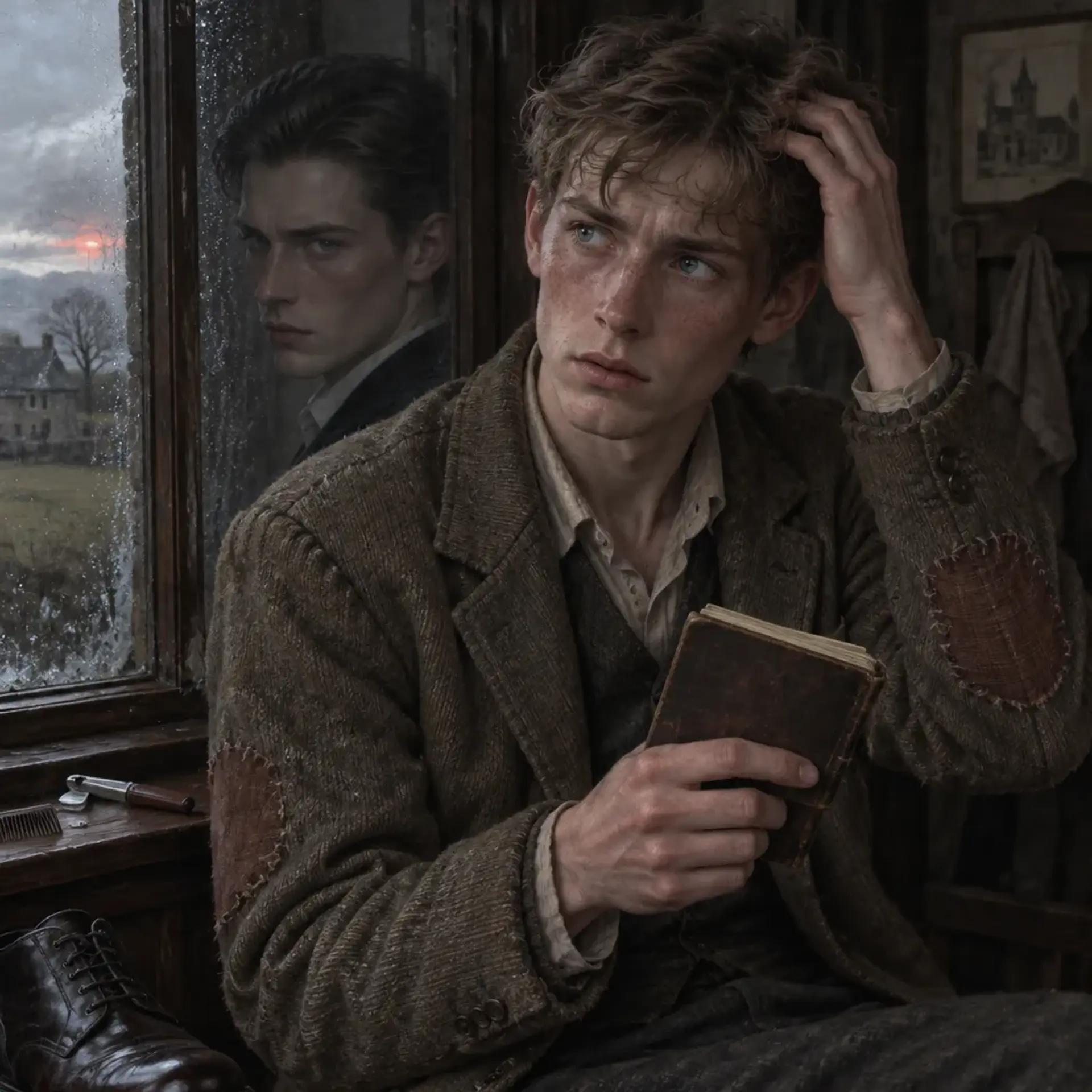
William Windon is a lanky young man with a long, earnest face, a brown-spotted complexion, and dark-blond hair that refuses to lie flat at the crown. His blue eyes are clear and ordinary until he passes a pane of glass: there, the reflected stranger's eyes look like moonlight over a still pond, and his expression is stern where William's is not. His skin is weathered in small, unheroic ways: reddened knuckles, a pale line where a shirt collar usually sits, and wind-rough cheeks from country walks. He moves with the careful, slightly self-conscious precision of someone who has learned to check how he looks before entering a room. His clothes are practical and repeatedly mended, but he keeps one polished pair of boots almost absurdly clean. The unexpected detail is the neatness of his bedroom grooming station: comb, razor, and cloth aligned like instruments laid out by a surgeon, because he cannot trust the reflection to show him what his own face is doing.
Clothing
Country clothes kept serviceable rather than fashionable: a worn jacket with careful elbow repairs, a shirt whose collar has softened with washing, and trousers patched at the inner seam. He over-cares for one pair of polished boots. He dislikes dressing in front of reflective glass and sometimes leaves his collar uneven because he cannot be sure how it sits.
Body language
William's shoulders draw inward when he is being watched, but he squares them when he has made up his mind. He smooths his cuffs, checks his hair by touch, and glances at nearby glass without quite turning his head. When the reflection takes interest, his posture becomes unnaturally still for a beat, as though he is listening through his own bones.
- Height
- A little above average.
- Build
- Lanky, long-limbed, and more wiry than strong.
- Eyes
- Blue; in the reflection, a colder blue like moonlight on still water.
- Hair
- Dark blond.
- Skin
- Fair skin, browned and wind-reddened outdoors, with scattered brown spots across his face.
- Age
- Young adult, about 19
- Gender
- Male
Distinguishing features
Personality
16 traits and drivesWilliam is proud of his local roots but uneasy about being noticed. He wants to be thought dependable, yet keeps a secret that makes ordinary trust feel dangerous. He is cautious around strangers and glass, but can become stubborn when someone dismisses what he has experienced. Around Hector he often falls back into the role of a son listening to a lecture; around Elizabeth he is more patient, though he pretends her questions irritate him. With neighbors he tries to be courteous, sometimes too late and too carefully. The reflection pulls against all of this: it is socially bolder, more judgmental, and less concerned with the cost of a sharp remark. William is embarrassed by its interventions, yet sometimes feels relief when it says what he cannot. In private, he tries to bargain with it through silence, notes, and routine. When frightened he becomes meticulous; when angry he speaks too quickly, then replays every word. He is not simply timid or brave. He is a careful young man trying to protect an ordinary life while some other presence keeps insisting that ordinary manners are not enough.
Quirks
Habits
Traits · 4
Flaws · 4
Fears · 4
Wants and needs · 4
Combat
HP 0William is not a trained combatant and tries to escape, take cover, or get help rather than fight. If cornered, he uses whatever ordinary object is at hand to make space and flee. The reflection may seize a moment to speak or disrupt his focus, but no reliable combat benefit is established.
William Windon
Possessions
Background
William Windon was born in Wiltshire into a family that had lived in the county for generations. His father, Hector, is a historian with a habit of turning every dinner conversation into a correction; his younger sister Elizabeth has a quicker eye for people and a sharper sense of what is proper. William grew up between Hector's books and the practical rhythms of a rural household. He was proud of knowing local paths, names, and customs, but that pride never made him especially bold. He liked objects with histories because they seemed easier to understand than people. The heart-stone entered his life as a curiosity. A London visitor named Abraham Gorff had brought it home from a visit to the Hush House, claiming it was a fossilized living heart forged of heart and scale. He had received it as payment for entry, wrapped in newspaper, from an amateur who had never been allowed near Brancrug. The object looked like a lump of Dover cliff chalk crudely carved into a human heart. Barnacles and limp strands of sea grass clung to its surface. It was thrown into the sea, then washed back to shore, wet with salt, water, and black ooze. Beneath the rock a red-pink hue seemed to return, as if blood or light were waking inside it. Abraham, who had come from London and settled in Wiltshire, studied the object. It repulsed him and drew him in. When he showed it to neighbors, it went lifeless in their presence. Taken to the Hampshire shore after weeks of inactivity, it reddened when dropped in water. Abraham decided it was special, and his, but his refusal to let other people see it was not simple greed. The stone seemed to dislike company. In time his house filled with hauntings: voices, moving doors, and footsteps on halls and stairs. He learned that the heart beat and wept salt water. Unable to bear it, he sold it to a seventeen-year-old lad who had once seen it before it had gone dead in front of the neighbors. That lad was William. At first William showed off his strange purchase. The stone was a fine thing to own, a conversation piece with a private mystery. Then he felt its pulse in his chest as if it were his own. After tasting the sea, blood, and soil in his mouth, he brought a hammer to it. He expected rock to crack. Instead, pain struck through his chest, and he fell, groaning and weeping. He heard a voice come out of his mouth that was not quite his own. For a fraction of a moment he saw a muscle twitch violently inside the stone. Then his body seemed to give out. William woke with his mother holding his face. She said his heart had stopped. The stone lay cold and pristine, apparently untouched by the hammer. Days later he hid it in a hollow log. He came back to find it gone. The days after were worse. In mirrors and windows William saw a different young man: long-faced, handsome by a polished English standard, with short black hair carefully combed back and blue eyes like moonlight on fresh water. The stranger held himself sternly and did not reflect William's face at all. William began to shave and comb by touch, making a careful routine of guessing what the mirror would show. He tried to dismiss it as nerves, exhaustion, or the aftereffects of a near-death episode. He failed. One night, while William groomed himself for bed, the reflection's mouth moved with his and said, in an older man's voice, “Well, it's not often you use that one.” The remark was plain, observant, and more disturbing for not sounding like a threat. The stranger's accent belonged to an older generation. Since then, the reflection has grown more independent. Sometimes William's movements jerk as if someone else is trying to turn his head. Sometimes the reflection changes his room while he sleeps. It comments on his clothes and combing, and occasionally stops him from speaking, apparently because it judges a remark improper. The reflection has also shown a cruel streak. When Hector made a dismissive comment about country people, the stranger answered through William with a cutting observation that got William in trouble. When a neighbor's child accidentally ran into him with a toy wagon and cried while apologizing, the reflection used a slur against the Welsh neighbor. The word is not repeated here. William was made to muck out the neighbor's stables. He resents the reflection for making him answer for words he did not choose, but he also knows the stranger's sharpness can land where his own timidity would not. William has learned Abraham Gorff moved to Canada. He wants to find him, recover the missing heart-stone, and learn whether the reflection is its inhabitant, a consequence of the stone, or something the stone opened a way for. He has not told Hector everything. Hector would likely try to explain the phenomenon as folklore, fraud, or an artifact of local belief, and then make a catalogue of it. William has told Elizabeth only that he dislikes mirrors. She has noticed more than he thinks. She continues to pester him about the boy she likes, proper manners, and things that look nice. The reflection listens to these conversations with an interest it pretends not to have. William's current life is a struggle to keep ordinary routines intact while investigating a problem that refuses to stay in one place. He avoids glass when he can, but windows are unavoidable. He keeps a notebook of the reflection's remarks and changes to his room, though he fears the notes may be read by the person they describe. He has begun visiting the coast when he can, partly because the taste of salt sometimes brings the stranger into sharper focus. Each visit makes him fear that the heart is not lost so much as waiting for him to return it to the water.
Role in the story
A haunted young witness and potential ally whose investigation can lead characters toward Abraham Gorff, the Hush House, the missing heart-stone, and the uncertain identity of the presence in the glass.
“William grew up between Hector's books and the practical rhythms of a rural household.”
Known connections
Media
0 imagesNo images yet.
Turn William Windon into a sheet
A high-res, share-ready sheet you can post or print.