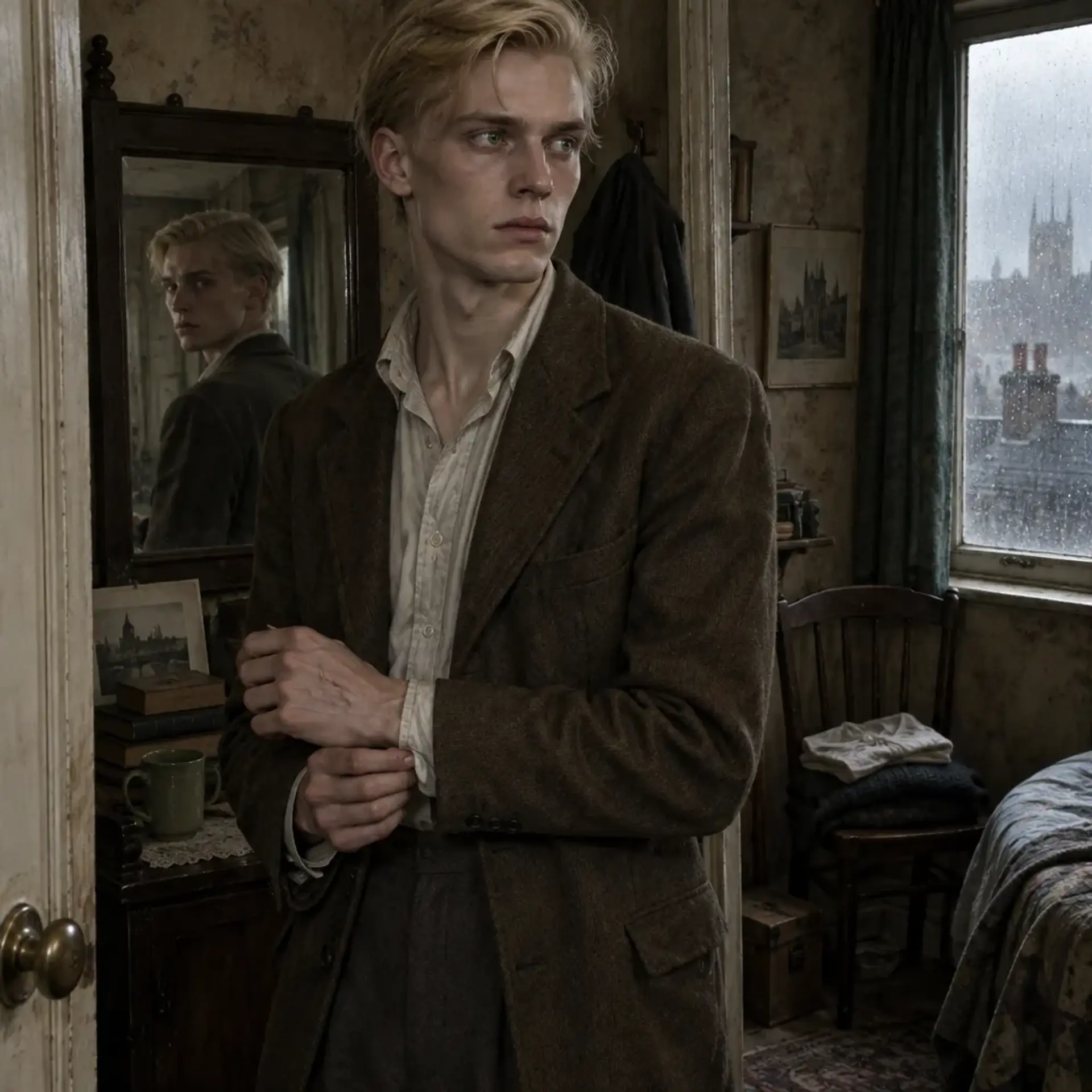
Mark Bell
Mark Bell
At the table
Voice
A naturally deeper, rounded voice than Mary's, with a dry rasp that comes through after a night of pacing. His work and household life have made it practical rather than theatrical: he projects when he needs to be heard across a room, then catches himself and reins in the volume. His speech carries middle-class English reserve and the precision of someone trying to sound properly composed. When angered he gets faster and more direct, not quieter or more polite.
His voice has a lower, fuller resonance than Mary's former voice, with a slight rasp at the edges as though shaped by cold mornings and a dry throat. It is not a practiced public voice. He speaks carefully, in the clipped, practical phrasing of someone raised in an English household where appearances mattered but conversation was not always kind. When startled, he runs words together; when discussing clothing, tea, or household order, his sentences become exact. Anger makes him blunt and emphatic rather than soft or ceremonious. The name Kent, when he uses it, has a breath caught in the first sound and a hard finish; the texture belongs to that name alone.
Speech patterns
How to play them
Treat Mark as a person rather than a puzzle or a prize. Ask what name and pronouns he wants used, and be direct without demanding a tidy explanation of Mary and Kent. Offer practical choices, especially about safety, clothing, rent, and the Bell children. He responds to calm respect, clear boundaries, and ordinary domestic kindness. Do not use cold iron as a test or threaten the children to compel him.
Goal
Build a safe, respectable life with Trudy, keep supporting the Bell children where possible, and learn why the seekers and the drowned woman want him.
Motivation
To make a home that is not built on fear or unpaid obligation, while preserving the tenderness and responsibility Mary had for her siblings.
Appearance
Mark is tall enough to make doorframes seem lower and narrow rooms feel suddenly occupied. His frame is lithe but stronger and broader than Mary's, with a long reach and an upright, careful carriage that looks learned from watching respectable young men rather than from a lifetime of confidence. Bright blond hair lies in neat, combed ridges when he has a mirror and time; after a difficult night it lifts at the crown in a static halo. His malachite-green eyes are strikingly clear, and his face has the handsome, unfamiliar regularity that first appeared in Mary's reflection. His skin is light, but not porcelain: it has the pallor of someone who has spent too many hours indoors and the slightly rough, dry texture of cold weather and cheap soap. He moves economically, placing his feet as if avoiding a creaking board, then forgets to be inconspicuous and occupies the whole doorway. The unexpected detail is his almost domestic fussiness: he checks the drape of a curtain and straightens a chair before he will discuss a haunting. He leaves people with the impression of a young man caught between a respectable parlour and a storm-tide.
Clothing
Clean, practical postwar clothes when he can get them: shirt, trousers, jacket, and shoes that he considers inadequate. Trudy's gifted socks and undergarments are kept carefully folded. He prefers well-cut, respectable clothing and dislikes garments that read as feminine. His borrowed or old clothes may split or hang badly when his body changes.
Body language
He stands neatly and holds his shoulders as though wearing a better coat than he owns. In a doorway he forgets how much space he takes up. His hands often smooth his cuffs or align small objects; when startled, one hand goes to his chest as if checking that the beat is still there. He can turn away from a mirror while his reflection continues to watch.
- Height
- Tall for an eighteen-year-old man, markedly taller than Mary's former body; exact measurement unknown.
- Build
- Lithe, tall, and stronger than Mary's former frame; long-limbed, with a young man's shoulders and a careful, unpracticed economy of movement.
- Eyes
- Malachite green
- Hair
- Bright blond
- Skin
- Light, with an indoor pallor and a slightly dry, weathered texture from cold air and inexpensive soap.
- Age
- 18
- Gender
- Male
- Size
- Medium, by ordinary human appearance
Distinguishing features
Personality
20 traits and drivesMark's defining tension is between reserve and appetite. He is shy, home-oriented, and eager to be regarded as a respectable young man, yet he has a strong desire to explore, to be seen, and to make choices that are his. Before May 30, those impulses often fought with Mary's need to get home, help the children, or avoid attention. Since the change settled, the conflict has softened rather than disappeared: he is less driven to seize every outing as proof of freedom, but he can still redirect a plan when he wants to see a film, inspect a shop, or stay somewhere longer. He is careful with people who seem kind, not because he distrusts kindness but because he does not know what it will cost. He can appear stiff or proud when he is actually embarrassed. He wants decent clothes and good manners, but does not believe money or polish makes someone good. He is conscious of being watched, and yet he will stare openly at a car or television set when wonder gets the better of him. That contrast makes him seem both old-fashioned and newly born into the world. Mary's solemn devotion remains in him. He can forget to eat but remembers which child needs coaxing, which one is angry, and who should not be left alone with Malinda when she has been drinking. He is protective without being naturally commanding; he dislikes shouting, but if a child is threatened he can become abrupt and physically forceful. The fight with Simon showed the danger in this. He is ashamed of having injured his father, but does not entirely believe he was wrong to act when he thought the children were in danger. Mark is particular about domestic things. Tea should be made in a certain order; clothes should be folded; a room should not look as if nobody cares whether it is lived in. These standards are partly a bid for control and partly genuine pleasure. Trudy's flat is small and imperfect, but he tries to make his corner orderly. He accepts her practical help while resenting the feeling of dependence, then repays it by doing chores and contributing to rent. He is grateful in a quiet, sometimes indirect way, such as keeping her shoes clean or making tea without being asked. His response to his own body is mixed. He is more comfortable inhabiting it than before, and his wish to prove himself separately has quieted. At the same time, he dislikes having his body treated as evidence in an argument. Bathing and reflective water can still unsettle him. He does not want Mary reduced to a vanished girl, nor does he want to be called a trick or a costume. He is increasingly able to say that he is Mark, although the memories and feelings inside that answer remain tangled. In company, he tries to be polite and often overcorrects into formality. With strangers he chooses his words carefully, hoping to appear ordinary. With Trudy, he is more willing to disagree, though he can make a simple question about rent sound like a debate over standards. With Henry, he is defensive but attentive. With the younger children, he is gentler and less guarded. With people searching for him, he becomes quiet, watches exits, and puts himself between them and anyone he considers vulnerable. His tastes are not a simple rejection of Mary's life. He dislikes being pressed into feminine presentation and is attracted to women, but he is not defined by those preferences. He has learned that wanting a life does not require abandoning the people who made him. His greatest weakness is that he still thinks he must earn a right to take up space by being useful, tidy, and brave. His greatest strength is that even when frightened, he continues to make breakfast, carry a child to a chair, and look for somewhere safe to sleep.
- Alignment
- Not applicable as a canonical Secret Histories statistic. In ordinary terms, protective and conscientious, with an increasingly stubborn claim to his own life.
Quirks
Habits
Traits · 5
Flaws · 5
Fears · 5
Wants and needs · 5
Combat
HP 0Avoids a fight if there is any route out. If a child or Trudy is threatened, he will put himself between them and the danger, use furniture or a household object, and strike hard enough to make space. He is not trained, and anger or fear can make his response disproportionate. In a Secret Histories game, resolve actions using the table's actual rules; the descriptive mechanics here are custom and do not claim canonical combat values.
Mark Bell
Actions
Reactions
Services they sell
Rewards they can give
Equipment
- Trudy's shoes (clothing)A pair of serviceable shoes from Trudy, carefully cleaned despite Mark's complaints about their cut.
- Clothes and undergarments (clothing)A small, neatly kept set of borrowed and purchased clothes, some of which fit poorly as his body changes.
- Shaving razor (personal item)A shaving razor he sometimes forgets to put away; Trudy insists it be stored safely.
- Absent chalk heart (missing object)The heart is missing. Mark does not possess it.
Possessions
Background
Mark's history begins with a small, crude object that looked as if someone had cut the shape of an anatomical heart from a lump of Dover chalk and then forgotten to finish the work. Barnacles clung to its creases; weed was wound around it, and salt had whitened its pits. It was said to be a fossilized living heart, forged from heart and scale, and a visitor named Bartholomew Golden once left it at the Hush House as payment for entry. Golden claimed it could bring servants from man's shadow out of the chalk cliffs and borderlands, laborers made from the land rather than human births. The house did not welcome him back to Brancrug. The heart itself was thrown into the sea and returned to shore, dark with water and a black, tar-like ooze. Beneath its chalk skin, a reddish-pink light showed as if blood had remembered its work. Abraham Groff, a young man from London, found it on the shore and carried it home in his pocket. It beat beneath his coat on the train. He studied it, repelled and fascinated by it in equal measure. When he showed it to neighbors, it seemed to die in their presence. Alone, and later at a Hampshire shore, it stirred again when wetted. Abraham decided that it was his, not out of simple greed but because the thing seemed to dislike visitors. In his home it brought sounds: voices without speakers, doors shifting, footsteps on stairs. At last he sold it to William Windon, a Wiltshire lad of seventeen who had once seen it before it went inert. William had hidden it in a log after striking it with a hammer and apparently stopping its heart. Years later Malinda Bell found the queer stone in that log and brought it home for her eldest daughter, Mary. It was not a grand birthday present, but it was an attempt at one. Mary was eighteen, dark blond, blue-grey eyed, and already practiced at being grateful for what little was offered. Her parents, Malinda and Simon, had money enough to be called middle class, but the house ran on neglect, resentments, and Mary's unpaid labor. Mary kept the younger children fed and settled while trying to learn and find work. She did not know what the heart was. She kept it because it was hers, and because it was easier to care for a strange rock than to ask what her parents had meant by giving it. The reflection came first. In a mirror Mary saw a handsome blond young man with green eyes looking back. At first she assumed it was a trick of light, then a cruel joke, then a private oddity she could ignore. The figure watched her from glass, sometimes turning away when she noticed. The stone beat in time with her heart. Mary was too busy to make a mystery of it. She took a part-time job, helped with the children, and sometimes slipped out at night in the other body's shape. She called the young man Kent, as if a name could make a frightening convenience manageable. The change arrived spontaneously; she would wake, or find herself, taller, male, and wearing a body that was not hers. By dawn, it might be over. The first night was not a revelation but a fright. Mary woke after a bad dream with the wrong weight in her shoulders and a different breath rasping in her throat. She touched her face, found a jaw she did not recognize, and nearly cried out. In the mirror, the young man looked as terrified as she felt. Then she realized she could leave the house without being recognized as herself. The first excursion was awkward and exhilarated: she walked out past sleeping houses, discovered how her stride changed, and went toward the shore. She climbed a tree, explored a disused building, and stood watching the water until the cold got through her borrowed clothes. The freedom was real, but it was not uncomplicated. Kent was shy, preferred a respectable appearance, and disliked being treated as a novelty. He also wanted the evening to be his own. When Mary planned to go home, he sometimes diverted her toward a pub, a shop window, or a road he wanted to inspect. He was not merely a mask Mary wore; he had preferences that did not always obey hers. The pub adventure made this plain. Mary, in Kent's body, entered a local pub expecting to have a quick look and leave. The room smelled of wet wool, beer, coal smoke, and old wood. Kent straightened his cuffs and tried to look as if he belonged there. He was fascinated by the television, whose flickering pictures drew him nearer than he intended, and by the orderly ritual of a pint being set down. He was less interested in the drink than in the manner of the place: how men made room for one another, who was permitted to speak, and what clothes suggested a person could be trusted. When a woman smiled at him, Kent wanted to stay and respond; Mary wanted to go. The disagreement showed in the body's hesitation, a pause that looked to the room like shyness. Kent eventually chose to leave, but only after finishing the conversation in his own awkward, restrained way. Afterward Mary was furious at being overruled; Kent was offended that she thought his interest ridiculous. Neither could yet explain that they were beginning to want different things. The family learned the truth through mishaps rather than confession. Simon once came home unexpectedly while Mary was out as Kent. She tried to make her way back without being seen, taking a route through lanes she knew as Mary but did not know in Kent's longer stride. Simon caught sight of her and called out, believing a strange young man was near the house. Mary could not answer in her own voice. She hurried home, hid, and waited for the change to end. The strain made the house feel like a place with an audience behind every wall. Another night Malinda, drunk and angry, caught Kent trying to leave. She demanded to know who he was and why he was in the house. Mary tried to make an excuse; Kent's voice came out instead, deeper and unfamiliar. Malinda seized the moment as proof of a secret or insult, and the argument became loud enough to wake the children. Mary was caught between fear of being discovered and fear that Malinda would wake the younger ones. She got them quiet, promised she was going nowhere, and waited until Malinda's attention wandered. It was not a triumphant escape. It was a careful retreat past a sleeping sibling, a sticky stair, and a mother who might wake again at any sound. Trudy, Mary's friend, noticed how tired she was and helped with the children. Short, skinny, dirty-blond, hazel-eyed, and proudly unconventional in a way that made older neighbors tut, Trudy had a working-class upbringing and a more practical understanding of money than Mary did. She was the first person outside the family to see Kent clearly. The encounter came when Mary changed during the day. Trudy was talking to her in a familiar place when Mary's face and proportions began to shift in a pane of glass. The blond young man appeared beside Mary, then in her place. Trudy did not run. She asked whether Mary was ill, whether the change hurt, and whether she needed help getting home. Kent answered one question without Mary's intention, and Trudy heard him. Her certainty about what she had seen unsettled her, but she did not turn it into gossip. She began helping with practical matters: a jacket, a plausible explanation, and a place to sit until the change passed. The heart disappeared. Afterward the changes grew worse. Kent appeared in reflective surfaces without waiting for Mary to change, spoke when Mary had not decided to speak, and began to react to the world with increasing independence. Cars astonished him: their speed, their bright metal, the enclosed motion of them. He watched televisions as if each image were a window to a room he might enter. He grew particular about tea and preferred it made in a precise order. Bathing became difficult because the water reflected him, and he was acutely aware of Mary's discomfort as well as his own. He began to form opinions about the Bell household, especially about how often Mary was expected to absorb the damage other people caused. Henry, Mary's fourteen-year-old brother, noticed more than he said. He had grown rowdier and cunning, resentful of his parents and sometimes of Mary. He watched the odd young man in the glass, then watched Mary. One evening he told her quietly that he knew something was wrong and that he would not tell Simon or Malinda unless she was in danger. His questions were blunt: Was Kent going to hurt her? Was Mary still there? Mary could not answer cleanly. Henry's wariness became a kind of alliance, though he still tested boundaries and sometimes used what he knew to needle her. His watchfulness helped protect the secret while also reminding Mary she was not as invisible as she wanted to be. Strangers began asking around for a blond young man with green eyes. Their interest was not ordinary curiosity. Kent felt watched and Mary felt the house narrow around them. A second uncanny visitor began appearing at night: a woman with straw-like blond hair and eyes so dark blue they seemed almost black, her appearance carrying the cold, soaked impression of someone drowned. She called Kent her brother and said she would bring the others. She did not seem to belong to the people searching for him, and she came from the direction of the sea. Kent wanted to know her, feared what she promised, and yearned after her when she vanished into the waves. Four months after the heart's return to the sea, on May 30, the last division failed. The change did not arrive as a clean transformation. Mary woke with a feeling like a garment being peeled away from inside her skin. Her face in the mirror did not distort or melt; it simply stopped being hers. The young man's features remained when she stepped back. Her voice, her shoulders, the shape of her body and the way her clothes hung had become his. The shock was absolute. She tried to call for help and could not find a way to say which part of her needed saving. Mark, as he would later ask to be called, stood in the morning light with Mary's memories in him and Kent's preferences at the surface. The two did not become neatly separable people. Memories, emotions, and instincts crossed and muddled. Mary’s devotion to her siblings remained, as did the need to care for them. The desire to seize every night for himself softened. He was less driven to prove that he existed separately, though he did not know what had changed. He walked downstairs in morning clothes and began making breakfast. He lifted Oswald gently but firmly into a chair. Simon came down prepared to leave for work and stopped. He did not recognize his daughter in front of him, but he recognized her habits: the way the spoon was placed, the care with the little one, the familiar concern for the household. The mismatch frightened him. He was not a cruel man, but he took pride in a life that looked ordinary from outside. He asked Mary to come back, then corrected himself when the person before him answered. Malinda saw a changeling where Simon saw a crisis. She was drunk, frightened, and furious at the idea that her daughter had been taken. Her tenderness, when it surfaced, came out as accusation. She said the body was wrong, that a thing had stolen Mary, and that no one should pretend otherwise. The younger children clung to the familiar voice and familiar gestures, unsure what to call the person who had carried them. Henry confronted Mark later that morning. He stared long enough to be certain, then asked whether Mary was gone. Mark told him, honestly, that he did not know. Henry was angry at the answer and relieved by it. He asked whether the person before him still remembered the birthday, the chores, the way Mary had shielded Matilda from being treated as a replacement. Mark did. Henry finally said that was enough for him for now, though he continued to watch. Simon arranged private medical visits. Dr Bronson, a London psychologist, came expecting a straightforward explanation and quickly realized that neither deception nor an ordinary delusion accounted for what he was hearing. He listened to Mark's memories and Mary's memories without treating either as a performance. He could not certify a supernatural cause; he could say the distress was real and the identity experience profoundly complicated. Dr Maylor, a physician from East Anglia, examined Mark with formal restraint. The bodily changes were not an illusion: Mark's anatomy was male, with no female breasts and with male external reproductive anatomy. Dr Maylor was visibly unsettled, but he kept his language clinical and respectful, documented what he could, and advised regular checks rather than making claims he could not support. Simon requested continuing appointments to establish Mark's health and identity, partly from genuine concern and partly from fear of local gossip that his daughter had chosen to pretend to be a man or had undergone an inexplicable sex change. Two months of therapy and attempted physical treatments did not reverse the change. Mark asked to be called Mark, Marven, or Marcus, but Mark became the name people around him could manage. The argument that ended Mark's life in the Bell home began with the accumulated strain. Malinda drank more and sought illicit explanations from people who promised knowledge of changelings and stolen children. Her cruelty sharpened. Simon tried to impose ordinary rules on an extraordinary situation, and Mark tried to protect the children from a quarrel that had already become part of their daily weather. The fight turned physical. Simon struck Mark hard in the head. Mark stumbled, blood running down his face, and nearly fell. He did not react as Simon expected or as Mary would have done. He seized the nearest object and struck Simon with enough force to bring him down in front of Jonas and Oswald. Mark shouted that his father would kill them. In the confusion, the words seemed to refer to Simon and to the drowned woman, both of whom Mark felt closing around the family. Seeing Simon hurt, Mark's anger collapsed into action: he called an ambulance and stayed with him until help came. The outcome was serious but not fatal. Simon went to hospital; Mark was told to leave the house. Malinda called him a changeling and a thief. The younger children were frightened, and Mark carried the knowledge of their faces with him. Trudy brought him to her small rented flat. He resisted at first, not wanting to turn her life into another burden, then accepted when he understood that he was safe there. Trudy's own family was working class, and the flat reflected hard choices: limited space, thin walls, and furniture acquired for use rather than appearance. Mark sleeps on the couch and is clearing a small space of his own, one box and one carefully folded item at a time. Trudy brought him socks, undergarments, and a pair of shoes as a gift. The shoes are serviceable but, in Mark's view, poorly shaped and not up to his standards. He is grateful and shows it by polishing them and setting them straight beside the couch. He has found new work suited to his body and contributes toward rent. He is uncomfortable with the work's roughness and wants better clothes, but he does not want Trudy paying for him indefinitely. As roommates they negotiate the small rituals of survival. Trudy asks before borrowing his things and expects him to do the same. She does not indulge his standards, but she makes room for them: tea is made his way when there is time, and he is allowed to keep one shelf neat. Mark, in turn, tries to help with washing up and rent, though he can be precious about the order in which a task should be done. Trudy is unsettled by his changing manner, but she has seen the old devotion to Mary’s siblings survive in him. When he paces at night, she asks whether he wants company or quiet. He sleeps badly, sometimes jerking awake as if trying to escape a dream; he leaves shaving razors out, which Trudy repeatedly tells him to put away. He still sleeps shirtless when he can, partly from discomfort and partly because the altered body feels less like a costume that way. He has tested Malinda's talk of iron once: cold iron brought searing pain and left a small scar on his left hand. He refuses to repeat the experiment. Mark is not at ease with everything, but he is more at ease with being himself than he was when each excursion had to be seized from Mary. His desires are quieter; his homebody nature has become clearer. He likes television, a properly made cup of tea, well-kept clothes, and knowing where the door is. He continues to want the drowned woman to return, though he cannot decide whether he misses a sister, a promise, or the one person who seemed to know what he was. He remains devoted to the Bell children, especially Matilda and the youngest, and carries the guilt of leaving them. The strangers still seek the blond young man. The heart is gone, but its absence did not end the haunting. Mark has a life now, imperfectly his own, and no certain account of what he is.
Role in the story
A vulnerable, evolving ally and mystery at the intersection of domestic responsibility and supernatural transformation. Mark can draw the player characters into the search for the missing heart, the strangers seeking him, and the drowned woman who calls him brother.
“Barnacles clung to its creases; weed was wound around it, and salt had whitened its pits.”
- Faction
- No known faction. The heart's reported connection to the Hush House and the seekers' interest remain unresolved.
Known connections
Media
0 imagesNo images yet.
Turn Mark Bell into a sheet
A high-res, share-ready sheet you can post or print.