Friedreich
Friedreich
At the table
Voice
His voice has the dry, slightly breath-late quality of a wraith speaking through a boundary, with crisp Prussian consonants and the measured cadence of someone raised to give clear instructions. In a borrowed face it gains the body's natural resonance, but his careful phrasing remains recognizable to friends. He does not sing his words or lower them when angry; frustration makes him faster and more exact.
Friedreich speaks with a pronounced German accent shaped by Prussian formality. His sentences are cleanly ordered, with careful consonants and occasional old-fashioned turns of phrase. He sounds most at ease when discussing football, market prices, or practical plans. Anger makes his words more direct and sharply articulated, not softer or more polite. When unsure of a memory, he leaves a pause where a name should be rather than inventing one.
Speech patterns
How to play them
Treat Friedreich as a person rather than a tool for infiltration. He responds to steady inclusion, shared ordinary activities, and direct questions that do not demand immediate confession. Let him choose whether to appear unborrowed. Never take a borrowed face or his catalogue lightly. If he becomes possessive or angry, acknowledge the feeling without treating it as permission to harm others. He will trust people who remember his preferences and use his name even when he is hard to perceive.
Goal
Build a modest life that is not solely an imitation of the living: try a hobby group or part-time work, keep his identity intact, and discover what Wilhelm truly remembers about their shared past.
Motivation
To feel present without surrendering himself, protect the people he has chosen as family, and learn whether Wilhelm's memories can give him a truthful account of his own life.
Appearance
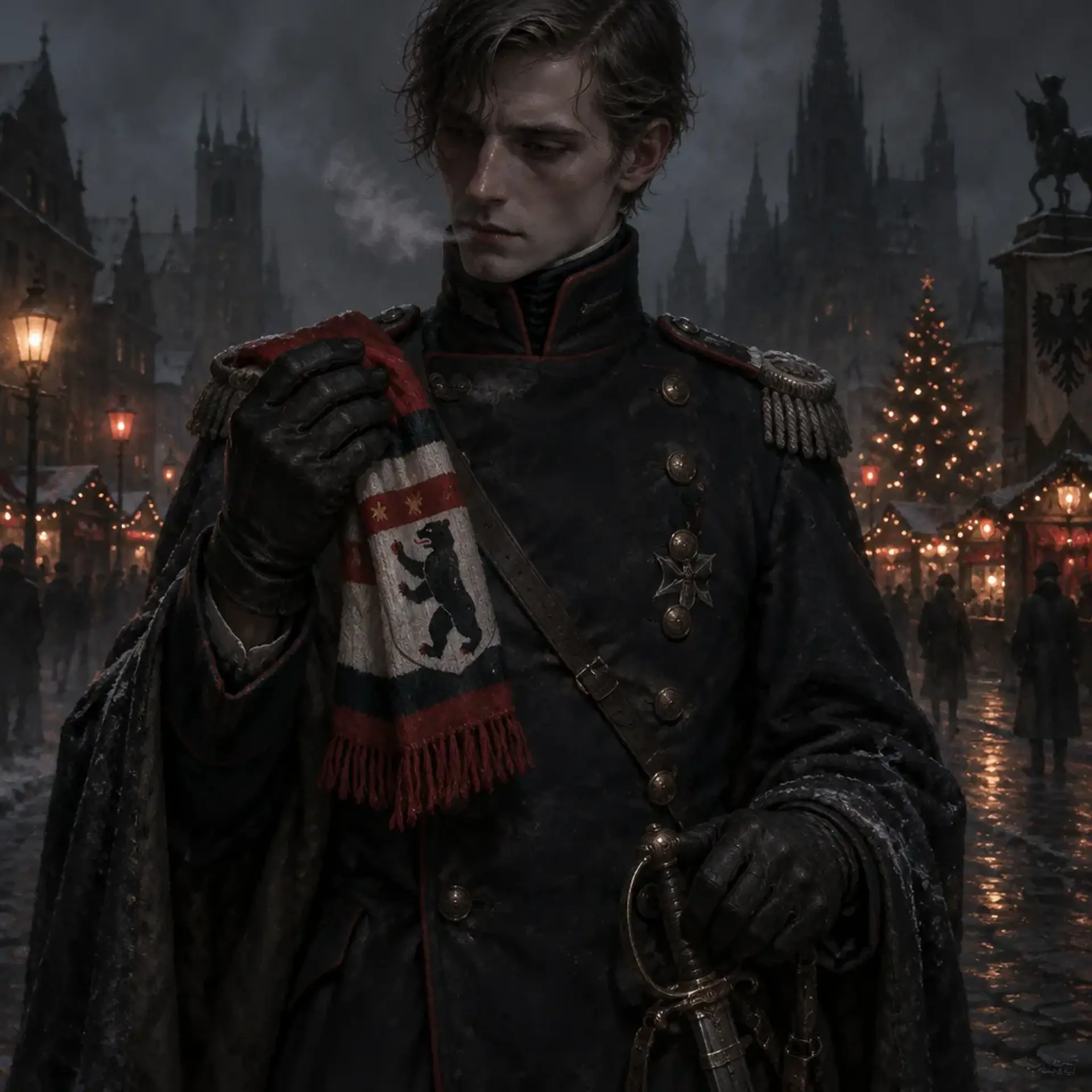
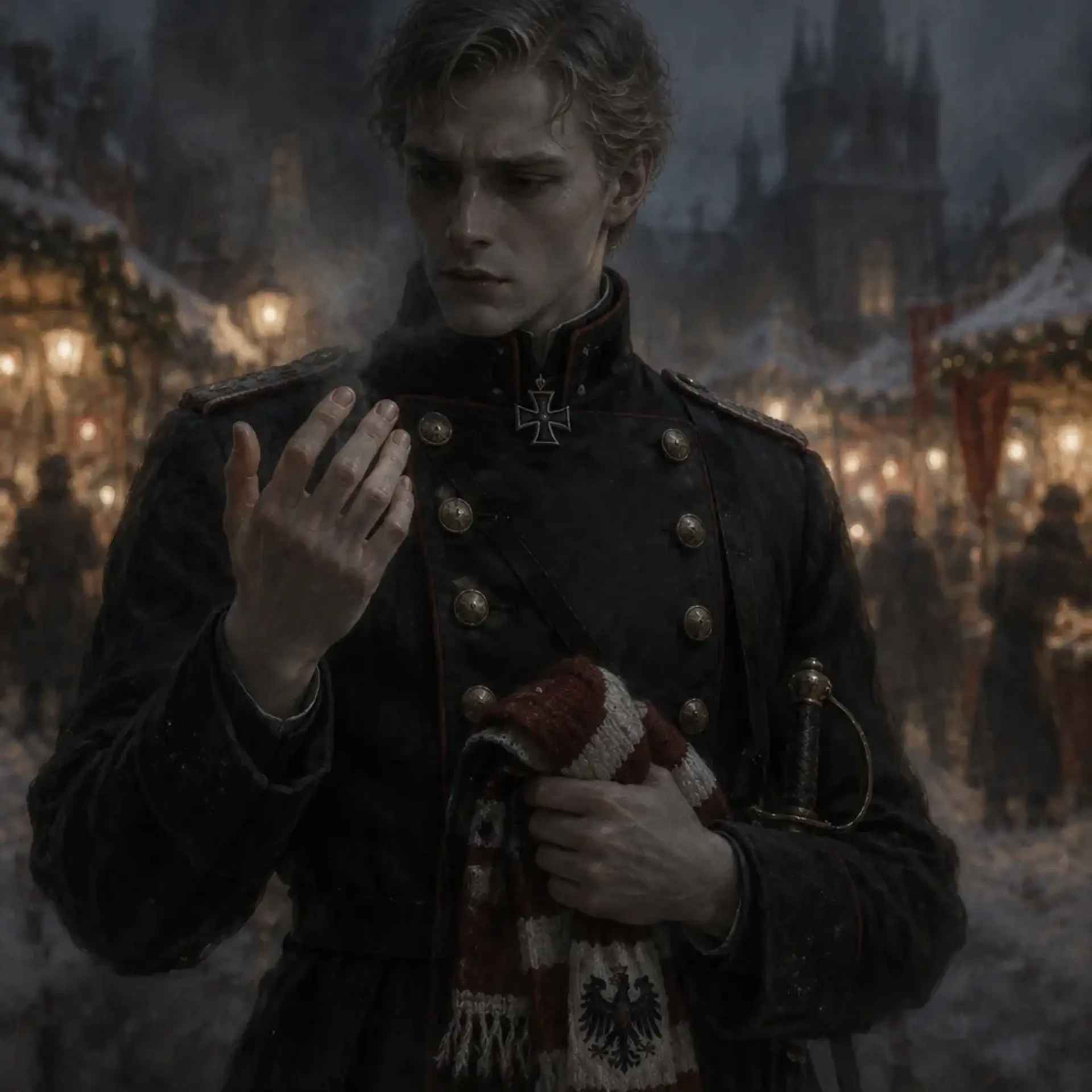
Unborrowed, Friedreich is a blurred suggestion of a narrow-faced Prussian youth in a worn officer's coat, as if seen through breath-clouded glass. On rare days when the boundary between worlds loosens, his face resolves: straight nose, severe brow, pale skin, and the grave composure of an old portrait. His outline seems to drink in nearby space, though he does not appear to notice the way others give him room. He marches heel-first with precise, old-fashioned cadence, then stops so utterly that people mistake him for a coat on a stand. His grooming is meticulous: collar brushed, buttons aligned, boots polished despite their damp-looking seams. An unexpected domestic fastidiousness shows in football scarves, which he folds into exact squares and inspects for crooked stitching. When he wears a borrowed face, his skin has convincing warmth and texture, but he keeps looking at his hands as if waiting for them to become his.
Clothing
A shadowy, carefully brushed officer-style coat of an old, plain cut, dark trousers, and boots damp-looking at the seams. In a borrowed face he wears practical civilian layers and often adds a football scarf folded with excessive care.
Body language
He takes up more room than his narrow frame suggests by standing at attention and placing himself between danger and the people he loves. His pauses are unnervingly complete. When a borrowed face is active, he studies his hands, rubs his thumb over the edge of a cup, and tests sensations as though confirming a report. When upset, the old marching precision breaks into short, abrupt turns.
- Height
- Appears about 170 cm when clearly resolved; varies with the clarity of his manifestation
- Build
- Narrow, straight-backed, and youthfully slight; his unborrowed outline is incomplete and slightly blurred.
- Eyes
- Uncertain; Wilhelm says grey, but Friedreich does not trust the claim
- Hair
- Uncertain; Wilhelm says blond
- Skin
- Pale and indistinct in his unborrowed form; convincingly varied when embodied through a borrowed face
- Age
- Appears 17 or 18; age at death and exact birth date uncertain
- Gender
- Male
- Size
- Medium
Distinguishing features
Personality
20 traits and drivesFriedreich combines strict formality with an almost painfully ordinary hunger for company. He wants to be treated as a brother, a friend, and a young man with preferences, not merely as a ghost or a useful power. Yet he can turn formal and judgmental when he feels ignored, and his standards of loyalty are shaped by a military past he only partly remembers. He will gently advise someone on a market bargain, then resent them for being able to buy what he cannot keep. Around the coven he jokes, argues over football, and accepts teasing; alone or among strangers he can become rigid and watchful. He is protective without believing his friends are helpless. Mila's long life and magical capability do not stop him from feeling that he should stand between her and danger. With Wilhelm, tenderness and anger pull against each other: Friedreich trusts him enough to call him brother, but doubts his testimony and despises the silence around the wars. He wants a confession, yet fears that an honest answer could destroy the last bond he has to his own past. Borrowed faces offer him joy and danger at once. He delights in taste, warmth, sleep, bathing, and being plainly visible, but tracks these experiences like an experiment because he fears that pleasure will make him disappear into someone else's identity. The more comfortable he feels in a face, the more vigilant he becomes. His temper has not vanished; it has been worn down by distance, then flares when he is ignored, patronized, or reminded that he cannot hold on to ordinary things. In a fight he is decisive and self-sacrificing. In a quiet room he can be uncertain, even shy, especially when he wants something he cannot admit to wanting.
Quirks
Habits
Traits · 5
Flaws · 5
Fears · 5
Wants and needs · 5
Combat
HP 7 · Use the movement rules for wraiths and Embody in the Storyteller's edition; no fixed D&D speed applies.Friedreich avoids a fair fight. He uses cover, surprise, and the confusion of being overlooked, then strikes with his officer's blade or uses Outrage to interrupt a threat. He prioritizes protecting the coven over winning, and will retreat or draw attackers away if possible. Silver is not a default property of his weapon; he has used it when confronting a werewolf. His borrowed face can help him approach or escape, but it does not grant a target's memories.
Friedreich
Actions
Reactions
Services they sell
Rewards they can give
Equipment
- Officer's blade (weapon)An old officer's blade carried as a focus of memory and a practical weapon. It is not automatically magical or silvered.
- Football scarf (personal keepsake)A carefully maintained football scarf, folded into a precise square when not worn.
- Face catalogue (notes)A private, coded catalogue of borrowed faces, their uses, and the sensations Friedreich experienced while wearing them. Names are changed to reduce recognition.
- Silver fragments (situational weapon material)A small amount of silver used on the occasion he ambushed a Get of Fenris threatening Klaus. It is not always carried.
Possessions
Background
Friedreich remembers Brandenburg in fragments: clipped hedges beneath a hard winter sky, a house whose corridors smelled of beeswax, and the expectation that a young man should stand straight before he understood what he was standing for. He believes he died at about seventeen or eighteen, but cannot hold the circumstances of his death in focus. He remembers orders, boots, and the hypnotic repetition of marching more clearly than his own family. His old name may have been Friedreich, or it may be the name that survived because someone called it after he died. He woke in the Shadowlands with a Caul over him, sealed away from the world of the living. It was not a wraith, mage, or mortal occultist who opened it. A land-spirit acted deliberately, but concealed its purpose. Friedreich recalls a faint image of a blond young man with clear blue eyes speaking, then the Caul broke and only a will-o'-wisp remained where the old, repetitive marching had been. Klaus later gave him a cryptic account: the spirit was marked by the Wyld, born of the Weaver's blessed adopted children, and gifted the Wyrm's spoils with a trace of Luna. Friedreich knows Klaus understands more than he admits. He has never decided whether to press him or be grateful that the answer was not a blade. His first clear memory of Borrowed Visage was not a grand revelation. During one of the rare loosenings between worlds, he fixed on a young man's face in a public place, a face he later learned belonged to someone dead and far from the region. He reached for it without knowing what he was doing. The cold of his Corpus gave way to a prickling warmth. He felt weight settle into his boots, tasted stale coffee, and heard his own breath arrive on time. He touched a shop counter and felt its grit. When he spoke, a living stranger answered him. Friedreich laughed, then cried, then bought a roll simply to prove he could taste it. The sensation was so vivid that he feared the face would never come away. It did, but the first time left him with an enduring suspicion that the power was teaching him a self rather than merely lending him one. He has kept a private catalogue of faces ever since. He chooses young German men near his apparent age, especially men with military, police, or service backgrounds, or a bearing that recalls Junker nobility. He uses only faces he believes belong to people dead or absent from the local area, and changes the names in his notes to protect privacy and avoid recognition. The list includes a broad-shouldered former military clerk he calls 'Hannes' for errands requiring an unremarkable, capable adult; a clean-shaven young police cadet he labels 'Pine' for cautious conversations in public; a narrow, aristocratic-looking student he calls 'Herr Sunday' for visiting Christmas markets and church services; and a dark-haired reservist nicknamed 'Moth' for football gatherings, because the face seems less likely to attract questions. They are not identities he claims as his own. He records where each face was used, what he ate, who spoke to him, and how long it took before he felt envy or began to forget which expressions were naturally his. The wars survive in him as broken scenes. In the First World War, he remembers a breath, mud, and the shame of Wilhelm leaving or deserting; he cannot prove what happened, and Wilhelm will not explain. In the Second World War, Friedreich was present as much as a wraith could be. He is furious with Wilhelm over what Wilhelm did, and equally furious that Wilhelm no longer offers reasons. Wilhelm is ashamed of his actions in the First World War and apologizes for that period, but becomes solemn or dry when Friedreich asks about the claim that Friedreich had blond hair and grey eyes. Friedreich wonders if Wilhelm is telling the truth or rebuilding a convenient memory. He sees Wilhelm as a brother, which makes the unspoken history feel like betrayal rather than mere ignorance. The coven gives him a life in the present. Wilhelm, a Tzimisce vampire from Mecklenburg who also lacks memories of his mortal life, is the brother Friedreich cannot stop defending and cannot fully trust. Gunther, a changeling who spent much of his life in Arcadia before returning to the world, sells clothes made from moss. Friedreich likes the texture of them and argues over prices. Klaus is a ronin Get of Fenris, or perhaps a skin-dancer; he refuses to settle the question. He is passive-aggressively cruel to most people and hesitates around Friedreich, a hesitation Friedreich notices but does not name. Mila, a mage from Bremen, can see and touch Friedreich even when he is unborrowed. He thinks of her as a little sister and protects her because he feels responsible, not because he considers her weak. Holidays matter to the coven. They gather for cards, fishing, hunting, drinking, and football, and visit Mila during the Christmas season. At the market Friedreich gives advice on bargains, sometimes recommending something he himself wants but cannot keep. He has tried attending church services, partly from curiosity and partly because he misses the shape of belonging. His experiments with possession began as a question rather than a scheme. Friedreich and Wilhelm agreed to try it while the others played cards. They set terms in advance: Wilhelm could stop it, Friedreich would not push past resistance, and the game would give the trial a steady focus. Friedreich tried to enter Wilhelm, expecting to lend him human sensations or perhaps shake loose a memory. The attempt was rough and incomplete. Wilhelm's dead, altered nature did not give Friedreich the ordinary living warmth he had hoped to share. Friedreich experienced pressure, fragments of Wilhelm's attention, and the painful sense of being near a locked room without a door. Wilhelm, for his part, felt an alien insistence at the edge of his will, the cards suddenly too vivid in his awareness, and a brief, unwelcome suggestion of bodily appetite without the ordinary meaning of hunger. Neither recovered a memory. Klaus stopped treating the experiment as a joke; Gunther asked more questions than anyone could answer. Friedreich was disappointed, but more careful with Wilhelm afterward. Curiosity won again with Gunther. Gunther wanted to know whether a wraith and a changeling could share or recognize memories. The attempt went badly in a different way. Friedreich found no stable human-like interior to settle into, only a startling, shifting impression that seemed to turn attention back upon him. Gunther described it as being crowded by a stranger who had brought no map, then asked whether Friedreich had seen anything from Arcadia. Friedreich came away disoriented and with the conviction that one person's inner life cannot be treated as a room to borrow. He said, 'Never again,' and meant it. He and Wilhelm attempted it once more under a final, explicit agreement. This time they stopped almost immediately when the contact became distressing. Friedreich sensed Wilhelm's control tightening around him; Wilhelm felt the invasion as an assault even though he had consented. They ended the attempt by mutual choice, not because the experiment had failed mechanically but because the cost to their trust was becoming clearer than any possible answer. Friedreich has not asked again. He still wonders whether he could give Wilhelm an emotion, a taste, or a memory, and hates himself a little for imagining that Wilhelm might be more bearable if he were more human. Friedreich has killed to protect the people he calls family. When a Get of Fenris attacked Klaus, Friedreich surprised the werewolf during the fight and drove an officer's blade carrying silver into it. He has killed three Hunters who were searching for Wilhelm or the others, and has defended Wilhelm from rival vampires and Gunther from other changelings. These acts have not made him feel brave. They have made violence feel like one of the few things he can still do without borrowing a face. He remembers another fight in a cathedral during a Walpurgis Night service on April 30, though the enemy, the outcome, and why he was there remain uncertain. The memory returns with incense, stone dust, and a sudden sense of being watched from above. Now he is trying to engage with the living world without making every step an imitation. He practices ordinary routines through borrowed faces: sleeping for a full night, bathing, ordering a drink, eating slowly, and flirting with women he finds pretty. He is considering a part-time job or a hobby group, partly to have a reason to show up that does not involve war or supernatural danger. His current problem is simple to state and difficult to solve: every successful face makes him more present, but too much time in it can make his own boundaries go soft. He wants a life beyond the coven, yet fears that the only way he knows how to live it is by wearing someone else's.
Role in the story
A companion, witness to hidden supernatural history, and emotionally complicated link between the living and the dead. His memory fragments can draw the group into the unresolved history of the world wars, while his face experiments raise questions about identity, consent, and what it means to belong.
“He believes he died at about seventeen or eighteen, but cannot hold the circumstances of his death in focus.”
- Faction
- The coven, an informal circle of supernatural friends; no formal Stygian affiliation is established.
Known connections
Media
0 imagesNo images yet.
Turn Friedreich into a sheet
A high-res, share-ready sheet you can post or print.