Friedreich
Friedreich
At the table
Voice
A young man's voice with a firm Brandenburg-Prussian accent, shaped by imagined or remembered drill and by years of speaking from the margins of conversations. It has a dry, papery edge when he is tired. His breathing does not always match his speech: when agitated, it seems to catch up after the words, making his anger feel slightly out of time.
His German is clipped and formal, with the strong Prussian accent of the heritage he believes he had. English, when used, is careful and slightly over-enunciated. He sounds as if each sentence has been inspected before release. When rattled, his breath arrives late and the words become blunt, not softer.
Speech patterns
How to play them
Acknowledge him directly when he is visible, and do not treat a borrowed face as permission to claim its original owner's life. Offer clear boundaries before any experiment with possession. He responds best to practical companionship, football, holiday errands, and honest questions asked without cornering Wilhelm in public.
Goal
Build a small, repeatable place in the living world through a job or hobby group without losing himself in borrowed identities, and get Wilhelm to explain their shared past honestly.
Motivation
To be recognized as Friedreich rather than as whichever dead man's face he is wearing, while preserving the family he has chosen.
Appearance
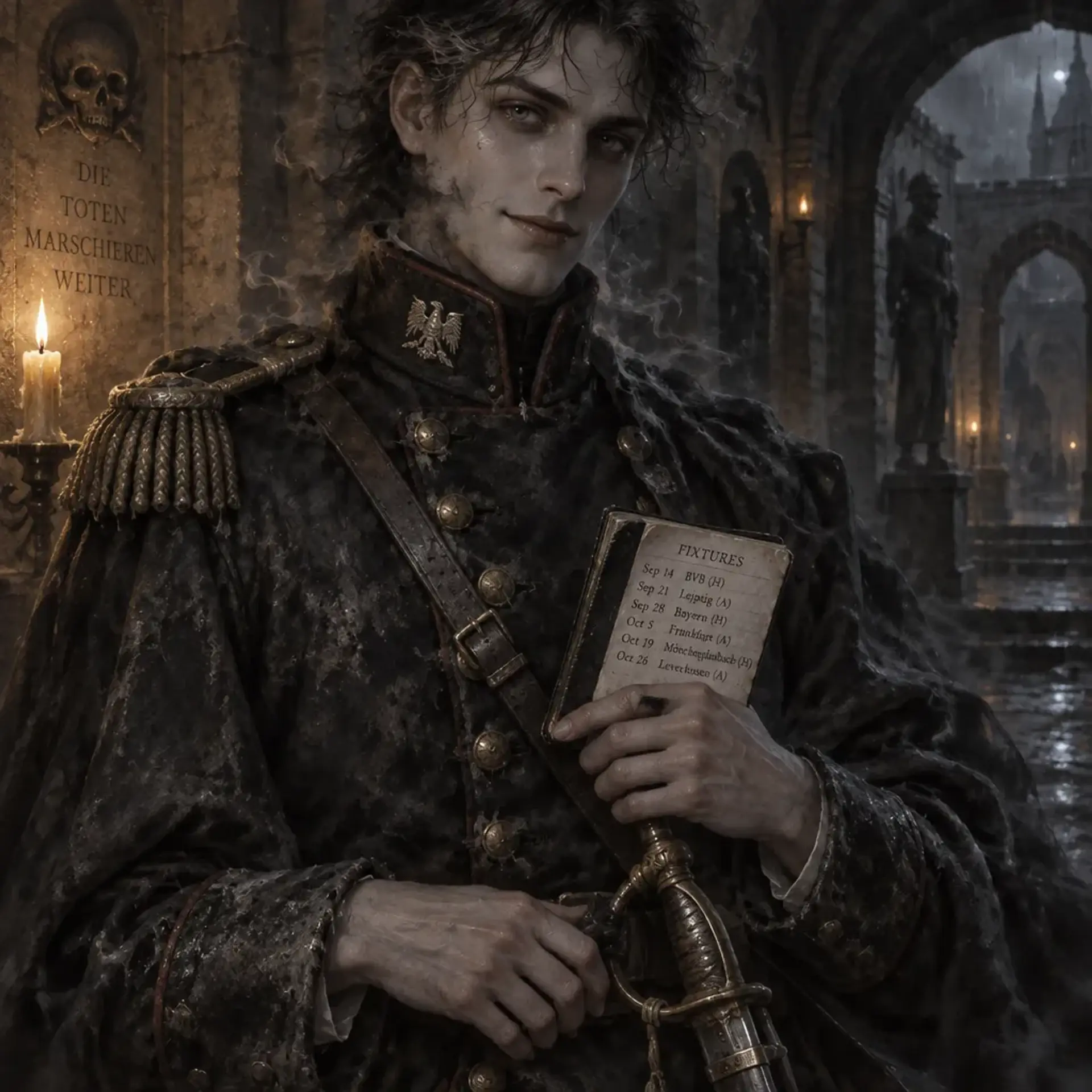
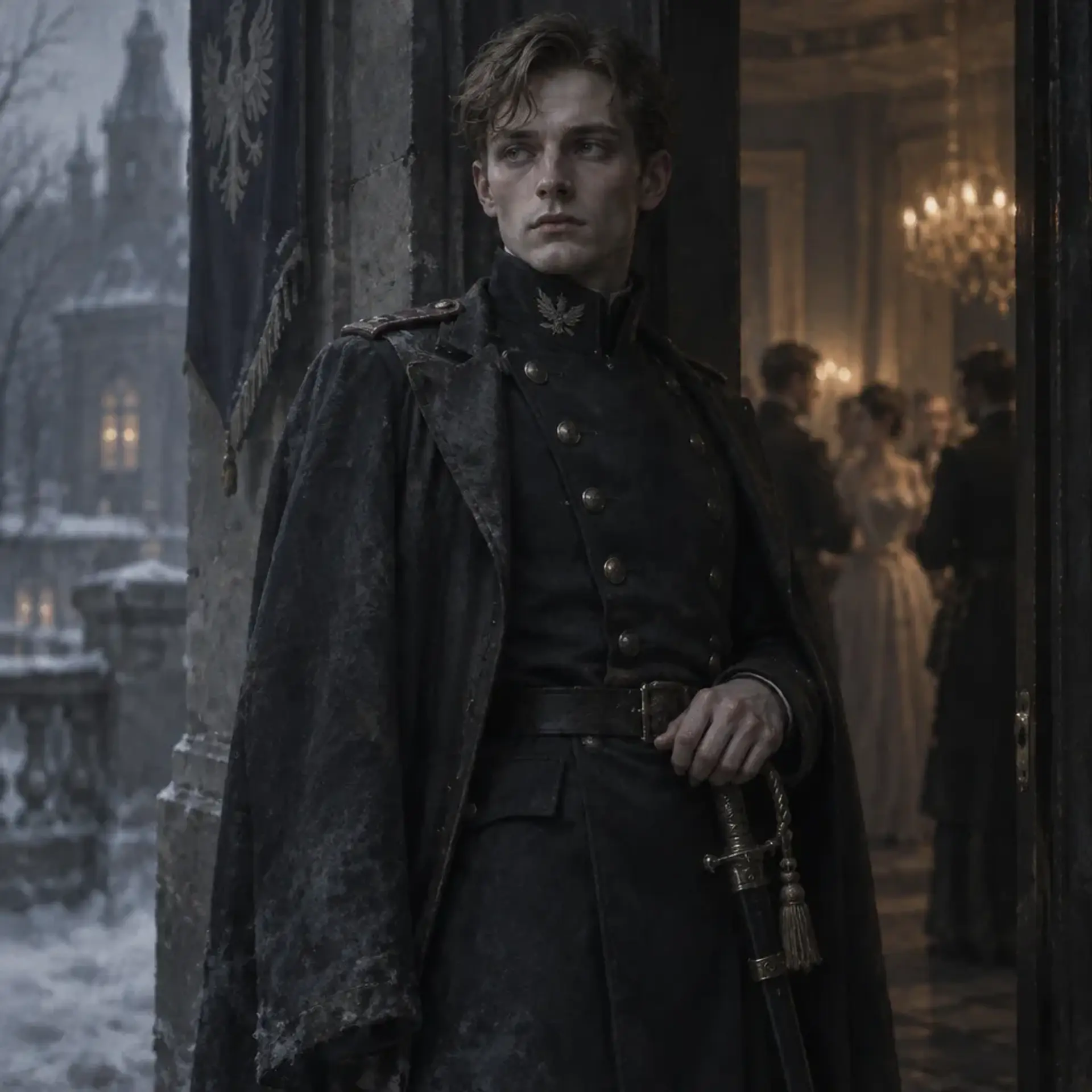
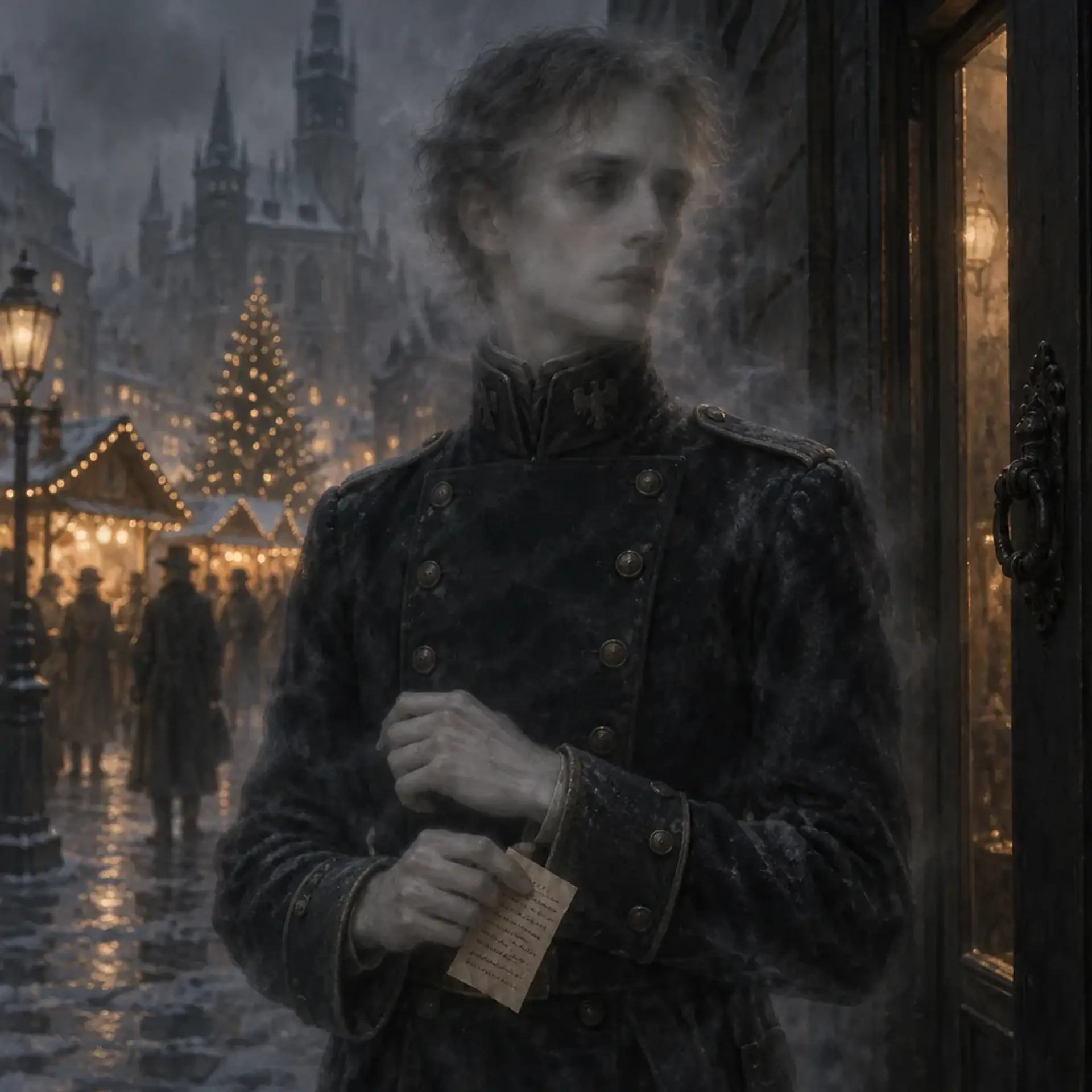
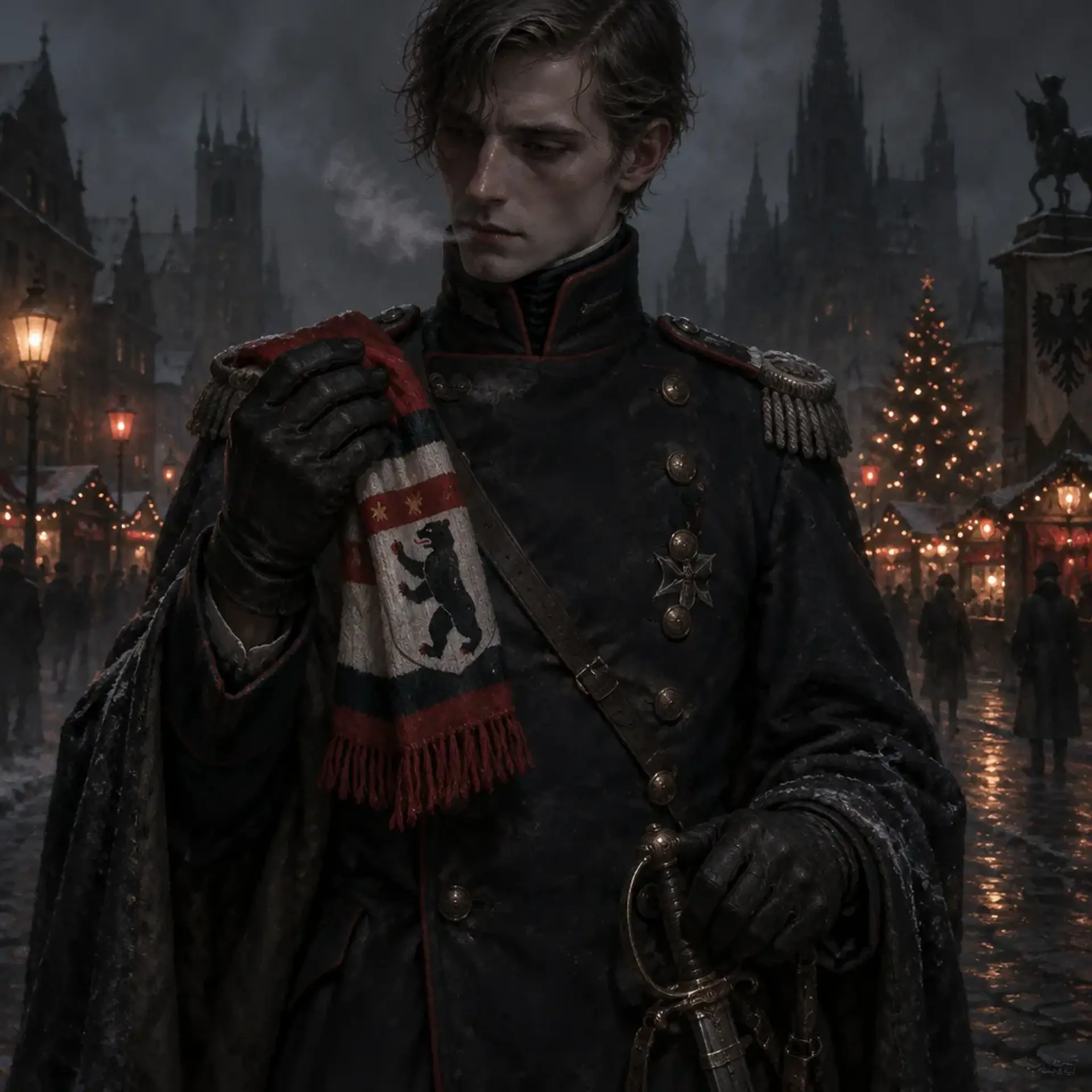
Friedreich's unborrowed form is the blurred suggestion of a young Prussian man in a worn officer's coat, his features incomplete as if seen through breath-clouded glass. On rare days when the boundary between worlds loosens, he resolves into a pale, narrow-faced youth with a straight nose, a severe brow, and an expression that looks borrowed from an old portrait. He moves with an exact, heel-first marching step, then stops so completely that people mistake him for a coat on a stand. When unsettled, his next breath arrives a fraction too late, like a delayed echo. The unexpected detail: he is meticulous about football scarves, folding them into precise squares and quietly judging the stitching, a domestic fussiness at odds with his military bearing. When embodied through a stolen face, his texture and warmth seem convincingly human, though he watches his own hands as if checking that they belong to him.
Clothing
A shadowy, carefully brushed officer-style coat with an old, plain cut, dark trousers, and boots that seem damp at the seams. When embodied he favors practical civilian layers, sometimes adding a football scarf folded too neatly.
Body language
He stands with parade-ground precision and marches heel-first, but pauses with such total stillness that people may overlook him. When angry, his jaw works and his delayed breath becomes conspicuous; he does not become gentler or quieter. While wearing a face, he checks his fingers and posture as if rehearsing ownership.
- Height
- Appears about 170 cm in his usual manifestation; borrowed faces vary.
- Build
- Lean, adolescent proportions in his unborrowed manifestation; borrowed bodies vary with the face.
- Eyes
- Unborrowed eyes are indistinct; Wilhelm says Friedreich's living eyes were grey, a claim Friedreich does not fully trust.
- Hair
- Unborrowed hair is indistinct; Wilhelm says it was blond. Borrowed faces retain their own hair.
- Skin
- Ash-pale and indistinct in his unborrowed manifestation; borrowed faces retain their own complexion.
- Age
- Appears about 17 or 18; his age at death and the length of his existence in the Shadowlands are uncertain to him.
- Gender
- Male
- Size
- Medium
Distinguishing features
Personality
17 traits and drivesFriedreich is disciplined because routine gives his scattered existence a shape, but he dislikes being treated as a relic of military order. He can be tender toward friends and exacting about small courtesies, then abruptly fierce if someone threatens the coven. His care is practical: he checks exits, remembers who dislikes which drink, and stands between danger and Mila without making a speech about it. Yet protection can become control. He is capable of listening patiently to Gunther's questions, but if he feels unseen or treated as an object of curiosity, irritation flashes before he retreats into a remote, exhausted silence. He is not consistently solemn. Football, Christmas markets, fishing, and the prospect of ordinary work bring out a competitive, almost boyish side. He enjoys advising others on bargains, especially when the item is something he secretly wants. He is curious about bodily life with an intensity that embarrasses him: warmth, sleep, bathing, food, and flirting are not trivialities when he has lost reliable access to them. A successful borrowed face makes him giddy, then uneasy; he may laugh at a taste of bread and later stare at his hands, wondering whose gestures he has kept. His loyalty to Wilhelm is both chosen and resented. Friedreich sees him as a brother, has defended him, and still wants an explanation for the First World War desertion and the Second World War crimes. Wilhelm's apology for the earlier desertion matters, but cannot repair the later silence. Friedreich wants to believe that love and accountability can coexist. When angered, he becomes more direct, not more polite: his sentences sharpen, his jaw tightens, and his delayed breath betrays how close he is to losing control. He is fascinated by the possibility of possession, but not careless about consent. The experiments with Wilhelm and Gunther taught him that curiosity can violate even when everyone agreed beforehand. He now insists on boundaries, a stop signal, and a conversation afterward. He wants to offer Wilhelm human sensation, perhaps even a memory, but has begun to understand that neither can be given like a gift. This knowledge saddens him and makes him more careful. Friedreich's central contradiction is that he longs to be seen as himself while repeatedly borrowing other people's faces to be seen at all. He can be brave in a fight and frightened by a harmless mirror; proud of his imagined heritage and suspicious of the only person who can describe it; angry at Wilhelm yet ready to defend him. He is trying to become a person through choices, not merely through the face he wears or the history others assign him.
- Alignment
- Protective and duty-bound, but capable of frightening violence when his chosen family is threatened. Moral language is a personal struggle, not a rules alignment.
Quirks
Habits
Traits · 5
Flaws · 4
Fears · 4
Wants and needs · 4
Combat
HP 7 · Not assigned as a D&D-style speed. Use the Storyteller System's movement rules; Friedreich moves with an exact marching gait when manifested.Avoids a fair fight. He watches for a threat to turn, then strikes with his blade to make an opening for a friend to escape. He protects the coven before himself. He has killed when he believed there was no other way, but does not treat violence as proof of honor. A borrowed face is for access or misdirection, not a combat bonus unless the Storyteller rules otherwise.
Friedreich
Actions
Reactions
Services they sell
Rewards they can give
Equipment
- Officer's blade (weapon)An old officer's blade he carries as a familiar weapon. Its supernatural properties are not assumed; a past use with silver against a werewolf is part of his history, not a general rule.
- Face-use list (personal record)A coded notebook listing faces, aliases, suitable situations, and cautions about identity drift.
- Football scarf (keepsake)A folded football scarf he maintains with almost ceremonial precision.
Possessions
Background
Friedreich remembers Brandenburg as a succession of damp roads, clipped hedges, and rooms where boys were expected to stand straight. He does not remember his family clearly. He remembers the sensation of being instructed to march, the sound of boots on packed ground, and the certainty that a young man ought to know where he belongs. His recollections may be true, shaped by his Shadow, or assembled from the faces and histories he has worn. Wilhelm once told him Friedreich had blond hair and grey eyes. Friedreich cannot decide whether this is memory, kindness, or an ideologue's convenient invention. His first clear memory after death is not a face. It is marching. He was caught in a repetitive, joyless circuit in the Shadowlands, unable to stop or understand why he was still moving. The wisp that interrupted the cycle seemed to carry an image: a young blond man with clear blue eyes, speaking from a distance. Friedreich remembers no words with confidence. He remembers waking from the compulsion, and the terrible knowledge that the living world had continued without him. Klaus later gave him an explanation for who opened his Caul. It was not a wraith, mage, or occultist, Klaus said, but a spirit of the lands and of humanity, touched by the Wyld, adopted among the Weaver's children, and bearing something taken from the Wyrm with a trace of Luna. Friedreich has no way to verify this account. He suspects Klaus knows more than he admits, and the explanation sounds like a map drawn by someone who wants to leave the dangerous parts off the page. The wisp and the half-seen blond figure remain more vivid to him than Klaus's cosmology. Friedreich's first face-taking came by accident. While watching the living during a brief loosening of the worlds, he reached toward a young man whose features recalled the face he thought he had lost. The stranger had died away from the district, and Friedreich's power caught the outline as if it were a coat left unattended. For the first time since death he could feel cold air against a cheek, taste bread, and hear his own voice land in a room. He ate too quickly and cried at the taste. Then, looking at a dark shop window, he saw a stranger looking back. The pleasure of being seen and the panic of not being himself arrived together. He gradually began keeping a private list of faces, changing the names he writes beside them so no one can use the list to identify their sources. He favors young German men near his apparent age, especially those with military, police, or old noble bearing. He checks, as best he can, that a face's original owner is dead or not nearby. A retired railway guard with a square jaw is his practical face for errands and ordinary conversations. A dead reservist's solemn, clean-cut face is for seeing Wilhelm and the others. A young constable's alert features are reserved for unfamiliar streets. A narrow-faced Junker descendant's portrait-like look is his choice for Christmas markets, where he advises companions on bargains but sometimes points out something beautiful because he wants it himself. He has begun to consider a part-time job or hobby group, and tests whether his borrowed faces can manage routine without making him disappear into them. Wilhelm became the closest thing Friedreich has to a brother. Friedreich accompanied him through both world wars as often as he could, though memory breaks up the details. From the First World War he sometimes recalls a breath, a moment of abandonment, and Wilhelm leaving. Wilhelm is ashamed of that desertion and apologizes for it, but seldom explains. The Second World War is worse: Friedreich is furious about what Wilhelm did, and Wilhelm will not discuss it. Friedreich believes the crimes belong to Wilhelm, yet fears that their shared past makes him complicit. He has defended Wilhelm from other vampires, then resented himself for doing so. The coven is an improbable household rather than a formal order. It gathers for cards, fishing, hunting, drinks, holidays, and football. Gunther, a changeling who spent much of his time in Arcadia before returning to the mundane world, sells clothes made from moss. He asks questions with an earnestness that can feel like a hand reaching into a wound. Klaus is a ronin Get of Fenris, or perhaps a skin-dancer; he refuses to say. His passive-aggressive barbs usually land cleanly, but he hesitates around Friedreich. Mila, a mage from Bremen, can see and touch Friedreich even when he is not wearing a face. He thinks of her as a little sister and protects her out of loyalty, not because he thinks her helpless. Holidays matter. At Christmas, Mila's visits and the market's lights let Friedreich borrow a face and pretend, briefly, that this is an ordinary family outing. His protectiveness has cost lives. When a Get of Fenris tried to kill Klaus, Friedreich struck by surprise with his officer's blade, using silver in the desperate fight. He has also killed three hunters who pursued Wilhelm or the others, and has fought vampires and changelings who threatened his chosen family. These events trouble him less as tactical memories than as evidence that he can still choose violence with terrible speed. Curiosity about possession became an experiment with Wilhelm. They agreed to terms before Friedreich tried to enter him during a card game, using the deal and the repeated handling of cards as an anchor. Klaus watched in alarm; Gunther watched with questions. Friedreich felt the boundary as pressure and then as an intimate, disorienting proximity to Wilhelm's thoughts. He could not simply hand Wilhelm human emotion or restore a missing past. He could nudge sensation, but the experience was uneven and filtered through Wilhelm's own body and defenses. Alcohol was the test: Wilhelm swallowed, registered the burn and the bodily response, but the drink did not unlock a hidden self. Friedreich found no clean memories waiting to be shared. The game collapsed into missed turns, cards held too tightly, and Friedreich's fear that he was trespassing even with permission. They stopped, separated carefully, and talked through what each had felt. The experiment left Wilhelm with a fleeting reminder that sensation was possible, and Friedreich with less confidence that he could give his brother anything he lacked. Later, Gunther wanted to know whether a wraith and a changeling could share memories. Friedreich agreed from affection and curiosity, but the attempt was worse. Gunther's inner experience did not feel like a human room to enter; it was crowded with strange associations, sharp shifts, and impressions that refused to hold still. Friedreich felt his own identity tugged out of shape while Gunther tried to understand him in return. Neither got a reliable shared memory. They broke contact, checked that each could still name himself, and agreed never to repeat it. Friedreich said, 'Never again,' and meant it. He tried once more with Wilhelm under a clear last-time agreement. This attempt was more deliberate: no alcohol test, no audience, a short interval, and a plan to stop at the first sign of confusion. It produced no revelation about Wilhelm's past. Instead, Friedreich recognized how much of his own picture of Wilhelm was built from loyalty, wartime fragments, and questions Wilhelm would not answer. Wilhelm again apologized for the First World War. The apology did not repair the silence about the Second. It did, however, give them a boundary they could both respect. Friedreich's present problem is not only finding a stable face. Long use makes the borrowed identity feel easier than his own, while envy and anger gather underneath the convenience. He wants a place in the living world: a job, a hobby, a seat at the table without having to borrow somebody else's life. He also wants Wilhelm to tell the truth, and fears that the answer will either confirm the worst or destroy the brotherhood that has kept him moving.
Role in the story
A ghostly companion and moral pressure point: Friedreich offers access to a close-knit supernatural circle, but his borrowed faces, wartime memories, and unresolved bond with Wilhelm raise questions about identity, complicity, and what family owes its members.
“His recollections may be true, shaped by his Shadow, or assembled from the faces and histories he has worn.”
- Faction
- A member of an informal supernatural coven. In Wraith terms he is a wraith in the Shadowlands; no formal Stygian rank is established.
Known connections
Media
0 imagesNo images yet.
Turn Friedreich into a sheet
A high-res, share-ready sheet you can post or print.