William Windon
William Windon
At the table
Voice
William's voice has a lightly breath-checked start, as though his chest still reminds him to take care. His vowels and rhythm are those of a young man raised in Wiltshire, and his gardening work leaves him comfortable with plain, concrete descriptions. The reflection's voice uses William's mouth but sounds older, deeper, and shaped by a different generation; it favors clipped remarks, formal judgments, and strange comparisons to weather, water, or forge-work.
William's voice is an ordinary young man's voice, clear and direct, with the slight breath-check of someone recovering from illness. His work gives him a habit of naming practical things precisely: soil, weather, growth, and the condition of a plant. When the reflection speaks through him, the same mouth produces a deeper, older-sounding voice with a different accent and a dry, formal cadence. It does not become soothing when angry; it gets more exact, choosing each cutting word as if setting a tool down in its proper place.
Speech patterns
How to play them
Approach William with patience and directness. Give him room to answer in his own words, and do not assume every remark or action came from him. He is more forthcoming while gardening or discussing plants than when questioned as an occult curiosity. Treat the reflection as a person with feelings, but set clear limits around insults, theft, and taking control. If confronted about the heart, he wants honest help more than promises of an easy cure.
Goal
Find the missing heart and learn whether it created, housed, or merely awakened the reflection, while preserving his health and building a life as a botanist.
Motivation
William wants a meaningful, ordinary future as a botanist and hopes he can keep the people he loves safe. The reflection wants to explore, enjoy the unfamiliar modern world, preserve its own dignity, and understand what it was before it became tangible. Its motives are not wholly opposed to William's, but neither has agreed on what their shared life should become.
Appearance
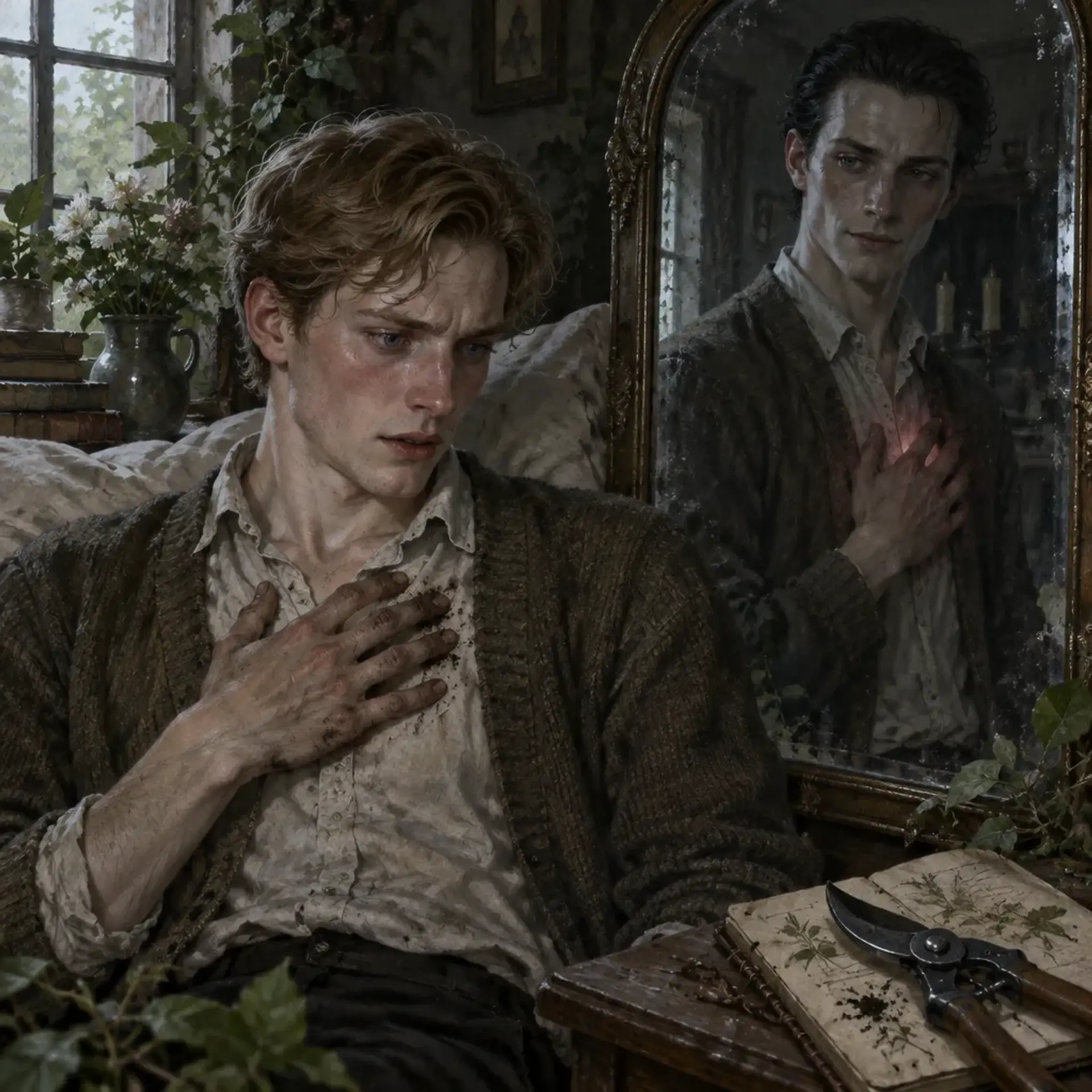
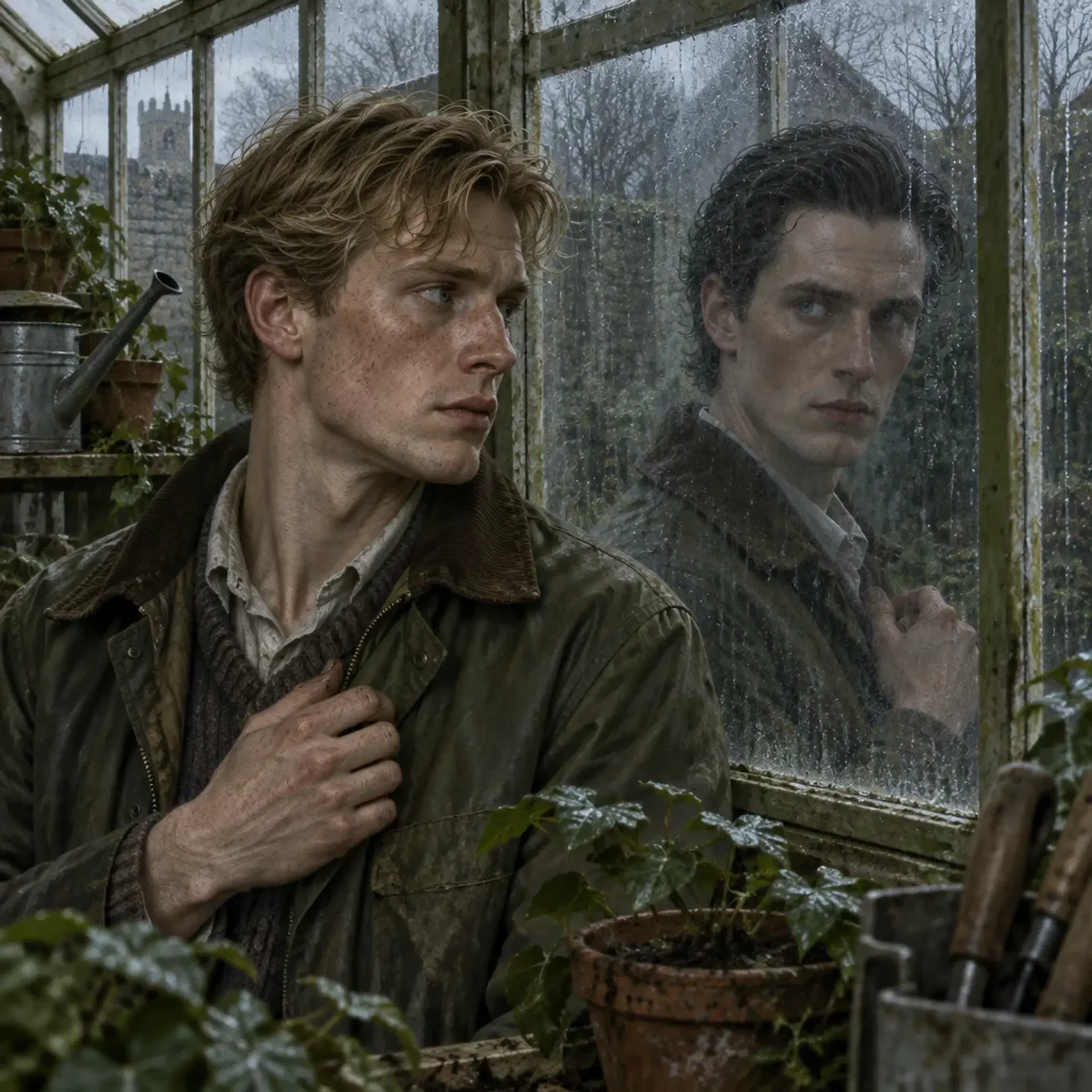
William Windon is a dark-blond, blue-eyed young man with brown freckles scattered over his face and the weathered, attentive look of someone accustomed to working outdoors. His gardener's hands are usually faintly earth-dark beneath the nails, and his clothes carry the clean, crushed-green smell of stems, damp soil, and soap. He moves carefully while recovering from his heart stoppage, as if listening to his own body before trusting it. His reflection is not his double: in glass and still water, a long-faced young man looks back with moonlit blue eyes, short black hair slicked neatly back and trimmed at the sides, and a stern, composed expression. The stranger copies William's clothes but not his face or posture. A noticeable pause precedes William's speech, accompanied by a small intake through his nose, as if he is waiting to find out which of them will answer. Unexpected detail: despite his rural gardener's work, William is fascinated by modern cars and electrical devices, and will stop to study their mechanisms with the absorbed seriousness of a natural philosopher.
Clothing
Practical gardener's clothes: work shirt, worn trousers, sturdy boots, and a jacket suited to damp English weather. He keeps himself reasonably neat. The reflection appears in the same clothes but wears them with a more formal, deliberately arranged bearing.
Body language
William carries himself with a gardener's careful economy, protecting his recovering chest and pausing before sudden effort. He rubs soil from his thumb when thinking and glances toward reflective surfaces without turning his head. When the stranger is close to the surface, William's posture can stiffen; his chin lifts, his shoulders square, and his mouth forms a wry expression that does not belong to his usual gentleness.
- Height
- Not specified
- Build
- Lean and sturdy from outdoor work, currently still mindful of his recovery
- Eyes
- Blue; the reflection's blue eyes seem like moonlight on a freshwater pond
- Hair
- Dark blond; the reflection's hair is short, black, and carefully slicked back
- Skin
- Fair, weather-touched skin with brown freckles
- Age
- Young adult; exact age unspecified
- Gender
- Male
- Size
- Not applicable as a canonical Secret Histories statistic
Distinguishing features
Personality
21 traits and drivesWilliam is gentle without being meek: he dislikes needless cruelty, but will stand his ground when someone vulnerable is being humiliated. He is warm and sociable with friends, yet turns inward when frightened and can conceal distress behind talk of work. He wants to be sensible, but the inexplicable has made him curious in spite of himself. The reflection pulls against him. It is formal about manners and appearance, but impulsive about exploration; it can be cutting toward strangers, yet tenderly apologetic after a frightening loss of control. It enjoys modern films and machines while judging modern behavior. In quiet moods it talks as if it and William are sharing a room; under stress it may seize the body before either of them has understood what is happening.
- Alignment
- Not applicable as a canonical Secret Histories statistic. In ordinary terms, William is compassionate and conscientious; the reflection is exacting, proud, and capable of cruelty.
Quirks
Habits
Traits · 6
Flaws · 5
Fears · 5
Wants and needs · 5
Combat
HP 0 · Ordinary walking pace; not established as a system statisticWilliam avoids violence and lacks formal combat training. He will try to get between danger and someone vulnerable, then escape or call for help. If the reflection takes control, it reacts on instinct, especially to war imagery or threats; this can produce a sudden shove or struggle but is not a reliable fighting style. The numeric fields here do not imply a canonical Secret Histories combat ruleset.
William Windon
Actions
Reactions
Services they sell
Rewards they can give
Equipment
- Gardener's workwear (clothing)Work clothes and sturdy footwear appropriate to estate gardening.
- Gardening tools (tools)A small practical tool kit for tending plants; its exact contents vary with his work.
- The Heart of England (occult object, missing)The missing chalk-and-scale heart once kept by William. It is not currently in his possession.
Possessions
Background
William Windon was born in Wiltshire to a family with deep roots in the county. His father, Hector, is a historian, an intellectual who distrusts old hierarchies and prefers new ideas, modern artists, and arguments about society. Hector's own father, remembered by the family as Bobby, was a fierce veteran of the Second World War. Hector is dismissive of the country's conduct in that war and of the rigid institutions Bobby respected, but the family past has never been as settled as Hector would like. He is also involved in an occult circle. He has not told William its full business, and William's quiet interest in plants and practical work once struck him as a disappointing refusal of the intellectual life Hector had imagined for his son. William grew up warm-hearted and sensitive, with a habit of noticing when other people were uncomfortable. His sister Elizabeth has always tested his patience by asking his opinion about attractive things, her admirers, and whether he is behaving properly. He has friends from school, Tommy DeHare, John Mollask, and Ryan O'Leary, and a girlfriend, Adaline, whose auburn hair and soft brown eyes have become a point of fierce, absurd interest to the stranger in William's reflection. William works as a gardener on an estate and is training toward becoming a botanist. Plants offer him a kind of honest attention: they respond to weather and care without pretending to be simple. The trouble began with a rock that was not merely a rock. Years earlier, an amateur alchemist named Bartholomew Golden brought a strange object to Hush House as payment for entry. Wrapped in newspaper, it looked like a human heart crudely shaped from Dover chalk, crusted with barnacles and sea grass. Golden called it the Heart of England and claimed it could bring servants from man's shadow, born of chalk cliffs and borderlands to labor for a house. No one now knows what he meant, and no one knows the stone's name or purpose. Golden was never allowed near Brancrug again. The heart was thrown into the sea and returned to shore, weeping seawater and black ooze, with a red-pink glow beneath its stony surface. A young man named Abraham Groff found it and took it home. The object seemed dead in company and revived when brought to a Hampshire shore and dipped in water. Groff became protective of it, not from greed so much as the sense that the thing disliked visitors. In time, voices, moving doors, and footsteps troubled his house. He sold it to William, then a seventeen-year-old local lad who had once seen the object apparently lifeless. Groff eventually moved to Canada. William has learned this, but has not found him. William kept the heart until its pulse began to echo inside his own chest. He tasted salt, blood, and soil without having put them in his mouth. Believing it was a stone that could be broken, he struck it with a hammer. The pain seemed to enter his chest. He fell, groaning and spitting blood, and glimpsed a muscle twitching under the rock. His own heart stopped. He awoke with his mother Clare's hands on his face and the knowledge that he had very nearly died. He hid the heart in a hollow log. Days later it looked pristine, as if the hammer had never touched it. Then it vanished. Afterward, mirrors became wrong. At first William saw a stern young man with neatly combed black hair and blue eyes where his own face should have been. The stranger copied William's clothes, but its face was structurally different. Its movements began to jerk away from William's, as if it wanted to go somewhere else. One night, while William was following his bedtime routine, the stranger spoke through his mouth: "Well, it's not often you use that one." Its voice sounded older than William's, and carried an accent that seemed to belong to another generation. William was cautious, then irritated, then accustomed to the presence in the way people become accustomed to a draught they cannot repair. The presence grew bolder. It criticized William's grooming, his manners, and his clothes, sometimes stopping him from saying something it judged improper. It made cutting remarks about family and neighbors when it thought itself alone. Once it insulted the Welsh neighbor's child with a slur after the child accidentally hit William with a toy wagon and tearfully apologized. William was made to muck out the neighbor's stables as a consequence. He was angry at the reflection and ashamed that anyone else might mistake its cruelty for his own. The reflection has its own opinions and emotions. It likes books and films, is fascinated by cars and electrical devices, and has a reckless appetite for exploration. It steals cigarettes, cigars, cheese, sweets, tinned fish, and other household goods, hiding them in William's room. Once William discovered a bottle of apple juice beneath his bed that was actually alcohol. It holds strict, old-fashioned rules about tea and table manners, though its own behavior can be wildly inconsistent. Bathing is awkward: the water shows the stranger, and both it and William possess a degree of English prudishness. Sometimes the reflection takes charge of washing, offering sarcastic commentary on William's body; William has felt it blush with embarrassment. It is especially interested in Adaline. When it first saw her, its attention became unmistakable. William had not expected to compete with himself for his own girlfriend's attention. The reflection has made remarks about Elizabeth too, often simply calling her "interesting," in a tone William cannot interpret. It dislikes William's cousin Ronald White, who calls himself a modern man. It also distrusts the paranormal. Though it is itself inexplicable, the reflection fears ghosts and fae and cannot give William a clear account of why. The worst breach came during a war film. The reflection reacted sharply, and William lost control of his body as if reliving an old shell shock. His family thought his heart had failed again. He fought, frightened and disoriented, until Elizabeth changed the channel. Later, the reflection mumbled an apology and offered a fragment of memory in consolation: salt, forges, and dark woods, plus a sense of terror it could not put into ordinary explanation. It sometimes talks about its father and siblings as if describing weather or the sea rather than living people. It has implied that this is its first time existing in a tangible way, but William does not know what that means. William's illness forced him onto bed rest. During that period, he woke cold and went into the hall with a small light. When he spoke to Elizabeth, the voice and accent that emerged were not his. On another night, he fell asleep near the private fireplace in his father's study and dreamed of salt, forges, and a dark wood. These episodes unsettled Hector, who had already recognized that the heart was unnatural. Hector's occult connections may give him a way to investigate, but he has not told William what he knows, and William is not sure he wants to be treated as a puzzle. Clare has been his steadiest support. She set regular times to take him outdoors and garden with her. She reads from a book or the Bible while he works, then brings him tea and snacks. The reflection does not insult Clare; it sometimes answers Bible passages with passages of its own that William does not recognize. Their quiet routines helped William recover. After roughly five months, he returned to estate work. His father became more guarded around him, while Clare remained warm and stoic. Elizabeth has since found a boyfriend, Romy Brock, an artist who plays rock and roll on the guitar. One night, William and the reflection shared a bottle of scotch and bourbon left out by mistake for his health. The reflection became drunk in a way William could feel: teasing, arguing, smiling, yelling as if they were in a pub together, and briefly treating the body's clothes as a matter of rebellion. William stopped it before it went further. In the morning, Clare found the empty bottle and Hector shouted, then abruptly quieted and offered William chores. The episode was funny, humiliating, and clarifying. The reflection is not just an echo or a malicious haunting. It can be pleased, ashamed, drunk, frightened, and companionable. William is trying to resume his life while searching for the missing heart and for Abraham Groff. He suspects that the heart and the reflection are related, but has no proof that the stone created the stranger, housed it, or merely brought it close enough to William to take root. The reflection has begun to explain itself, but every explanation is incomplete. William wants to become a botanist, protect his family, and remain himself. He also wants the stranger to be safe, though he cannot yet say whether that means finding it a body, finding the heart, or learning how to live together. Beyond William's household, work, and friendships, the reflection has a history it cannot remember in sequence, a family it describes in fragments, and an apparent fear of the very unseen world that might explain it. It is not a solved mystery, and William's life is no longer entirely his own.
Role in the story
A recovering gardener bound to a distinct and increasingly independent reflection, William is both a person in need of help and a living clue to the missing Heart of England. He can lead the characters toward Hush House, Abraham Groff, Hector's occult circle, and the unexplained history inside the stranger. His story is not simply about exorcising a passenger: William is trying to negotiate a shared existence with someone who has emotions, memories, and desires of its own.
“His father, Hector, is a historian, an intellectual who distrusts old hierarchies and prefers new ideas, modern artists, and arguments about society.”
- Faction
- No known formal affiliation. Hector participates in an occult circle, but William's membership is unconfirmed.
Known connections
Media
0 imagesNo images yet.
Turn William Windon into a sheet
A high-res, share-ready sheet you can post or print.