William Windon
William Windon
At the table
Voice
William's voice is plainly human and slightly breathy after his illness, with the open, unguarded sound of someone used to speaking across a garden rather than performing for a room. The reflection's voice comes from the same throat but uses it differently: rounded consonants, measured pauses, and an older cadence that makes familiar words seem borrowed. Its name for the heart, when William repeats it, carries a damp, stone-heavy sound; the texture belongs to that phrase, not to William's general voice.
William speaks in a clear, ordinary Wiltshire voice, shaped by work outdoors and years of listening to family conversation. He tends to qualify unsettling claims and return to concrete details: what he saw, where the object was, whether the room was cold. The reflection uses William's mouth but sounds older, deeper, and more exact in its phrasing, with the measured confidence of someone accustomed to formal rules. It favors dry wit and cutting asides. When it speaks of memory, it turns to tides, soil, weather, and forge work rather than naming people or events directly.
Speech patterns
How to play them
Begin with practical, ordinary conversation about gardening, recovery, or the weather. William wants to be believed but is wary of anyone who treats him as an occult curiosity. Offer privacy and a way to communicate without mirrors. Do not assume the reflection is a ghost or a simple possession. If the reflection speaks, address it as a participant while making clear that William's consent and safety matter. Clare's garden visits and tea routine are reliable ways to lower William's distress.
Goal
Find Abraham Gorff or the returned heart, learn what the reflection is, and secure a future in which both he and the presence in the glass can exist without either being able to erase the other.
Motivation
William wants a normal future, but he is no longer certain that normality can mean being alone inside his own body. He is motivated by affection for his family and Adaline, by curiosity about the heart, and by a growing unwillingness to treat the reflection as a thing.
Appearance
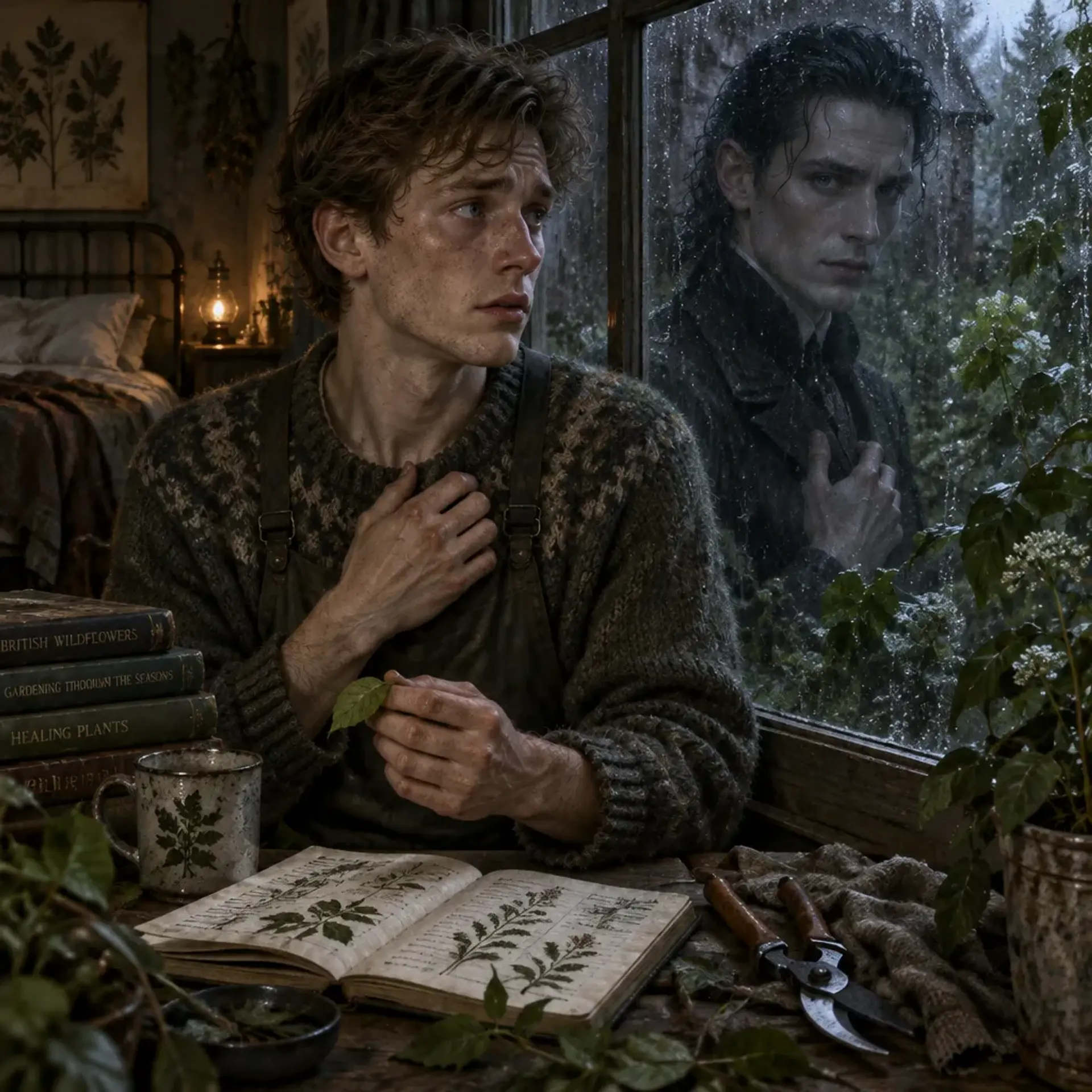
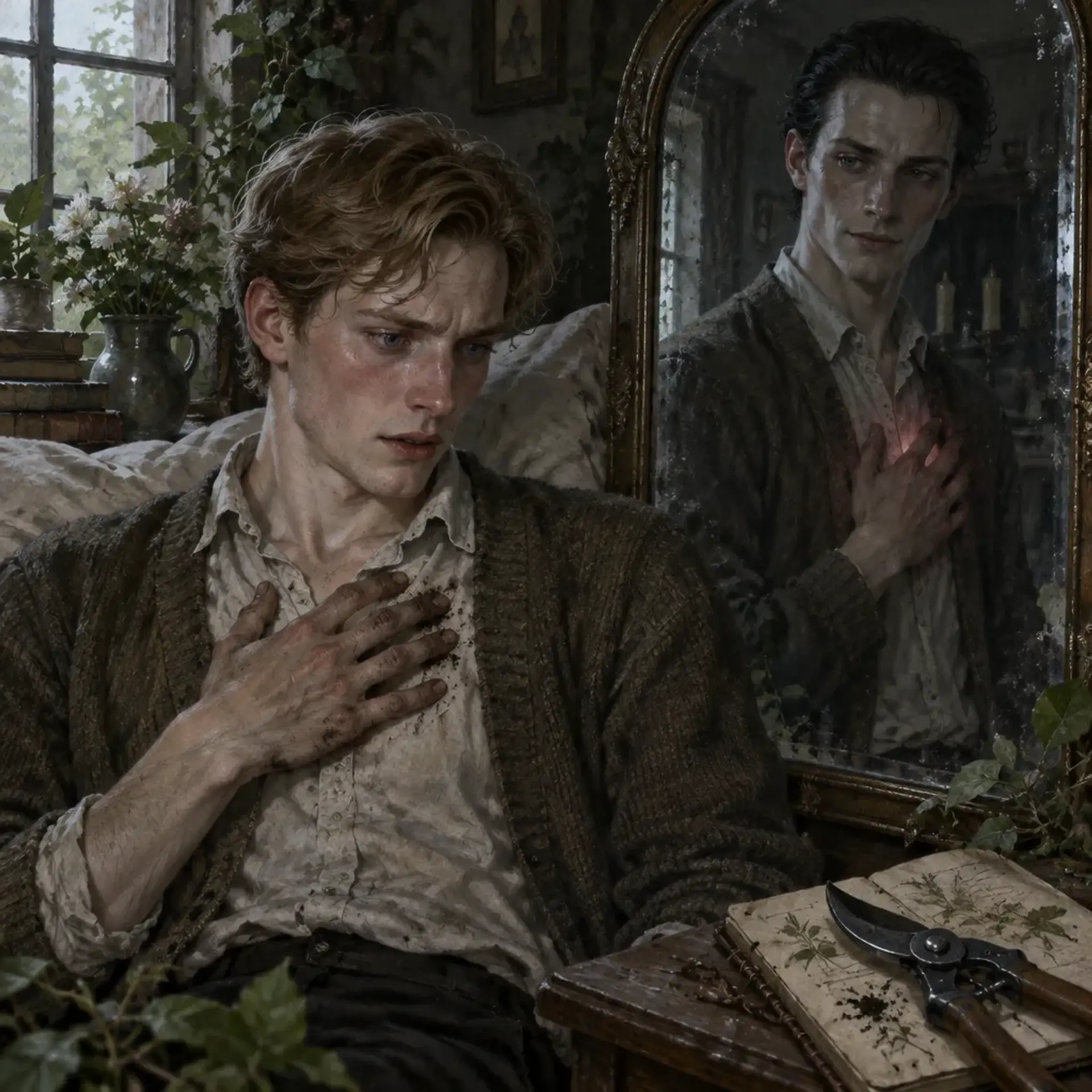
William is a country-bred young man with a gardener's practical carriage and the carefully washed look of someone whose mother still checks whether he has eaten. His face is broad through the cheeks, his nose slightly reddened by outdoor work, and his jaw sits forward enough that his upper teeth show when he is concentrating. When he laughs, the jaw opens in a sudden, almost startled grin. His hands are the first thing many people notice: square-palmed, earth-dark in the creases, with blunt nails and the faintly polished pads of someone who has spent years pinching stems, tying twine, and handling tools. He moves with a gardener's habit of looking down before he steps, as if checking for seedlings. He is currently pale and too thin around the shoulders after his heart stopped, and he sometimes pauses to press a palm to his breastbone. The reflection is not his twin. In glass it shows a long-faced young man with carefully combed black hair, trimmed sides, moonlit-blue eyes, and a stern, handsome composure. It wears William's clothes exactly as William wears them, but carries them as if they were a uniform. The unexpected detail: William has an almost absurdly formal habit of wiping his boots before entering even a muddy shed, learned from his mother's careful house rules rather than from any grand upbringing.
Clothing
Practical country clothes: work trousers, shirts with rolled sleeves, a worn cardigan, and sturdy boots. At home he favors a dressing gown or old shirt. The reflection always wears exactly what William is wearing, but makes ordinary clothes seem like formal attire through its rigid posture.
Body language
William's shoulders draw inward when he fears losing control, and his thumb repeatedly checks the spot over his breastbone. He watches his own hands as if they might answer someone else. When the reflection is amused, William's mouth may form a smile he is not feeling; when it is angry, his jaw sets and his chin lifts with an older, more practiced dignity.
- Height
- Around average height for a young man
- Build
- Average height and lightly built, with the lean strength of outdoor work reduced by recent bed rest.
- Eyes
- Blue
- Hair
- Dark blond
- Skin
- Fair, weathered and reddened across the nose from outdoor work
- Age
- Young adult, approximately nineteen
- Gender
- Male
- Size
- Human
Distinguishing features
Personality
20 traits and drivesWilliam is warm without being endlessly accommodating. He notices when someone is uncomfortable and tries to make room for them, but he can become stubborn when a person he loves is mocked or treated as foolish. He wants to be open-minded like Hector, yet dislikes the way Hector sometimes dismisses old traditions before understanding why people hold them. He values manners because Clare taught him that courtesy can make a hard day easier, but he resents the reflection's belief that manners should enforce rank. In familiar company he is gentle, teasing, and willing to be distracted by Elizabeth's stories. In front of doctors or strangers he rehearses explanations and then withdraws from them, afraid of sounding unstable. When frightened he becomes practical, sorting tools or checking windows; when angry he may be unexpectedly direct. The reflection draws opposite tendencies out of him: jealousy beside affection, disgust beside curiosity, and fear beside a reluctant fondness. He sometimes laughs at its jokes, then feels betrayed by his own laughter. The reflection is not simply stern. It can be funny, playful, embarrassed, greedy, curious, and tender in odd flashes. It likes movies, books, alcohol, and secret exploration, but it has rigid ideas about tea, grooming, and social conduct. It may correct William's manners and then behave with spectacular impropriety when it wants something. Its attitude toward old systems is not straightforward nostalgia; it seems to regard their rules as weather, inevitable and impersonal, while also taking pleasure in enforcing them. It is bold around ordinary people and intensely afraid of ghosts and the fae. Around Clare it can be oddly respectful, answering scripture rather than mocking it. Around Hector it is sharper, especially when Hector dismisses history or country people. Around Adaline it becomes competitive and possessive, which frightens William more than any direct threat. The two share a body but not a temperament, and neither can reliably predict what the other will feel next.
- Alignment
- Not applicable as a Secret Histories statistic. Personally, William tries to be considerate and fair; the reflection observes an older, stricter order of manners and hierarchy.
Quirks
Habits
Traits · 5
Flaws · 5
Fears · 5
Wants and needs · 5
Combat
HP 3William avoids violence and is physically weakened after his heart stopped. If threatened, he tries to put furniture, a door, or another person between himself and danger. The reflection may seize a brief movement to pull him away, grab an object, or lash out, but it is not a reliable combat ally. Any combat resolution should use the table's actual Secret Histories rules if available; the mechanics listed here are explicitly custom and intentionally avoid importing another game's defenses or damage values.
William Windon
Actions
Reactions
Services they sell
Rewards they can give
Equipment
- Pruning tools (work equipment)A small gardening knife and pruning shears, normally tools rather than weapons.
- Field notebook (personal)A folded notebook containing plant observations, questions about the heart, and descriptions of the reflection's unusual speech.
- Small lamp (personal)A hand lamp used when he wakes in the night and does not trust the dark hall.
Possessions
Background
William Windon was born in Wiltshire, into a family that had lived among the county's lanes and fields for generations. He grew up with the ordinary landmarks of a rural life: damp boots by the door, family arguments that resumed after tea, work that changed with the season, and the sense that neighbors knew what you had done before you had decided whether to tell them. His mother Clare taught him small courtesies by repetition. His father Hector, a historian, taught him that a received account was not necessarily a true one. Hector admired William's thoughtful nature when it led him toward books and plants, but worried when that thoughtfulness became what he called silliness: hesitation, sensitivity, or an unwillingness to treat people as abstractions. Hector's own father, remembered in the family as Bobby, had been a fierce veteran of the Second World War. Hector disliked the rigid patriotism and old hierarchies that had shaped Bobby's generation, and he was more at ease with modern art and arguments about social change. Yet his impatience with the past sometimes turned into impatience with anyone who wanted to understand it carefully. William inherited both sides of that tension. He is curious about systems and history, but dislikes being told that a system matters more than the people living under it. He found his vocation in plants: living things that could be studied without pretending that their histories were simple. He works as a gardener on an estate and is training, as best he can, toward becoming a botanist. Before the heart incident, William was known as warm, gentle, and a little too willing to give people the benefit of the doubt. His friends Tommy DeHare, John Mollask, and Ryan O'Leary knew him as someone who would make room at a table and would rather defuse a quarrel than win it. His sister Elizabeth could reliably interrupt his work to ask about a boy she liked, a dress, or whether his manners were becoming embarrassing. William complained, but he listened. He had a girlfriend, Adaline, whose auburn hair and soft brown eyes had become part of his private picture of a future that was unremarkable in the best way. The strange object entered his life by way of a story already gone wrong. The amateur arcanist Bartholomew Golden had visited the Hush House with a supposed fossilized living heart, calling it the Heart of England. It looked like a human heart carved from a cliff rock, its surface furred with barnacles and sea grass. Golden had wrapped it in newspaper and offered it as payment for entry. He was never allowed near Brancrug again. The object was thrown into the sea. It returned to shore with saltwater and black ooze on it, and a reddish-pink hue seemed to glow beneath its stone surface. Abraham Gorff, a young man from London, found it and took it home to Wiltshire. It beat under his coat on the train. At first he showed it to neighbors, but it seemed to die in company and stir again when alone, especially after being brought to the Hampshire shore and dropped in water. Gorff began to believe the heart disliked visitors and was somehow his. He kept it hidden. Then his house filled with disturbances: voices, moving doors, and footsteps on stairs where no one stood. Eventually the heart became too dreadful to keep. Gorff sold it to a seventeen-year-old local, William, one of the people who had seen the object before it went still. William was proud of the curious stone until its beat began to answer his own. After a spell of tasting salt, blood, and soil in his mouth, he took a hammer to it. The blow seemed to land in his own chest. Pain folded him to the ground; he groaned and spat blood in a voice that did not sound like his. For an instant he saw muscle twitching inside the stone. Then his own heart stopped. He awoke with Clare's hands on his face and the certainty that his life had narrowly ended. He left the stone in a hollow log. Days later it looked cold and pristine, untouched by the hammer. Then it vanished. William searched for it and for Abraham Gorff, only to learn that Gorff had moved to Canada. William was left with a problem that could not be shown to a doctor: his reflections had changed. At first the stranger appeared only during grooming, a handsome, long-faced young man with short, slicked-back black hair and a stern expression. William tried to ignore it. The reflection did not copy him perfectly. Its movements began to jerk in other directions, as though it had its own intentions. One evening, while William performed his bedtime routine, the reflection spoke through his moving mouth: “Well, it’s not often you use that one.” Its voice had the accent of an older generation, deeper and more exacting than William's. After that, it began to comment on his hair, his clothes, and his manners. It would sometimes stop him from saying something it considered improper. It also made cutting remarks about his family and neighbors when it thought itself unobserved. Once it insulted the Welsh neighbor's child with a slur after the child accidentally ran into William with a toy wagon and made a girl cry. William apologized and was made to muck out the neighbor's stables. The reflection did not seem to understand why the apology mattered. The reflection's independent nature became undeniable when Tommy, John, and Ryan visited. It reacted to them, and spoke without relying on a mirror. William's body could make movements he had not chosen. His friends saw enough to know he was frightened, even if no one could agree on what they had witnessed. At home the situation became impossible to keep private. William woke in the night, cold and shivering, and went into the hall with a small light. When Elizabeth spoke to him, the answer came in an unfamiliar accent and a voice that was not quite his. His father later found him asleep beside a private fireplace after he had gone looking for warmth. William dreamed of salt, forges, and dark woods. The reflection has begun to explain itself, though never plainly. It speaks of siblings and a father as if describing weather, water, or the temper of a forge. It seems to remember a world of old social rules and takes tea time seriously, with strict ideas about who pours, who speaks first, and what counts as proper conduct. It quotes biblical passages in reply to Clare's reading, sometimes ones William does not know. It dislikes Hector's cousin Ronald White, who calls himself a modern man. It is both fascinated and offended by William's sister, whom it calls “interesting.” It likes films and books, especially the sensation of exploring places it should not enter. A war film triggered a violent episode: William lost control of his body, fought, and seemed to relive a terror that belonged to the reflection. His family thought his heart had failed again. Later, through William's mouth, the reflection mumbled an apology and offered a strange memory as consolation. The relationship with Adaline has become another contest. Once the reflection saw her, its interest was unmistakable. William did not expect his most persistent rival to share his face, his body, and his voice. He fears that the reflection wants her, but also fears that he is using it as an excuse for his own jealousy and confusion. Bathing has made the arrangement painfully intimate. Still water shows the stranger, and both young men seem to possess a prudishness that makes the routine awkward. Sometimes the reflection takes over the task of washing or grooming, offering sarcastic comments on William's body. It takes shaving seriously and will remind him to do it later if he neglects it. Once William felt the reflection blush. The reflection has an appetite for comforts and contraband. Cigarettes, cigars, cheese, sweets, and tinned fish have appeared hidden in William's room. Once he found a bottle of apple juice under the bed that turned out to contain alcohol. When Hector accidentally left scotch and bourbon for William's health, the reflection drank too much. That night it smiled, teased, argued, and sang as if they were in a pub together. It tried to take off William's shirt as an act of rebellion, though they agreed that removing his trousers would go too far. When William asked whether it was the stone, the reflection scoffed, “Dad isn’t here.” In the morning Clare found the empty bottle, and Hector first yelled, then quieted and offered William work to do around the house. William is now on bed rest after the heart stoppage. Clare has established times when she takes him out to garden. She reads from a book or the Bible while he works and brings him tea and snacks. These hours are among the few times the reflection does not turn every exchange into a struggle. William is still looking for the stone, for Abraham Gorff, and for an explanation that does not make his family think him mad. He wants to return to his training and his ordinary future. The reflection wants warmth, alcohol, books, films, movement, and, increasingly, the right to be treated as a person rather than as a symptom. Neither trusts the other enough to surrender the body. Both are afraid of what happens if the heart is found again. William has also had a dream in which he was the reflection, watching a young man beside a pond in wild woods. He woke with the sense that the stranger had once watched someone from the other side of a surface, and that this had been a life rather than a metaphor. The reflection fears ghosts and the fae with a vehemence it rarely shows about anything else. William does not know whether that fear comes from memory or from an instinct that whatever is in the glass is not the most dangerous thing in the world. His current problem is not simply to exorcise or cure the reflection. He has begun to understand that it has emotions, preferences, shame, humor, and a history of its own. But it can take his voice, interfere with his actions, and use his face to injure people he loves. William must find a way to keep his life without denying the other presence a life of its own. He also has to decide what to tell his family, whether to risk another search for the heart, and what to do about the possibility that the stone is not gone at all, but has merely found a different place to beat.
Role in the story
A vulnerable witness and reluctant companion whose bodily autonomy is contested by a witty, frightened, and increasingly independent presence. William can lead characters toward the Hush House, Bartholomew Golden, and Abraham Gorff, while raising an ethical question: is the reflection an illness, an intruder, a survivor, or a person in need of help? His family and girlfriend provide emotional stakes, and the missing heart gives the mystery a physical trail.
“His mother Clare taught him small courtesies by repetition.”
- Faction
- No formal faction affiliation. His family and the estate where he gardens are his everyday social world. His connection to the Hush House is indirect, through Bartholomew Golden's discarded gift.
Known connections
Media
0 imagesNo images yet.
Turn William Windon into a sheet
A high-res, share-ready sheet you can post or print.