Mary Bell
Mary Bell
At the table
Voice
Mary sounds as though she has spent years calling over kettles, children, and the clatter of a busy kitchen. There is a faint rasp after a long shift, and she takes a quick breath before speaking when she expects an argument. Kent's voice has a different, carefully mannered cadence, with a slight hitch when someone addresses him directly; he sounds like a young man trying to remember how confident people stand.
Mary's voice has the slightly dry, work-worn texture of someone who talks over kitchen noise and calls children in from another room. She speaks quickly when listing tasks, clips her sentences when annoyed, and adds a small breath before asking for help. Kent's voice seems to catch at the beginning of a sentence, then becomes unexpectedly formal, as if good manners are a shelter he can carry with him. Neither voice is defined by a singing-range label.
Speech patterns
How to play them
Begin with ordinary practical needs rather than lore. Mary responds to direct kindness, help with a concrete task, or someone treating her as a person rather than a stand-in parent. Do not force her to explain the stone before trust exists. Kent is easier to engage through gardening, gentle company, or an honest invitation that does not demand an immediate answer.
Goal
Give her siblings a childhood with room for play and mistakes, while discovering how to keep her own life from disappearing into their needs.
Motivation
Love for her siblings, a craving for ordinary freedom, and the dawning suspicion that the uncanny presence in her life deserves more than fear or dismissal.
Appearance
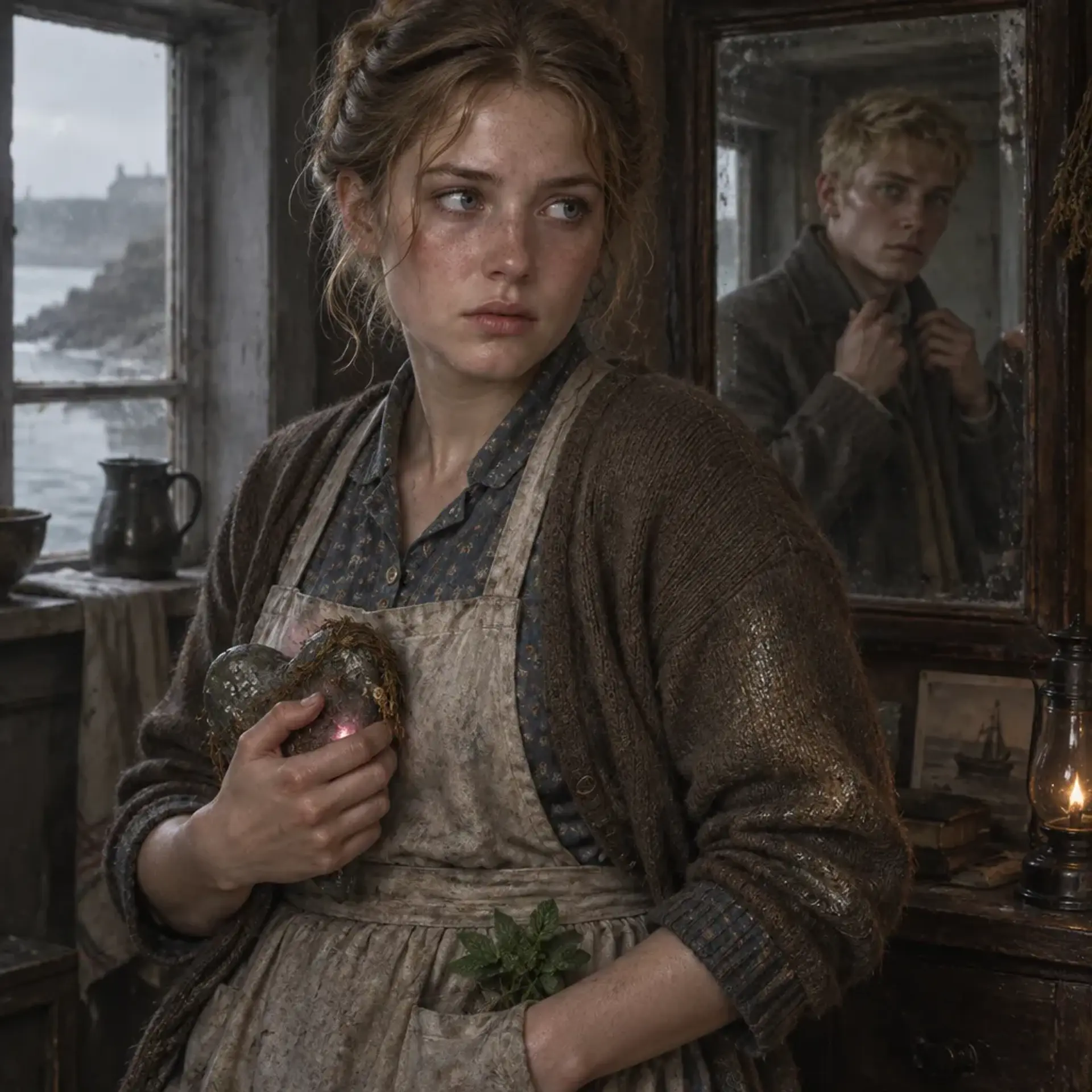
Mary is a young woman with a weather-paled face, a scatter of tiny freckles across the bridge of her nose, and blue-grey eyes that look attentive even when exhaustion has made the rest of her seem absent. Her dark-blond hair is usually pinned up quickly, with escaped wisps catching at her temples. She moves with the efficient, half-listening pace of someone who has learned to carry a child, a basket, and a conversation at once. When the borrowed appearance of Kent overtakes her, the reflected young man has short bright-blond hair, malachite-green eyes, and a handsome, taller silhouette; his posture is awkwardly careful, as if he is forever trying not to take up too much room while hoping someone will notice him. The unexpected detail is that Mary is an avid collector of tiny garden cuttings and will tuck a sprig of mint or a rescued seedling into the pocket of even her work clothes.
Clothing
Mary wears practical postwar dresses, a cardigan gone shiny at the elbows, sturdy shoes, and a work apron when she can. Kent's borrowed outfits are often ill-fitting: a man's coat, trousers with an awkward waist, and a collar he repeatedly tries to settle.
Body language
Mary angles herself between a quarrel and the nearest child, often without noticing she has done it. When tired, she rubs the heel of one hand against her forehead and keeps working. As Kent, she stands too straight at first, then fidgets with his cuffs and looks for a task that will make his presence seem justified.
- Height
- About 5 feet 4 inches as Mary; Kent's reflected form appears taller.
- Build
- Compact, sturdy from household work rather than deliberate exercise; Kent's reflected form appears taller and narrower.
- Eyes
- Blue-grey; Kent's reflected appearance has malachite-green eyes.
- Hair
- Dark blond; Kent's reflected appearance has short bright-blond hair.
- Skin
- Fair, weather-paled, with small freckles across the nose.
- Age
- 18
- Gender
- Female
- Size
- Medium
Distinguishing features
Personality
17 traits and drivesMary is dutiful without being naturally selfless: she cares deeply for her siblings, but resents the way care has been made compulsory. She can be gentle and funny with children, sharply practical with adults, and surprisingly stubborn when someone tries to make Matilda or another younger child take her place. She is not fearless; she simply has learned that fear rarely cancels the washing, the shift, or the need to get a child safely upstairs. In private she likes strange stones, seedlings, and unproductive wandering, pleasures she has trained herself to call foolish. Her mood changes what she notices. When calm, she remembers small kindnesses and takes care to make people comfortable. When hurried, she becomes brisk enough to sound cold, especially if someone is wasting time while a child needs help. When exhausted, she goes quiet and mechanically completes tasks, then may snap at a harmless question because it is the final demand in a long line. When angry, she does not become genteel; her words get plain, pointed, and difficult to interrupt. Shame makes her joke or change the subject. Praise makes her suspicious, because she expects a compliment to be followed by another request. Kent complicates those habits. In that appearance, Mary is more observant of how she is being seen and less certain of what to do with the attention. Kent seems shy, but his shyness has a grabby edge: he wants someone to ask him to stay, then is embarrassed when they do. He has careful, middle-class manners and an instinctive liking for tidy gardens, tea, and a settled home. He is more of a homebody than Mary's first adventures suggested. His curiosity leads him out, but his strongest pleasure is returning to a warm room or finding a patch of soil to tend. Mary finds this both endearing and irritating. It is difficult to resent someone for wanting a home when she has spent so long keeping one together. Mary is naive in particular ways, not stupid. She expects that a sensible explanation can settle a problem, and sometimes underestimates how deliberately other people can behave badly. She is good at reading household moods but less practiced at recognizing when a stranger's attention is dangerous. She wants to believe people can improve if given a chance, yet becomes fierce when their failures land on the children. Her central contradiction is that she wants to leave the house and also fears what will happen if she does. She wants to be needed and wants, just as urgently, to be free of being needed.
- Alignment
- Compassionate and dutiful, though her kindness sometimes hardens into concealment and stubborn control.
Quirks
Habits
Traits · 5
Flaws · 4
Fears · 4
Wants and needs · 4
Combat
HP 0 · No canonical movement statistic supplied; ordinary walking pace.Avoids violence and looks for a door, a witness, or a distraction. If someone threatens a child, she acts immediately and without much thought, using furniture, a thrown object, or a loud household command. She has no canonical combat training or system-specific combat statistics.
Mary Bell
Actions
Reactions
Services they sell
Rewards they can give
Equipment
- The heart-shaped stone (unidentified uncanny object)A rough, heart-shaped cliff stone with barnacles and sea-grass traces; it sometimes darkens with seawater and glows faintly red-pink beneath its surface.
- Mending tin (tool)A small sewing kit and spare buttons, kept for household repairs and emergencies.
- Garden seeds (personal)A paper packet of seeds from Trudy, partly planted and partly saved for a better patch of soil.
Possessions
Background
Mary Bell was born into a crowded, isolated household in Kent, the eldest of eight children and the person most likely to notice when the coal was low, a hem had split, or one of the little ones had gone quiet. Her parents, Malinda and Simon Bell, were not monsters in the storybook sense. They were worse in the ordinary, wearing-down way: careless with promises, quick to quarrel, and so occupied by their own appetites and resentments that responsibility kept landing on Mary. She did schoolwork where she could, learned household arithmetic by stretching money, and took a part-time job because the children needed more than good intentions. Simon had been gone for much of Mary's childhood, taking work wherever he could find it and treating home as a place he returned to rather than a life he shared. On an early trip away, he came back with Jonas, a small boy with bright blond hair and vivid blue eyes, and the explanation that Jonas was his son. Malinda's anger was loud, but it did not make her more available to the children. Simon could be unexpectedly gentle with the little ones and still disappear again when the house became difficult. Mary learned that affection and reliability were not the same thing. She also learned to read the pause before her parents' arguments, and to move the younger children out of the kitchen before a cup or a cruel word flew. The siblings formed Mary's private country. Henry, fourteen, had begun to make his resentment clever, testing what he could get away with and sometimes turning his sharpness on Mary. Matilda, twelve, was her sweetheart: willing to help, but too young to be made a replacement parent. Mary intervened whenever Malinda tried to make Matilda carry Mary's old burden. Chrissy, nine, and Olympia, ten, were close companions; Chrissy's dark eyes and freckles and Olympia's grey-blue gaze made them look unlike sisters, but children do not need matching faces to build a private alliance. Belladonna, five, had black hair and green eyes and an unknown father. Jonas was also five, the consequence of Simon's absence made visible. Abigail, four, with red hair and bright green eyes, pleased Simon because she resembled his grandmother. The youngest, Oswald, two, followed Mary with his blanket and treated her as a safe room. Mary loved them all, and resented that love could be used as a reason to ask more of her. On Mary's eighteenth birthday, Malinda gave her a curious stone found in a log. It was not quite a present so much as something Malinda had noticed and carried home because Mary liked odd rocks. Mary thanked her anyway. She did not call it jewelry, and Malinda, often drunk and inattentive, did not ask whether Mary liked it. The object looked like a cliff stone carved into the blunt outline of a human heart. Barnacles and dried sea-grass clung to it. The family's history did not include its earlier passage through Abraham Groff's hands, or how it had been discarded into the sea and returned to shore. Mary only knew that it was ugly, heavy, and strangely difficult to leave behind. At first it merely seemed to beat in time with her pulse. Then, when Mary looked into a mirror, her image sometimes showed a short-haired young man with malachite eyes. She assumed it was a trick of fatigue, then a trick of the glass, then something she had no time to solve. The reflected stranger seemed to avoid her gaze when she stared directly at him. At other moments he looked plainly curious, eager for attention, and embarrassed to have been caught wanting it. The strange sight repulsed Mary, but it also made her feel less alone in a house where privacy was scarce. Her first full night as Kent began after a bad dream. Mary woke with the certainty that the face in the darkened mirror was not hers. She touched her own cheek and saw the reflected young man do the same. When she tried the door, the sensation shifted from watching to being elsewhere. She found herself outside in Kent's appearance, wearing a borrowed coat that did not sit right and carrying no good explanation for why she was there. She walked because she could. The streets were cold, wet, and magnificently free of anyone asking her to fetch, mend, soothe, or stand between two angry adults. She climbed a tree in a neglected yard, explored an empty outbuilding, and sat by the sea listening to water fret at stones. Before dawn she returned home, uncertain whether she had slept, walked, or done both. Her first adventure was small enough to sound foolish if described aloud and large enough to change her life. On a later night, as Kent, she slipped past the sleeping house and followed the riverward streets to a shut, disused building with a broken pane. Inside, she found a stairwell that smelled of damp plaster and old paper. A door that ought to have opened onto a storeroom led instead to a narrow space with a view of chalk-white cliffs, though she was nowhere near the coast. The heart beat through the pocket of her coat. She fled when footsteps sounded upstairs, but she left with the knowledge that the world had seams, and that she could sometimes pass through them. Malinda's drunken event came weeks later. Mary had gone out as Kent after a day of chores and a miserable shift, hoping for one hour in which nobody knew what she owed them. She returned late and found Malinda waiting in the kitchen, swaying beside a cold cup of tea. Malinda mistook Kent for a young man who had come to see Mary, then for Simon's visitor, and finally for someone who had no right to be in her house. Mary tried to answer without revealing herself. Malinda laughed, reached up to straighten Kent's collar, and said Mary had always been a poor liar. That tenderness, misplaced and fleeting, shook Mary more than the accusations. When Malinda lurched toward the stairs, Kent caught her before she fell. Mary got her mother to bed, heard her mumble an apology meant for somebody else, and returned to her own room before dawn. She did not tell herself that she had forgiven Malinda. She did remember the warmth of her mother's hand on the wrong face. The first time the siblings encountered Kent at close quarters, Matilda was half-awake and looking for Mary. She saw him at the back door and asked whether he was lost. Kent tried to sound confident, but his attention kept catching on the household's garden pots and the little patch where Mary had coaxed herbs out of bad soil. Matilda asked him to hold a lantern while she checked a loose latch. He did, and she spoke to him as if he were simply a shy boy in need of a task. Later, Mary found that Matilda had left a mug of tea and a heel of bread by the door for the stranger. She never explained why this made her smile. Oswald once woke during Mary's return and clutched Kent's trouser leg, too sleepy to understand the change. Mary froze, terrified he would cry. He instead dragged his blanket to the chair and leaned against Kent's knee. Mary sat still until he fell asleep, then carried him back to bed. Abigail asked the next day whether Mary's friend had come to visit. Mary said she had not seen anyone. Henry, more suspicious, later caught Kent leaving and tried to bait him with questions about Mary. Kent answered with stiff politeness, then made an awkward escape by asking whether Henry had seen the garden gate swinging loose. Henry remembered the exchange and began watching the house more closely. Trudy, Mary's friend, was the first person outside the household to notice that Mary was not merely tired. Short, skinny, dirty-blond, hazel-eyed, and proud of her self-described rebellious clothes, Trudy helped with the children without pretending that it was natural for Mary to need help. One afternoon she found Mary asleep over a mending basket and took the younger children to buy sweets. Another evening, she met Kent by an allotment plot and recognized something in the way he watched Mary from across the lane. She did not expose him. Instead she handed him a packet of seeds and said, with no ceremony, that if he was going to lurk near the garden he could make himself useful. Kent planted them badly, apologized to the soil, and spent the next visit correcting the rows. Trudy later told Mary she had met a peculiar young man who seemed to be waiting for permission to exist. The pub adventure was Kent's first attempt at being somewhere for his own sake. Mary had only meant to pass the public house and listen to the noise through its door. Kent, more curious and attention-hungry than she expected, wanted to go in. He stood at the threshold long enough for a regular to ask whether he was waiting for someone. He said yes, then had to invent a person. Inside, the warmth and smoke made him cough. He ordered a ginger beer, held it with both hands, and listened to talk about work, rationing, football, and the new anxieties of the Cold War. A man mocked his careful manners; Kent replied with a prim observation about how the man's coat would fare in rain. The table laughed, not cruelly, and Kent blushed. For a few minutes he felt a wish that did not seem to come from Mary: to be remembered as himself, to have a place set aside, and to be asked back. He left before the feeling could become a plan. Mary woke the next morning with the taste of ginger and smoke in her mouth, and no clear memory of choosing either. Now Mary keeps working, caring, and trying to understand the stone without allowing it to become the only story of her life. Her problems are immediate: money, fatigue, Malinda's drinking, Simon's absences, Henry's hostility, and the fear that one of the little ones will pay for the adults' failures. Her other problem is that Kent's appearances are no longer merely a reflection. They offer freedom, but also leave Mary with missing hours, an unfamiliar voice, and the unsettling possibility that someone else has hopes of his own.
Role in the story
A grounded, sympathetic guide to the ordinary pressures of postwar life whose nights are becoming entangled with uncanny histories. She can offer the party a human stake in mysteries of place and identity, while Kent's appearances create a source of uncertainty, access, and difficult choices.
“Her parents, Malinda and Simon Bell, were not monsters in the storybook sense.”
- Faction
- No formal faction. Connected to her family, local working life, and the strange histories surrounding the heart-shaped stone.
Known connections
Media
0 imagesNo images yet.
Turn Mary Bell into a sheet
A high-res, share-ready sheet you can post or print.