William Windon
William Windon
At the table
“s speech becomes blunt and fast; the reflection”
Voice
William's voice has a clean, work-worn quality: a little breathless from his recent illness, with the occasional dry throat-clear before he says something he knows may sound strange. He speaks as though he is accustomed to being heard over wind in a garden, not a crowd. The reflection's voice comes from the same body but sounds older in its timing and accent, its consonants carefully placed and its humor delivered without a smile. The difference is not a different pitch label so much as a difference in certainty: William reaches for words; the stranger seems to have been waiting with them.
William speaks plainly, with the familiar rhythms of a Wiltshire upbringing and the practical vocabulary of garden work. He tends to name the thing he can see before speculating about what it means: wet stone, a bad root, a door left open. When uneasy, he starts a sentence confidently and then qualifies it with “I think,” “perhaps,” or “I might have.” His voice is clear but still young, sometimes quickening when he wants to be believed. The reflection uses William's mouth and physical voice, but its cadence feels older: measured, precise, and faintly amused. It prefers dry observations over dramatic threats, and its comments about plants, tides, and human manners can sound like a person describing weather. It does not become quieter or more polite when angry; its words become more direct and exact.
Speech patterns
How to play them
Begin with practical, ordinary conversation and let William's concern for plants or the visitor's wellbeing establish trust. He is most candid when asked concrete questions without being hurried. Do not treat the reflection as a simple possession or a comic sidekick: it has preferences, judgments, and an unclear history. William is likely to cooperate if someone takes both his fear and his loved ones seriously, but he may shut down if they propose cutting, breaking, or casually studying the heart. Give the reflection room to reveal itself through mirrors and remarks, while allowing William to resist, bargain, or contradict it.
Goal
Find the missing heart or Abraham Gorff, learn why the reflection has his own agency, and discover whether the familiar face can return without sacrificing William's life or the safety of his family.
Motivation
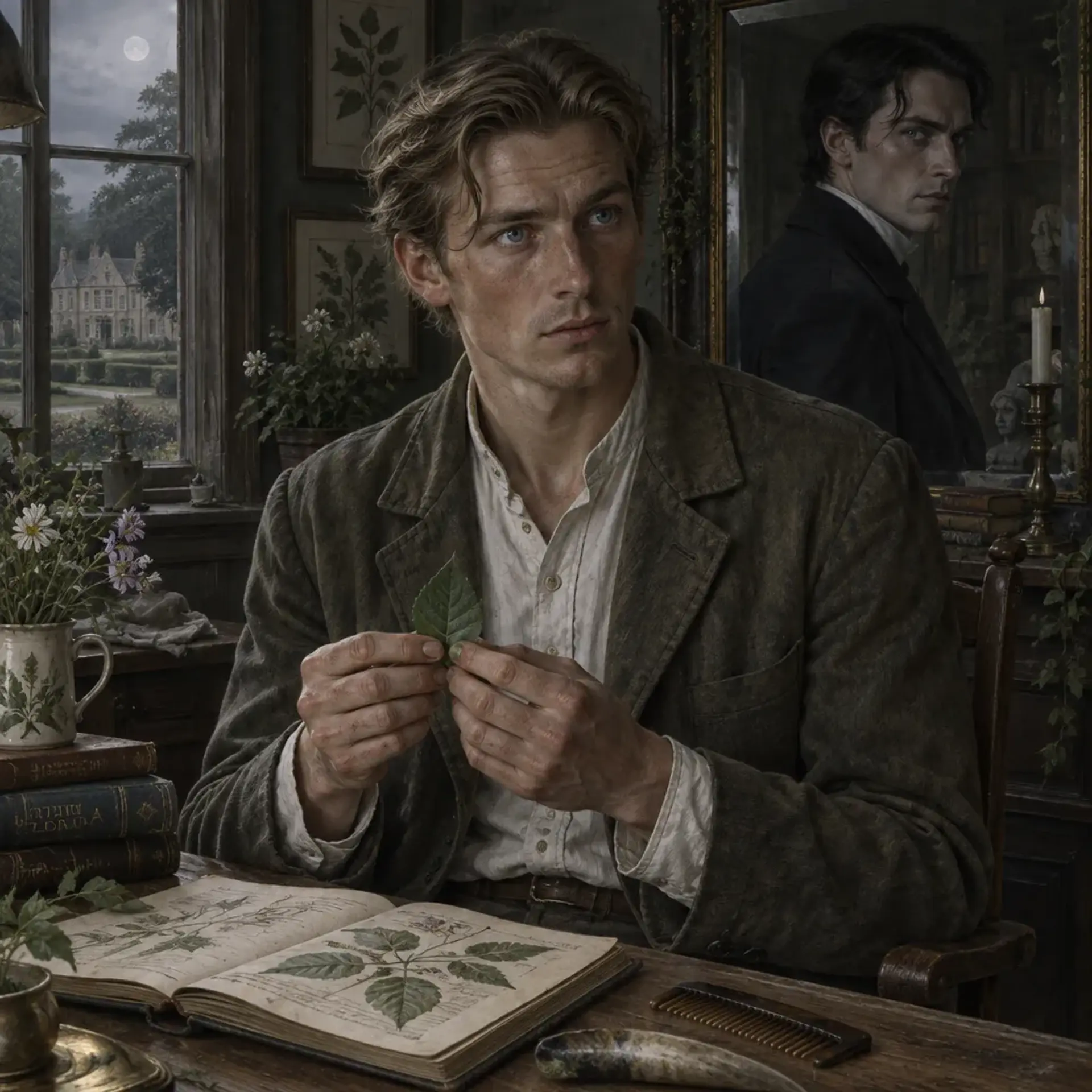
William wants his own life back, but not at the price of destroying whatever the heart is or endangering the people around him. He also wants to become a botanist and believes that patient attention to living things may help him understand an object that seems to be part stone, part flesh, and part history.
Appearance
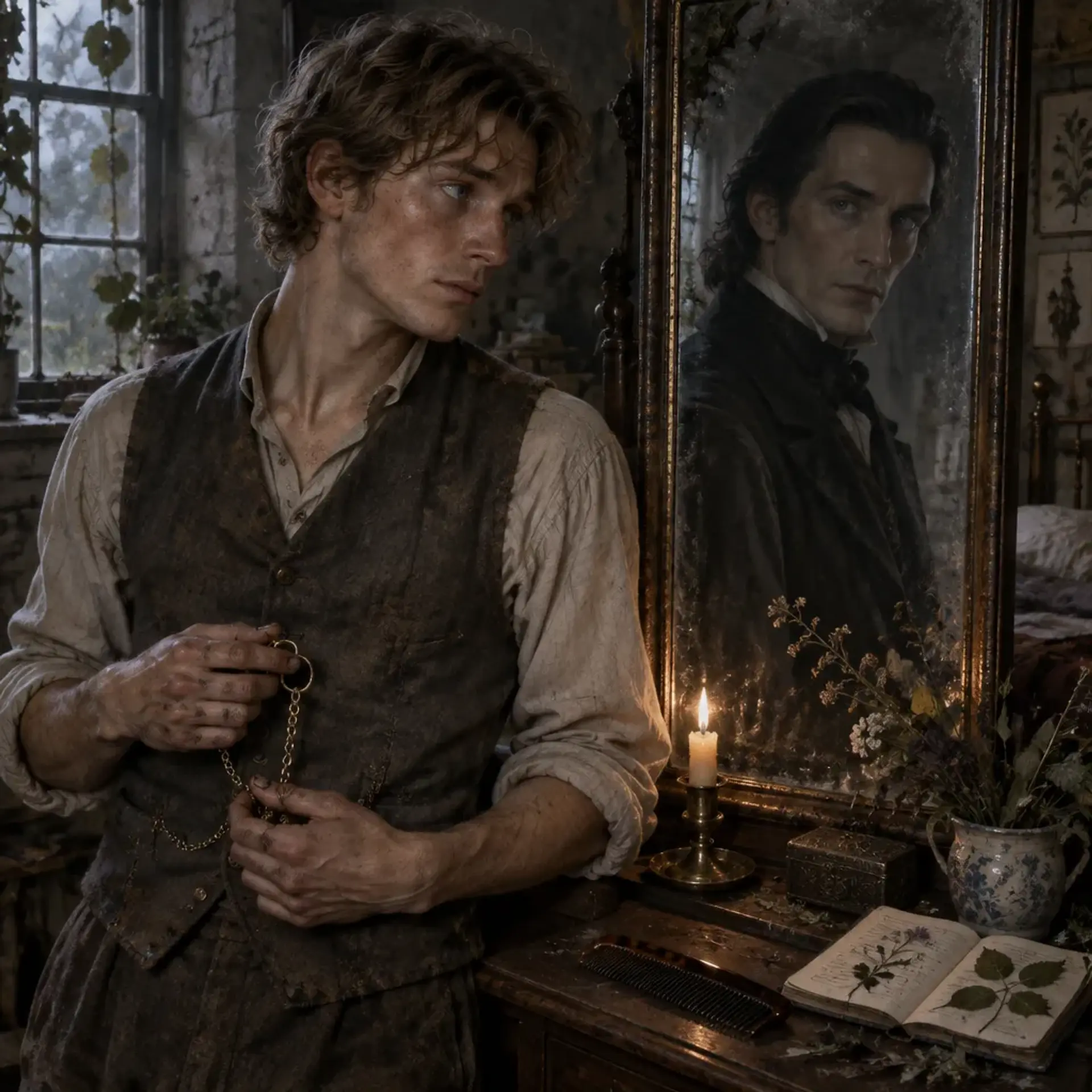
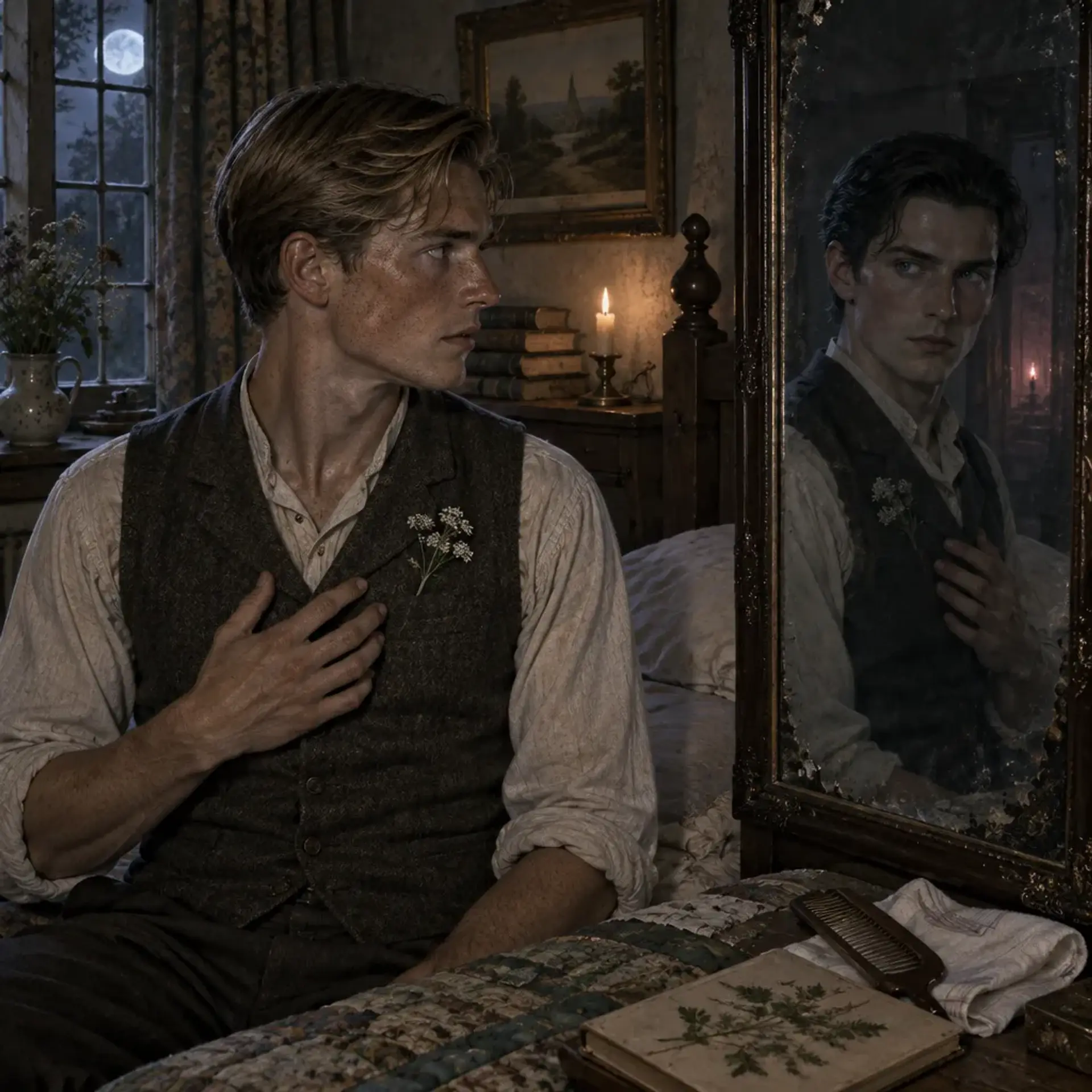
William Windon is a country-raised young man whose first impression is more workmanlike than handsome: sun-browned skin, a dusting of brown freckles across his nose and cheekbones, dark blond hair usually combed into place with wet fingers, and clear blue eyes that tend to look directly at a person before dropping to their hands, shoes, or tools. His face is long, still boyish around the mouth, and accustomed to smiling when he is embarrassed. He has the sturdy, practical look of someone who has carried compost, pruned hedges, and walked home in wet boots, though his recent bed rest has made him thinner through the shoulders. He moves with a gardener's economy: testing a step before placing his weight, turning sideways around furniture, and reaching for a surface as if it might need dusting or trimming. Since the heart episode, he sometimes stops halfway through a movement, fingers pressed to his sternum, listening for a rhythm that should be his. His grooming is unusually deliberate for a young man who works outdoors. He combs his hair carefully, wipes soil from his nails, and checks his reflection before leaving a room, not out of vanity but because the stranger has taught him to fear the moment his face might be replaced. The unexpected detail is his habit of arranging small flowers in his buttonhole: not showy blooms, but tiny, carefully chosen weeds or hedgerow flowers, each one pressed flat enough to sit neatly against his coat. People notice that he seems to carry a little piece of the garden even when he is nowhere near it. His reflection is a separate presence in the story: a handsome, long-faced young man with short, black hair combed back and blue eyes like moonlight on a still pond. Its expression is stern, composed, and older than William's. At first it appears only where William ought to be; now it sometimes moves late, early, or not at all.
Clothing
At home he wears a clean shirt, a wool waistcoat, and trousers that are more orderly than his work would suggest. For gardening he favors durable boots, a patched jacket, and sleeves rolled to the forearm. He keeps a comb and a square of clean cloth close at hand. His buttonhole often holds one small hedgerow flower or weed, selected and positioned with care.
Body language
William's shoulders lift slightly whenever someone approaches from behind, and he often turns his whole body rather than only his head. He holds his chest when he is frightened, though he tries to disguise it as adjusting his shirt. Around friends he leans forward and smiles quickly; around Hector he sits straighter and becomes watchful. Near a mirror he becomes nearly motionless, with his eyes fixed on the glass and his fingers unconsciously checking his own jaw or hair. When the reflection takes over his speech, his lips move with an unnatural decisiveness and his hands tend to settle as if they have been arranged.
- Height
- Average height; exact measurement unspecified
- Build
- Average height, lean and practical, with the modest strength of a young gardener. Still recovering from a life-threatening episode and currently on bed rest.
- Eyes
- Blue
- Hair
- Dark blond
- Skin
- Light, sun-browned, with brown freckles
- Age
- Young adult; exact age unspecified
- Gender
- Male
- Size
- Medium
Distinguishing features
Personality
22 traits and drivesWilliam is practical without being incurious. He likes an answer that can be tested by hand, yet the heart has made him pay attention to questions that have no safe experiment. He is proud of being useful and dislikes being treated as a fool, especially by people who think rural life is simple. At the same time, he is not a swaggering skeptic: he can admit when something frightens him, though he often waits until he is alone to do it. He can be warm and quick with a joke among Tommy DeHare, John Mollask, and Ryan O'Leary, then abruptly formal when a visitor asks about his illness. He is tender with Clare and Elizabeth but resents being watched over, and he is embarrassed by how much he wants Adaline to reassure him. His manner changes with his sense of safety. In the garden, with a familiar task and daylight around him, he becomes patient, observant, and quietly confident. He can explain why a plant has taken in one bed and failed in another, remembering small details other people overlook. In the house, especially near glass after dark, that confidence narrows. He checks what the reflection is doing before he checks what he is doing. He may try to make a joke of the fear, but the joke often comes out too fast. If someone dismisses his experience, he grows defensive and talks more than he means to. If someone listens without demanding proof, he becomes thoughtful and will disclose details in fragments. William is not naturally cruel. He can be proud, touchy, and socially awkward, but he is capable of apologizing when he knows he has done wrong. The incident with the Welsh neighbor's child matters because the reflection's insult came through his voice. William has never repeated the slur, and he accepts the work he was made to do as a consequence, though the punishment did not make him feel that the harm had been repaired. The distinction between his intentions and what his mouth says has become a painful part of his character. He fears that people will judge him by the words the stranger chooses, and he knows that fear cannot excuse the hurt caused. His emotions pull in conflicting directions. He wants privacy, but he is lonely during bed rest. He wants to find Abraham Gorff, but worries that Gorff will give him another confident explanation that proves useless. He wants to protect Elizabeth and Adaline, but his silence makes them less able to judge the danger. He resents the reflection's comments and also listens closely, because the stranger sometimes notices something true before William does. He wants to be the only person in his own body, yet the reflection's attention to ordinary life can feel like company on nights when William is awake and afraid. The stranger has a dry wit and a taste for exposing pretence. It comments on William's combing, clothes, and manners as if it has been assigned to supervise him. A badly chosen collar may earn, “You have dressed as though the day were a court case.” If William tries to avoid a mirror by looking at a window, it may observe, “A clever retreat, except that the glass has come with you.” When William has soil on his cuff, the reflection may remark, “The earth has made a more convincing claim on you than your waistcoat.” Its comments are not always hostile. It may point out that William's hands shake, that he has not eaten, or that Adaline is waiting for an answer. The useful observations are unsettling because they prove the stranger pays attention. It has also developed opinions about clothes and grooming. It prefers William's hair neatly combed, though it criticizes him if he spends too long trying to look presentable. It dislikes a tie that is pulled crooked and has described one of William's jackets as “a hedge pretending to be a person.” It seems to appreciate clean lines, old-fashioned restraint, and clothing that has survived use without becoming shabby. William cannot tell whether these tastes belong to the stranger's own life or are borrowed from some memory attached to the heart. Its humor can be intimate and unkind. When Hector speaks with the certainty of a historian, the reflection may identify the gap between a fact and the confidence with which Hector presents it. It once supplied a cutting reply after Hector called country people silly. William was punished for the words, but the stranger did not apologize. Later it said, “He preferred the story in which he was not the fool.” William asked whether the reflection had meant to hurt his father. It replied that a remark could be accurate and still be unpleasant, as though that settled the question. The reflection's interest in Elizabeth is among William's sharpest worries. It watches her without the obvious crudity of a stranger staring at a person; it seems to study her as one might study the behavior of a plant not previously encountered. When she talks to William about the boy she likes, the reflection asks whether she wants advice, permission, or merely an audience. William finds the question perceptive and invasive. It calls her “interesting” in a tone that might mean affection, scientific curiosity, or something older and harder to name. When Elizabeth asks about what looks nice, the stranger can give an exact answer: a color suits her, a ribbon draws the eye away from a tired expression, a dress makes her stand more confidently. It sometimes offers the observation through William, leaving him unable to tell her which part of the answer was his. William has tried to make the reflection stop commenting on Elizabeth. The stranger replies that William is free to ignore the comments. When William says that is not the point, it asks what the point is. He cannot say “you are looking at my sister like an object” without hearing how strange and possessive the accusation sounds. He is protective of Elizabeth, but he knows she is not helpless and does not want to turn protection into control. That awareness makes his fear more difficult, not less. Adaline brings out a different, more openly competitive edge. The reflection has called her pleasing to look at, but its attention is not limited to her appearance. It notices when she has worked out that William is hiding a detail, recognizes the difference between her polite smile and her real amusement, and remembers what she wore on earlier visits. It once described her eyes as “soft, but not yielding,” a phrase William found beautiful until he wondered why the stranger had been studying her closely enough to choose it. It has corrected William on small matters: that Adaline asked him a question he did not answer, that she is waiting for him to tell her what he is afraid of, that he is about to say something false to spare himself an uncomfortable conversation. The reflection's comments can appear flirtatious, but its intentions are uncertain. It may be competing for attention, trying to learn human attachment, or simply enjoying William's jealousy. When Adaline is present, it sometimes makes William hold her gaze for too long, then asks why he is embarrassed to look at someone he claims to love. At other times it makes a dry remark about her practical judgment or her ability to see through him. William is not sure whether to be grateful that it understands her or furious that it has been watching her. He wants Adaline to see him as himself, yet he worries that the stranger's sharper observations make it seem more attentive than he is. With friends, William is more relaxed until the reflection intervenes. Tommy DeHare, John Mollask, and Ryan O'Leary's visit left him ashamed because they saw the phenomenon before he had decided how to describe it. The stranger's remark about muddy shoes was funny enough that, under different circumstances, the visitors might have laughed. But the voice came from William, the face in the mirror was wrong, and William's expression had not changed to match the words. Afterward he tried to make the incident seem manageable. Tommy challenged him; John wanted to know whether it happened often; Ryan tried to stay cheerful and keep William from looking alone. William answered too little, then regretted it. He is grateful they came and afraid that they will return only to see the stranger. William's most important formative experience was the heart's apparent death and his own heart stopping after the hammer blow. Before that, he believed that danger usually announced itself through an obvious cause: a sharp tool, a fall, a fever, a bad decision. The heart taught him that an object could be both inert and alive, and that an attempt to end a danger could make the danger enter his body. The encounter did not make him fearless or mystically wise. It made him attentive, suspicious of easy explanations, and painfully aware that his body might not belong to him alone. He can still be gentle, funny, and hopeful. He is not defined entirely by the haunting. He wants to work again, learn the names and uses of plants, and spend an afternoon with Adaline without thinking about a pane of glass. He can be pleased by a new shoot in a neglected bed and proud when Elizabeth asks his opinion. His small flower in the buttonhole is not a symbol he chose; it is simply a thing he likes. That ordinary preference is one of the details he insists remains his.
- Alignment
- Not applicable as a canonical Secret Histories statistic; personally decent, proud, and increasingly divided against himself.
Quirks
Habits
Traits · 6
Flaws · 5
Fears · 5
Wants and needs · 6
Combat
HP 3 · Ordinary human walking pace; currently limited by recovery and bed rest. No canonical movement statistic supplied.William is not a combatant. He avoids a fight, seeks cover, and tries to get another person to safety. If cornered, he may push past an attacker or throw a nearby object to make an opening. The reflection is not a reliable combat ally and may make a situation worse by speaking or seizing William's attention. All conflict mechanics here are custom, non-canonical abstractions, not claims about official Secret Histories rules.
William Windon
Actions
Reactions
Services they sell
Rewards they can give
Equipment
- Pruning knife (tool)A small, practical gardening knife for pruning, kept clean and used as a tool rather than a weapon.
- Botany notebook (personal item)A pocket notebook containing plant observations, pressed fragments, and increasingly anxious notes about the heart and the reflection.
- Comb (personal item)A plain comb William uses carefully before bed and before leaving the house.
- The Heart of England (missing uncanny object)The fossilized, heart-shaped stone is missing. William last left it in a hollow log, where it later disappeared.
Possessions
Background
William Windon was born in Wiltshire into a family that knew the county by its hedges, field boundaries, church paths, and old arguments over who had the right to use which gate. He grew up among people who could identify a change in the weather by the look of a ditch and who considered a strange object on a beach less alarming than a strange person asking too many questions about it. His father, Hector, became a historian, collecting the past in documents and dates. William preferred the past that grew: roots, seeds, soil, and the slow evidence left by seasons. He found work as a gardener on an estate and began training himself toward botany, taking notes on plants he could name and plants he could not. He was proud of his place in the world, but not settled in it. He wanted to know more than his village knew, and he wanted that knowledge to be useful. The object reached William by way of Abraham Gorff, a Londoner who had come to the coast with an amateur arcanist's curiosity and a newspaper-wrapped gift. Gorff had called the thing the Heart of England. It looked like a human heart cut from the pale, familiar stone of the Dover cliffs, with barnacles and clinging sea grass lodged in its creases. The story attached to it was that it had been forged of heart and scale and was supposedly fossilized, though nobody who handled it could establish what any of those claims meant. It had been left at the Hush House as payment for entry. Afterward Gorff was never allowed near Brancrug again. The heart was thrown back into the sea. It returned to shore in a state of undignified ruin, dripping brine and black ooze. Beneath the cliff-stone surface, a red-pink hue had appeared, as if a light or a trace of blood had returned to it. A young man picked it up, carried it home in his pocket, and felt it beat through his coat after the train journey. That young man was Abraham Gorff. He returned to Wiltshire, studied it, and found himself both repelled and drawn in. When he showed it to neighbors, it seemed to die in their presence. When he brought it to a shore in Hampshire weeks later and dipped it in water, its inner color returned. Gorff decided the heart was special and belonged to him. He did not hide it from others because he wanted a treasure to himself; he believed the stone disliked guests as much as he did. The house around Gorff began to acquire a second life. Voices sounded where no one stood. Doors shifted. Footsteps passed along halls and stairs. Gorff learned to recognize the heart's beat and the salt water it wept, but recognition did not make the haunting tolerable. In time he sold it to William, one of the people who had seen the object appear dead in company. Gorff later moved to Canada. William has not met him since, and has learned that the distance may make finding him harder without making him less necessary. At first William treated the heart as a curious possession. He showed it off. He liked having something that made other people ask questions, and he liked that he alone could say what it had done. Then its beat began to align with his own. At times he felt a second pulse under his ribs, or the disturbing sensation that his own heart had learned a rhythm from the stone. After spells of tasting the sea, blood, and soil in his mouth, William decided to destroy it. He swung a hammer against the stone. The blow did not break it. Pain seemed to travel from the heart into his chest, sharp enough to bring him to the floor. He groaned and coughed blood, while the stone showed, for a fraction of a moment, a violent twitch of living muscle beneath its rock. William's body gave way as though it had received the blow instead. He woke with his mother, Clare, holding his face. His heart had stopped. The doctors and family could not explain the event in a way that helped William understand what had happened. His body recovered enough to survive, but he was put on bed rest and left with a fear that each heartbeat might be conditional. He carried the stone away and left it in a hollow log, thinking distance would end the trouble. Days later, he found the heart cold and pristine, apparently untouched by the hammer. Later still, it had vanished from the log. Whether it left by itself, was taken, or was never where he thought it was has become one of William's constant questions. The first sign that the heart had left something behind was his reflection. William saw a stranger in the mirror: long-faced, handsome, with short black hair combed back and blue eyes with the cold light of a pond under the moon. It held itself to what William thought of as an older English standard of neatness and reserve, and it wore a stern expression that made William feel he had been caught doing something vulgar. William tested the reflection cautiously. He moved; it moved. He lifted a hand; it lifted its hand. He tried to make the face smile. It did not. Eventually he tried to ignore it, since for a time it did little more than be irritating. Then the reflection began to move of its own accord. While William groomed himself before bed, the stranger's face would become stern even if William was relaxed. Its body would jerk as if it wished to turn away from the mirror. One night, during William's ordinary bedtime routine, the reflected mouth moved with his and spoke in William's own voice: “Well, it's not often you use that one.” The remark concerned a comb William had chosen, but the voice was not his. It had the sound and accent of an older generation, deeper and more settled than William's own. The reflection paused after speaking, as if surprised that the observation had reached the air. William's efforts to locate the heart or Gorff have become a private campaign. He has asked cautious questions, retraced his steps, and attempted to make sense of what his father knows about old objects and old records without telling Hector everything. He is afraid that a direct confession would bring the heart into a historian's hands, where it might be studied, catalogued, or passed to someone who mistakes curiosity for control. He is also afraid that keeping quiet will leave the thing free to make its own choices. Hector's history work has become a source of friction. He once remarked that country people were silly, meaning it as a dry generalization about credulous local stories. William, already strained by the stranger's presence, snapped back with a cutting remark that the reflection supplied through his mouth. Hector heard William say it. William remembers the moment not as a victory but as an invasion: the words had been sharper and more precisely aimed than anything he would have chosen. He was punished for the disrespect and told to spend time mucking out a neighbor's stables after the reflection had insulted the Welsh neighbor's child with a slur. William will not repeat the word. The child had accidentally hit him with a toy wagon, made a girl cry, and apologized. The reflection chose the moment to be cruel; William had to live with the consequence. His mates Tommy DeHare, John Mollask, and Ryan O'Leary came to visit him while he was recovering. They brought the kind of ordinary noise William had missed: talk of school, jokes that did not require anyone to be clever, and the comforting disorder of friends crowding into a room. William had meant to tell them about the mirror, but he had only managed to make the story sound foolish. When Tommy glanced toward the glass, the reflection looked back at him with an expression William was not making. John noticed that the face did not follow William's turn exactly. Ryan tried to laugh it off and asked whether William had been practicing expressions. Then the reflection spoke through William without his intending it, making a dry, cutting comment about the visitors and their muddy shoes. The voice came from William's mouth, but its phrasing and old-fashioned cadence belonged to the stranger. All three friends went still. William tried to apologize, but the reflection's lips moved ahead of his. It reacted to the visitors as if they were in the room with it, not merely in front of the glass. Tommy got angry, then frightened; John watched the mirror rather than William; Ryan took a step between William and the door, though he could not have said what he meant to protect him from. The visit ended awkwardly. They left with different explanations, but none of them believed William was simply joking. Their friendship remains, though William worries they will avoid coming back. Their visit proved something worse than the reflection's ability to mimic him: it could answer people, and it could use William's body as its speaking place. William's sister Elizabeth has become both a refuge and a source of uneasy fascination for the reflection. She pesters him about the boy she likes, about what looks nice, and about whether he is behaving properly. William is sometimes annoyed by her questions, but he knows the ordinary domestic chatter is a kindness. The stranger listens too carefully. It calls Elizabeth “interesting,” most often when she has left the room, and says it as if she were a tidepool creature, a new plant, or a custom it has not encountered before. It asks what she likes, how she chooses a ribbon, and why she assumes affection should be spoken aloud. When Elizabeth asks William to judge a dress or a piece of jewelry, the reflection has offered unexpectedly exact observations, then made them unsettling by comparing her expressions to “the small pause before a wave takes a footprint.” It has also interfered with William's manners around her. Once, when Elizabeth complained that he never notices what people are wearing, William tried to answer sincerely. The stranger stopped his words and supplied a remark that was too perceptive and too personal. Elizabeth stared at him and asked when he had become observant. William could not explain that the person who had noticed her was not quite him. He is protective of her, but the protection is now complicated by the possibility that the reflection is interested in her for reasons it cannot describe in ordinary human terms. When it calls her interesting, William feels jealous, frightened, and ashamed of both reactions. Adaline, William's girlfriend, became the reflection's favorite audience without ever agreeing to be one. She has auburn hair and soft brown eyes, and William finds her pleasing to look at in a way he feels does not need to be explained. The first time the reflection saw her, William noticed its posture change. Its stern expression softened by a fraction, then became intent. It commented on the color of her hair, the steadiness of her gaze, and the way she let silence sit between sentences. William asked it to stop. The reflection answered that it was only noticing what was there. When Adaline visited, William tried to act as if nothing had changed. He became too careful with his words, too conscious of the glass in the room, and too quick to glance away from her face. The reflection used those glances. It made William look at Adaline when he wanted to look elsewhere, or held his gaze on her a second too long. It has made observations about the clothes she wears, the way she tucks her hair back, and the small expressions she makes when William is avoiding a question. Some comments are genuinely helpful: the stranger can see that she is worried before William admits it. Others are intrusive. It has described her as “warmth with a name,” and once called her “a pleasing interruption” while William was trying to explain his recovery. Adaline is not merely an object of the reflection's interest. She has asked William why he seems to argue with empty rooms and why he looks at mirrors as if they might accuse him. William has told her some of the truth, but not enough. He fears that the reflection will try to charm her, and fears almost as much that she will find it more compelling than he is. Their relationship is strained by his evasions, his illness, and the awkward fact that the stranger may use his face and voice to speak to her. The reflection seems to enjoy this rivalry, though whether that enjoyment is desire, experiment, or simple amusement remains unclear. The most important event has not yet happened, or perhaps it has happened once and has not been understood. During a full moon, William stood before his mirror and saw his own face again. His familiar face was there: dark blond hair, freckles, blue eyes, the expression he had seen in his mother's hands as she held him after his heart stopped. For a moment, the return of himself felt so ordinary that he did not question it. He reached up and touched his cheek, testing the shape of his jaw as he might when shaving or checking for dirt. His fingers found the skin he expected. Then he realized that the face in the glass was not the face his hand was touching. The mirror showed William's old face, but the hand against William's cheek belonged to the stranger's face. William looked at the glass and at the reflection's hand, then looked down at his own fingers as if they might settle the matter. The moonlight fell across the glass, and the old William in it had no black hair, no severe mouth, no stranger's stillness. It was himself, unmistakably himself, down to the small asymmetry in his smile. He pressed his palm harder against his cheek. The mirror's William did not flinch. The room seemed to hold its breath. William felt the returning face as a kind of homesickness, so sharp it nearly hurt. He asked, aloud, “Is that me?” The reflected William did not answer. Instead, for one breath, its lips moved with the deeper voice of the stranger. William felt his own mouth open, though he did not remember choosing to speak. Then the mirror-face smiled, a small, tired smile that William recognized from his own worst moments. The stranger's expression appeared over it, not as a second face but as a pressure behind the eyes. The reflection seemed to be allowing William a glimpse, or trying to show that it could. The old face vanished when the moon passed behind a cloud. William was left with the black-haired stranger looking back at him, calm and stern. William has not told anyone the full detail. He does not know whether the old face was a promise, a trick, a memory of the heart, or proof that the stranger has not wholly replaced him. He keeps hoping that the reflection is a tenant rather than an heir. Meanwhile, he wants to return to the estate garden, resume his botanical training, find the heart, and learn what it is without placing it in anyone else's hands. He wants Adaline to know the truth, Elizabeth to remain safe, and his friends to keep visiting. He wants his father to stop dismissing local accounts before hearing them. He wants all of that while fearing that the heart has already chosen a future in which William is only the surface the stranger uses.
Role in the story
A vulnerable witness and possible companion whose ordinary ambitions remain alive beneath an uncanny crisis. William can lead investigators toward the missing heart, the Hush House, Brancrug, and Abraham Gorff's trail to Canada. The reflection can provide unnerving observations, provoke social trouble, or reveal that the heart's history is larger than William understands. The character works best as a person with agency, not merely as a haunted body: he can refuse help, make mistakes, apologize, pursue his botany, and choose whom to trust.
“His father, Hector, became a historian, collecting the past in documents and dates.”
- Faction
- No confirmed faction affiliation. William is connected to his family's Wiltshire community and the estate where he works. The Hush House and Brancrug belong to the heart's history, not to any organization William claims to serve.
Known connections
Media
0 imagesNo images yet.
Turn William Windon into a sheet
A high-res, share-ready sheet you can post or print.