William Windon
William Windon
At the table
Voice
William's voice carries the breath and rasp of outdoor work, with a plain local rhythm. When he is tired, he takes a careful breath before speaking and favors short sentences. The reflection's voice is audibly his and not his: a deeper, older-sounding cadence, shaped with deliberate precision and dry emphasis. Its comments about grooming often sound like a relative correcting a familiar habit; its remarks about the family can turn cold without becoming loud.
William's voice is a little rough from outdoor work and the strain of recent illness. He speaks in an unshowy Wiltshire cadence, with words clipped when he is embarrassed and more animated when discussing plants. Nervousness makes him fill silences with practical details. The reflection uses his mouth, but its voice seems older, lower in texture, and more measured, as if each remark has already been considered and found amusing.
Speech patterns
How to play them
Meet William with patience and practical kindness. He responds best to questions about gardening, his recovery, or the people he cares about, but do not demand that he prove what he sees. If the reflection speaks, acknowledge what happened without treating William as a spectacle. Family and Adaline matter more to him than solving the mystery quickly. The stone, Abraham Gorff, and the Hush House are useful leads, but William is not yet in a condition to pursue them alone.
Goal
Find the heart-shaped stone, discover what the reflection is, and regain enough health to pursue botanical training without placing his family in danger.
Motivation
To keep his life his own while protecting the people he loves. His ambitions are ordinary and precious to him: recover, return to the gardens, learn botany, and be someone Adaline can rely on. The mystery matters because it threatens those ordinary hopes.
Appearance
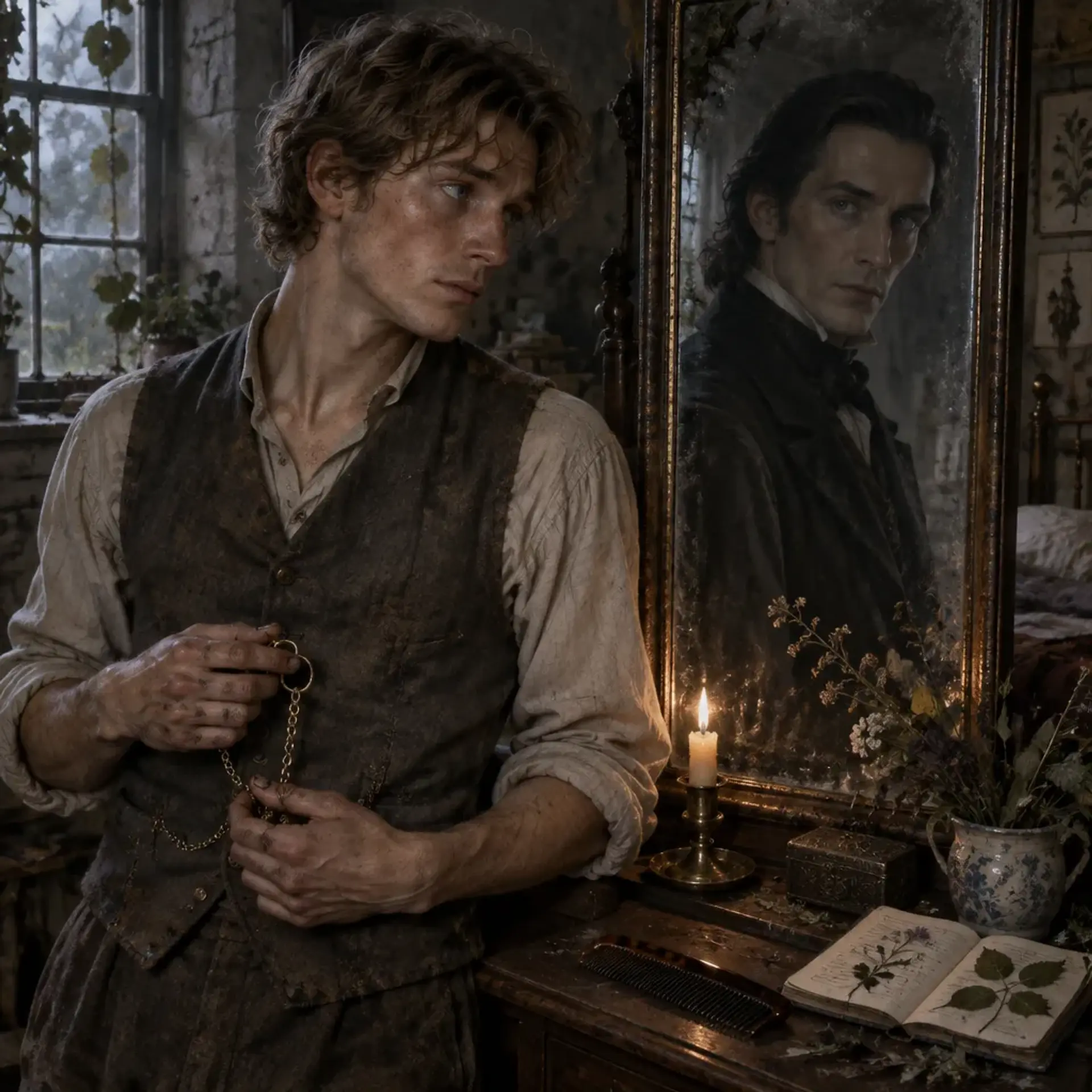
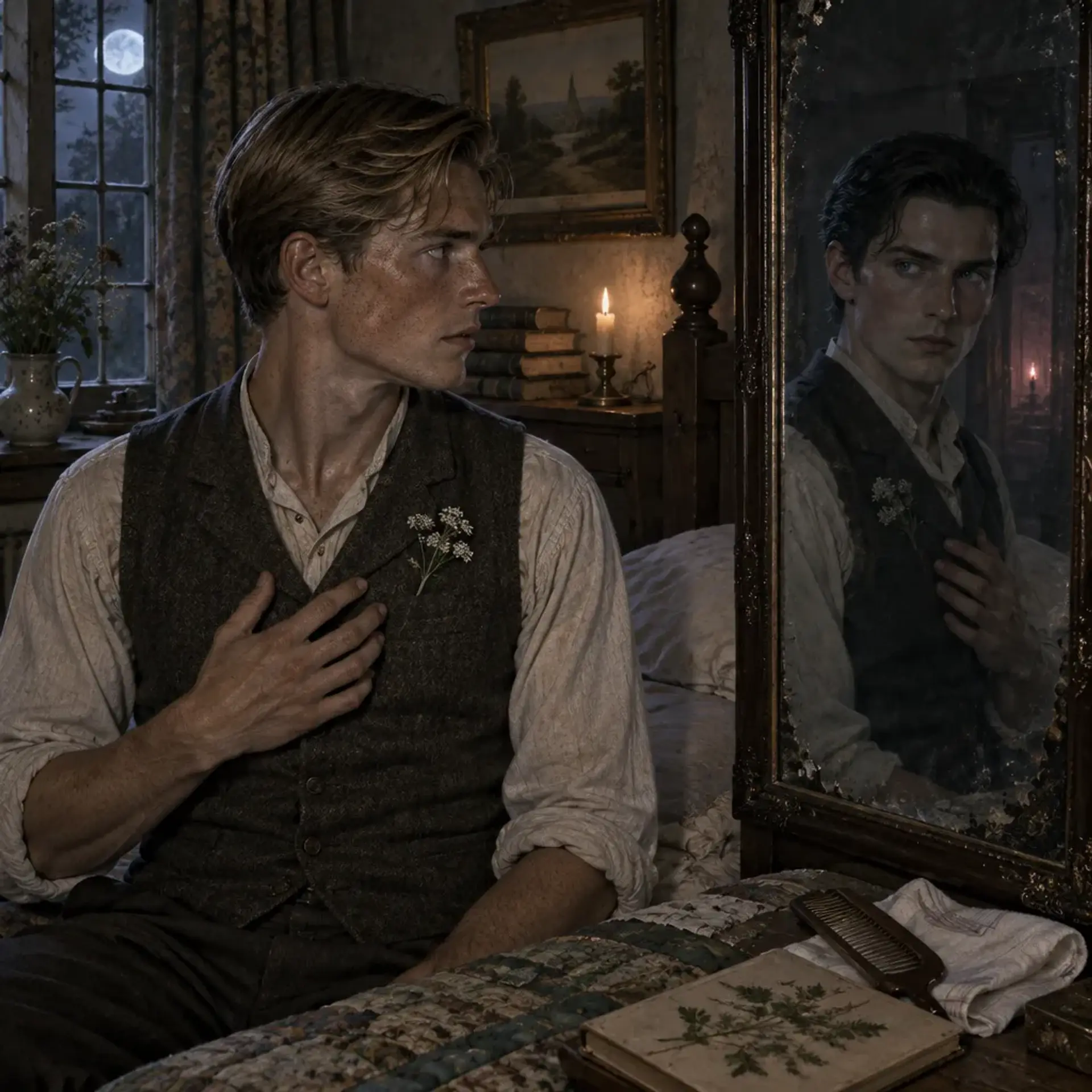
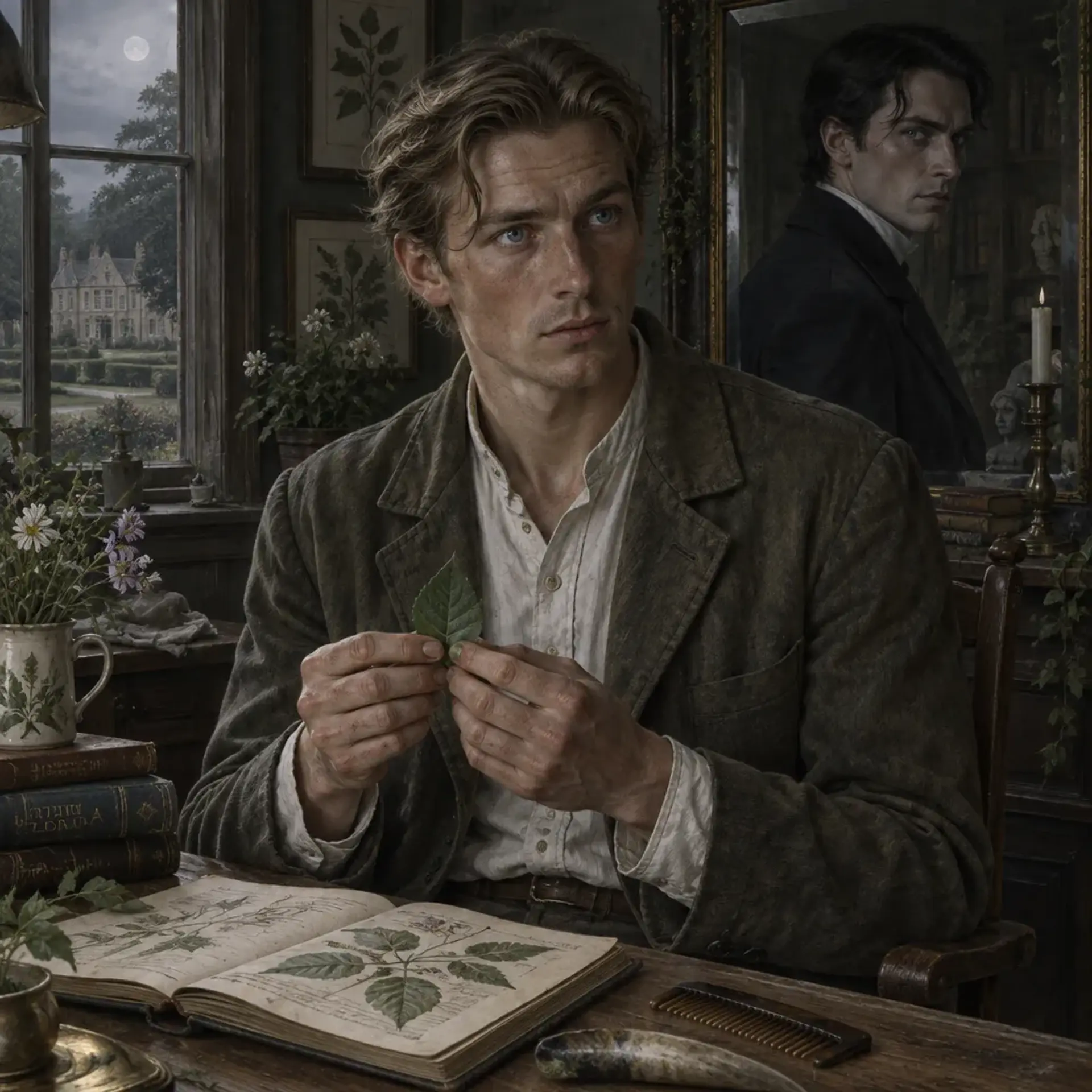
William Windon is a young Wiltshire man with a long, sun-browned face, blue eyes, and dark-blond hair that catches pale gold at the edges. Small brown freckles and sun spots scatter over his nose and cheekbones. His hair is usually combed back with more care than his work clothes merit, though a day in the garden leaves loose strands curling at his temples. His hands are broad and nicked by ordinary horticultural work, with soil darkened into the creases and a thumbnail that never quite loses its green stain. He moves with a gardener's economical balance, accustomed to stepping around beds and tools without looking down. Since his heart stopped, he has a guarded, measured gait, as if testing whether his body will keep its promises. His face in glass is often not his: the stranger is long-faced, handsome by an older English standard, with neat dark hair and moonlit blue eyes. The stranger holds himself as though a room were already his to judge. Unexpected detail: William keeps his fingernails meticulously clean and shaped, even when the rest of him is muddy, because his mother once told him a botanist must be able to examine delicate growth without bruising it.
Clothing
Practical estate-gardener's clothes: sturdy trousers, a worn jacket, work boots, and shirts that can be washed repeatedly. On bed rest he wears a clean, plain shirt and keeps a comb within reach. Before seeing Adaline he makes a conspicuous effort to remove the soil from his cuffs.
Body language
William's shoulders draw in when he sees the stranger, but his hands remain busy: smoothing a cuff, turning a leaf, or testing the edge of a chair. When he is trying to seem well, he stands too straight and breathes too shallowly. The reflection's posture is cleaner and more assured, with a slight tilt of the head that makes even silence feel like an evaluation.
- Height
- Average height for a young man
- Build
- Lean and work-hardened, with a gardener's functional strength rather than a fighter's training. His recent illness has left him visibly cautious and easily tired.
- Eyes
- Blue, with a grey cast in cold light
- Hair
- Dark blond
- Skin
- Fair, weathered by outdoor work, with freckles and small brown sun spots across his face
- Age
- Young adult, approximately 18
- Gender
- Male
- Size
- Medium
Distinguishing features
Personality
18 traits and drivesWilliam is proud of being useful and quietly embarrassed by how much he wants reassurance. He is observant and patient with plants, but impatient with his own illness. Around his family he tries to be dependable, though he can turn defensive when Clare treats him as fragile or Hector treats his worries as an exaggeration. With his friends he uses humor to smooth over fear; after their visit, he is more willing to admit that the reflection is real, but still hates being watched while he admits it. With Adaline he becomes earnest and self-conscious, wanting to impress her while resenting the stranger's unsolicited advice. The reflection is more composed than William, but its composure has sharp edges: it can be wry and almost helpful, then abruptly cruel or possessive. William is not sure whether its manners conceal old-fashioned affection, contempt, or a wish to take his place. He does not want to hate it, because it may be the only witness to what happened to his heart. He does not want to trust it, because it watches his family as if they were specimens.
Quirks
Habits
Traits · 5
Flaws · 4
Fears · 4
Wants and needs · 5
Combat
HP 1Avoids violence. William is recovering from a cardiac arrest and is not suited to a sustained fight. He tries to retreat, call for help, and protect others by putting himself between them and immediate danger. The reflection's intervention is a custom narrative complication, not a canonical Secret Histories combat ability.
William Windon
Actions
Reactions
Services they sell
Equipment
- Pruning knife (tool)A gardener's everyday tool, kept close during work but not carried as a weapon.
- Horn comb (personal item)A comb used in the morning and at bedtime, which has become part of William's uneasy ritual of checking his face.
- Botany notebook (book)Notes on plants, symptoms, and the dates on which the reflection has appeared or spoken.
Possessions
Background
William Windon was born in Wiltshire into a family that had lived in the county for generations. His father, Hector, works as a historian, a man who can make a parish boundary sound like a matter of national consequence. His mother Clare keeps the household going and has a practical tenderness that William trusts more readily than he admits. His younger sister Elizabeth has begun asking him for advice about boys, clothes, and what counts as proper manners. William is fond of her, but her questions make him feel abruptly older and less qualified than he wants to appear. He works as a gardener on a local estate and hopes to train as a botanist. Plants offer him a kind of order he can believe in: a seed does not flatter, a root does not pretend, and a sick leaf gives evidence of its trouble if one learns how to look. The trouble began with a stone that had already passed through too many hands. Bartholomew Golden, an amateur arcanist, visited the Hush House and left a supposedly fossilized living heart as payment for entry. He called it the Heart of England. It was shaped like a human heart, though at first glance it looked like a lump of Dover cliff, rough with barnacles and clotted with sea grass. The Hush House people rejected the gift and threw it out to sea. It eventually returned to shore, washed in salt, water, and a black ooze. Beneath the rock, a red-pink hue seemed to have returned, like a light behind skin. Abraham Gorff found it and took it home. He was London-born, living in Wiltshire, and at first treated the object as an oddity. When he showed it to neighbors, it seemed to die in company. When he took it to a Hampshire shore and put it in water, it flushed pink again. Abraham decided it was special and, though he did not describe his attachment as greed, he refused to let others see it. The stone seemed to dislike visitors as much as he did. The house grew increasingly difficult to inhabit: voices without speakers, doors moving, footfalls in empty halls and on stairs. Abraham came to understand that the heart was beating and weeping salt water. Frightened, he sold it to a seventeen-year-old local boy, William, one of the people who had seen it when it appeared dead. William was proud of his queer trinket until he began to feel its pulse beneath his own ribs. After a spell of tasting seawater, blood, and soil in his mouth, he tried to break it with a hammer. The blow did not crack the stone. Instead, pain struck through William's chest. He fell, groaning, and spat blood in a voice that sounded unlike his own. For a fraction of a moment, he saw muscle twitch inside the stone. Then his body failed. He woke with Clare's hands on his face. She told him his heart had stopped. William left the stone in a hollow log. Days later, it looked cold and pristine, despite the hammer blow. The reflection began afterward. At first it was only a stranger where William's face should have been: a handsome, long-faced young man with carefully combed dark hair, blue eyes like moonlight over a freshwater pond, and an expression of stern appraisal. William was cautious while grooming, afraid that touching his face might mean touching someone else's. Eventually he tried to ignore it. The stranger did not oblige. It began to move out of time with William, shifting its gaze or posture as if impatient with his body. One night, while William performed his ordinary bedtime routine, the reflection's mouth moved with his and said, in a voice older and deeper than William's, “Well, it's not often you use that one.” The comment referred to a grooming brush William had picked up. It was so mundane that William doubted himself more than he feared the words. The stranger paused too, as if surprised to have spoken aloud. After that it commented more often, especially during the quiet rituals of morning and bedtime. It criticizes William's combing, shirts, and manners; makes dry observations about the household; and sometimes interrupts him when it judges his words improper. William searched for the stone, but it had vanished from the hollow log. He also tried to trace Abraham Gorff, only to learn that Abraham had moved to Canada. The stranger has become harder to avoid. Windows, polished cutlery, still water, and darkened panes can all betray a face that is not William's. At times it seems to change objects in William's room while he sleeps, though he has no proof beyond their altered positions and the reflection's irritating implication that he ought to pay closer attention. The visit from William's schoolmates Tommy DeHare, John Mollask, and Ryan O'Leary turned private dread into an undeniable event. They came to see him while he was on bed rest after his heart stopped. William had hoped their company might make the house feel ordinary again. Instead, the reflection reacted to them. It leaned toward the room's surface while William sat rigidly in a chair, and its mouth formed words that William had not chosen. The boys saw the glass move out of step. One of them asked William whether he had said something; another answered that the voice came from the mirror. William tried to laugh it off, but the reflection made a sharp remark about their muddy boots and their habit of treating his sickroom like a public house. It spoke through William's mouth while he was trying to deny it. The three friends stopped joking. Tommy moved between William and the mirror, John checked the glass as if it might be a trick, and Ryan stayed close enough to catch William when his legs began to shake. They left with no satisfying explanation. William was grateful they believed him, and ashamed that their visit had become a spectacle. The reflection's relationship with Hector is openly contentious. Hector once spoke dismissively about how silly country people could be. The reflection cut in with a cutting remark about Hector's own habit of mistaking book learning for wisdom. William was reprimanded for the insult, though Hector could tell his son had not quite intended it. The stranger's contempt for Hector seems less like a disagreement about class than a personal grievance against anyone who treats the past as something safely finished. Elizabeth draws a different response. The reflection calls her “interesting,” a word it uses with unnerving emphasis. When she asks William for advice about a boy she likes, the stranger watches from glass and offers observations about the boy's posture, shoes, and lack of imagination. It can be cruelly accurate and sometimes even helpful, which makes William hate that he listens. When Elizabeth asks what looks nice, the reflection supplies suggestions in a tone that sounds like a judgment from an old portrait. William tries to shield her from it, but she has occasionally caught the stranger smiling at her from a window after William has turned away. The expression is not plainly hostile; that is what troubles him most. The reflection's interest in Adaline has made William's private struggle ridiculous as well as frightening. Adaline has auburn hair and soft brown eyes, and William likes her enough to become self-conscious around her. The first time the stranger saw her, it appraised her with a long, silent stare. Afterward it began offering advice about William's clothes, hair, and choice of words. The advice is sometimes sound, often intrusive, and always delivered as if the reflection were a rival with a claim. When William dresses carefully to see Adaline, the stranger may call the effort “a promising attempt at civilization.” When she laughs at William's jokes, it watches her in the glass and later says she has good taste, then adds that she should not be encouraged. William has never had to compete with himself before, and the reflection seems to find this very funny. The stranger has spoken of having siblings and a father, but describes them as if they were weather, tide, or a sensation rather than living people. It says the sea has kin, that certain absences have names, and that a father can be a pressure rather than a person. William cannot tell whether these are memories, metaphors, or bait. He dreams that he is the reflection, standing in the glass while someone else wears his body. In the dream, the other William wakes and reaches for a face that is no longer his. William is currently on bed rest and angry at the enforced idleness. He wants to find the heart, locate Abraham, and learn whether the stranger is a guest, a parasite, a dead man's remnant, or something stranger. He also wants to become a botanist, keep his family safe, and see Adaline without the mirror turning it into a contest. He has not told Clare every detail of the reflection's speech. He has not told Hector that the stranger sometimes seems to know things from before William was born. And he has not told Elizabeth that when the reflection calls her interesting, it sounds almost as though it recognizes her.
Role in the story
A recovering young gardener caught between an occult object and an increasingly independent reflection. William can provide a human-scale point of entry into the mystery of the Heart of England, while his family, friends, ambitions, and romantic life give the consequences weight beyond the supernatural puzzle.
“His father, Hector, works as a historian, a man who can make a parish boundary sound like a matter of national consequence.”
Known connections
Media
0 imagesNo images yet.
Turn William Windon into a sheet
A high-res, share-ready sheet you can post or print.