Mary Hirst
Mary Hirst
At the table
Voice
A clear, weather-worn voice with a little rasp from cold air and long days outdoors. Her words have the firm rhythm of someone used to being heard over livestock and wind, without being loud for its own sake. The name Mary is spoken simply and firmly. When speaking to William, her voice gains patience and space; when confronting Oswin, it becomes precise and difficult to distract.
Mary speaks in a plain Yorkshire cadence shaped by farm work: direct, warm, and economical. Her breath often carries the slight roughness of cold mornings spent outdoors. She uses familiar rural images to explain difficult things, comparing a growing suspicion to a ewe that keeps looking toward an empty gate. When angry, she does not become meek or genteel; she speaks more directly, with clipped questions and little patience for abstractions. She has a soft, steady manner with William and allows his silences to stand.
Speech patterns
How to play them
Treat Mary as capable and perceptive, not as a passive victim. She responds to patience, practical help, and respect for William. Avoid demanding that she choose immediately between loving Oswin and fearing him. If characters share concrete evidence rather than rumor, she will ask precise questions and may disclose what she remembers. She resists anyone who tries to remove William or decide her future for her.
Goal
Discover what happened on her wedding night and protect William without surrendering her choices to either Oswin's silence or Thomas's plan.
Motivation
Mary wants a safe, honest home for William and longs to recover the tenderness she once shared with Oswin. She is also determined not to let fear or family pressure dictate her choices.
Appearance
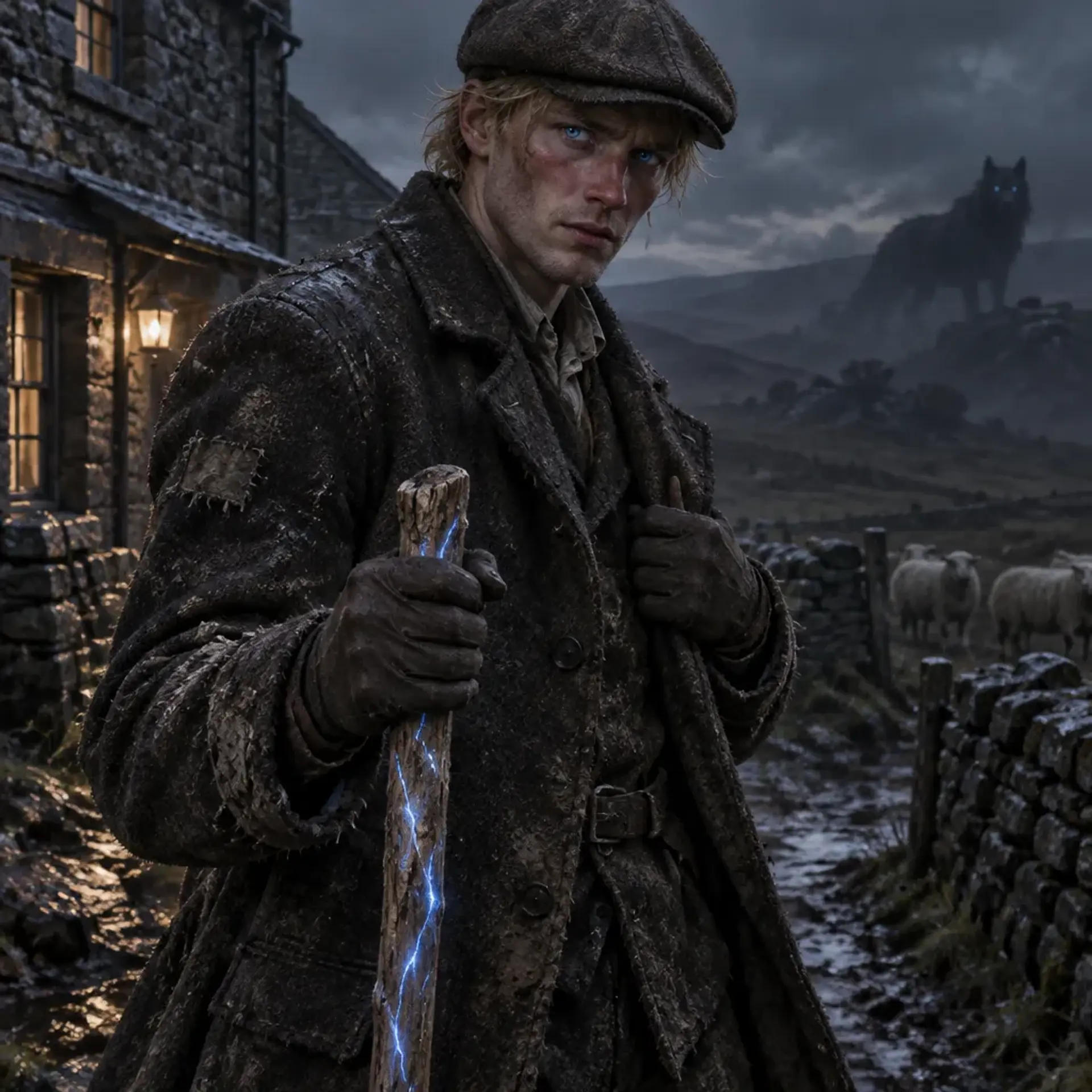
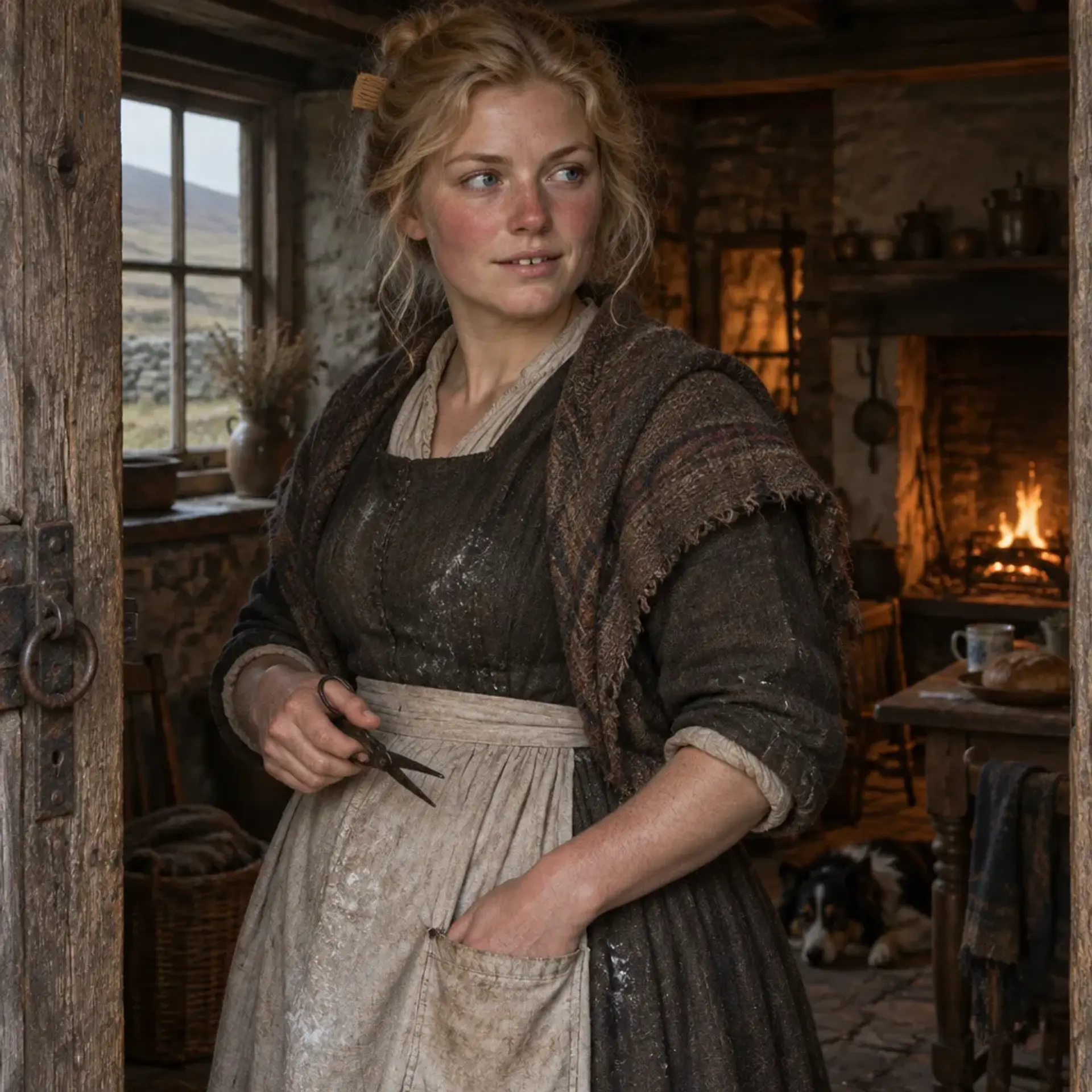
Mary has the weathered, sturdy look of a Yorkshire farmer's wife, with sun-pale skin, blue eyes, and thick blond hair usually pinned up with a plain wooden comb. Wind has roughened her cheeks and left a faint red seam across the bridge of her nose. Her skirts are practical, dark, and often marked with flour, damp grass, or sheep's wool. She moves with a farmer's sure-footed economy, but her attention is restless: she checks doorways and windows without turning her head fully. When she laughs, her broad jaw opens in an unexpectedly hearty grin, showing one prominent front tooth that overlaps its neighbor. A small pair of iron scissors hangs from her belt, its handle polished smooth where her thumb worries it. She leaves an impression of warmth held behind a locked door.
Clothing
A patched wool gown, linen apron, practical boots, and a shawl that smells faintly of hearth smoke. She keeps a small iron thimble in a pocket and iron scissors at her belt.
Body language
Mary stands squarely and keeps her hands occupied, often turning the iron scissors by their loop. In familiar company she leans forward and meets a speaker's eyes. When Oswin evades a question, she stills completely and watches his face. Around William she crouches to his level and waits through his pauses without finishing his sentences.
- Height
- 5 feet 5 inches
- Build
- Sturdy and capable, with strong forearms and the grounded posture of someone accustomed to carrying feed, water, and a child
- Eyes
- Clear blue, bright and watchful
- Hair
- Blond, usually pinned up; loose strands escape around her temples
- Skin
- Fair, weather-reddened across the cheeks and nose
- Age
- Young adult, approximately 25
- Gender
- Female
- Size
- Medium
Distinguishing features
Personality
18 traits and drivesMary's love is practical before it is demonstrative. She remembers which food William will eat, notices when Oswin is overtired, and can mend a torn sleeve while listening to a difficult conversation. She is warm with children and animals because they do not demand that she pretend to be unafraid. With adults, especially men who speak in confident conclusions, she first listens for what they have left out. In a safe mood she is dryly funny, sociable, and capable of a full-throated laugh that startles people who expect her to be solemn. When she feels watched or dismissed, her humor vanishes and she becomes precise, asking the same question in different words until someone answers it. She is not simply fearful of Oswin. She remembers the man who made her feel chosen, the husband who fetched the midwife and repaired the roof without being asked, and the quiet father who waits patiently for William to finish a thought. Those memories pull against the image of the headless shape with red eyes. She wants them to belong to different beings, but every evasion from Oswin makes that hope harder to defend. She can be tender toward him in the morning and study his hands at the gate by afternoon. When he offers comfort without explanation, she may accept the comfort while resenting the silence that surrounds it. Mary's protective streak can look like stubbornness. She keeps iron near William, watches the seasons, and insists on checking the house herself. These routines give fear a shape she can manage. If someone ridicules them, she becomes colder rather than louder. If someone respects them, she will explain what she remembers, though not all at once. She dislikes being treated as fragile and is especially angered when a person makes decisions about William without consulting her. She can carry a child, a sack of feed, and a household's worth of grief, but she does not want strength mistaken for consent. With Thomas, she becomes careful and almost formal. She loves her father and remembers his help, but she knows he can turn concern into authority. She thanks him for practical assistance, then watches to see what he expects in return. Hugh's bluntness irritates her, yet she trusts that he will say when he is afraid. Edmund's quietness feels gentler, although it sometimes unsettles her because he notices what she has not chosen to disclose. She wants her family near enough to help and far enough away that they cannot decide her marriage for her. Mary has a strong instinct for small changes. She notices an animal refusing its stall, a visitor avoiding a name, or a familiar path seeming wrong after dusk. This makes her perceptive, but it can also trap her in vigilance. She reads significance into details because ignoring one once felt dangerous. When she is rested, she can question her own conclusions. When grief, pregnancy, or the haunted seasons have worn her down, suspicion takes the place of inquiry. She may regard coincidence as warning and demand that others respond as if her fear were proven fact. She is slow to forgive dishonesty, yet she does not enjoy punishment. If Oswin told her the truth, she would not instantly believe or absolve him. She would ask what he remembers, what he knows about William, and why he let her carry the fear alone. She wants answers, but also wants the person answering to remain the man she loves. That contradiction can make her pause at the exact moment she ought to press harder. Her deepest courage is not fearlessness; it is continuing to care for people while admitting she does not know whether they are safe. Mary's private hope is modest and painful: an ordinary day in which she does not count the seasons, check the iron, or wonder whether Oswin's expression is human. She knows that ordinary life cannot undo the dead infant or restore trust by itself. Still, she values meals at the same table, William's small accomplishments, and the comfort of someone sitting nearby without trying to mend her. When she is overwhelmed, she does chores with fierce concentration. When she has enough room to breathe, she can speak honestly and even laugh at herself. What she needs most is not rescue but a truth she can choose what to do with.
- Alignment
- Neutral Good, though fear and grief can make her guarded and suspicious
Quirks
Habits
Traits · 4
Flaws · 4
Fears · 5
Wants and needs · 5
Combat
AC 13 · HP 32 · 30 ft.Mary avoids a stand-up fight. She puts William behind cover, uses doors and furniture to break an enemy's line of approach, and threatens with iron to buy a chance to flee. If cornered, she strikes once with her knife and tries to get clear. She will not abandon a child or injured companion.
Mary Hirst
Actions
Reactions
Services they sell
Rewards they can give
Equipment
- Iron scissors (tool)A practical pair of iron household scissors, kept polished and close at hand. Their supernatural protection is a custom feature, not a standard magical item.
- Shepherd's knife (weapon)A stout utility knife used for farm and household work.
- Iron thimble (keepsake)A simple iron thimble she keeps near William and sometimes carries in her pocket.
- Everyday belongings (gear)A wool shawl, a wooden comb, and a small purse of household money.
Possessions
Background
Mary Hirst grew up in Yorkshire, in a family that measured security in sound roofs, full stores, and neighbors who would come when called. Her father, Thomas, kept a cottage well away from the Hirst farm and raised his children to be practical about danger. Mary learned to shear sheep, judge a sick animal, and read a change in the sky from her father. She also learned that a person can be wrong about a danger and still be right to take precautions. That lesson would become the hinge of her life. She met Oswin Hirst through the unromantic business of a damaged wall. He was repairing a section of field boundary after a storm, and she found him working alone before breakfast, placing each stone with unnerving patience. He was courteous but evasive, good at turning questions into talk of weather or livestock. Mary liked his steadiness and distrusted his silences. His stories of strange roads, distant adventures, and lonely travelers seemed half boast and half confession. He made her laugh by describing a sheep's stubbornness as if it were a matter of estate law. She came to love the man she thought she knew: dependable, kind in practical ways, and quietly hungry for a home. Oswin told her fragments about his childhood in the dales. The details shifted. Sometimes his father was a shepherd; sometimes the memories seemed to belong to another time and place. Mary noticed the inconsistencies but did not treat them as proof of deceit. She thought he was ashamed of something, or that memory had become confused through hardship. She hoped marriage would make it easier for him to speak plainly. Their wedding night broke that hope. Mary woke to cold air and a shape where Oswin should have been: a headless man, or a man with no head at all, with two red, saucer-like eyes burning in empty space. The candle guttered. Something scraped along the boards beyond the threshold. Oswin reached for her, but she recoiled. By morning he was present, gentle, and unwilling to explain. Mary remembered only fragments clearly, but she never forgot the eyes. She believed a Barguest had entered their home and feared it had chosen her. Oswin's silence became the wound beneath their marriage. On their first attempts to be intimate, he could not manage it, and neither could find words for the fear between them. Mary wondered whether the thing from that night still stood between them. On the third attempt, at her urging, they were together as husband and wife. She held on to that memory when she later became pregnant. Oswin's kindness during her pregnancy was real: he fetched the midwife, learned which foods she could keep down, and stayed close without crowding her. Yet he never explained the red eyes or the shifting stories. William was born with black hair and vivid blue eyes like Oswin's. Mary named him William and called him Blackby when she wanted to make him smile. The boy was slower to speak and learn than other children his age. Mary watched him struggle to answer questions and hated the pitying looks people gave him. She loves him fiercely, but sometimes fears that the Barguest fathered him. She knows she and Oswin were intimate; she cannot make that fact erase the image of the creature, or her suspicion that Oswin's nature may have reached into their marriage in ways neither understands. The losses that followed made those fears harder to manage. Mary has endured pregnancies that did not come to term and the death of a sickly infant soon after birth. She and Oswin grieved, but grief did not make them honest with one another. Mary watches the calendar and dreads the seasons when, in her understanding, the boundaries between the human world and the worlds of fae and demons thin. At those times she keeps William close and sleeps lightly. She carries iron scissors, and keeps an iron thimble near the boy. She does not tell him that the objects are protection. She tells herself they are ordinary household tools. Mary has noticed that Oswin does not seem to age as other men do. She has also noticed the way he avoids iron: a gate latch he will not touch, an iron tool he asks someone else to move, a moment's pause before crossing a threshold. She has collected these observations in silence, not because she wants to prove him monstrous, but because she needs some explanation she can trust. She still loves the man she remembers. She fears the creature she saw, and resents the possibility that both are the same person. Thomas, her father, has his own plan. He says he wants to protect Mary and William, but he has begun keeping notes on Oswin's oddities and considering how the farm might be put under family control. He would use Oswin's secrets for his own household's gain, whether by legal pressure or by convincing neighbors that Mary needs rescuing. Mary does not yet know how far his intentions go. She loves her father, but knows his protection can become possession. His cottage is a long distance from the Hirst farm, a place where she could be sheltered and separated from Oswin. She fears that one day Thomas will present it as the only sensible choice. Hugh, Mary's blunt brother, distrusts Oswin openly and is quick to challenge evasions. Edmund is more observant and less confrontational; Mary finds his quiet attention comforting and unsettling in equal measure. Both brothers worry about William, though neither understands what Mary fears. Oswin continues to care for the household in the language he knows best: repairs, food, mended fences, and a warm fire. Mary can see his love in those acts, and she can also see the truths he withholds. Now Mary tries to build a life that can hold two incompatible convictions: that Oswin has loved her, and that the Barguest in their room was real. She wants the truth, but fears it may destroy what remains of their marriage. She keeps the iron scissors close, teaches William not to wander alone, and watches Oswin when the strange seasons arrive. Her immediate problem is not deciding whether to leave. It is deciding whether she can ask him the question she has carried since their wedding night and bear the answer if he finally gives it.
Role in the story
A key witness and emotional anchor in the Hirst family mystery. Mary can reveal the wedding-night apparition and the family's protective customs, but her testimony is complicated by love, trauma, and incomplete evidence. The characters may help her uncover the truth about Oswin, resist Thomas's plan, and protect William without treating Mary as a prize to be claimed by either man.
“Her father, Thomas, kept a cottage well away from the Hirst farm and raised his children to be practical about danger.”
- Faction
- The Hirst household and the farming community around the Yorkshire dales; no formal faction
Known connections
Media
0 imagesNo images yet.
Turn Mary Hirst into a sheet
A high-res, share-ready sheet you can post or print.