Mary Bell
Mary Bell
At the table
Voice
Mary's voice is lightly roughened by tiredness and by calling across a busy house; it carries practical urgency rather than theatrical sweetness. Kent's voice comes from the same physical instrument but feels unfamiliar to her, more forward in the chest and more carefully articulated, as if he has learned speech from formal rooms he has not yet entered. When startled, Mary loses words; Kent tends to over-explain how little he needs help.
Mary speaks in practical, unshowy sentences, often starting with what needs doing. Kent chooses more formal phrasing when trying to appear respectable, but his frustration makes him direct and sometimes imperious. Neither has a polished theatrical manner. Mary occasionally slips into the clipped instructions of someone used to calling children from another room.
Speech patterns
How to play them
Approach Mary with practical help and respect for her time; do not assume she will abandon her siblings to pursue a mystery. Offer privacy before asking about the reflection. Trudy can help establish trust. Address Kent as a person when he is present, but do not let his wishes erase Mary's consent. These are roleplaying recommendations, not canonical mechanical modifiers.
Goal
Keep her siblings safe while finding a path to college with Trudy, recover the missing heart or understand what has changed since it vanished, and establish boundaries with Kent before either of them is harmed.
Motivation
Mary is driven by fierce love for her siblings and a growing need to have a future of her own. Kent is driven by curiosity, dignity, comfort, and the urge to become more than a face in a reflection.
Appearance
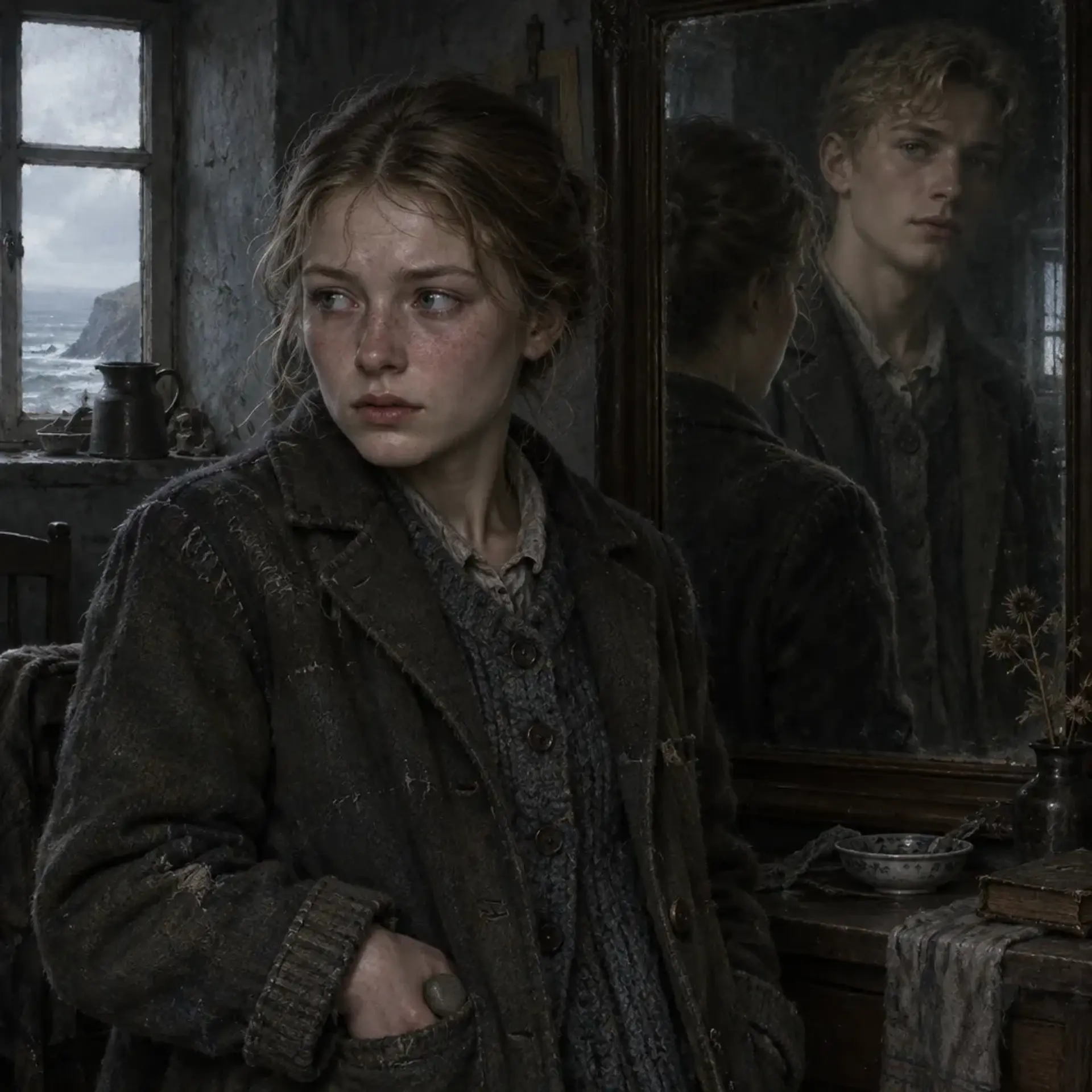
Mary is a young woman with a slight, work-worn frame and a habit of standing as though she is making room for someone else. She keeps her weight on the balls of her feet, ready to turn toward a child who calls or a chore she has forgotten. Her dark-blond hair is usually pinned or tied back quickly, with flyaways catching on her collar. Blue-grey eyes, a pale, tired face, and a small, attentive frown make her look older when she is listening. She moves economically, saving energy, but her attention is restless. When Kent emerges, the same face and posture are replaced by a taller young man, broader through the shoulders, with short bright-blond hair, malachite eyes, and an unfamiliar, self-possessed way of claiming a doorway. His clothes sit badly on Mary and may pull at seams. The unexpected detail for a girl expected to stay home and serve is her practiced, almost automatic habit of taking the outside edge of a pavement and scanning windows as if she were escorting a party through unfamiliar streets. She leaves the impression of someone who has learned to be overlooked, then suddenly notices everything.
Clothing
Mary wears serviceable, repeatedly mended postwar clothes chosen for chores and part-time work. Kent is often stuck with these garments and finds them ill-fitting and insufficiently respectable. He is actively seeking proper young men's clothes, especially a decent coat, shirt, and shoes. Changes can happen in the daytime as well as at night, so she cannot always prepare.
Body language
Mary angles her shoulders inward and leaves space for others, but her eyes keep checking the room. She shifts her weight toward whichever child might need her next. Kent stands taller and takes up the doorway without noticing that he has blocked it; when uneasy, he squares his shoulders and fusses with cuffs that do not fit. In the reflection, he sometimes turns away before Mary does.
- Height
- Mary: approximately 5 feet 4 inches. Kent's apparent form is noticeably taller, around 5 feet 10 inches.
- Build
- Mary is slight and wiry from constant work, with a tired, practical posture. Kent's apparent form is taller, broader-shouldered, and more solidly built, making Mary's clothes sit badly and sometimes strain.
- Eyes
- Mary: blue-grey. Kent's reflected or emergent appearance: malachite green.
- Hair
- Mary: dark blond. Kent: short, bright blond.
- Skin
- Fair, usually pale with fatigue and wind-reddened cheeks.
- Age
- 18
- Gender
- Female
- Size
- Mary is an ordinary-sized young woman; Kent's apparent form is larger and taller.
Distinguishing features
Personality
20 traits and drivesMary is considerate without being naturally meek. She has learned to soothe people because it prevents arguments from spilling onto the children, but she can be stubborn and sharply decisive when someone threatens Matilda or Oswald. She is naive about some kinds of danger, partly because she has had so little leisure to imagine a life outside her household, yet she is observant about moods, money, and the practical routes through a crisis. She can accept a strange explanation more readily than an emotional one: a reflection that moves on its own is frightening, but admitting how trapped she feels at home is harder. She behaves differently depending on who needs her. With the younger children she is warm and playful when she can spare the energy, and quietly strict when they are in danger. With Henry she tries patience first, then becomes unexpectedly hard when he tries to turn his resentment on the little ones. With Malinda she measures every word, sometimes offering care she does not feel because the alternative is an unpredictable row. With Simon she is more guarded, tired of his assumption that money and occasional visits make him present. With Trudy she can laugh, complain, and briefly imagine college, though even friendship is often interrupted by a chore. Kent is not simply Mary's opposite. He shares her curiosity and can be startled by cruelty, but he has none of her practiced habit of making himself small. He wants to be regarded as a respectable young man, not a curiosity, a dependent, or a mistake in Mary's life. This makes him shy in unfamiliar rooms and proud when challenged. He prefers a warm interior, clean clothes, and settled company to wild wandering, although the sea and unfamiliar places draw him into adventures he would not plan in advance. His middle-class English sensibilities lead him to judge bad manners even as he is learning the world through borrowed access to Mary's life. Kent's emerging opinions are uncomfortable for Mary because they are not always cruel or foolish. He sees that she is overworked and that the adults have made her responsible for problems they should address. He can be protective of the younger siblings, especially when he sees them frightened. At the same time, he dislikes being confined to Mary's appearance and clothes, wants to pursue women, and increasingly alters plans to serve his own preferences. He can be gallant in imagination and entitled in practice. He wants to be wanted, but has not yet learned that another person's consent is not a prize to win. Mary is most hopeful when doing something concrete with Trudy: looking at a college prospectus, sharing a joke, or imagining work that belongs to her alone. She becomes brittle when every solution depends on her sacrificing more time. Kent is most confident when dressed well or treated as an adult; he becomes defensive and impulsive when made to feel ridiculous. Both can be gentle, but neither is always generous. Their conflict is sharpened by the fact that Mary cannot simply walk away from him and he cannot yet make a life without her.
- Alignment
- Not applicable as a Secret Histories rule. In ordinary terms, Mary is protective and conscientious; Kent is self-regarding, curious, and developing his own loyalties.
Quirks
Habits
Traits · 5
Flaws · 5
Fears · 5
Wants and needs · 5
Combat
HP 0Avoid a fight. Mary protects the children and looks for an exit, an adult witness, or a way to draw attention. Kent is more likely to stand his ground than Mary, but he has no established combat training and his pride can make a bad situation worse. Use the supplied aspects as narrative affinities only; resolve any dangerous action with the table's actual Secret Histories procedures.
Mary Bell
Actions
Services they sell
Rewards they can give
Equipment
- Mary's work clothes (clothing)An ordinary, mended coat and practical clothes; unsuitable when Kent takes the foreground.
- The chalk heart (occult object, currently lost)The object Malinda found in a log, shaped crudely like an anatomical heart. It is missing at present.
- Household notebook (personal)A small notebook Mary uses for chores, errands, and schoolwork she hopes to resume.
Possessions
Background
Mary Bell is eighteen, the eldest of eight children, and lives with her family in Rochester, Kent. Her parents have enough money to be called middle class, but comfort has not made their home reliable. Malinda Bell drinks too much and can be affectionate, careless, or frighteningly absorbed in herself. Simon Bell takes work far from home whenever he can, returning with money, excuses, and the expectation that the household will somehow have continued without him. Mary has become the person who makes that expectation come true. She tries to keep the younger children fed, washed, and at least partly educated while finding whatever part-time work she can. She loves them. She also resents how easily love becomes an obligation no one else has to acknowledge. Her siblings are not a tidy household of dependants. Henry, fourteen, is turning rude and cunning, angry at his parents and sometimes at Mary, whose authority he dislikes even when he relies on her. Matilda, twelve, is Mary's sweetheart sister and the one most likely to quietly take a chore from her hands. Mary is determined that Matilda will not simply become her replacement. Olympia, ten, is close to Chrissy, nine, whose unknown Jamaican father is a fact the adults handle badly and the children understand in fragments. Chrissy has tan, freckled skin, wavy dark hair, and very dark eyes. Jonas, five, is Simon's son by another relationship, bright blond and blue-eyed; his presence has never been an easy matter for Malinda to forgive. Belladonna, five, has black hair and green eyes, and the identity of her father is uncertain. Abigail, four, is red-haired and green-eyed, resembling Simon's grandmother in a way he openly favors. Oswald, two, with ashy-blond hair and Simon's steel-grey eyes, follows Mary with his blanket and seeks her comfort. Mary tries to make time for him, but the hours rarely stretch far enough. On Mary's eighteenth birthday, Malinda found a peculiar stone lodged in a log and gave it to her. It was a small, crude object shaped like an anatomical heart, pale and rough as a piece of the Dover cliffs, with old barnacles and scraps of seagrass clinging to its contours. Mary was not impressed by the present, but she was grateful that her mother had remembered the birthday at all. She did not tell Malinda it was jewelry. Malinda was too drunk to care, and Mary had no reason to invite questions about an object she could not explain. The heart had already passed through other hands. An amateur alchemist, Bartholomew Golden, had once left it at Hush House as payment for entry, calling it the Heart of England and claiming it could bring servants from man's shadow out of chalk cliffs and borderlands. He was never allowed near Brancrug again. Abraham Groff, a young man from London, later found the heart returned by the sea after it had been thrown out. It beat beneath his coat on the train home. In Wiltshire, it seemed inert in company and alive by the shore, where water brought a red-pink light beneath its stone surface. Groff became possessive of it less from greed than from the impression that it disliked visitors. As the house around it filled with footsteps, moved doors, and disembodied voices, he sold it to William Windon, a local lad of seventeen. William hid it in a log and struck it with a hammer; the heart stopped. Malinda eventually found it there. The object arrived in Mary's life with a history no one in the Bell household knew. For a while it was only an odd keepsake. Then its beat began to follow Mary's. The first time she noticed, she assumed she was tired. Later, her reflection changed. In the mirror was a handsome young man, taller than her, with short bright-blond hair and green eyes. At first it seemed like a joke or a trick of exhaustion. The reflected figure looked away when she looked directly at him, made expressions she had not made, and sometimes seemed to watch the room rather than the glass. Mary had no leisure to investigate. She had younger children to mind and work to find; she treated the impossible image as another problem she could postpone. The first night she woke in Kent's body, she had been dreaming badly and sat bolt upright in a room that was not quite hers. The hands were wrong, the shoulders too broad, and the voice that came out of her throat was a young man's. Terror gave way to practical panic: she had to get home before her family found the bed empty. By dawn, she was herself again. The relief did not erase the strange exhilaration of having escaped the house. In the following weeks, the changes came without warning, sometimes at night and sometimes in the day. Mary learned to improvise: borrow clothing, avoid familiar neighbors, and return before anyone asked why she had been gone. She did not call it a second life. It was an inconvenient and occasionally useful way to get outside. Her first adventure as Kent began with a walk along the shore, where Mary had gone to test whether the old story about the stone and the sea meant anything. Kent came forward with no warning. The tide had pulled back from the mud flats, leaving weed and shining channels between chalky stones. He was frightened by the cold air, the unfamiliar body, and Mary's ordinary clothes hanging awkwardly on him. Then the fear became interest. He climbed a low sea wall, cut his palm on a rough edge, and stared at the blood with a detached fascination. He kept going until he found a wrecked shed and a set of steps leading to a disused storehouse. There he discovered how much he liked being alone outside the house, but also how much he preferred shelter, proper clothes, and a respectable destination to scrambling about in wet weeds. He returned before dawn with mud on Mary's hem and no explanation she could give her mother. The first journey home from that outing nearly exposed them. Simon returned earlier than expected, and Mary found herself in Kent while walking back toward the house. Kent did not know the streets as Mary did, and his posture drew attention. He tried to pass as a young man visiting, then realized he was approaching the wrong entrance and that Simon was already inside. Mary, present as a pressure of memory and alarm, helped him remember which window latch stuck and where the family kept spare clothes. He slipped around the house and waited until Simon left the room. The episode taught Mary that Kent was not merely an image that borrowed her face; he could act, make decisions, and need help. It also taught Kent that Mary's family was not a backdrop. They were people who could be hurt if he made a careless choice. A worse incident followed when Malinda, drunk and awake late, caught Kent trying to leave the house. He had dressed in Mary's clothes because those were the clothes available, and he was furious at the fit. Malinda recognized Mary's face but sensed something wrong in the way the figure held itself. She accused her daughter of sneaking out, then shifted between pleading and anger. Kent tried to push past her. Mary fought him internally, afraid he would knock Malinda down or wake the children. He stopped, but only after Mary gave him a vivid memory of Oswald reaching for her blanket. Malinda grabbed at his sleeve, and the seam tore. By morning, Mary had to explain a damaged garment and a missing hour. She said she had been restless and had gone to the yard. Malinda accepted the explanation because accepting it asked less of her than asking another question. Kent remembered the humiliation and resented being trapped in a body whose clothes could not fit him. The pub adventure was less frightening and more revealing. Kent went into a local pub without Mary's plan or permission, drawn by the warm light and by the thought that a young man ought to be able to sit down and order a drink without having to account for himself. He was stiff with the room's noise and unsure of its customs, but he wanted to appear as if he belonged. He tried a mild, respectable manner, asked for a seat near the fire, and studied the men who seemed at ease. A customer mistook him for a visitor and asked where he was staying. Kent gave an evasive answer, then grew prickly when someone laughed at his ill-fitting coat. He noticed a young woman at the bar and wanted to speak to her, but Mary's fear of being recognized kept interrupting him. He left with his pride wounded and an intense wish for better clothes. Mary learned that Kent was not simply curious about the world: he wanted a particular kind of life in it, with privacy, manners, and romantic attention. He, in turn, began to understand that Mary had reasons to fear being seen. Trudy, Mary's friend, was the first person outside the family to notice the pattern. Trudy is short, skinny, dirty-blond, hazel-eyed, and calls herself a rebel. Her alternative clothes make her stand out in the early Cold War years, and her working-class family has taught her to be skeptical of people who assume other people's time belongs to them. She had already been helping Mary with the children and had repeatedly told her that both of them should go to college. One day she encountered Kent and recognized Mary's face before she recognized the stranger inside it. He attempted to bluff, then stiffened when she called him Mary. Trudy did not scream or flee. She asked what was happening, listened to the answer as best she could, and insisted that Mary deserved to know what was happening to her own life. She is now in the know and has begun looking for a solution, though she cannot promise that the solution will be safe. The changes have grown more serious since the heart disappeared. Mary cannot say when or how it was lost. Kent has started to speak without waiting for her to call him forward, to move in the reflection when Mary is looking elsewhere, and to form clear opinions about the Bells. He thinks Henry is clever but cruel when frightened, Malinda is careless in ways that can be dangerous, and Simon is too willing to call absence work. He is increasingly frustrated when he is stuck in Mary's body and increasingly ready to change plans when he does emerge. Mary fears that the separation between their thoughts will widen until she cannot tell which decisions are hers. Now strangers have begun asking after a blond young man with green eyes. Their questions have the unsettling precision of people who know what they are looking for. A second visitor appears only at night, coming from the sea: a woman with straw-like blond hair and blue-black eyes, looking like a drowned ghost. She claims to be Kent's sister and says she will bring the others. She operates independently of the people seeking the young man, and no one knows whether she is telling the truth. Kent recognizes something in her voice but cannot explain what. Mary, Trudy, and Henry have each seen enough to understand that this is no longer a private oddity. Mary's immediate problem is still painfully ordinary. She must keep her siblings safe, hold onto work, and find a way to study with Trudy without leaving the younger children wholly to chance. She needs the heart, or at least an answer to what it did. She has not yet worked out whether Kent is a guest, a danger, a dependent, or a person who has as much right to fear as she does. Kent is trying to claim a life of his own without understanding how much of Mary's life he already occupies.
Role in the story
A young caretaker whose uncanny reflection is becoming an independent person. Mary connects domestic pressures, a lost occult object, a coastal visitor, and strangers searching for Kent. She can be an ally, a witness, or the center of a mystery about consent, identity, and the cost of becoming more than one's assigned role.
“Her parents have enough money to be called middle class, but comfort has not made their home reliable.”
- Faction
- No confirmed faction. Mary is tied to the Bell household and to Trudy's informal circle. Her connection to the occult history surrounding the heart is involuntary and increasingly visible.
Known connections
Media
0 imagesNo images yet.
Turn Mary Bell into a sheet
A high-res, share-ready sheet you can post or print.