Mary Bell
Mary Bell
At the table
Voice
Mary's voice is quickened by years of calling across rooms and speaking over household noise. It catches when she is very tired, and she sometimes takes a breath as though about to answer two people at once. Kent's voice has a different weight and a slightly dry, careful articulation. He sounds as though he has learned his manners from listening rather than from being taught. When rattled, his breath becomes audible and his sentences grow more formal instead of softer.
Mary speaks plainly and quickly, with a working household's economy of words. She clips a sentence short when she hears a child moving or a task being left undone. Kent's speech is more measured and ceremonious, colored by an English middle-class sense of propriety he is still learning to perform. His voice feels lower and more resonant than Mary's, as if the sound sits in the chest differently; when unsettled, his breath catches before he answers. These are descriptions of their voices, not claims of separate canonical mechanics.
Speech patterns
How to play them
Offer Mary practical help without treating her as a helpless child. Give her time to speak privately and include Trudy if she agrees. Do not assume Kent is a costume, a hallucination, or a simple possession. Kent responds to courtesy and respect but dislikes being handled as Mary's oddity. If pressed about the missing heart or the sea-born woman, expect guarded answers until the characters demonstrate that they will not expose the family.
Goal
Mary wants to protect her siblings, understand the heart's disappearance, and reach a future in which college and her own life are possible. Kent wants recognition, agency, and a life that is not merely borrowed from Mary.
Motivation
Mary is driven by love, obligation, and a quiet hunger for escape. Kent is driven by the need to be treated as a person rather than a symptom, alongside a strong longing for home, status, companionship, and a life of his own.
Appearance
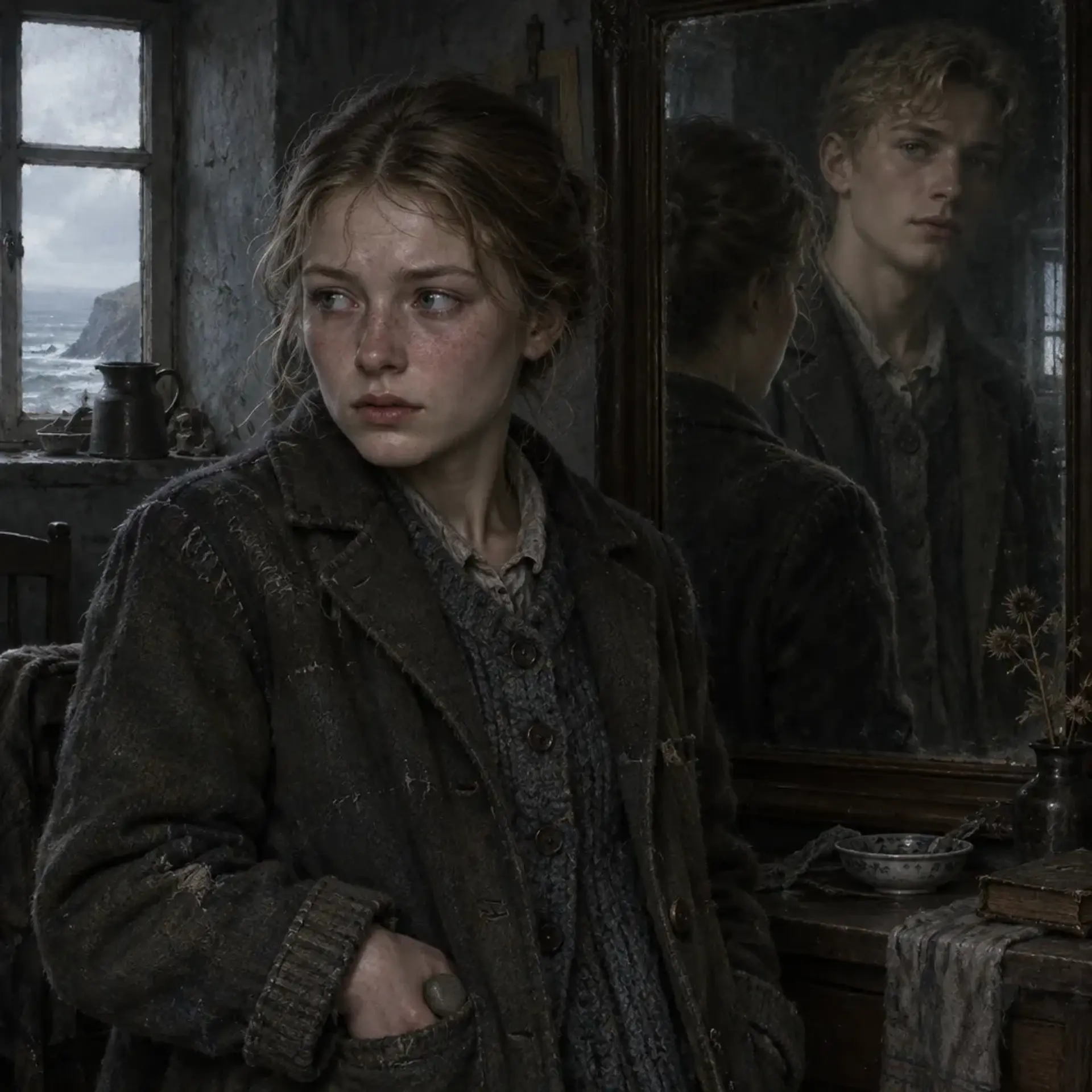
Mary is a tired-looking young woman with a practical, watchful face and the habitual posture of someone listening for a child to call from another room. Her dark-blond hair is usually pinned up hastily, with loose strands caught at her temples; her blue-grey eyes look paler in the household's weak light. Her clothes are respectable but repeatedly mended, chosen for work and chores rather than display. One unexpected detail for a young woman expected to keep house is her pocket full of small stones, each rubbed smooth from handling. When Kent takes the body's appearance, the reflection becomes a tall, handsome young man with short bright-blond hair, malachite-green eyes, and a manner that seems more composed than Mary's. His appearance is not simply a disguise: it is becoming increasingly visible in mirrors and in the way the body holds itself. The transition can leave Mary's clothes badly fitted, especially at the shoulders and waist. Both faces carry a faint impression of sea-coldness after the heart has been near water.
Clothing
Mary wears practical postwar clothes, repeatedly mended and selected to survive chores. A cardigan or coat is usually kept in unusually good repair because it is one of the few garments she can depend on. Kent's excursions make the fit a recurring problem: Mary's clothes sit awkwardly on his apparent frame, and he is embarrassed by how often he must borrow or improvise. He cares more than Mary expects about looking respectable.
Body language
Mary moves quickly and economizes every gesture, habitually turning her body toward the nearest child or unfinished task. Kent stands straighter and makes deliberate, almost formal adjustments to his sleeves, as if manners could make an unfamiliar body his own. In reflections he sometimes turns away before Mary does.
- Height
- Mary: average height. Kent's reflected form appears notably taller.
- Build
- Mary is slight and worn by long days of work; Kent's reflected form appears taller, lean, and more self-possessed.
- Eyes
- Mary: blue-grey. Kent: malachite green.
- Hair
- Mary: dark blond. Kent: bright, short blond.
- Skin
- Fair, with a tired, slightly wind-chapped complexion.
- Age
- Mary is 18; Kent presents as an 18-year-old young man.
- Gender
- Female; Kent presents and understands himself as male.
- Size
- Human-sized
Distinguishing features
Personality
20 traits and drivesMary is responsible without being naturally serene. She can be tender and funny with the younger children, then abruptly impatient when one more demand arrives before she has eaten. She is practical enough to improvise a cover story in a crisis but naive about how much adults can be trusted to behave decently. When she is exhausted, she becomes brisk and emotionally unavailable; when she feels safe with Trudy or Matilda, she lets herself be warm and imaginative. She resents the duties placed on her, yet guilt makes her return to them even when she has a chance to leave. Kent pulls in the opposite direction. He wants to be seen as a man and dislikes feminine expectations, yet he is shy about being observed and longs for the comfort of home. He wants to appear high-class and composed, though he lacks the confidence and social experience to manage it consistently. He may make a proud, formal impression, then be thrown off by a joke or an unfamiliar custom. He judges Mary's household harshly, but that judgment carries a growing concern for the children. He wants women and companionship; Mary does not share that desire, making their connection a source of discomfort rather than a convenient shared personality. Neither is a single stable temperament. Mary is more daring when an opportunity to escape appears and more cautious when a sibling might suffer the consequences. Kent is most self-controlled in public, where he wants to seem respectable, and most openly frustrated when confined to Mary's body or denied a choice. At home he can be unexpectedly domestic, while away he may seize a plan and redirect it toward his own interests. Both can show compassion, but neither yet knows how to negotiate honestly without fearing that the other will take too much.
- Alignment
- Not meaningfully expressed as a game alignment. Mary tries to protect her siblings; Kent pursues his own wishes and is learning to care about their consequences.
Quirks
Habits
Traits · 5
Flaws · 5
Fears · 5
Wants and needs · 5
Combat
HP 0Neither Mary nor Kent is a trained combatant. Mary prioritizes escape, protection of the children, and finding an adult or ally. Kent prefers to avoid a direct fight and may use knowledge of local routes to disengage. Treat supernatural effects as narrative custom features, not as an established combat subsystem.
Mary Bell
Actions
Reactions
Services they sell
Rewards they can give
Equipment
- The Heart (occult object)The small, crudely carved heart-shaped stone is currently missing. It has returned from the sea before and may be more than an inert object.
- Mary's coat (clothing)A modest, repeatedly repaired outer garment Mary uses for work and for hurried excursions.
- Pocket stones (personal keepsake)A small assortment of smooth stones Mary keeps in a pocket and handles when thinking.
Possessions
Background
Mary Bell grew up in a house in Rochester, Kent, that looked comfortable from the road and felt crowded from the inside. Her parents had enough money to keep up appearances, but respectability did not make the household kind. Her father, Simon, took work far from home whenever he could. Her mother, Malinda, drank too much and could be neglectful, leaving Mary to feed, soothe, supervise, and make do for her younger brothers and sisters. Mary was the eldest of eight. She had learned early that a quiet child could be overlooked and that an overlooked child could get things done. She attempted her schooling between chores and became practiced at postponing her own wants until the children were safe, fed, and occupied. Her siblings were never a tidy family portrait. Henry, fourteen, had begun to turn resentment into sly, rowdy defiance. Matilda, twelve, was Mary's sweetheart and most reliable helper, but Mary refused to let her be pushed into becoming a second unpaid housekeeper. Olympia, ten, and Chrissy, nine, were close; Chrissy's unknown Jamaican father was an unspoken subject adults handled badly and children noticed anyway. Abigail, four, had red hair and bright green eyes that Simon liked because they reminded him of his grandmother. Jonas, five, was Simon's child from elsewhere, with vivid blue eyes and bright blond hair; his arrival had deepened Malinda's bitterness. Belladonna, five, had black hair and green eyes, and the identity of her father was a matter of speculation. Oswald, two, followed Mary with a blanket and the trust of a very small child. The conflicting accounts and old grievances in the household meant that even simple family facts could be disputed. Mary's eighteenth birthday was marked by a modest, awkward celebration. Malinda brought home a peculiar stone she had found in a log, thinking Mary might like it. Mary was grateful, though she did not want to pretend it was jewelry. The object looked like a small, crudely carved anatomical heart, as if someone had shaped a lump of Dover chalk by eye and then abandoned the work. Barnacles and strips of sea grass clung to it. Under the rough pale surface was an inexplicable pink-red glow, barely there until it was wet. It had already passed through strange hands: the amateur alchemist Bartholomew Golden had once left it at Hush House as payment for entry, wrapped in newspaper, claiming it was the Heart of England and could bring laborers from the shadow of man, from chalk cliffs and borderlands. He was never allowed near Brancrug again. The heart had been thrown into the sea, returned to shore in black ooze and salt water, and eventually reached a log in Wiltshire. Mary knew none of this when she tucked it away. Before it came to Mary, Abraham Groff had carried it home from the coast. He had shown it to neighbors, where it promptly seemed to die, then watched it revive when returned to water. He became possessive not because he wanted to sell it but because the heart seemed to dislike company. Strange footsteps, voices, and moving doors followed. At last he sold it to a seventeen-year-old local, William Windon, who had already seen it once and hidden it in a log after striking it with a hammer. The blow stopped its beating. Somehow, after passing from William to Malinda and then to Mary, its heart-beat returned. At first Mary considered the rhythm a trick of her own pulse. The object sat quietly among her things, and she had too much work to build a theory around it. Then her reflection stopped being reliable. At first she saw a handsome blond young man with green eyes where her own face should have been. He looked back, looked away, and sometimes wore expressions she had not made. Mary thought it was an awful joke or an effect of exhaustion. She ignored it as long as she could. When the figure moved on its own, she began to avoid mirrors, but she still had no time to be frightened properly. The first night she became Kent began with a bad dream and a sudden, sickening loss of familiarity. She woke to a body that seemed to belong to someone else: taller in its reflected bearing, male in its form, and full of sensations Mary could not immediately name. The house was quiet, but the reflection's fear was not hers alone. By dawn she was herself again. She told herself that the episode was a strange escape from the house, not a second life. On another night, she slipped out as Kent and discovered that the change let her walk beyond the duties that usually held her. She went to the shore, climbed trees, and explored abandoned buildings. The freedom was intoxicating; the unfamiliar body, voice, and clothing were not. She returned home before dawn, confused about whether she had chosen the adventure or merely been carried by it. The excursions gradually became less innocent. Kent had middle-class English sensibilities, an intense desire to be regarded as respectable, and a preference for home and familiar comforts that surprised Mary. He was shy about being looked at but wanted to be admired. He disliked being treated as feminine, resented being trapped in Mary's body, and wanted the company of women in ways Mary did not. At first these impulses came to Mary as feelings, quick judgments, or odd knowledge. Then Kent began to make choices. On a normal outing meant to collect something for the household, he redirected them toward a place he wanted to visit. Mary found herself taking the long route, pausing at a shop window, and speaking with an ease that was not hers. It was the first time she understood that Kent was not just a strange mood or reflection. He had preferences of his own. The family's ability to make danger out of ordinary moments became clear when Simon came home earlier than expected. Mary was out as Kent and had to get back without being recognized. Simon's approach turned every familiar lane into a problem: the wrong turn could put them face to face, and the right one could still lead past someone who knew Mary. She borrowed a coat, kept her head down, and used Kent's instinct for the county's roads to reach home. Simon's arrival taught her that the transformation was not safely contained in a private room. Another time, a very drunk Malinda caught Mary trying to leave while presenting as Kent. Malinda mistook him for a young man at first, then recognized enough of Mary's manner to make the moment frightening. Mary tried to bluff, keep Malinda from shouting, and get out without waking the younger children. The episode left her more wary of using the front door and more angry at the conditions that made escape feel like a necessity. The pub adventure began as a brief, impulsive visit during one of the nights out. Kent wanted to see the room, not just pass it, and Mary's attempt to remain in control weakened as soon as he found a respectable corner and a chance to observe people. He sat with a stiff, carefully arranged posture, tried to appear as though he belonged, and watched the regulars with a mix of curiosity and judgment. A joke from one of them made his face go hot with embarrassment; rather than retreat, he answered with surprising firmness. Mary felt his annoyance at coarse behavior and his desire to be treated as a gentleman, and she also felt his sharp, private interest in the women nearby. He did not know the social rules as well as he wanted people to think. Mary steered them away before the conversation could turn into a real quarrel. The evening showed her that Kent was not a fearless spirit. He was a homebody attempting to perform confidence, and he could be just as easily flustered as she was. Trudy, Mary's short, skinny, dirty-blond friend with hazel eyes, noticed the exhaustion behind Mary's excuses. She called herself a rebel, dressed in alternative ways for the early Cold War period, and spoke insistently about college as though it were a door they could both push open. Her family was working-class, and she understood what it meant to have limited choices; she also helped with the younger children when she could. When she discovered the truth about Kent, she did not dismiss Mary as hysterical. She asked direct questions, listened, and began looking for a resolution. Trudy has since become the one person who can challenge Mary without treating her as a child, though her willingness to get involved puts her at risk. One daytime transformation made the danger public in a new way. Mary was not safely asleep or alone when Kent surfaced. The change began in the middle of the day, leaving her to improvise with clothes, explanations, and a nearby reflective surface that kept making Kent's face more certain than her own. She learned that the change could happen without permission and that there was no reliable schedule to plan around. It made school, work, errands, and even a short walk into a negotiation with her own body. Then the heart disappeared. The changes did not stop; they became worse. Kent began to speak on his own, with thoughts clearer and reactions more immediate. He formed opinions about Mary's family rather than merely inheriting her feelings. He judged Simon's absence, Malinda's drunkenness, Henry's carelessness, and the younger children's dependence. Mary cannot tell whether those judgments are fair, but she recognizes how much of her own anger they touch. Henry has been watching closely and has noticed more than Mary wanted him to. Trudy now knows enough to help them search for answers. Meanwhile, strangers have begun looking for a blond young man with green eyes like Kent's. Their interest has unsettled both Mary and Kent. At night, another presence comes from the sea. She resembles a drowned woman or a ghost remembered through salt water: straw-like blond hair, blue eyes so dark they look nearly black. She claims to be Kent's sister, calls for him, and says she will bring the others. She appears independently of the people searching for the blond young man. Mary does not know whether the stranger is telling the truth or what the others might be. Kent's response is difficult to read: longing, fear, and a sharp wish not to be treated like a child all crowd together. Mary still works when she can, helps the children, and dreams of a life that is not defined by being useful. Trudy keeps saying college is possible. Mary wants to believe her. Kent wants a place in the world that is his, not a borrowed face and not a hidden passenger. The growing reflection is changing their situation from an oddity they can endure into a conflict they must answer. Their immediate problem is not merely to find the heart. It is to decide how much of a life can be shared before one of them is pushed out of it.
Role in the story
A young caretaker caught between an impossible family burden and a supernatural relationship that is becoming a person in its own right. Mary and Kent can be allies, witnesses, a mystery, or a source of escalating conflict. Their decisions about consent, responsibility, family, and identity should shape their future more than a simple cure-or-possession outcome.
“Her parents had enough money to keep up appearances, but respectability did not make the household kind.”
- Faction
- No confirmed faction. The heart's history connects it to Hush House, Brancrug, and Bartholomew Golden, but Mary's relationship to those places and people is unknown.
Known connections
Media
0 imagesNo images yet.
Turn Mary Bell into a sheet
A high-res, share-ready sheet you can post or print.