Mary Bell
Mary Bell
At the table
Voice
Mary's voice comes from a tired, fast-working body: slightly dry, sometimes breathless, and shaped by calling children from one room to another. Kent's voice has more chest resonance and a more deliberate articulation, as though he is continually trying to sound like someone who belongs in a better-furnished room. The contrast is noticeable even before the listener understands why.
Mary speaks in a quick, work-worn rhythm, clipping words when she is trying to finish a task and occasionally losing the thread when someone interrupts. Her voice has a slight rasp from dry rooms, household dust, and too little rest. Kent's voice is naturally deeper and more forward, with a careful, almost rehearsed formality shaped by his wish to sound respectable. He does not become softer when angry: anger makes his consonants more exact and his sentences more pointed.
Speech patterns
How to play them
Mary responds best to practical kindness, patience, and offers that do not treat her as a helpless child. Do not demand that she disclose everything in front of her family. Trudy can help establish trust. Kent responds to courtesy and to being addressed as a person, but do not mistake his preference for respectable manners as proof of harmlessness. Give Mary and Kent separate opportunities to speak and make clear that consent and control are contested.
Goal
Mary wants to find the missing heart, understand the transformations, and keep her siblings safe without surrendering her future. Kent wants a stable body, respectable clothes, freedom to choose his own destinations, and the chance to pursue women.
Motivation
Mary is driven by love for her siblings and a small, stubborn hope of education and a life of her own. Kent is driven by self-definition, social dignity, curiosity about his county, and the frustrated desire to be treated as a man with choices.
Appearance
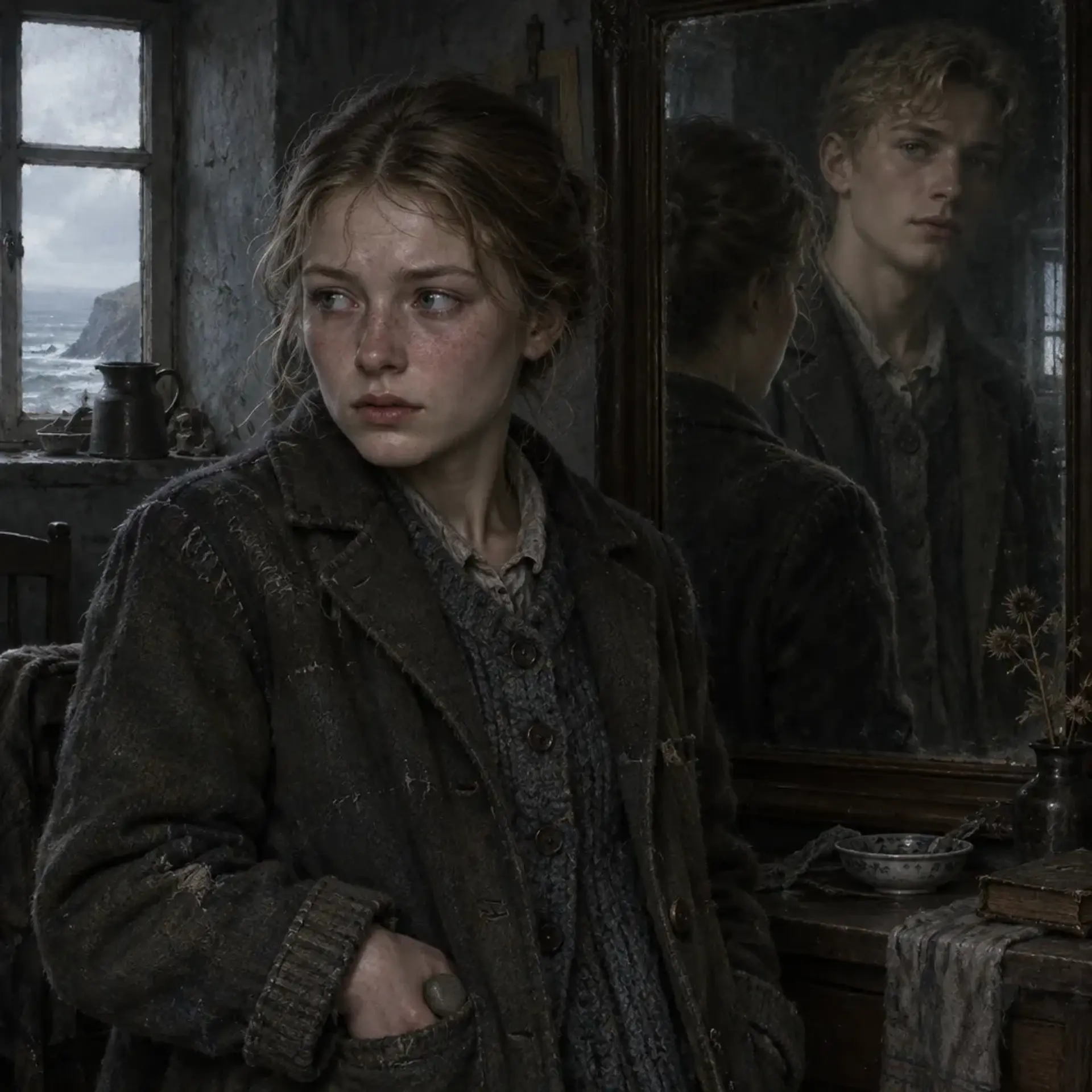
Mary is a young woman with a tired, watchful face, dark blond hair that refuses to stay pinned, and blue-grey eyes with a faint cloudy cast in poor light. Her skin has the uneven pallor of someone who spends too many hours indoors doing other people's work, with wind-roughened cheeks from hurried trips through Rochester. She moves economically, always leaving a hand free for a child, a basket, or a door. When Kent takes her form, her reflected image first changes: the face becomes a handsome young man with short bright-blond hair, malachite-green eyes, and a longer, more assured silhouette. In a full change, the body grows taller and broader through the shoulders; Mary's clothes pull at seams, sleeves ride up, and skirts become an immediate practical problem. Kent carries himself as if entering a room where he expects to be judged, trying to look composed and well-bred even when startled. An unexpected detail for a household drudge: Mary collects tiny polished stones and arranges them by weight, not colour, in the hem of an old sewing box.
Clothing
Mary wears practical, repeatedly mended day dresses, a cardigan, and shoes chosen for errands rather than appearance. Kent is often stuck in Mary's clothes, which embarrasses him and can split seams if he moves carelessly. He has begun acquiring borrowed shirts, a second-hand jacket, and a tie, all of which he considers inadequate. Trudy helps find garments that might pass as his without drawing attention.
Body language
Mary keeps her shoulders slightly rounded, turns toward any sound from the children, and uses quick hands that never seem to finish one task before beginning another. Kent lengthens his posture, squares his shoulders, and tries to make his borrowed clothes look intentional. He smooths a lapel that is not there, stands at a careful distance from strangers, and looks away from mirrors only after the reflection has done so.
- Height
- Mary: approximately 5 feet 4 inches. Kent's form: approximately 5 feet 10 inches.
- Build
- Mary is slight and wiry from constant work rather than exercise. Kent's form is taller and broader through the shoulders, with a young man's sturdy frame that makes Mary's clothes fit badly.
- Eyes
- Mary: blue-grey. Kent's reflected and changed form: malachite green.
- Hair
- Mary: dark blond. Kent: bright blond, cut short.
- Skin
- Fair, with wind-roughened cheeks and the pallor of someone who spends much of her time indoors.
- Age
- 18
- Gender
- Female, though Kent is a distinct male presence and manifests as a young man.
- Size
- Mary: approximately average adult human height and build. Kent's form is taller and broader.
Distinguishing features
Personality
19 traits and drivesMary is dutiful but not naturally meek. She can be funny and sharp with Trudy, but in the Bell house she often swallows irritation because an argument costs more energy than she has. She is genuinely tender toward the children, yet resents how much of her youth their care consumes. She is naive about the occult, not stupid about people: she recognizes danger in a room but has little practice imagining that she is allowed to leave it. When frightened, she becomes efficient and almost cold, making lists, finding coats, and arranging exits. When she feels safe, the resentment and humour she usually suppresses come out together. Kent pulls against Mary in nearly every ordinary matter. He is shy about being scrutinized but wants to be seen as high-class and respectable. He prefers familiar places and the comforts of home, yet once outside he may abruptly change the plan to satisfy his own curiosity. He dislikes feminine clothes and behaviours, but is not a swaggering adventurer; a disapproving stare can make him self-conscious, and he would rather be mistaken for a well-brought-up young gentleman than admired as a spectacle. He judges people by manners and presentation, then surprises himself by caring about the children Mary loves. His opinion of Simon and Malinda is hardening. He has begun to regard Henry as a threat, though he does not know whether this is insight or possessiveness over Mary's life. Mary's feelings about Kent are equally mixed. She is repulsed by losing control and drawn to the strange freedom of being able to leave the house in a different body. She is ashamed of the relief she feels when Kent walks beyond the familiar streets, because she knows the children remain behind. She does not think of herself as living a double life; she thinks of the changes as another emergency to manage. That refusal to name the situation helps her function, but prevents her from asking what she wants. Kent's desire for women is a particularly sharp point of conflict. He experiences attraction as his own, not Mary's, and sees no reason he should not act on it. Mary experiences the same body as hers and does not consent to being used for a courtship she did not choose. Kent's sense of being a man is sincere, but sincerity does not settle the question of bodily consent. He is learning, slowly and resentfully, that a desire can be real and still be limited by another person's boundaries. Mary is learning that keeping peace is not the same as agreeing. Their moods change with place. At home, Mary is alert to every sound and Kent is frustrated by the confinement and the clothes. On the street, Mary is anxious about being recognized while Kent becomes curious and self-conscious. Near the sea, Kent is more certain, as if the landscape has supplied him with a posture and purpose. When Trudy is present, Mary can speak plainly, while Kent tries to impress her and dislikes how easily she sees through him. Neither of them is wholly brave or wholly frightened; they take turns being the one who can move.
- Alignment
- Not applicable as a Secret Histories rule. In ordinary moral terms, Mary is compassionate and protective; Kent is self-regarding, curious, and capable of unexpected tenderness.
Quirks
Habits
Traits · 5
Flaws · 5
Fears · 5
Wants and needs · 4
Combat
HP 3 · Ordinary human walking and running pace; no canonical numeric movement statistic supplied.This is not a D&D conversion. No canonical Secret Histories combat statistics were supplied, so the entries are deliberately custom and descriptive. Mary avoids violence, uses doors, furniture, and distraction to escape, and protects children first. Kent has more physical confidence but little practical fighting experience; his instinct is to confront an insult or seize an exit, not to fight to the death.
Mary Bell
Actions
Reactions
Services they sell
Rewards they can give
Equipment
- Sewing box (personal keepsake)Mary's old sewing box, with tiny polished stones sorted by weight in its hem.
- Mary's everyday clothes (clothing)A patched cardigan and practical shoes used for work and errands.
- Kent's borrowed clothes (disguise and clothing)Second-hand garments Trudy has helped locate; the fit remains imperfect and may draw attention.
- Investigation notebook (evidence)A small notebook shared by Mary and Trudy for recording changes, sightings, and possible leads.
Possessions
Background
Mary Bell is eighteen, the eldest child in a crowded household in Rochester, Kent. Her parents have enough money to be called middle class and enough private disorder to make the label feel like a joke. Simon Bell is away for work whenever he can manage it, and Malinda Bell drinks too much, quarrels too loudly, and often leaves the children to fend for one another. Mary learned early that being the oldest meant noticing what had not been done: meals, mending, schoolbooks, baths, a little one's blanket, the temper in a room before it became a row. She has not been formally made responsible for her siblings, but everyone behaves as if she has been. There are eight children, each with a different claim on Mary's attention. Henry, fourteen, has begun testing the household's limits with a calculating kind of rudeness. Matilda, twelve, is Mary's closest ally and the one she most fears will be pressed into replacing her. Chrissy, nine, and Olympia, ten, are near inseparable. Abigail, four, is red-haired and green-eyed, and Simon treats her resemblance to his grandmother as a point in her favour. Jonas, five, is Simon's child from elsewhere, a bright-haired reminder of an old hurt Malinda cannot set aside. Belladonna, five, has dark hair and green eyes, and her parentage is a question the adults avoid. Oswald, two, follows Mary with a blanket and an unsteady devotion that makes her feel loved and trapped at once. Mary cares for all of them, but care is not the same as having enough time. Her mother gave her a small, awkward eighteenth-birthday gathering. Malinda had found a strange object lodged in a log and brought it home because Mary liked collecting stones. Mary thanked her, though the gift looked less like a keepsake than a piece of Dover cliff crudely carved into the shape of an anatomical heart. Barnacles and scraps of sea grass clung to it. Its surface was cold, rough, and ugly. Mary put it away rather than hurt her mother's feelings. She did not know that the object had once been offered to Hush House by the amateur alchemist Bartholomew Golden as payment for entry, wrapped in newspaper. Golden had described it as a fossilized living heart, forged of heart and scale, able to bring forth nonhuman labourers from chalk cliffs and borderlands. Hush House refused him access to Brancrug afterward. The heart was thrown into the sea, returned to shore, and passed through other hands before reaching Mary. For a while it was only a peculiar thing in a box. Then it began beating in time with Mary's pulse. She assumed fatigue, imagination, or a trick of sound. The reflection in the mirror changed next. It was a young man looking back at her, short bright-blond hair, green eyes, handsome face, and an expression that seemed to notice her noticing him. Sometimes he looked away first. Sometimes he watched her with an alert, almost offended composure. Mary had too much to do to make a mystery of it. She began calling the reflected presence Kent, partly because it felt like a place-name and partly because she had no better explanation. The first full change happened after a bad dream. Mary woke in a body that was not hers, in a room that was still hers. She felt taller, heavier through the shoulders, and sick with the knowledge that her own hands did not look right. The transformation did not give her a separate set of memories or a clear voice in her head. Instead there was a force of response, a different temper, and strange knowledge that seemed to belong to the county itself. She could still think as Mary, but her posture and impulses had shifted. Dawn brought her back. She told herself it was a nightmare that had gone on too long. The first night out as Kent was an accident made into an escape. He found the front door, moved through Rochester's dark streets, and reached the river air before fear caught up with him. A few hours of freedom became a tour of places Mary had never had leisure to explore: a steep lane, an abandoned building, tree branches above a wall, the cold edge of the shore. Kent felt at home in a way Mary did not understand. He was less frightened by the dark than by looking shabby, and he kept checking glass for his own face. He brought back a stain of mud and a sense that the world was wider than the rooms she scrubbed. Mary learned to dress the body in a hurry and to make excuses when it changed at inconvenient times. A day transformation is worse than a night one. Once Simon returned earlier than expected while she was out as Kent. Mary had to get back toward home in unfamiliar clothes, too tall for the coat she had borrowed, trying to arrange her face into a version of herself he might accept. The journey was a tense sequence of borrowed cover stories, avoiding acquaintances, and waiting for a chance to get inside. Simon's presence made the whole event feel like a threat, though he did not discover the truth. The near miss taught Mary that a change could happen away from home and leave her with no safe plan. The most frightening incident at home involved Malinda. Mary, as Kent, was trying to leave quietly when Malinda, drunk and suspicious, caught sight of him. She demanded to know who the young man was and why he was in her house. Kent reacted with a stiff, defensive insistence on being treated as a respectable person, which only made the encounter stranger. Mary could feel the household's history pressing into the moment: Malinda's anger, the children's sleeping forms, Simon's absences, and the danger of a scene that would wake everyone. She bluffed, kept her hands visible, and escaped the house before Malinda could decide whether to call for help. The next morning Malinda remembered only fragments and blamed drink. Mary did not tell her the truth. Mary's friend Trudy is the first person outside the family to notice that something is seriously wrong. Trudy is short and wiry, dresses in conspicuously unconventional clothes for the period, and calls herself a rebel with the confidence of someone who has already annoyed several respectable people. Her family is working class, and she understands how exhausting it is to be expected to accept whatever circumstances one is given. She helps with the younger children when she can and insists that Mary should consider college, insisting she will go too. One day Trudy saw Kent where she expected Mary. Rather than shriek or run, she stared, asked a blunt question, and noticed that the young man used Mary's hands too carefully. Mary explained enough to make Trudy believe that there was a real danger. Since then Trudy has helped with clothing, cover stories, and research, though none of them knows how to end the changes. A pub excursion showed Kent's personality more clearly. Mary expected a short, cautious visit; Kent changed the plan, chose a place where he thought the room would be respectable, and became quietly offended by the worn cuffs and borrowed fit of his clothes. He spoke with an awkwardly formal politeness, watching the women at the bar without Mary's interest or comfort. He wanted to be treated as a young man with prospects, not as a curiosity or a poor relation. He was not fearless: a loud voice made him stiffen, and he kept an exit in view. But when a patron mocked Mary, Kent answered with a cold, precise rebuke that surprised her. He did not want a fight. He wanted the room to understand that he had standards and expected them to matter. The changes have become less private since the heart disappeared. The object vanished from its hiding place, leaving no clear trail. Kent now speaks on his own in reflections, sometimes before Mary has changed, and his thoughts are more distinct. He has begun forming opinions about the Bells. He dislikes Simon's absences, thinks Malinda humiliates herself, and is especially watchful of Henry's growing cruelty. His judgments are not always fair, but they are his. Henry has started watching Mary with unsettling care, having noticed gaps in her explanations and differences in how she carries herself. Trudy is now helping Mary search for a resolution. Their enquiries have attracted attention. Strange people have been looking for a blond young man with green eyes, a description that fits Kent and makes him afraid in a way he will not admit. Separately, a woman appears at night from the sea, looking like a drowned ghost: straw-like blond hair, blue-black eyes, and a voice that calls for Kent. She claims to be his sister and says she will bring the others. Mary does not know whether she is a threat, a relative, or a lie with a human face. Kent recognizes something in her, but will not explain it. Mary's current life is a precarious double routine, not a glamorous secret identity. She still works, keeps house, protects her siblings, and tries to finish her schooling. Kent increasingly resents being trapped in Mary's body and increasingly chooses his own destinations when he gets the chance. He wants better clothes, a respectable life, and women Mary has no wish to pursue. Mary wants to keep her family safe and remain herself. Neither is certain that those desires can coexist. The missing heart, the watchers, and the woman from the sea have made a private oddity into a problem with a horizon.
Role in the story
A central human mystery, vulnerable ally, and source of clues about a vanished occult object. Mary and Kent create a conflict involving identity, consent, family obligation, and the possible return of an older county-bound presence.
“Her parents have enough money to be called middle class and enough private disorder to make the label feel like a joke.”
- Faction
- No confirmed faction. Mary is connected to her family and Trudy. The strange searchers and the sea-woman's promised companions are unknown groups, not identified organizations.
Known connections
Media
0 imagesNo images yet.
Turn Mary Bell into a sheet
A high-res, share-ready sheet you can post or print.