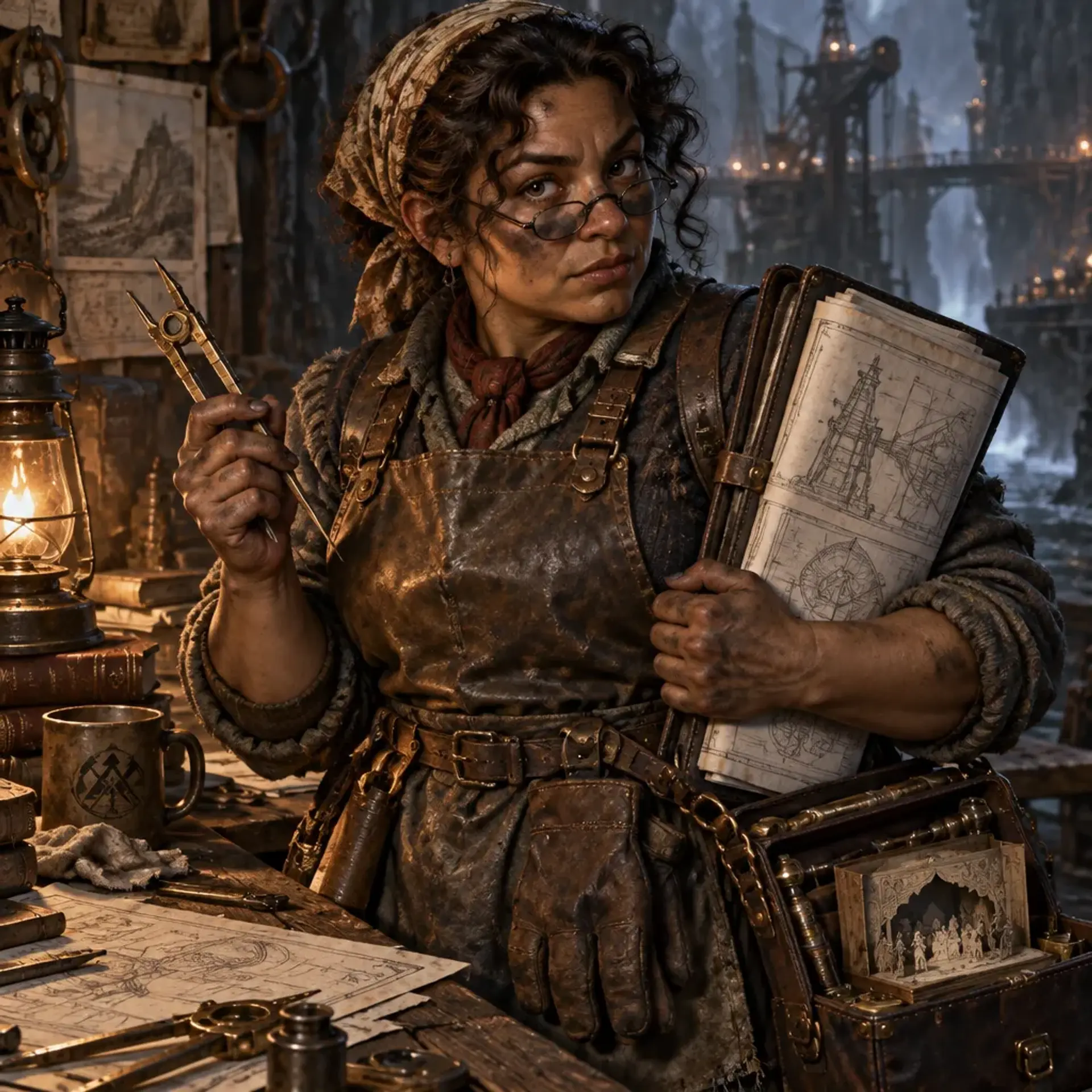
Eskil Dray
Eskil Dray
At the table
Voice
A low, dry voice with a faint rasp from stone dust and long hours in enclosed workshops. His words land with deliberate, measured stops; when he is shaken, his breathing briefly catches before he gathers himself and speaks plainly.
He speaks in a low, dry, work-worn voice, with consonants clipped clean as if trimming a stone edge. His breath is normally steady and faintly roughened by years in dusty shops. When rattled, he catches a short rasp in his throat, stops, and counts four deliberate breaths before continuing. He does not raise his voice to sound convincing.
Speech patterns
How to play them
Ask what the characters know about altered markers and listen for specific evidence. Eskil responds best to direct questions and practical tasks, not absolution. If shown Oskeld Marn's notched iron ring, he freezes, recognizes it as his brother's, and asks where it came from. He will share his rubbings and testify to his own work, but will not claim to know what his brother intended.
Goal
Trace who commissioned the diverted route markers, identify what happened to his brother, and help restore safe passage without concealing his own part in the harm.
Motivation
He wants the work to be understood accurately, including his own complicity, and hopes that a truthful account may keep another crew from being sent into danger.
Appearance
Eskil's beard is clipped to a blunt, practical line, but the rest of his grooming is nearly fastidious: his hair is combed flat beneath a close-fitting cap, and he scrubs his nails with a sliver of pumice until the skin around them reddens. Fine granite dust still gathers in the creases of his knuckles and the seams of his cuffs. He moves with a mason's measured economy, turning his whole body to inspect a surface rather than craning his neck. Within a minute, people notice his unexpected habit of carrying a tiny, brightly painted wooden fish on his belt, its cheerful blue scales absurd against his grey work clothes.
Clothing
A patched leather work coat over thick grey wool, fur-lined boots, a leather apron scored with shallow chisel marks, and a close-fitting cap that keeps stone grit from his hair. His tools are wrapped in oiled cloth.
Body language
He keeps his shoulders squared as if bracing a stone lintel. His eyes track seams and corners before settling on a speaker. When a subject touches his culpability, he presses his thumb into the ridged edge of his chisel handle and holds still.
- Height
- 4 ft. 6 in.
- Build
- Compact, sturdy, and broad through the shoulders, with the grounded balance of someone accustomed to hauling blocks and working at awkward angles.
- Eyes
- Dark brown, with pale stone dust often caught on his lashes
- Hair
- Dark brown, shot through with iron-grey
- Skin
- Ruddy, weathered brown with a grey cast from persistent stone dust
- Age
- Adult, approximately 118 years old
- Gender
- Male
- Size
- Medium
Distinguishing features
Personality
13 traits and drivesEskil is painfully honest about facts that incriminate him, yet guarded about the private grief underneath them. He can be patient to the point of tenderness while teaching a craft, but grows sharp when someone treats a route marker as decoration. In ordinary company he is reserved and dryly funny; when confronted with evidence of his brother's involvement, his composure gives way to startled, almost boyish disbelief.
- Alignment
- Neutral Good
Quirks
Habits
Traits · 3
Flaws · 3
Fears · 3
Wants and needs · 4
Combat
AC 13 · HP 38 · 25 ft.Eskil avoids combat and tries to put stonework, a doorway, or a sturdy ally between himself and danger. If trapped, he uses Fracture the Footing to create an escape opening, then retreats while calling out hazards and routes. He will not attack a confused or fleeing opponent unless doing so is the only way to protect someone from immediate harm.
Eskil Dray
Actions
Reactions
Services they sell
Rewards they can give
Equipment
- Heavy Mason's Chisel (tool, improvised weapon)A stout, short-handled chisel with a blunted striking end and a grip polished by years of use.
- Mason's Mallet (tool)A worn leather mallet used for controlled taps and occasional emergency defense.
- Marker Rubbings (evidence)A weatherproof booklet of charcoal rubbings, measurements, and route-marker sketches, including the altered cuts he made.
- Painted Fish (keepsake)A small wooden fish with lopsided blue paint, given to him by a child from a rescue crew.
Possessions
Background
Eskil learned marker-smithing from his mother in the stone-cut shops above the Abyssal Trench, where a notch in a channel marker could mean the difference between a safe return and a crew lost under pressure. He was proud of making signs legible in bad light and bad weather, and took contracts from anyone who paid for honest work. A customer with proper seals hired him to recut several route markers, giving him exact measurements and an urgent deadline. Eskil cut the stone where he was told, never asking why the new notches pointed away from established lanes. When crews began vanishing and the routes went wrong, he recognized the style and understood what he had enabled. He has since kept a rubbing of every marker he altered and sought the people who ordered the work. The ring carried by Trench-Warden Oskeld Marn is the one Eskil remembers on his estranged brother, last seen leaving for the lower trenches.
Role in the story
A human-scale hinge between the altered route markers and the people harmed by them. Eskil's craft gives the party a way to connect deliberate tampering to its physical evidence, while his family tie to Oskeld Marn turns an investigation into a personal reckoning.
“He was proud of making signs legible in bad light and bad weather, and took contracts from anyone who paid for honest work.”
- Faction
- No formal faction allegiance. He has accepted work from local marker crews and now cooperates cautiously with Sheshe while investigating the diverted routes.
Known connections
Media
0 imagesNo images yet.
Turn Eskil Dray into a sheet
A high-res, share-ready sheet you can post or print.