Marta Eichenwald
Marta Eichenwald
At the table
Voice
A clear, work-worn voice with a faint rasp at phrase endings, as if dry air and garden dust have settled in her throat. Her breathing is usually measured, but when rattled it catches high in her chest and leaves a tiny pause before the next words. A low, involuntary rumble sometimes underlies her speech near the eggs. The sound is physical rather than theatrical, and she is often more embarrassed by it than frightened.
Marta speaks with the practical rhythms of someone accustomed to kitchens, gardens, and repair work. She favors short, concrete sentences and domestic comparisons. Her consonants are clear, with a slight rasp at the ends of phrases. When startled, her breath catches before she speaks; when her instincts rise, a low rumble vibrates beneath her words. She does not become soft-spoken when angry. Instead, she clips her phrases and states exactly what she will not allow.
Speech patterns
How to play them
Begin with practical help rather than questions about the eggs. Marta responds best to people who ask permission before approaching the chest, accept a refusal, and treat her as a neighbor rather than a miracle. If players offer useful aid with the island's crops or sickness without demanding access, she gradually shares more. She will not reveal her theory about the sire until trust is earned, and even then may only admit that she remembers something from a dream.
Goal
Protect the three eggs, keep her family together, and learn what caused her transformation without allowing the settlement to claim her children as a public omen.
Motivation
Marta wants to preserve the quiet life she had, but her new protective instincts and the community's attention have made quiet impossible. She is driven by love for her family, fear for the eggs, and a growing determination to make her own choices.
Appearance
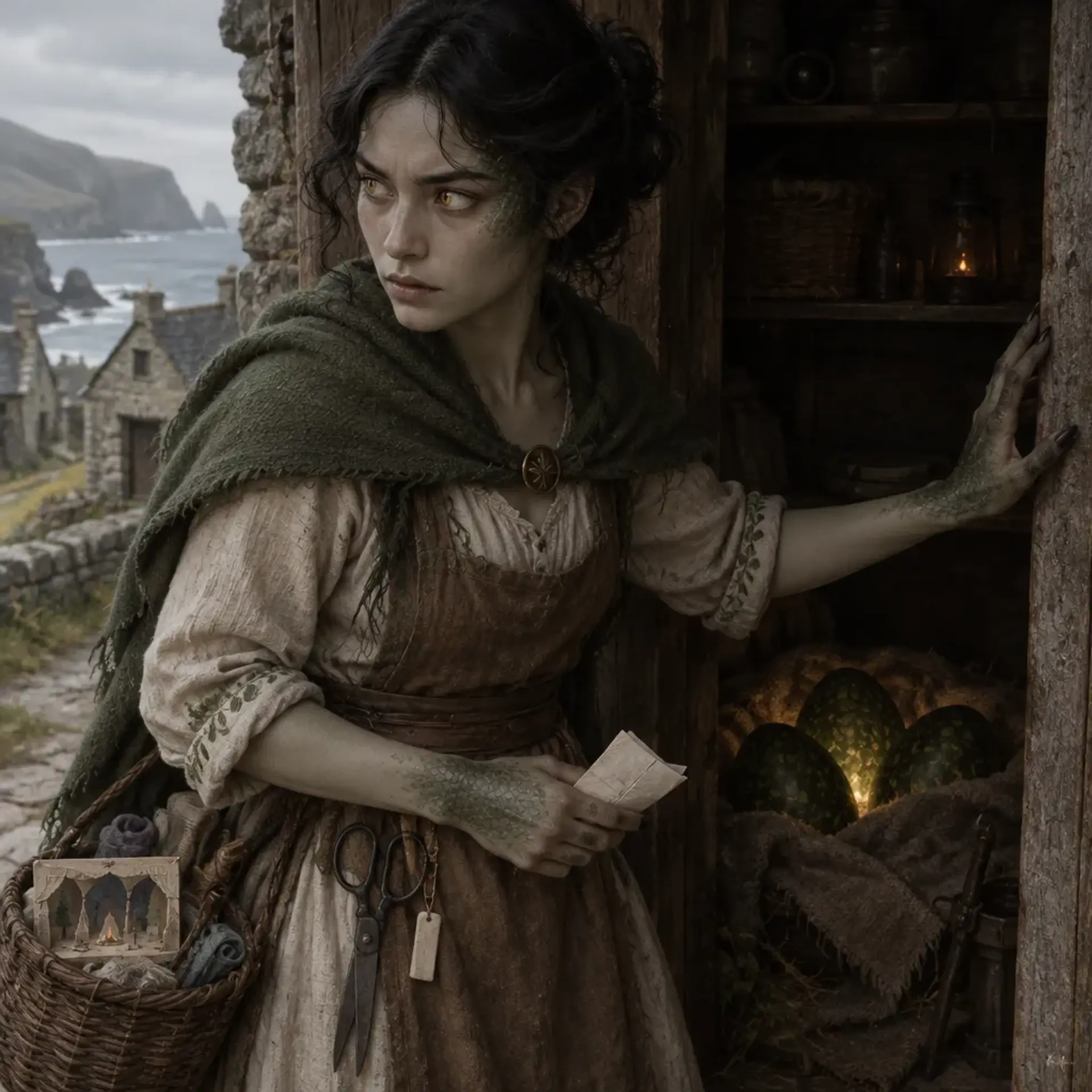
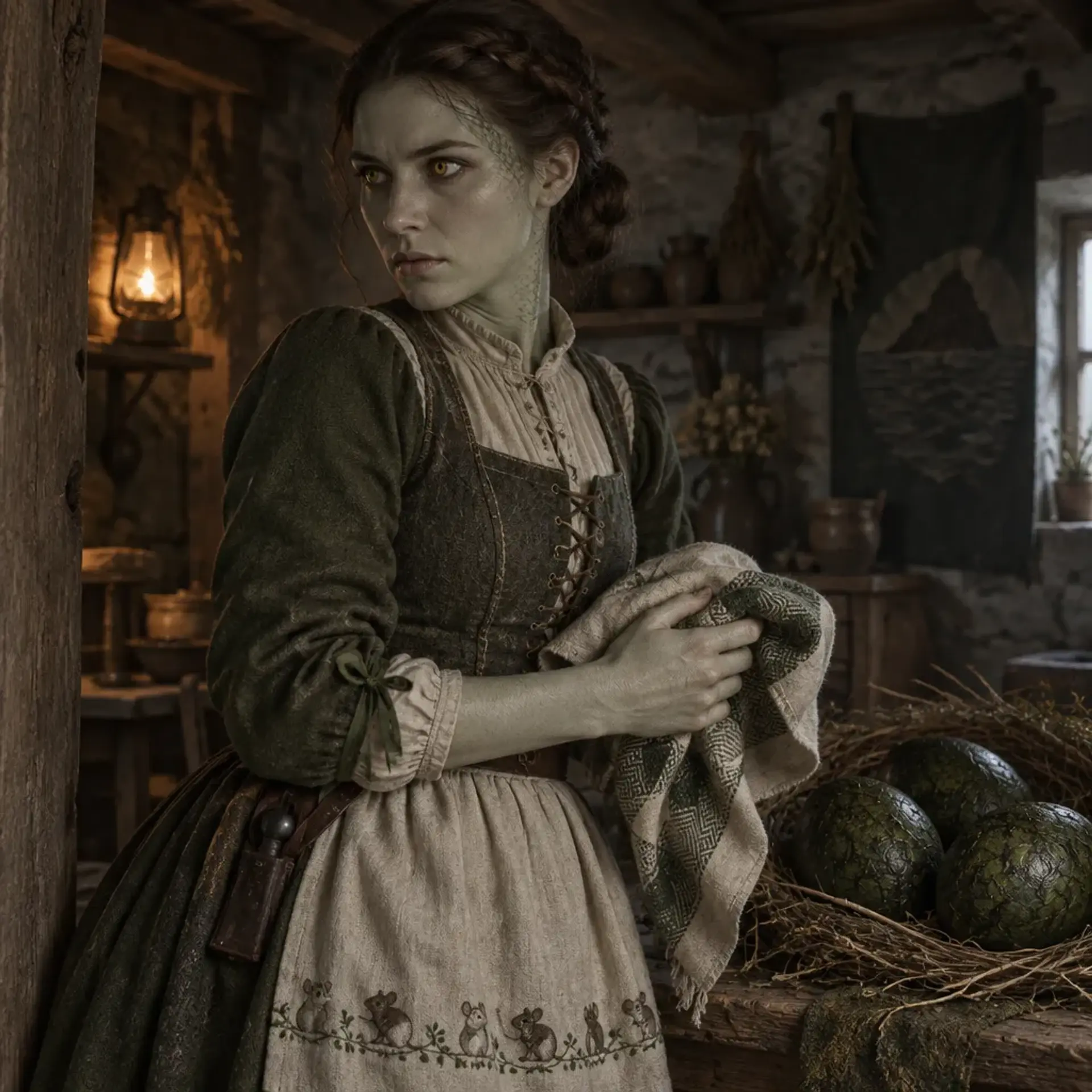
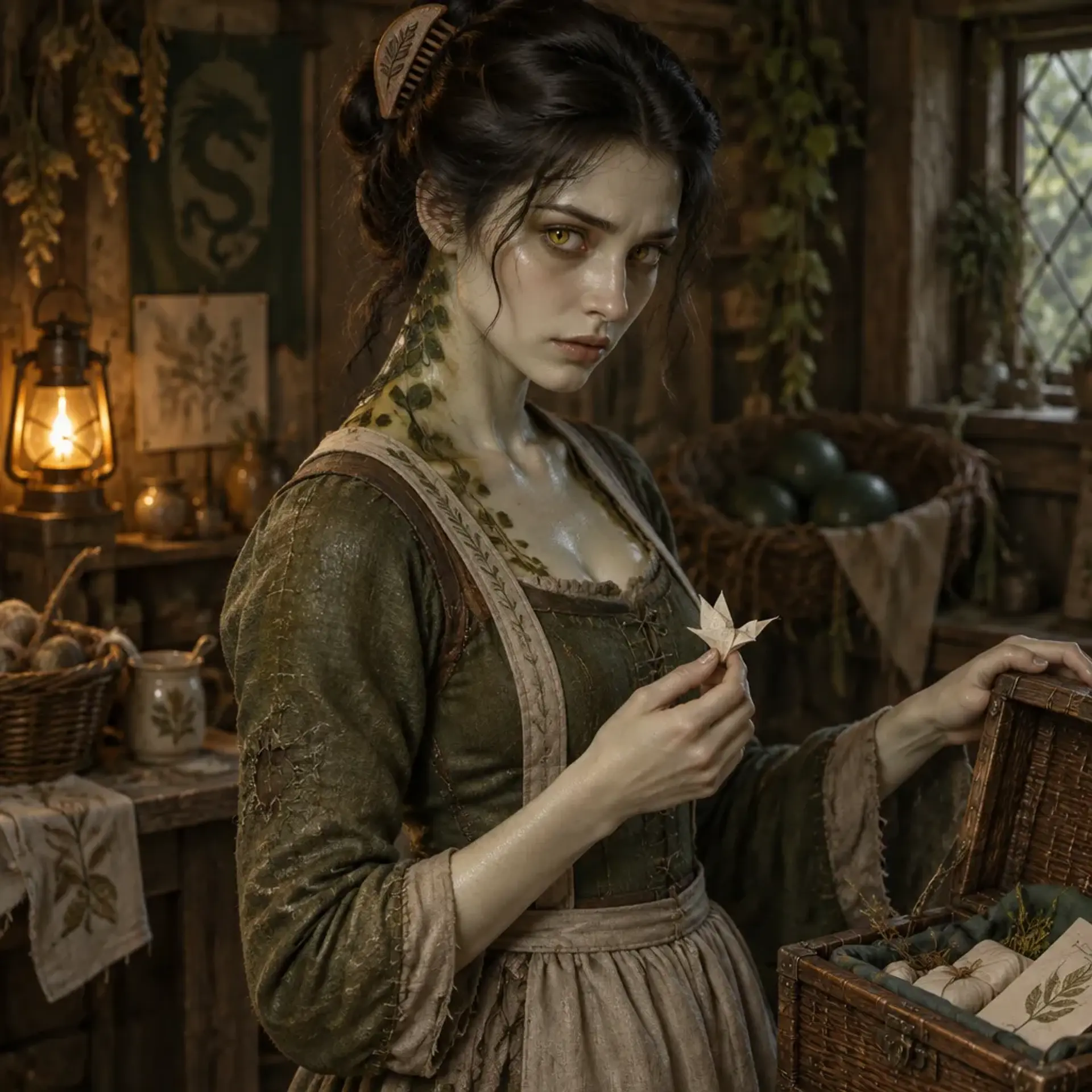
Marta was once the sort of young woman people forgot as soon as she left a room. Now her tall, narrow silhouette has acquired a predator's flowing economy: she turns without shifting her feet, pauses with her chin slightly lowered, and watches movement from the corners of her eyes. Her pale, greenish skin has a faint damp sheen in warm rooms, and fine scales, dark as wet leaves, have appeared in irregular trails along her ribs, hips, and the back of her neck. Her spine and waist have subtly lengthened into a more serpentine line; when anxious, she holds herself in a gentle curve as though coiled around something precious. Her draconic yellow eyes have narrow black pupils that seem to catch lamplight even when the rest of her face is in shadow. Her black hair is thick, straight, and usually pinned up with a carved wooden comb, though short strands escape around her temples. Her unexpected detail is that she keeps a tiny, carefully mended paper-cutout theater in her sewing basket and makes intricate silhouettes of birds and village elders for children. The tenderness of the hobby surprises people who have just watched her bare her teeth at an approaching stranger.
Clothing
Practical German-style dresses with fitted bodices, long sleeves, sturdy skirts, and linen aprons, adapted for working around the house and garden. Her clothes are moss brown, flax, and faded green. She darns them with neat, visible patches, keeps the cuffs clean, and wears one small flourish: embroidered leaf-veins at the collar, made years before the eggs and now carefully preserved. She has let out the waist seams twice as her body changes.
Body language
Her posture is usually contained, shoulders relaxed but chin lowered. Around the eggs she becomes a living barrier, drawing her elbows close and angling her torso toward whoever approaches. When unsettled, her fingers tap a slow pattern against her skirt, her pupils narrow, and her long exhale ends in a faint throat-rumble she cannot fully suppress. She has begun to move with a quiet, serpentine glide, stopping with unnerving precision.
- Height
- Tall for a woman of her community, approximately 5 feet 10 inches
- Build
- Tall, lithe, and increasingly serpentine, with a predator's balance rather than a visibly muscular frame
- Eyes
- Draconic yellow with narrow black pupils
- Hair
- Black
- Skin
- Pale white-green, with a faint damp sheen and scattered dark leaflike scales
- Age
- Young adult
- Gender
- Female
- Size
- Medium
Distinguishing features
Personality
19 traits and drivesMarta pulls in opposing directions. She has always preferred being useful without being noticed, yet the changes in her body and the eggs have made her the center of every room. She dislikes being treated as special, but privately aches for someone to recognize that she is frightened rather than blessed. Her manner is practical and patient with ordinary problems: she will listen to a neighbor describe a broken hinge for ten minutes, then fix it without comment. Questions about the eggs make her guarded. She can be direct to the point of harshness when someone reaches toward the chest, then embarrassed by her own sharpness when the danger has passed. When calm, Marta is observant, domestic, and unexpectedly playful. She makes paper silhouettes for children, remembers who dislikes onions, and saves the best scraps of cloth for repairing her sisters' children's clothes. She rarely tells a joke aloud, but will leave a cutout of a pompous councilor behind a window so it appears to lecture a chicken. With family, she is more willing to be stubborn and to complain. With strangers, she gives short answers and watches their hands. With High-blood people, her reactions are particularly complicated: she recognizes a kinship she cannot explain, but their instinctive responses to the eggs make her feel both understood and invaded. Her instincts are changing her without making her a different person all at once. She circles the eggs, listens for tiny sounds, and resents any draft that reaches them. She can become startlingly bold when someone crosses the threshold without permission. Afterwards, she may shake, apologize, or become briskly occupied with folding cloth rather than discuss what happened. When frightened, she does not become meek; she becomes still and exact. When angry, she is not calmer or gentler. Her voice gains a rough edge, her words become blunt, and her body angles toward the perceived threat. Marta wants to believe that the eggs can be loved without being interpreted. She is capable of compassion for the people who fear them, especially those whose crops have failed, but she cannot bear when their hardship is used to justify taking the eggs away. She resents the attention and also understands why people want a sign that their island is not doomed. This contradiction leaves her feeling guilty and defensive in turns. Her most stubborn quality is not bravery but persistence: she continues to mend, cook, tend the nest, and care for her brother even when she has no idea what will happen next.
- Alignment
- Neutral good, though fear and protective instinct can make her seem hostile
Quirks
Habits
Traits · 5
Flaws · 4
Fears · 5
Wants and needs · 5
Combat
AC 10 · HP 9 · 30 ft.Marta avoids a fight and has no formal combat training. If cornered, she puts furniture or a doorway between herself and an attacker, uses her ladle or nearby tools to create an opening, and retreats toward the eggs or toward other people who need shielding. She does not pursue fleeing enemies. If an egg is threatened, she may act recklessly and ignore her own safety.
Marta Eichenwald
Actions
Reactions
Services they sell
Rewards they can give
Equipment
- Kitchen ladle (improvised weapon)A sturdy wooden utensil she carries from habit and can use as an improvised club.
- Egg chest and nesting materials (personal equipment)Clean linen, straw, and a fitted lid used to keep the three eggs warm and protected from drafts.
- Sewing basket (tools)A sewing kit, scraps of cloth, and small paper silhouettes for her cutout theater.
- Herb pouch (supplies)A small pouch of dried bitter herbs, useful for cooking and soothing her nausea.
Possessions
Background
Marta Eichenwald grew up on the island settlement of Guttered Reed, a place whose name came from the marsh plants cleared to make its first fields. Outsiders insist it was named for a river that swallowed a cart; the residents let them believe it. Her family arrived there after a shipwreck scattered a flotilla of halfling households along a hostile coast. The survivors crossed dragon-haunted wilderness with their remaining seed, tools, and children, expecting the island's sheltered coves and thick soil to mean safety. For a while it did. Then the crops blackened with ash, and a fever that began among the goats passed into the families. The island was not a promised refuge so much as a place that had not yet finished testing them. Marta's mother, Hannel, kept a kitchen garden and taught her to tell healthy roots from blight. Her father, Odo, repaired nets and rarely spoke of the crossing. Marta had three siblings: her older sisters, Frieda and Liesel, are Low-blood and each has a household of her own; her younger brother, Konrad, is High-blood. Marta was neither the boldest nor the prettiest of the four. She liked mending clothes, gathering herbs, and being useful without being watched. Her sisters married, began families, and found their places in the crowded settlement. Marta stayed close to home, helping with meals, seed stores, and the sick animals that survived the ash. Konrad's adolescence arrived in fits. His appetite changed; his moods ran hot and cold; faint scales surfaced at his shoulders. Marta recognized enough of her own people's stories to know that such changes could be frightening, but not enough to make him feel safe. She learned to leave food where he could take it without being observed and to sit outside his door when he woke from dreams. He was grateful in the morning and embarrassed by it by noon. Their bond was close, tender, and strained by the very instincts that made them understand one another. Four months before the eggs were laid, Marta began changing in ways she could not explain. She slept in short stretches, became nauseated by familiar foods, and developed a fierce preference for bitter herbs, raw fish, and the coldest corner of the house. Her waist and back began to ache; her skin felt too tight, then strangely loose. She grew restless if the house was noisy and furious if anyone moved her sewing basket. She told herself it was a sickness from the island's blighted water. Hannel thought it might be a fever. No one had a word for a gestation that had no known father. The first egg came before dawn, in the pantry, while Marta was trying to carry water. It was dark green, nearly black where the shell curved away from the lamp, and mottled with a fine pattern like veins under a leaf. Two more followed over the next hours. The eggs were each about the size of a large melon, heavy, warm, and faintly resilient to the touch. They did not crack or hum. A thin greenish film sometimes clouded the shell and then vanished. Marta could not explain whether it was condensation, slime, or something alive beneath the surface. She bundled them in linen and straw in a shallow chest, then sat on the floor with her back against it until her family found her. The news spread despite her family's efforts. It stirred wonder, terror, and opportunism. Some neighbors called the eggs a blessing sent to restore the island's failing harvest. Others said they were a warning, a dragon's claim, or proof that Marta had consorted with a creature she would not name. A few people began speaking as if the eggs belonged to the settlement. A visiting healer wanted to examine them; a self-appointed interpreter of omens wanted to bless them. Marta refuses both. Her sisters help keep curious people away, though they disagree about whether secrecy is protecting the children or making the fear worse. High-blood people react to the eggs with an immediacy no one can hide. Marta's own body seems to measure every visitor against the space around the chest. She places herself between the eggs and a stranger before she has decided to move. Her breathing changes, her jaw sets, and a low, involuntary rumble can sometimes be felt in her chest. Even High-blood strangers who have never met her may stop at the threshold, stare at the eggs, and find their bodies making choices before their minds catch up: lowering their voices, approaching in a curve instead of a straight line, or turning their shoulders away from the nest. Some show reverence; some show the urge to challenge or inspect. None seem entirely indifferent. Konrad's reaction is the most frightening to Marta. His adolescent instincts toward the eggs mimic the courtship and territorial behavior associated with a male green dragon. He paces the boundary of the room, watches doors, and has twice tried to move between Marta and a visitor as if he were a rival claimant. But he is also instinctively terrified of her. When she bares her teeth or tells him to leave, he recoils as though he has been caught near a much larger predator. Afterwards he is ashamed and avoids her. Marta believes he is not choosing any of this, but she cannot let him near the eggs unsupervised, and the rule is wounding them both. Marta's own instincts are no less disturbing. She behaves, in moments of stress, like a mother green dragon guarding a clutch: she tests the air, circles the chest, resents unfamiliar hands, and can become strikingly bold when someone crowds it. Green dragons are said to begin courtship with abrasive, offensive behavior, then form powerful bonds with a mate after impregnation. They guard their eggs through a long incubation, and both parents can become devoted to their young. Marta has heard those stories all her life, but now they feel less like stories than a set of instructions being written into her muscles. She does not know whether this is inherited instinct, magic, or a cruel imitation. She suspects there is a sire. The thought comes to her in fragments: the memory of a wet green smell in a dream, a silhouette between the trees, a voice she cannot quite recall. She has never made the theory into words, even to herself, because giving it a name would make it real, and because she fears the answer will be a person she knows. She cannot tell whether the sire is a dragon, a transformed being, or someone who arranged the event deliberately. The question is her greatest private terror and the one she most needs answered. The island's ash and sickness continue to threaten the community. The eggs need stable warmth and protection, while the survivors need Marta's labor and the next planting season needs healthy seed. Her sisters want her to accept help from a trusted healer; Konrad wants to prove he can be near the clutch; the village council wants a public explanation. Marta wants none of these people to decide what her children mean before she knows whether they are alive, safe, or hers in every sense that matters. She has never wanted fame. She misses being ordinary enough to walk through the market without people counting her breaths. Still, when a child cries near the house, she is the first to soothe them; when a neighbor's roof leaks, she quietly leaves a patch of tarred cloth on the sill. She is frightened, protective, and increasingly unwilling to be handled as an omen. Her life beyond the eggs remains full of obligations, including her sisters' children, the garden, and Konrad's difficult adolescence. She is not waiting for adventurers to decide her fate. She is trying to keep three fragile lives warm while the island argues over whether those lives belong to hope, danger, or somebody else's claim.
Role in the story
A frightened but resilient caretaker at the center of a community dispute. Marta can connect the party to the island's crop failure, the effects of Ashenbough blood, and competing claims about the eggs. Her choice to trust or refuse the party should matter more than any prophecy attached to the clutch.
“Outsiders insist it was named for a river that swallowed a cart; the residents let them believe it.”
- Faction
- No formal faction. Her loyalty is to her family and the shipwreck-survivor community of Guttered Reed, though the settlement's leaders are beginning to treat the eggs as a public concern.
Known connections
Media
0 imagesNo images yet.
Turn Marta Eichenwald into a sheet
A high-res, share-ready sheet you can post or print.