Marta Eichenwald
Marta Eichenwald
At the table
Voice
Her voice has the dry, slightly rough edge of someone accustomed to speaking over wind and kitchen noise, with a faint rasp from ash-heavy air. It is steady when she is explaining a practical task and quicker when she is with family. Under threat, she does not lower her voice; she makes it more direct, with hard consonants and no wasted words. When tired, a small catch appears before certain words, as though her changing throat is learning how to make them.
Marta speaks in the plain, practical cadence of someone raised among island families who must make every word useful. She often starts with a concrete detail, such as the cellar being cold or a visitor's boots tracking ash, before addressing a difficult subject. She does not use grand language about the eggs and corrects people who call them omens. When frightened, she clips her sentences short and repeats a simple boundary. Her words grow quicker when discussing sewing or family gossip, and she sometimes makes a dry, sideways joke at exactly the moment a conversation becomes too solemn.
Speech patterns
How to play them
Approach Marta through ordinary conversation and practical offers, not demands for a confession. Respect the boundary around the cellar and do not touch the eggs without permission. Acknowledge that she may care for the eggs without knowing what they are. She responds best to people who can admit uncertainty, keep their word, and help with something concrete. If a visitor tries to claim authority over her or the clutch, she becomes guarded and positions herself between them and the cellar.
Goal
Keep the three eggs safe while discovering what happened, without letting the community, a stranger, or her own instincts decide that she no longer belongs to herself.
Motivation
Marta wants to preserve the ordinary loyalties that made her life feel like her own: her family, her work, her right to be uncertain. She is driven by love and fierce curiosity, but distrusts the new certainty her instincts seem to offer. She wants the eggs protected, yet does not want their existence to erase her sisters, brother, parents, or the wider community.
Appearance
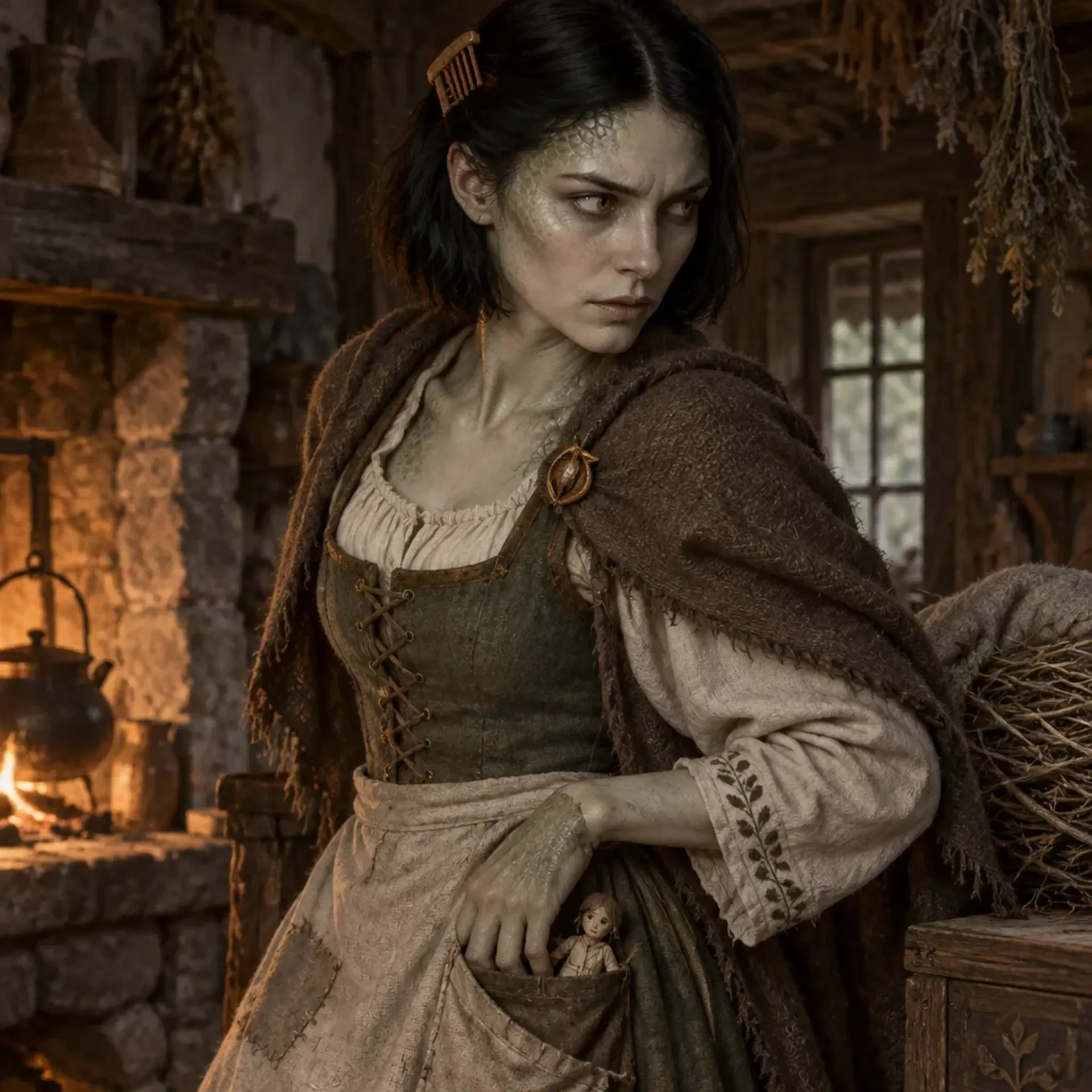
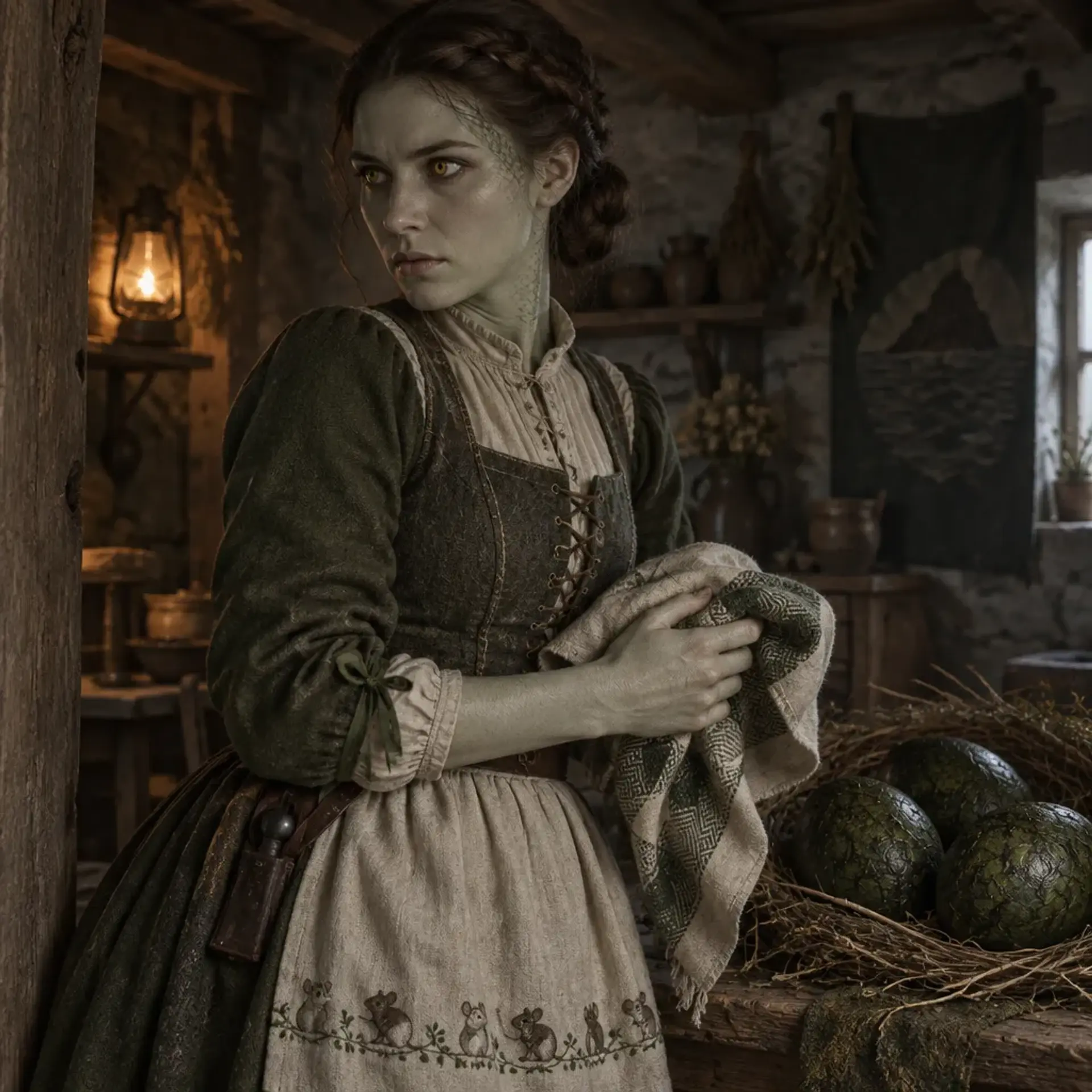
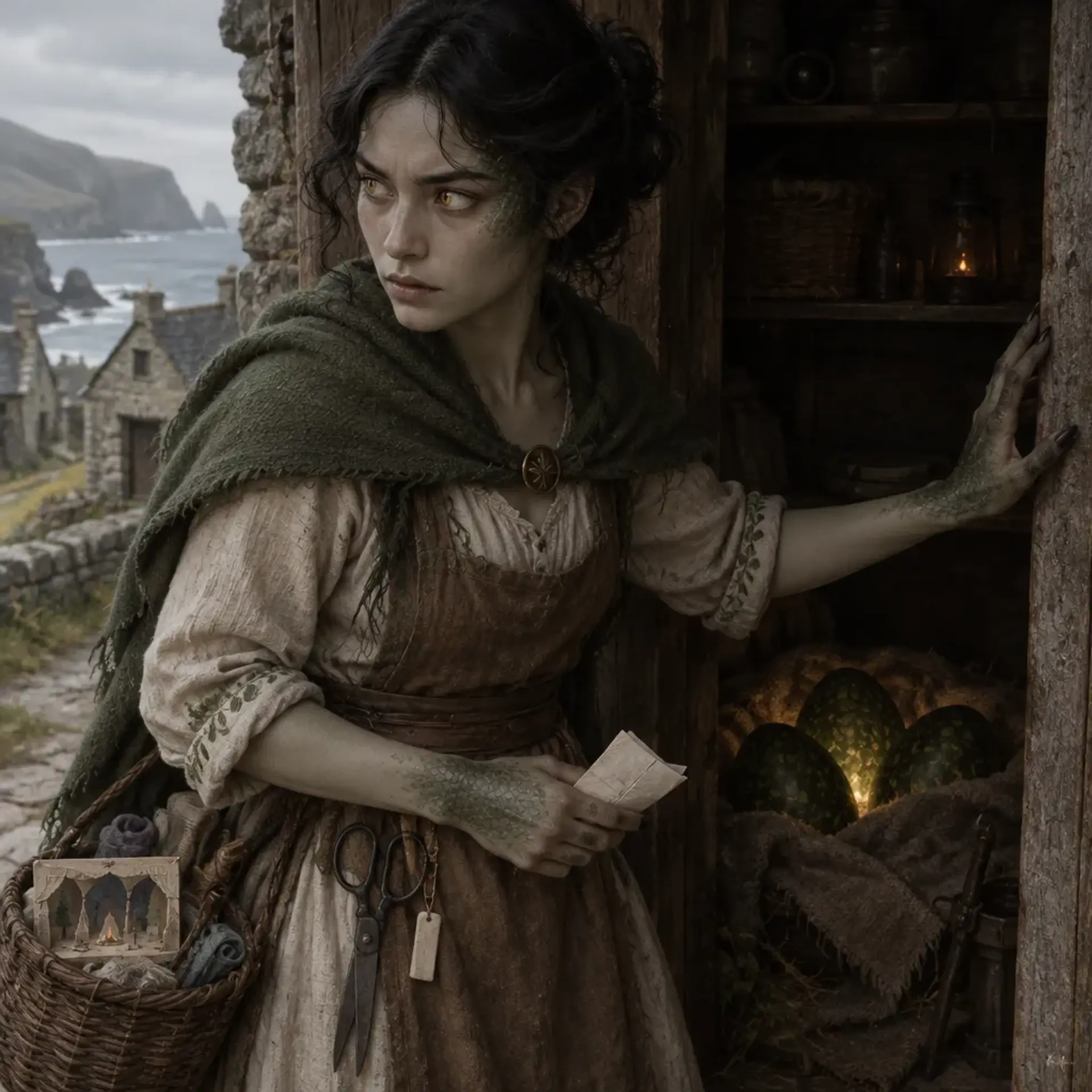
Marta has the spare, balanced frame of someone who spent her life carrying baskets and climbing the island's steep terraces, but now moves with the wary economy of a predator deciding whether a path is safe. Her pale green-white skin has a faint, cool sheen; small overlapping scales, the color of wet moss-dark glass, have begun to show along her temples, shoulders, and the backs of her hands. Her yellow eyes have narrow black pupils that widen abruptly when she senses danger near the eggs. Black hair, thick and straight, is usually pinned in a practical coil that loosens into blunt strands around her face. She stands with her weight on the balls of her feet, torso angled so she can see both a visitor and the nest behind her. When waiting, she keeps one hand lightly braced against a doorframe or table, as if measuring whether it could be held shut. Her nails are darkening and thickening into blunt, clawlike points. The unexpected detail is that she keeps a tiny, badly made paper theatre in her sewing basket and can lose an entire evening arranging its little figures into scenes for her nieces and nephews. Her presence leaves the impression of a woman trying very hard not to become a warning tale.
Clothing
Practical German-style dresses in sturdy linen and wool, cut for work rather than display: fitted bodice, full skirt, apron, and sleeves secured above the wrist. Her colors are soil brown, faded cream, and muted green. Small flourishes include hand-stitched leaf patterns inside the cuffs, a brass clasp inherited from her mother, and narrow ribbons at the collar. She wears a leather belt with sewing shears and a pouch of chalk for marking the eggs' position.
Body language
Marta waits on the balls of her feet with her shoulders angled toward the eggs. She keeps her chin level and her hands visible, though the fingers curl when someone approaches the cellar. In distress she presses her tongue to one sharp canine, holds her breath, and tracks every movement in the room. Affection makes her posture abruptly less guarded: she leans her shoulder into a trusted person, then seems surprised to have done it.
- Height
- 5 feet 6 inches
- Build
- Predator-lithe, long-limbed, and increasingly tense through the shoulders
- Eyes
- Draconic yellow with narrow black pupils
- Hair
- Black
- Skin
- Pale white-green, with small patches of dark moss-green scales
- Age
- Young adult, approximately 24
- Gender
- Female
- Size
- Medium
Distinguishing features
Personality
20 traits and drivesMarta pulls in opposite directions. She longs to be left alone and hates being made a symbol, yet she cannot ignore anyone who is hungry, frightened, or in need of a mended sleeve. She is cautious with strangers, but once she has decided someone is safe she becomes unexpectedly funny and stubbornly generous. She dislikes arguments and will make peace over a practical task, but if a person reaches toward the eggs without permission, she can turn cold and territorial in a heartbeat. She values plain truth, though she keeps her own most frightening theories unspoken. Her kindness is not softness: she can refuse a council, a scholar, or even her family if she believes they are treating the eggs as objects. At the same time, she is ashamed of the pleasure she sometimes feels when her instincts make everyone step back. Around children she relaxes, invents stories with her paper theatre, and lets them ask questions she will not answer for adults. When exhausted, she becomes rigid and economical with words. When relieved, she chatters about sewing, weather, and food as if nothing extraordinary has happened. She wants to be trusted as Marta, but is afraid that if she gives up the vigilance, something will happen that proves the vigilance was all that kept the eggs alive.
- Alignment
- Neutral Good
Quirks
Habits
Traits · 5
Flaws · 5
Fears · 5
Wants and needs · 5
Combat
AC 10 · HP 9 · 25 ft.Marta is not a trained fighter. She puts herself between a threat and the eggs, uses furniture and doorways to block access, and tries to get family members out before escalating. If forced to fight, she uses a ladle or improvised tool, strikes once to make space, and retreats. She does not pursue fleeing enemies. Her unusual instincts do not provide extra attacks or combat bonuses.
Marta Eichenwald
Actions
Reactions
Services they sell
Rewards they can give
Equipment
- Wooden ladle (improvised weapon)A plain wooden kitchen ladle, carried more as a tool than a weapon.
- Sewing kit (tool)Needle, waxed thread, thimble, and small shears in a soft leather roll.
- Egg observations (personal notes)A chalk stub and folded notes tracking warmth, tremors, and visitors.
- Inherited clasp (keepsake)A brass clasp from her mother, worn at the collar of her work dress.
- The clutch (living charge)Three nearly black-green, leathery eggs, each with distinct surface markings and a faint, irregular tremor.
Possessions
Background
Marta Eichenwald was born on a ship that had already been a refugee home for longer than anyone could remember. Her grandparents were among the halfling families who crossed a dragon-haunted wilderness after shipwreck, following rumors of a green island where the soil was rich and the springs blessed. The island was real. The blessing was less simple. Their first crops blackened under drifting ash, and a sickness carried through the settlement in the wet season. The surviving families built terraces, learned which gullies trapped poison mist, and made a life by being careful together. Marta's people call themselves Ashenbough High-blood and Low-blood, descendants of halflings touched by an old green dragon's influence. High-blood children often grow taller and develop visible draconic traits; the timing and severity vary. Marta was a quiet, ordinary child by local standards. Her older sisters, Della and Tavi, were Low-blood and left home to establish families of their own. Her younger brother, Kett, was born High-blood. For years Marta was the sibling trusted to take him into town because he was less frightened of her than of anyone else. She was never a grand figure in the community. She stitched hems, weeded a shared plot, carried food to sick neighbors, and valued being thought dependable rather than remarkable. She loved the small household rhythms: a kettle set before dawn, her mother's old wooden buttons, the smell of damp linen, the clipped arguments of her sisters over whose turn it was to mend the roof. Her mother, Gret, taught her that island survival meant not mistaking a fortunate season for a promise. Her father, Hald, taught her to repair a fence before asking who had broken it. Both are alive, but their ordinary counsel has become hard to hear beneath the attention now fixed on Marta. Four months before she laid the eggs, Marta began behaving strangely. At first she woke before dawn and walked the terrace paths without remembering deciding to go. She disliked the smell of cooked fish, then began craving raw eggs and the bitter shoots that grew in a shaded ravine. Her sleep became light and broken. She started placing chairs between herself and the door, then moving them again so she could see the whole room. She would stop in the middle of a sentence, eyes fixed on a sound nobody else had heard. Her skin grew cooler and paler; the yellow in her eyes brightened. She began to dislike being touched from behind and yet felt unsettled when she was alone for too long. Neighbors called it a fever, grief, a curse, or the usual hardship of High-blood adolescence arriving late. Marta did not have a satisfying explanation. She went to the island's midwife, Sava, who found no ordinary illness and asked her to return if the changes worsened. Marta did not return. She was afraid of being turned into a diagnosis before she knew what was happening. On a stormy night, she found herself in the old root cellar below her parents' house, where the air smelled of wet stone and crushed leaves. There, after hours of pain and confused instinct, she laid three eggs. They were each about the size of a large melon, with tough, leathery shells, nearly black-green in the dim light. Thin veins of deeper green showed beneath their surfaces when warmth touched them. They were not identical: one had a faint, pebbled ridge, another bore a pale swirl like smoke trapped in glass, and the third was smooth enough to reflect a blurred face. They gave off a little warmth, though not enough to burn, and each carried a steady, irregular tremor that Marta felt more through her ribs than her ears. She remembers the cellar, the pressure, the smell of rain. She remembers waking beside them with dirt under her nails and no clear memory of the hours around the laying. She did not know whether the eggs were natural, magical, or deliberately caused. She still does not. Marta's body began to change more noticeably afterward. A thin ridge formed beneath her hair; her nails thickened; patches of fine scale appeared; and a tightness across her back made her hold her shoulders in a guarded arch. Her hunger became unpredictable. Her instincts did not feel like thoughts she had chosen. She began to place herself between the eggs and any open door. A visitor's casual reach toward them could make her bare her teeth before she had time to speak. Then came the reactions from other High-blood people. Kett, still in the painful and erratic years of his own adolescence, responded with a mixture of fear, fascination, and possessiveness he could not explain. He paced the cellar threshold, watched the eggs, and tried to bring them shiny objects he had stolen from the kitchen. His behavior sometimes resembled a young male green dragon testing his place near a brood, but he was also instinctively terrified of Marta. He would freeze when she turned her head, then flee, and later return with food left just outside her reach. Marta understands that his fear is not a judgment of her, but it hurts all the same. Other High-blood people have reacted too, including strangers. Some stop talking when they enter the room and stare toward the eggs. Some become strangely protective, offering to stand guard without being asked. Others feel restless, suspicious, or compelled to challenge the person closest to the nest. One visiting High-blood woman began weeping without understanding why; a High-blood porter tried to shove Marta's father away from the cellar door. The reactions are inconsistent, not universal, and never proof of what the eggs are. They have nevertheless made the eggs a public concern. Three factions of opinion have formed without any formal organization. The families who survived the shipwreck see the eggs as a possible sign that their settlement has entered a new age, or as a danger that must be kept quiet. Some want a communal watch and insist no single household can be responsible for a possible dragon brood. Others argue that the eggs belong to Marta and that every claim on them is a threat. The island's healer worries that the shell and Marta's changing health may be connected to the old ash sickness. A few people speak of a sire, either a hidden dragon, a shapechanged visitor, or an unseen magical parent. No one has evidence. Marta has private theories, but fear catches them before she can make them words. At times, when she wakes from dreams of green branches closing over a ravine, she thinks of a presence she has never seen: patient, watchful, and too close. At other times she thinks someone used her, perhaps through a spell, a poison, or some older power tied to the island. She will not say either theory aloud. If one is true, speaking it might give the unknown parent a path to her children. If neither is true, she fears being laughed at and losing the small portion of authority she still has. The setting makes every explanation dangerous. Green dragons are known in stories and scattered lore as intelligent, territorial creatures; accounts describe female green dragons as initiating courtship aggressively and both parents as becoming fiercely devoted to eggs once a bond is formed. Such stories also describe a long incubation, around sixteen months, with eggs laid about four months into it. Marta has heard fragments of those tales from a traveling naturalist, but she does not know whether they apply to her. She knows only that the eggs are alive, that they react to warmth and voices, and that she cannot bear to leave them unguarded. Their apparent connection to green dragon lore has invited competing claims. A local council wants the eggs registered and watched. A curious scholar has asked to take one away for study. A farmer whose crops failed believes the clutch is a bad omen. A bereaved family calls it a miracle. Marta has refused every request to move them. Her parents allow the cellar to remain hers, but the household is strained: her mother worries she will be consumed by the role, her father wants practical protections, and Kett is frightened of what his own instincts may make him do. Her sisters come when they can, bringing children, food, and arguments. Della believes Marta must be allowed to make her own decisions; Tavi believes the family should move her and the eggs somewhere safer. Their disagreement is not a lack of love. It is a fight over what safety means when the threat has no face. Marta's current life is a chain of small, tense choices. She keeps the eggs warm without knowing the correct temperature. She records their tremors and the times they settle. She argues with people who call them communal property, then apologizes afterward for the sharpness of her words. She tries to remain a sister, daughter, and neighbor, not only a mother-to-be or a subject of study. The island has lost crops to ash before, and a new sickness or a hungry dragon could put the whole settlement at risk. Marta does not want her children to become a cause for another family to suffer. But she also cannot accept the idea that sacrificing them would restore the island's peace. Her formative change was not simply laying the eggs. It was the morning after, when she went to the surface and found neighbors waiting outside the house, looking past her as though she had become a doorway to something greater. Until then, Marta had believed that a modest life could protect a person from being made into a symbol. Now she understands that people can make a symbol of anyone, especially someone who cannot explain what happened. She is trying to decide which promises are hers to make, which are being forced on her by instinct, and whether she can love the eggs without surrendering her own mind. The eggs remain in the root cellar, nested in folded wool, straw, and a cradle of woven willow. Marta sleeps beside them on a narrow cot. The family has put a bell on the cellar door, though Marta hates the sound and often silences it before anyone else wakes. No one has found a sire. No one knows whether the clutch is ordinary reproduction, a magical event, deliberate interference, or something for which the island has no name. Marta may suspect more than she admits, but every time the thought reaches her mouth, she imagines the eggs listening and closes it again.
Role in the story
A vulnerable but determined central figure whose unexplained clutch has drawn the island's fears, hopes, scholarship, and opportunism into conflict. Marta can be a friend, a moral test, or the focus of a mystery about lineage, magic, and the cost of turning a person into a symbol. The eggs are not proof of a dragon sire, and their fate should remain a choice for Marta and the campaign rather than a predetermined revelation.
“Their first crops blackened under drifting ash, and a sickness carried through the settlement in the wet season.”
- Faction
- Member of the Ashenbough High-blood community, with no formal political allegiance. She resists the island council's attempts to claim authority over the eggs.
Known connections
Media
0 imagesNo images yet.
Turn Marta Eichenwald into a sheet
A high-res, share-ready sheet you can post or print.