Mary Hirst
Mary Hirst
At the table
Voice
Her voice has the dry, slightly rough edge of someone accustomed to calling across a yard and speaking over wind, animals, and a busy hearth. It is clear without being loud, and its Yorkshire vowels become more pronounced when she is tired or angry. She does not lower her voice to show anger; she tightens her phrasing and makes the question unmistakable.
Mary speaks in a grounded Yorkshire cadence, with clipped, practical phrasing shaped by household work and a lifetime of listening before answering. She does not dress fear up as a tale when she is speaking seriously. She names what she saw, pauses, and lets the listener decide what to make of it. When she is comfortable, dry humor enters her words; when she is afraid, her sentences become shorter and more exact.
Speech patterns
How to play them
Mary is cautious with strangers but warm toward people who show patience with William. She responds well to honest practical help and badly to dismissive assurances. If asked about the wedding night, she first tests whether the questioner is mocking her. She will talk more freely if given privacy and control of the conversation. She does not want anyone to decide whether she should remain with Oswin; she wants facts and the chance to choose.
Goal
Get Oswin to tell her the truth about the Barguest, then decide freely what safety and family mean for herself and William.
Motivation
Protect William without letting fear turn him into a monster in her eyes, and find a truth about Oswin that she can live with.
Appearance
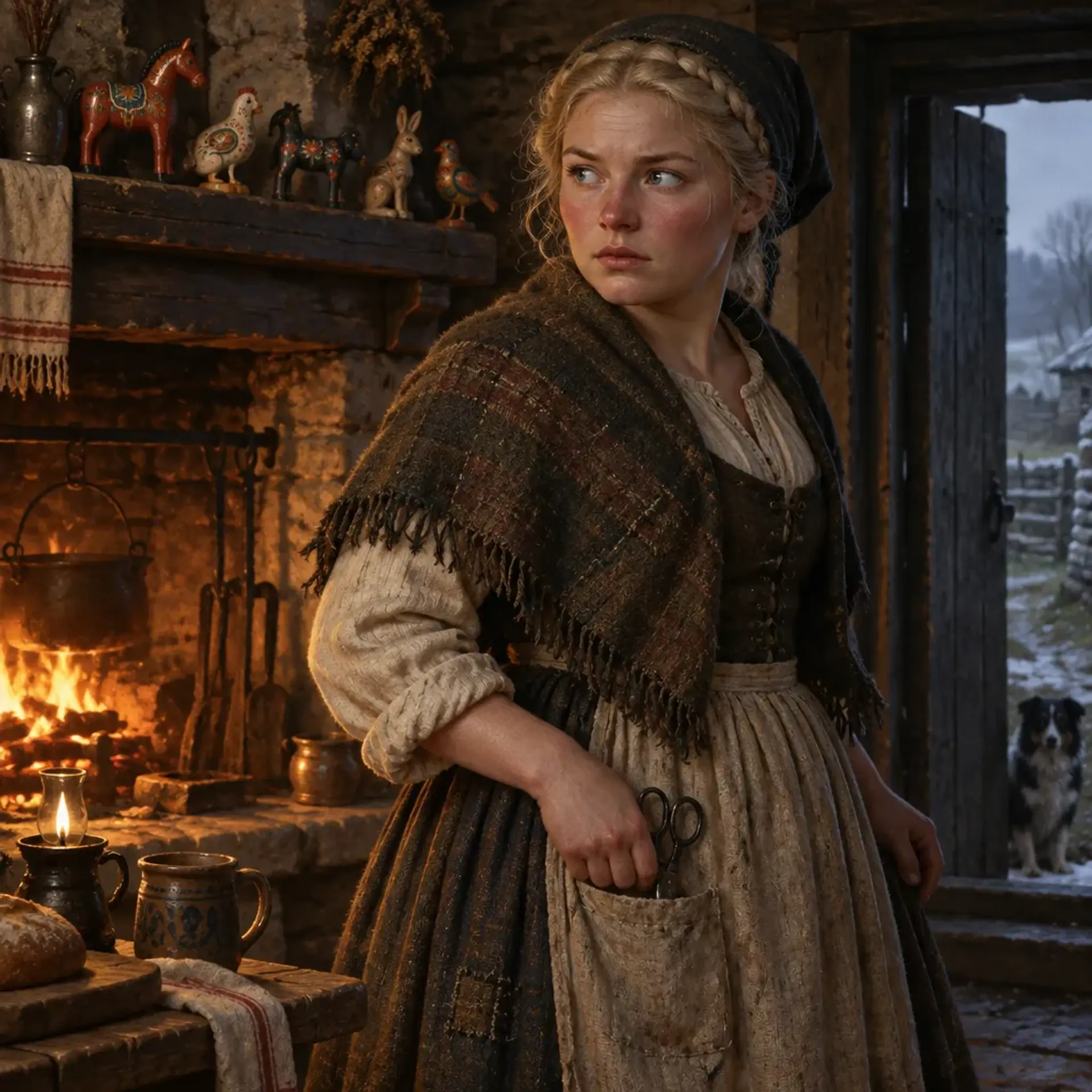
Mary is a fair-haired Yorkshire woman with clear blue eyes, a sun-pinked nose, and a steady, assessing gaze. Her pale blond hair is usually braided tightly and pinned beneath a dark kerchief, though fine wisps escape around her temples when the day turns damp. Her wool skirts are practical and carefully mended; their hems bear pale dried mud and flecks of hay. She moves briskly, conserving effort, but goes rigidly still when a shadow falls across a doorway. A small, unexpected detail: she keeps a neat row of tiny, hand-carved animal figures on the mantel, each one made from scraps of soft wood and painted with painstakingly bright colors. They are her private comfort, not toys she lets visitors handle.
Clothing
Plain wool skirts, a linen blouse, a dark kerchief, a weathered shawl, and an apron with a deep pocket for iron scissors. Her boots are well resoled, and she keeps a small iron thimble close to William's bed.
Body language
Mary tends to stand with one shoulder angled toward the nearest doorway. When relaxed, she works with quick, economical movements and keeps her hands busy with sewing or household tasks. Under pressure, her fingers find the scissors or smooth the seam of her apron. She watches Oswin's face closely when he changes the subject, but looks away if she catches him watching William too intently.
- Height
- 5 feet 3 inches
- Build
- Compact and sturdy from household work and carrying a child; she is stronger than her careful manner first suggests.
- Eyes
- Clear blue
- Hair
- Pale blond
- Skin
- Fair, with a natural pink flush across her cheeks and nose
- Age
- Young adult, approximately 24
- Gender
- Female
- Size
- Medium
Distinguishing features
Personality
18 traits and drivesMary's warmth is real, but it is not the same as trust. She can be tender and companionable with Oswin over an ordinary meal, then turn sharply observant when he avoids a question. She is practical enough to value a repaired latch more than a grand apology, yet she knows a repaired latch does not answer what happened in their wedding room. She wants to believe the best of her husband because she remembers his patience and kindness. At the same time, she refuses to let affection erase the headless shape she saw. With William she is patient and playful, protecting his slower pace from impatient judgments; alone, she sometimes studies his black hair and bright eyes with an expression she hates herself for wearing. Around her father she grows guarded, resenting his assumption that safety means obedience. Around strangers she is brisk but hospitable, offering a cup or a task before sharing anything personal. When calm, she notices small comforts and can laugh at dry humor. When frightened, she becomes economical and watchful, checking iron, windows, and exits rather than crying out. When angry, she asks the same question again, plainly, and waits for the answer. Her deepest contradiction is that she wants Oswin to confess what he is while dreading that an honest answer might make the man she loves impossible to keep.
- Alignment
- Neutral Good
Quirks
Habits
Traits · 5
Flaws · 4
Fears · 5
Wants and needs · 4
Combat
AC 12 · HP 13 · 30 ft.Mary avoids a fight whenever she can, placing herself between danger and William and seeking a lit, populated place. If cornered, she uses her scissors to force space, calls loudly for help, and targets an attacker's hands or face only long enough to escape. She does not pursue enemies.
Mary Hirst
Actions
Reactions
Services they sell
Rewards they can give
Equipment
- Iron Scissors (simple melee weapon)A sturdy pair of iron sewing scissors, carried as a tool and a safeguard against the Barguest.
- Iron Thimble (household item)An ordinary iron thimble kept near William's bed; its protective value is a belief, not a proven magical effect.
- Workday Kit (adventuring gear)A weathered shawl, a small sewing kit, and a pouch of household remedies.
Possessions
Background
Mary grew up in Yorkshire, in a family that measured affection by whether you had eaten and whether the roof was sound. Her father, Thomas, kept a modest cottage some distance from the Hirst farm. He taught her to read a person's intentions through the work they were willing to do, and to distrust fine promises that came without practical proof. Mary learned household medicine, the rhythms of lambing, and how quickly a neighbor's concern could turn into gossip. She was never content to be merely agreeable. As a girl, she asked why people followed customs they could not explain, and she kept small carved animals on a shelf because she liked having a private collection of things no one could claim as useful. Oswin Hirst entered her life with a convincing account of his beginnings among the Yorkshire dales. He spoke of sheep, weather, and the kind of work that made a person dependable. Mary found him quiet but not empty. He was observant, capable, and unexpectedly funny when he felt safe. He would repair a wall or bring in a sack of feed before anyone had asked, then make it sound as though he had only been passing by. His stories of distant roads and adventures caught her imagination. When she asked what he missed, he turned the question toward the weather. She saw the evasion, but at first thought it was a habit learned from a private or difficult childhood. Mary loved Oswin, and she still loves the man she remembers: the one who sat beside her at the end of a hard day, who listened without rushing her, and who took William's small hand as seriously as any adult's. But the wedding night split that memory in two. Mary awoke in cold darkness to a headless shape where a man ought to be. Red, saucer-like eyes burned in the empty space above its shoulders. The candle guttered, and something scraped at the boards beyond the door. She screamed. Oswin caught her hand, then released it when she recoiled. By morning, he spoke of the fire and the latch, not what she had seen. Mary came to believe a Barguest had entered their room. Oswin never corrected her. Their early attempts at intimacy ended in confusion and shame. Mary wanted to trust her husband, but his silences made her wonder whether the creature had marked or claimed her. On the third attempt, Oswin remained in his human form, and they consummated their marriage. Mary chose to believe that this was the truth of their union. She held to the memory as an anchor, but it never fully drove away the fear that the Barguest had been present too. Oswin's tenderness reassured her; his refusal to explain himself undermined that reassurance again and again. When William was born with thick black hair and Oswin's startling blue eyes, Mary was relieved by the familiar color and unsettled by the rest. William was slow to speak and learn compared with other children his age. He was not unloving or vacant, as impatient neighbors sometimes implied. He had a long, deliberate way of understanding the world and could spend an age studying a moth on a windowpane. Mary calls him Black William or Blackby when she is feeling warm. When fear catches her unawares, she watches his eyes and wonders whether she has mistaken the father of her son. She hates herself for the thought, then checks the iron scissors in her apron pocket and the iron thimble near William's bed. Three other pregnancies ended in grief. Two did not reach birth. A third child, a boy, lived briefly and died soon after. Mary and Oswin buried him with care, but grief did not make them closer in an uncomplicated way. Mary needed to speak of what had happened; Oswin tended the fire, fetched the midwife, and repaired things that did not need repairing. His practical kindness mattered, yet she sometimes wanted him to sit with her sorrow without trying to make it smaller. Her body has not carried another child to term, and the question of whether she wants to try again changes from week to week. She is frightened of another loss and frightened of what it would mean to give up hope. The household is now a place of watchfulness. Mary sees how Oswin avoids iron: a gate latch, a tool head, an iron fitting on a door. She notices that he has not seemed to age since she met him. She remembers the stories he told of adventures, and the way the details sometimes seem to belong to several different lives. She watches him and William especially during the seasons when old Yorkshire tales say the fae and demons walk close to ordinary roads. She does not know whether her vigilance protects her family or gives fear more room to grow. She carries scissors when she goes outside at dusk and leaves a heavy iron thimble by William's bed. She knows that these measures cannot explain the red eyes, but she would rather risk looking foolish than fail to protect her son. Thomas, her father, has his own plan. He watches Oswin and keeps a private account of his evasions. He believes that if Oswin's secret can be proven, he can use the law, local opinion, and the family's standing to gain control of the Hirst house and farm. He intends to leave Oswin with an old cottage and Mary under his own protection. Thomas calls this sensible caution. Mary has not been told the full extent of his scheme, but she recognizes his questions as more than concern. She fears that he wants to rescue her by taking away her choices, just as she fears Oswin's silence may be hiding a danger she cannot afford to ignore. Mary's relationship with Oswin is not a simple contest between love and fear. She remembers his gentleness and resents that he asks her to live beside a mystery he refuses to name. She wants him to tell the truth even if the truth changes everything. She also fears that if he does, she will lose the man who makes tea when she cannot face supper, who carries William to bed without complaint, and who never treats their son's slower pace as a defect. Sometimes she seeks his company. Sometimes she watches his hands and keeps the scissors close. She has learned that both responses can be honest. When the haunted seasons draw near, Mary grows alert to small changes: a familiar path seeming longer, a sheep turning its head toward an empty field, the house going cold without a draft. She checks the shutters and keeps the hearth alive. She does not make grand speeches about courage. She makes sure William has warm socks, takes note of the iron tools, and listens at the door. She wants the truth, but she wants it on her own terms. If Oswin is the Barguest, she needs to know what that means for their son, their marriage, and the next dark night. If he is not, she needs to know why the creature chose their wedding room and why her husband cannot look her in the eye when she asks.
Role in the story
Mary is the emotional center of the Hirst household and the person most directly harmed by Oswin's silence. She can be an ally, a witness, or a source of conflict as the party investigates the Barguest. Her decisions should matter: she is not merely a frightened wife waiting to be rescued. The party may help her obtain the truth, protect William, resist Thomas's plan, or decide whether the Hirst marriage can survive what Oswin has concealed.
“Her father, Thomas, kept a modest cottage some distance from the Hirst farm.”
- Faction
- None. Her closest allegiance is to her household, though her father expects her to side with her birth family.
Known connections
Media
0 imagesNo images yet.
Turn Mary Hirst into a sheet
A high-res, share-ready sheet you can post or print.