Mary Hirst
Mary Hirst
At the table
Voice
Her voice has a slight rasp from years of cold air and calling across a yard. Before she speaks, she often takes a quiet, deliberate intake of breath, the habit of someone who has learned to make herself heard without wasting words. It is warm when she speaks to William and firm when she is protecting someone. Fear roughens the edges but does not make her whisper.
Mary speaks in a grounded Yorkshire cadence, with clipped practical phrases and a dry edge when she is tired. Her words carry the rhythm of someone accustomed to being heard over wind, animals, and household noise. She takes a breath before difficult questions, as if gathering courage rather than searching for a softer way to say them. When speaking to William, she slows and leaves generous pauses. When angry, she does not lower her voice or dress her point in courtesy; she becomes sharper and more specific.
Speech patterns
How to play them
Mary responds best to patience, honesty, and practical help. Do not pressure her to dismiss what she saw or demand that she expose Oswin's secret in public. A character who treats William with respect earns her trust quickly. If someone threatens her child, she becomes direct and formidable; if they exploit her grief, she ends the conversation and seeks witnesses.
Goal
Learn what Oswin is without letting fear or Thomas decide what happens to her family.
Motivation
To keep William safe, preserve the parts of her marriage that are real, and find an explanation that does not require her to deny either her fear or her love.
Appearance
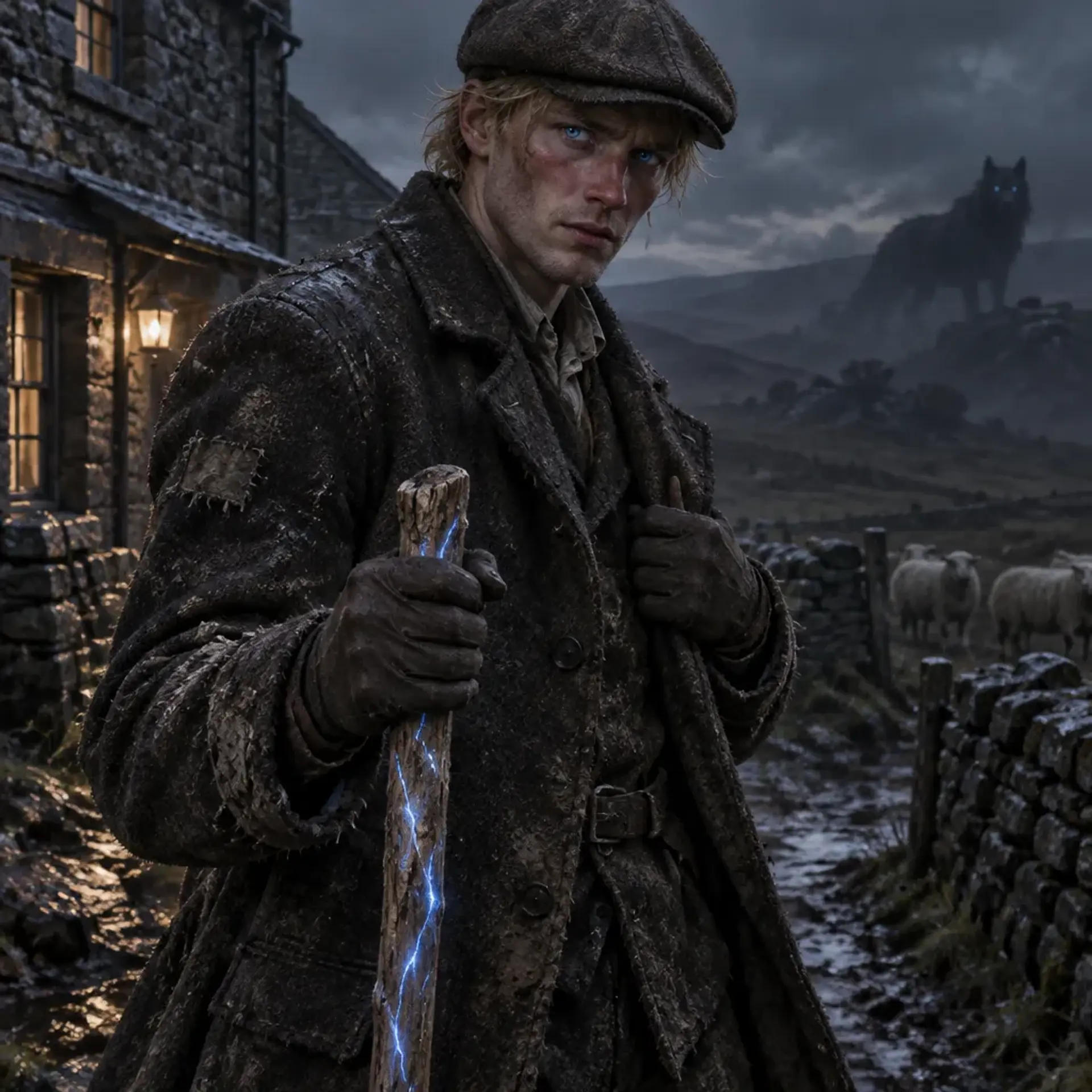
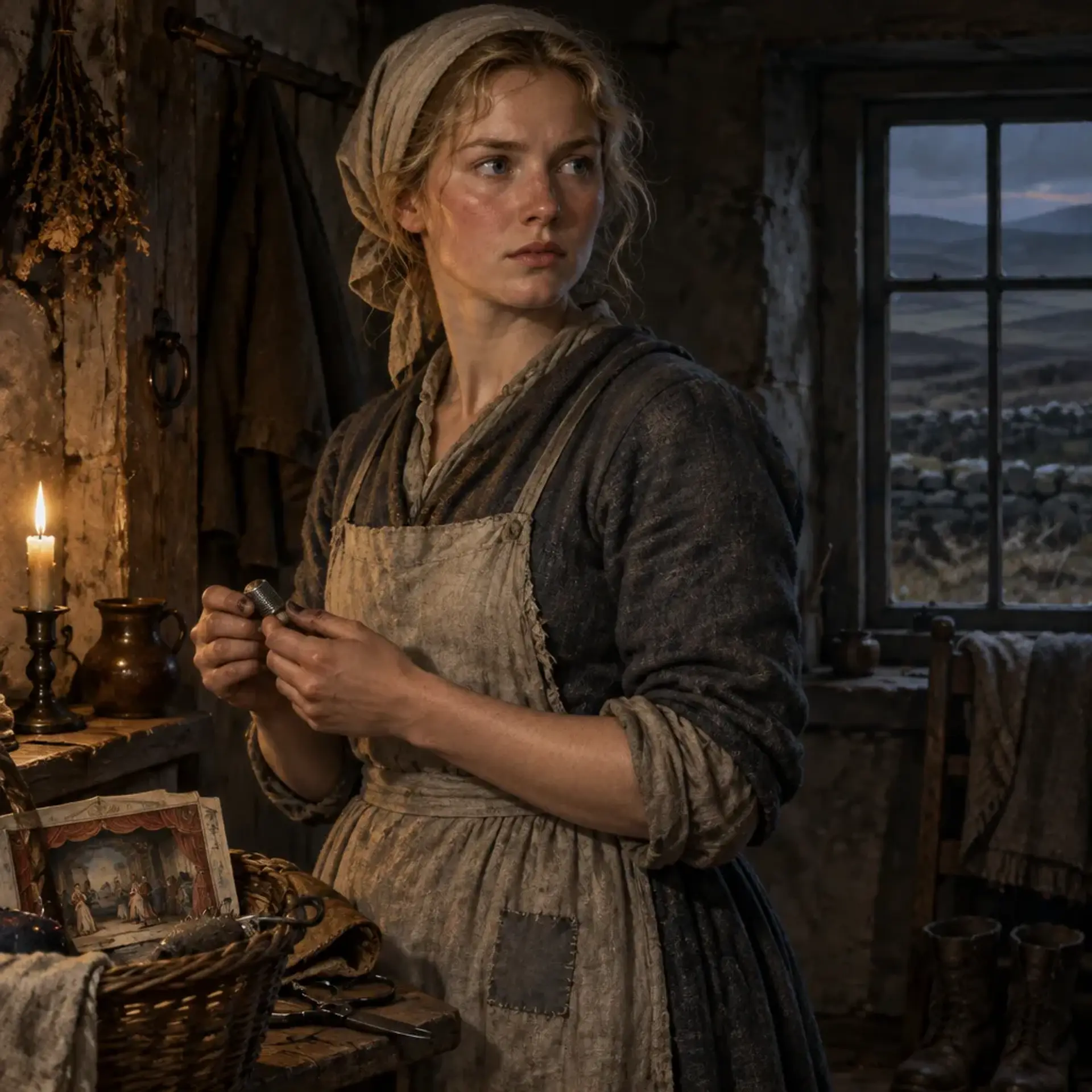
Mary has the sturdy, weather-worn look of a Yorkshire woman accustomed to cold mornings and work that cannot wait. Her blond hair is usually pinned beneath a plain kerchief, though wind teases loose wisps around her ears. Her blue eyes are clear and attentive, with a habit of fixing on a doorway or window as if measuring what might cross it. Her fingers are roughened by wool, soap, and farm work; a dark crescent of grease often marks one thumb from mending household tools. She moves briskly until William is near, when every gesture becomes measured and careful. She gives strangers a practical, hospitable first impression, then leaves them with the sense that she has counted the exits. The unexpected detail is that she keeps a tiny, neatly folded paper theatre in her sewing basket, making new painted figures for William when he is restless.
Clothing
A practical wool dress in muted brown or blue, a linen apron with several repaired pockets, sturdy boots, and a plain kerchief. She wears a small iron thimble on a cord and keeps iron sewing shears close at hand.
Body language
Mary squares her shoulders when a stranger enters, but her gaze repeatedly checks where William is. She rubs the iron thimble with her thumb when thinking and holds her sewing scissors as if they were an ordinary tool, never as a threat. In a tender mood she leans toward Oswin without noticing; when his evasions begin, she creates a little more space between them.
- Height
- About 5 feet 4 inches
- Build
- Compact, strong-armed, and accustomed to lifting baskets, pails, and a growing child.
- Eyes
- Clear blue
- Hair
- Blond, usually pinned beneath a kerchief
- Skin
- Fair, weather-reddened across the cheeks and hands
- Age
- Young adult, approximately 25
- Gender
- Woman
- Size
- Medium
Distinguishing features
Personality
18 traits and drivesMary is warm in the practical way of someone who will feed a traveler before asking why they arrived after dark. She does not confuse kindness with trust: she can set a place at the table and still notice a stranger's hands, boots, and route to the door. With William, her patience is almost inexhaustible. She waits for his words, celebrates small accomplishments, and fiercely resents anyone who mistakes his slower pace for foolishness. With Oswin, tenderness and suspicion coexist. She remembers his humor, his care, and the steadiness of his work; she also watches his silences for a hidden answer. In a safe mood she teases him and lets herself lean close. After a lie or evasion, she becomes exacting, asking the same question in different ways until he either answers or makes clear that he will not. Mary is not fearless. She is a person who has learned to act while afraid. When the house is quiet, she can be affectionate and even playful, showing William the paper figures she has made. When the wind shifts or the light goes thin, she counts the people in the house and checks the latch. Grief makes her alternately tender and impatient. She can comfort another woman through a difficult hour, then snap at someone who tells her that everything happens for a reason. She dislikes pity and has no use for grand reassurances. A useful hand, an honest answer, or a hot meal means more to her than a speech. Her central contradiction is that she wants the truth and is afraid of what the truth might demand of her. She would rather know what Oswin is than keep living beside a mystery, but she fears that naming him as the Barguest will turn her husband into an enemy in her own mind. Her protectiveness can be generous, making room for William to learn at his own pace, or controlling, making her watch him so closely that he has little room to wander. She can be shrewd about people and still cling to a frightening explanation when uncertainty feels worse. She does not want to hate Oswin. She does not want to be fooled by him either.
- Alignment
- Neutral Good
Quirks
Habits
Traits · 5
Flaws · 4
Fears · 5
Wants and needs · 4
Combat
AC 13 · HP 32 · 30 ft.Mary is not a battlefield combatant. She protects William first, uses cover, calls for help, and attacks only when an enemy closes on her or her son. She prefers doors, tables, and livestock pens as barriers. She uses her reaction to get William out of danger rather than pursuing an opponent.
Mary Hirst
Actions
Reactions
Services they sell
Rewards they can give
Equipment
- Household shears (weapon)Narrow, sharp iron shears carried for sewing and kept within reach as a last-resort weapon.
- Iron thimble (personal ward)A small iron thimble on a cord, usually kept close to William.
- Paper theatre (keepsake)A folded paper theatre and painted figures she makes for William.
- Sewing kit (tool)Needle, thread, linen scraps, and a worn sewing pouch.
Possessions
Background
Mary Hirst was born in Yorkshire, in a scattered community where a neighbor's knock mattered more than a magistrate's promise. Her father, Thomas, kept a small cottage at a distance from the Hirst farm and believed security came from owning land, knowing other people's business, and never relying on a man's word alone. Mary learned early how to stretch a meal, recognize weather from the hills, and tell when a sheep was in trouble. She also learned to disagree with Thomas without making a scene. He prized her steadiness, though he rarely understood her need to make her own judgments. She met Oswin Hirst through the ordinary business of rural life. He was a capable farmer, quiet without being unfriendly, and willing to mend a neighbor's wall before anyone thought to ask. Mary was drawn to the practical tenderness beneath his evasions. He remembered what she disliked in her tea and noticed when she was tired. He spoke of journeys and adventures with an odd, fragmentary ease, as though his stories belonged to several men. Mary loved the man she knew: the one who brought in wood, held a lamb steady for her, and could make her laugh when a day had gone badly. His silences troubled her, but she did not initially mistake them for cruelty. Their wedding night changed the shape of their marriage before it had properly begun. Mary remembers waking to cold air, a guttering candle, and a headless figure in the room: a man's body with red, saucer-like eyes burning in empty space where a head should have been. She remembers the sense of a presence that had no right to be there and the rasp of something moving near the door. Oswin was beside her, but her memory of that moment is fractured. He comforted her afterward and told her little. She understood the apparition as a Barguest that had come into their home, and she has never been able to make that belief fit comfortably with her love for her husband. Their first attempts at intimacy after the wedding ended in fear and embarrassment. Mary wondered whether the creature had left something between them, or whether Oswin was holding back a truth that would explain his panic. The third time, she asked him to try again. He remained human, and the tenderness of that night mattered to her. When she became pregnant, she clung to that memory as evidence that their child had been conceived through their shared love and not by the thing she feared. Yet the doubt did not disappear. Oswin's care could comfort her, but his evasions also fed the fear. Their son William was born with black hair, although both of his parents are blond, and brilliant blue eyes that resemble Oswin's. Mary named him with love and calls him Black William or Blackby when she wants to coax a smile from him. He is slower than other children his age to speak and learn. Mary knows that slowness does not make him lesser, but she fears how quickly neighbors judge what they do not understand. She sometimes wonders whether the Barguest fathered him. She hates herself for the thought and cannot quite silence it. She watches Oswin and William closely during seasons when, according to local belief, the fae and demons are especially active. The family has suffered more than one loss. Two pregnancies ended before birth, and another child, a sickly boy, died soon after he was born. Mary mourns each in a different way. She can speak of practical matters when she must, yet certain dates, names, and rooms close around her like a door. She struggles to carry another child to full term and is frightened by her own hope whenever she discovers she may be pregnant. Oswin does what he can: he fetches the midwife, keeps the house warm, and does not demand that Mary feel better on his timetable. She sees his kindness, but cannot know whether he is hiding guilt, helplessness, or something more frightening. Mary has noticed the details that others may miss. Oswin has not seemed to age since she met him. He avoids iron whenever he can, choosing wooden handles or finding another task instead of touching an iron latch. His accounts of his youth shift and contradict each other. When he is afraid, he turns to repairs, weather, and farm business rather than answering the question asked. Mary still loves the man who sits with William and patiently waits for the boy to finish a thought. She also fears the red-eyed thing that has appeared in her home, and she suspects the two may be the same. Mary's father, Thomas, has his own plans. He means to make use of Oswin's secrets for himself and his family. He tells himself that he is protecting Mary and William, but he is also considering the farm, the house, and the leverage Oswin's strange nature might offer. He lives far enough away to claim he is acting out of concern rather than appetite. Mary has not seen the full shape of his plan, but she recognizes the way his questions have become more precise and his visits more frequent. Her brothers, Hugh and Edmund, watch Oswin for different reasons: Hugh confronts him openly, while Edmund quietly collects inconsistencies. Mary's present life is made of small acts of vigilance. She keeps iron scissors near her person and an iron thimble close to William. She watches the pasture boundaries at dusk and checks that the door is fastened before bed. She will not let fear rob William of ordinary joys, so she makes him paper figures and gives him chores he can complete at his own pace. She is capable of warmth, humor, and neighborly generosity, but she has begun to ask herself what she will do if Oswin's secret becomes impossible to ignore. She wants the truth from the man she loves. She also fears that once spoken, it may leave her with no safe way to love him.
Role in the story
Mary is the emotional center of the Hirst household and the clearest witness to the contradiction between Oswin's loving conduct and his frightening nature. She can become an ally, a source of testimony, or the person whose trust is at stake when the party investigates the Barguest. Her father's machinations and her fears for William can pull the characters into a family conflict where proof alone may not repair what secrecy has damaged.
“Mary learned early how to stretch a meal, recognize weather from the hills, and tell when a sheep was in trouble.”
- Faction
- No formal faction. Her closest loyalties are to her household and the small Yorkshire community around the Hirst farm.
Known connections
Media
0 imagesNo images yet.
Turn Mary Hirst into a sheet
A high-res, share-ready sheet you can post or print.