Friedreich
Friedreich
At the table
Voice
A dry, clear-edged voice shaped by German speech, formal schooling, and the remembered habits of military life. He sounds like someone accustomed to being heard across a yard, not someone trying to sound grand. Excitement makes his words quick and precise; anger makes him more direct, not softer. When wearing a face, he can reproduce its vocal surface, but his own deliberate cadence tends to return.
His voice sounds as though it belongs to a disciplined young man trained to project across a drill yard: clipped consonants, clear German vowels, and a faint dry rasp that suggests cold air and too many shouted orders. In ordinary conversation he is precise, with a habit of finishing a sentence as if it were a formal report. When excited about a market bargain or a football match, his phrasing speeds up and the polish gives way to youthful eagerness. A borrowed face can alter the sound and rhythm of his voice, but a careful listener may hear his underlying crisp cadence.
Speech patterns
How to play them
Treat him as a person even when his appearance is borrowed. Ask before inviting him to wear a particular face, and do not assume that a convincing likeness gives him the target's memories. He responds well to practical invitations, shared games, and being given a specific place in a group. If he is angry about not being perceived, acknowledge the frustration rather than pretending to see him. With Wilhelm, avoid demanding a complete account all at once. With Mila, Friedreich is protective but can be reminded that she has her own judgment.
Goal
Find a way to remain recognizable to the coven without relying on a stolen face, and make Wilhelm speak honestly about the wars, even if the truth damages their brotherhood.
Motivation
To be recognized as Friedreich, not merely as the face he can borrow, and to remain useful to the people he calls family.
Appearance
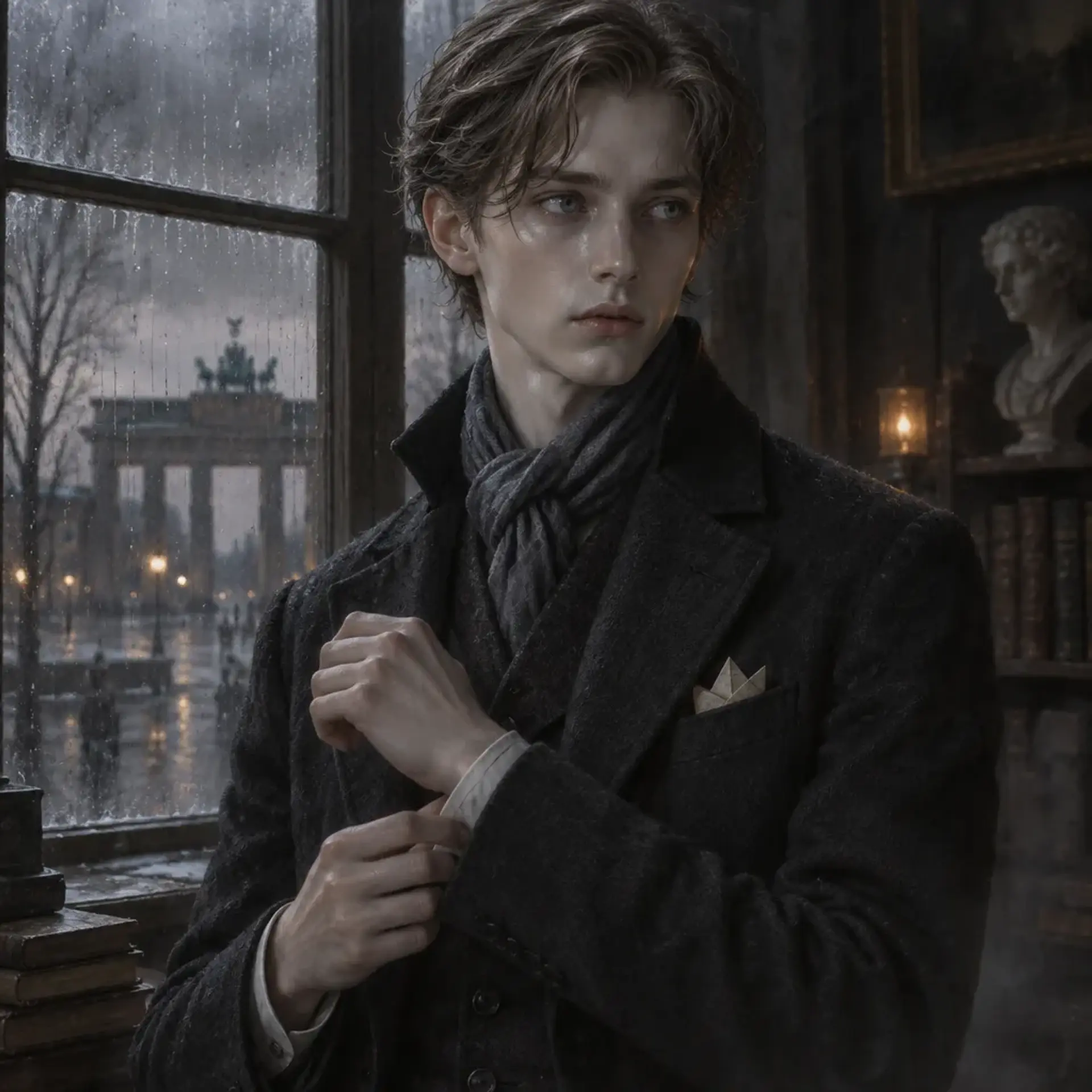
Friedreich looks like a young man in an old-fashioned Prussian family portrait who has stepped out of the frame and forgotten which side of the glass is his. His borrowed face is always a little too clean at the edges, as if carefully cut from damp paper and pressed over a blank, pale surface. When seen without a stolen face, his features are indistinct, but the shape of a youthful jaw and the suggestion of a military haircut remain. His uniform-like coat is not truly cloth: it has the matte, rubbed texture of old wool, but its folds sometimes hang as though underwater. He moves with measured parade-ground precision until something startles him, when his left shoulder leads and his feet make a quick, skidding correction. Within a minute, most people notice that he keeps checking the empty place at his throat where a collar should sit. The unexpected detail is a small, painstakingly embroidered sprig of wild strawberry on the inside of his cuff, a domestic, almost childish ornament amid the severe uniform styling. On days when the world seems to loosen its hold on the dead, his outlines gain depth and warmth. He can look nearly alive, though his shadow does not always agree with his posture.
Clothing
A dark, high-collared coat in a Prussian military style, worn over a plain shirt and trousers whose cut shifts subtly with his borrowed face. The coat appears brushed and cared for, but its seams have the soft, fibrous look of old paper. A tiny strawberry sprig is embroidered inside one cuff.
Body language
He stands as though awaiting inspection, chin level and shoulders squared, but favors his left side when he turns. His feet make tiny corrections as if a parade-ground line has shifted beneath him. He touches his throat, adjusts an absent collar, and watches people's mouths closely when they speak. Borrowed faces make his expressions more fluent, but his posture remains a little too disciplined.
- Height
- About 170 cm when he is clearly perceived; uncertain when his outline is indistinct.
- Build
- Lean and narrow-shouldered, with the wiry outline of a youth who was still growing when he died.
- Eyes
- Grey-blue when a face can be perceived; otherwise only the impression of eyes beneath a blurred brow.
- Hair
- Dark brown, closely cropped in the style of an old portrait; the apparent color changes slightly with the face he wears.
- Skin
- Pale grey-white when plainly perceived, like paper held in winter light; warmer tones appear with a borrowed face.
- Age
- Appears seventeen or eighteen; his actual age at death and the span of his existence as a wraith are uncertain to him.
- Gender
- Male
- Size
- Medium, approximately human-sized when clearly perceived
Distinguishing features
Personality
17 traits and drivesFriedreich is formal without being cold, and protective without being as selfless as he would like to believe. He has inherited or retained the habits of a young Junker: he offers a hand, expects a greeting to be returned, and believes that a person who has accepted responsibility should not casually abandon it. Those manners can be reassuring. They can also be an excuse to make decisions for others. Around the coven, especially during holidays, he relaxes into a lively, opinionated presence. He has surprisingly strong views about football, the value of a market bargain, and whether a coat is made to last. His advice can be useful, but it can also reveal an unspoken wish. If he tells someone that a beautiful object is a foolish purchase, he may be trying to protect them from waste. If he says it is an excellent bargain, he may simply be trying to live vicariously through their ownership of it. He is not naturally serene. Friedreich's discipline is a brace he puts around his feelings, and the brace slips when he is ignored. Being unseen is not an abstract inconvenience to him. It brings back the helplessness of standing outside a conversation among people he loves, unable to make a sound that reaches them. He tries to manage the humiliation through precision: he repeats a statement, clarifies the words, and gives the listener another chance. If the effort fails, his hurt can turn into anger. He does not always distinguish between someone who cannot perceive him and someone who has chosen not to listen. Afterward he is ashamed of the outburst and may retreat into stiff politeness, which can make the distance worse. He is more comfortable with actions than confessions. He will stand watch, find a route through a crowded market, remember who takes sugar, or position himself between Mila and a danger. He can express affection through service while remaining unable to say what he needs from a friend. His care for Mila shows the best and worst of this. He sees her as a younger sister and is proud of her competence; he does not think she is weak. But his sense of duty can make him intervene before she asks, particularly when the danger resembles an old battlefield memory. If she tells him to step back, he may obey at once and then quietly struggle with the feeling that he has failed her. His relationship with Wilhelm is the place where loyalty and judgment collide most painfully. Friedreich loves Wilhelm as a brother, though he cannot explain the origin of that love. He also believes Wilhelm deserted in the First World War and committed crimes in the Second. He will not allow brotherhood to make those things harmless. At the same time, he is conscious that his own memories are fragmented and that he may be accusing Wilhelm through a fog. He wants an explanation, but fears that he wants one only so he can decide whether to forgive. When Wilhelm refuses to speak, Friedreich sees the silence as an insult and a shield. His anger is real, but so is his terror that the bond between them will disappear if the truth is spoken plainly. Borrowed faces amplify these contradictions. When Friedreich wears a face, he becomes easier to perceive and more capable of participating in ordinary social life. He can read the room, speak naturally, and feel almost present. He is grateful for that ease, then frightened by how much he craves it. A borrowed expression can linger after he removes the face. He may find himself laughing in another person's rhythm, or becoming furious at a slight that belonged to the person whose appearance he used. At first he responds to this danger by insisting that he can stop whenever he chooses. In private, he knows the claim is not always true. The Shadow encourages him to think of identity as a luxury and continued visibility as a necessity. Friedreich is sentimental, though he tries to make sentiment look like tradition. Holidays matter because they give his scattered friends a reason to gather. A football match matters because everyone can argue about the same thing at the same time. A card game matters because the rules give him a place in the evening. He can be severe about keeping a promise and tender about an utterly ordinary shared habit. The tiny strawberry on his cuff is one such tenderness. He will pretend it is decorative, then become unexpectedly defensive if someone mocks it. He can be vain about competence, especially when his old military bearing earns him attention. He likes to know the right price, the proper way to approach a difficult person, and where danger is likely to come from. He dislikes being treated as a relic or a child. Yet he is also young in ways his formal manner cannot hide: easily excited by a full holiday gathering, eager for approval, and quick to be wounded when friends make plans without him. He wants to be a brother and a guardian, but also wants someone else to notice when he is tired. He will rarely ask for that directly. A friend who saves him a place, uses his name, or asks his opinion without making him perform a borrowed identity can reach him more easily than someone offering grand declarations of loyalty.
- Alignment
- Not applicable as a Wraith: The Oblivion rules statistic. In ordinary terms, loyal and protective, with a strong sense of duty and an unsteady sense of justice.
Quirks
Habits
Traits · 5
Flaws · 4
Fears · 4
Wants and needs · 4
Combat
HP 0 · Not represented by a standard numeric movement statistic in this profile. Use the chronicle's Wraith movement and scene rules.Friedreich is not a front-line bruiser. He tries to make an opponent hesitate by borrowing the face of someone they recognize, then escapes or places himself between danger and a companion. When he must fight, he uses disciplined movement, close-range shoves, and whatever weapon the scene makes plausible. The mechanics of his face theft are custom, not canonical Wraith rules. Resolve ordinary attacks and damage using the chronicle's Wraith rules, not hit points or armor class.
Friedreich
Actions
Reactions
Services they sell
Rewards they can give
Equipment
- Old uniform coat (possession)A ghostly, high-collared coat that recalls a young Junker's military dress. It is a personal memento and has no armor rating.
- Discarded portrait card (memento)A small, worn card bearing a portrait used in one of his earliest successful face thefts. The identity is not necessarily the same person he currently resembles.
- Playing cards (personal item)A deck he carries for the coven's games. It is an ordinary object in their gatherings, not a supernatural focus.
Possessions
Background
Friedreich remembers Brandenburg as a colorless place of sandy roads, low winter skies, and a house whose windows had to be polished before important visitors arrived. He cannot reliably recall the name of the estate, his parents, or whether he was born in 1900 or 1901. He knows he belonged to a Junker family, or at least that the clothes and manners that return to him belong to that world: stiff collars, careful greetings, a horse's warm breath in cold air, and the certainty that an order ought to be obeyed. He was seventeen or eighteen when he died. The cause of his death remains obscured by what Wraith: The Oblivion calls the Caul, the psychic veil that separates a newly dead person from the truth of death. In Friedreich's case the Caul did not open gently. It was torn open by a woman he remembers only as a voice calling him by his childhood name, though he has no proof that the memory is real. She held his face between both hands and demanded that he look at her. For one instant he saw his own corpse and the people around it. Then the image vanished, leaving him with a name and a terrible awareness of the Shadowlands. His early years among the dead were spent trying to make himself visible. A wraith is not simply a transparent living person: the Shadowlands are a world of the dead, separated from the living world by the Shroud, and most living people cannot see or hear its inhabitants. Friedreich learned to recognize the loneliness of standing beside a conversation that could not include him. His first successful face theft was not a calculated trick. He borrowed the face of a young railway clerk whose portrait he had seen on a discarded identity card. A watchman mistook him for the clerk and answered a question. Friedreich remembers the shock more clearly than the clerk's name: for several minutes, someone had looked directly at him and expected him to answer. He carried that borrowed face for too long. Its habitual smile began to appear on him even when he felt grief, and he nearly forgot the line of his own mouth. That was his formative warning: visibility could become a kind of possession. The world wars reach him as broken recollections rather than a clean chronology. In the First World War he remembers a breath. It is not a metaphor to him, but a bodily sensation: cold air filling lungs that should have been beyond breath, the taste of metal, boots running over wet ground, then Wilhelm turning away. Friedreich believes Wilhelm deserted, though he cannot reconstruct the whole scene. He is angry that Wilhelm will not explain, and equally afraid that an explanation might make the anger harder to sustain. During the Second World War he was with Wilhelm as much as he could manage. He knows Wilhelm committed crimes, and Friedreich will not let companionship erase them. Yet his memory of the period is full of gaps, and he suspects that some of the gaps are defenses rather than accidents. Wilhelm's shame over the First World War and silence about the Second have become a wall between them. Friedreich calls him brother without knowing whether that bond began in life, in death, or in the long habit of surviving beside one another. The two wars also left him with memories of the dead and the living crossing too close. One of his sharpest recollections is a fight in a cathedral during a service on Walpurgis Night, April 30. He remembers candle smoke, stone under his palms, and a congregation whose prayers became indistinguishable from the cries of people neither side could see. He cannot say who began the violence or what the service was meant to protect. He returns to that memory when a place feels spiritually thin, looking for the missing detail that might explain why he was there. It has never given him an answer. Friedreich's current life is held together by a small, improbable coven of supernatural companions. They meet to play cards, hunt, fish, drink, and watch football. He values the ordinary rituals as fiercely as any oath: a chair kept open, an argument over a match, someone saving him a place near the fire even when they cannot perceive him. Gunther, a changeling who spent much of his time in Arcadia before returning to the real world, sells clothes made from moss. Friedreich admires the odd patience of Gunther's work and often offers opinions on what looks practical, despite having no useful sense of what a living person can comfortably wear. Klaus, a ronin Get of Fenris, or perhaps a skin-dancer, is passive-aggressively cruel to most people and strangely hesitant around Friedreich. Friedreich does not know whether Klaus sees a deserving person in him, or only a reminder of something Klaus would rather not name. Mila, a mage from Bremen, visits for holidays. She can always see him, a fact he considers both a comfort and a small miracle. He treats her as a little sister and protects her not because he thinks her weak, but because protection feels like a duty he understands. Her long life makes him feel protective and envious at once. He rarely admits the envy. Holidays are especially important. When more of the coven arrives, he becomes animated, and Christmas markets are among the few places where his old social instincts return in full. He advises everyone on bargains and what to buy. Sometimes he recommends a thing because it is a good deal; sometimes he recommends it because he wants it himself and cannot possess it as the living do. His greatest present problem is not an enemy but the instability of his borrowed faces. The better a theft works, the easier it becomes to mistake the borrowed mannerisms for his own. Prolonged use has left him with sudden envy, irrational anger, and a fear that the original Friedreich is only the last face he happened to wear. He is learning to set limits, but the power gives him what he has always craved: recognition, conversation, and a place at the table. The Shadow knows this and urges him to take one face permanently, then another, until no one can tell the difference between being seen and being someone else. Friedreich's answer, when he can manage it, is to return to his friends, to the market, and to the small, repeatable acts that do not require a stolen identity.
Role in the story
A loyal but compromised companion who can help the characters navigate a supernatural community while forcing questions about memory, identity, wartime responsibility, and what it means to be seen. His friendship with Wilhelm offers a personal route into unresolved history. His face theft can aid intrigue, but its identity risks make it a source of conflict rather than a convenient disguise.
“He cannot reliably recall the name of the estate, his parents, or whether he was born in 1900 or 1901.”
- Faction
- An informal supernatural coven of friends, with no formal faction or organization membership specified. He is a wraith of the Shadowlands. No affiliation with a canonical wraith faction is established.
Known connections
Media
0 imagesNo images yet.
Turn Friedreich into a sheet
A high-res, share-ready sheet you can post or print.