Oswin Hirst
Oswin Hirst
At the table
Voice
A weather-roughened, clear speaking voice, shaped by wind, smoke, and talking over sheep in open fields. It has a dry rasp at the edges but is not especially deep. When frightened or angry, his breath catches audibly and his consonants come out in short, clipped bursts.
He speaks in plain, work-shaped Yorkshire English, with clipped practical phrasing and the occasional local turn of expression. His voice has a faint rasp like dry wool dragged over wood, likely from years of wind and smoke. When rattled, his words break into brief, breathy bursts, as though he has just run uphill.
Speech patterns
How to play them
Meet visitors with practical hospitality and offer food, shelter, or help with animals before discussing anything supernatural. He is kind without being naïve and will bargain shrewdly to protect his household. Earn his trust by respecting Mary and William as people rather than treating them as curiosities. Direct questions about his nature make him evasive; threats to his family make him abruptly dangerous.
Goal
Keep Mary and William safe, make their home feel ordinary, and someday find a way to tell the truth without losing them.
Motivation
He wants to be loved as a husband and father, not feared as an omen, but he is terrified that honesty will prove those things cannot coexist.
Appearance
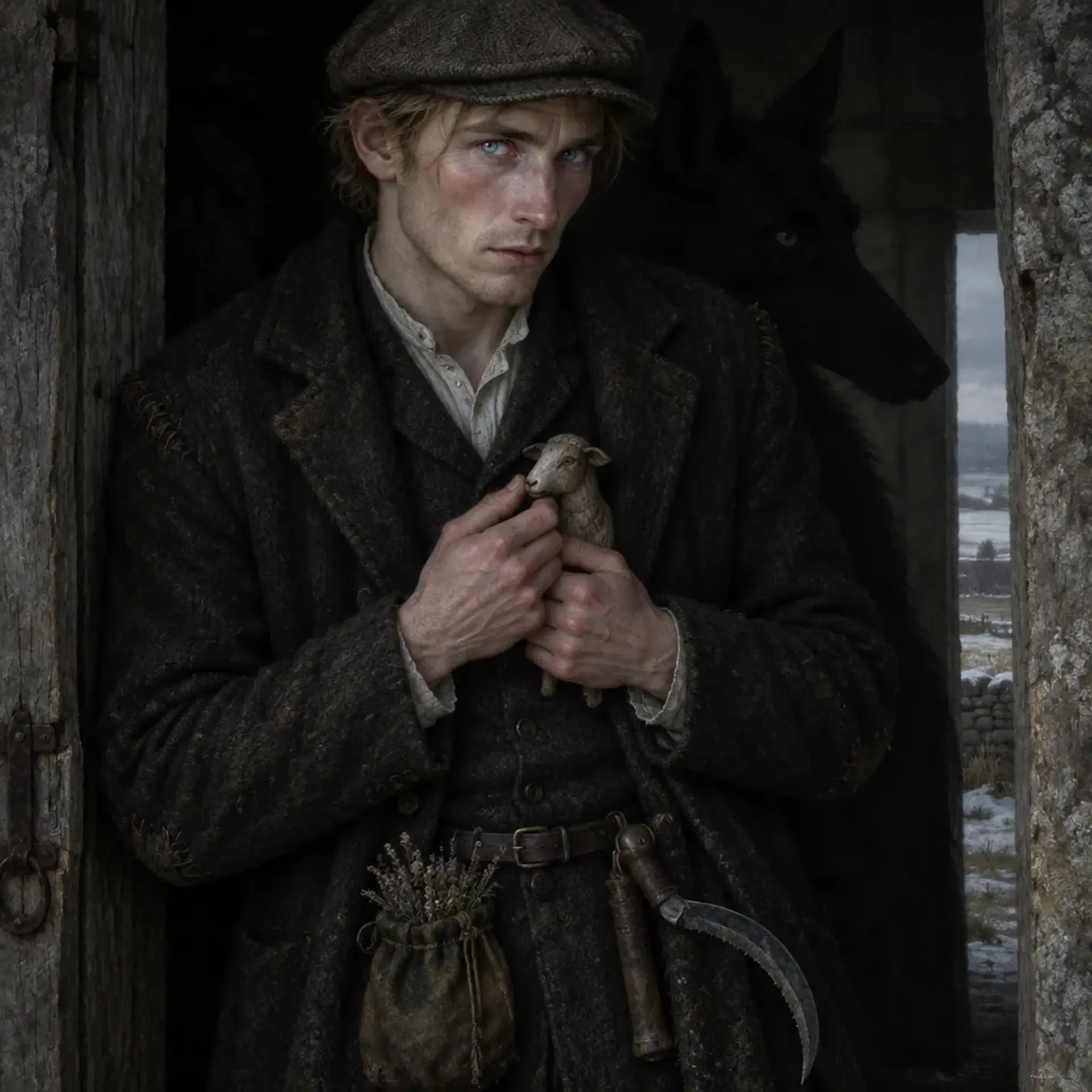
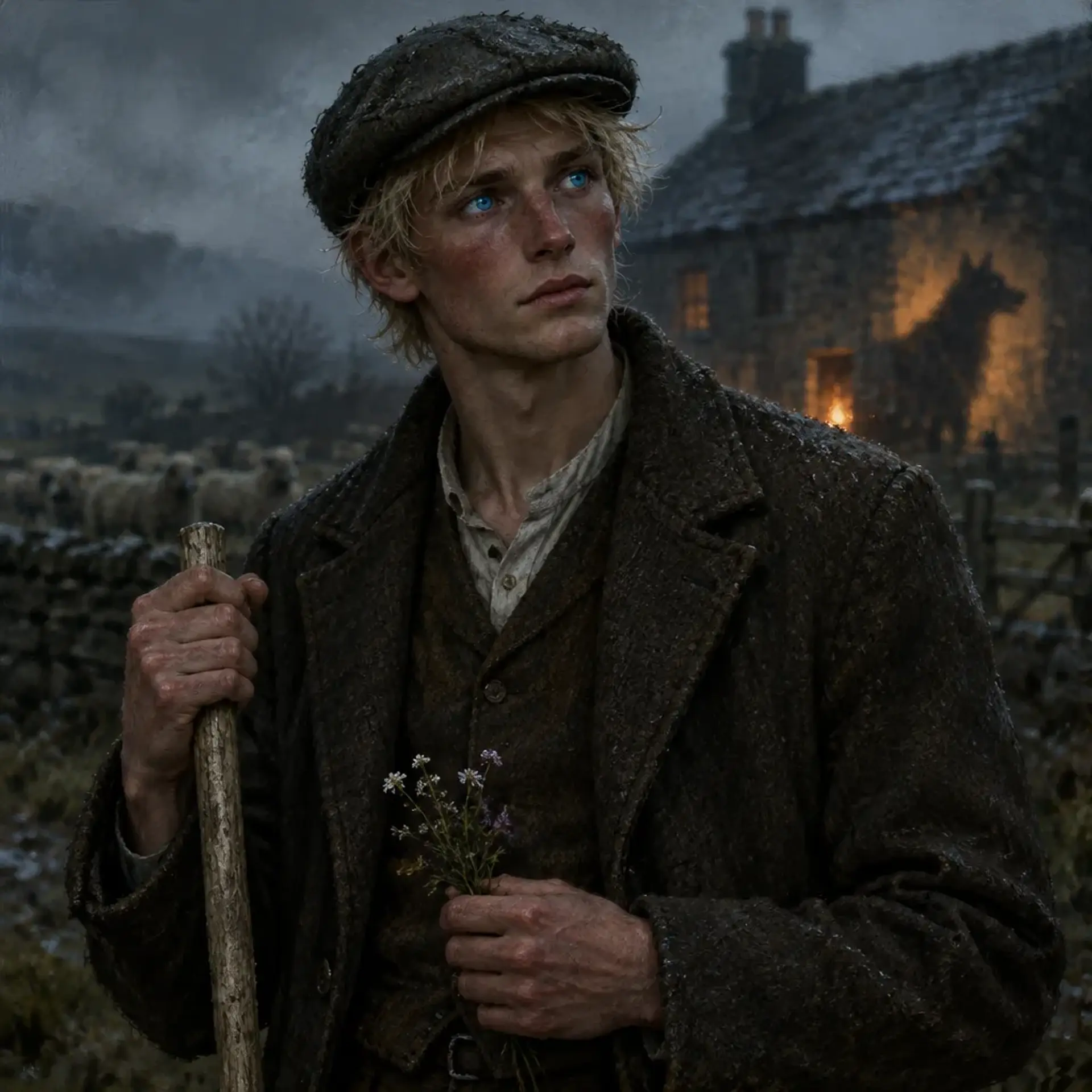
Oswin stands exactly six feet tall, handsome in the way of an old portrait whose subject has somehow outlasted the frame. His pale blond hair falls straight and fine beneath a familiar flat cap, and his bright blue eyes seem almost feverishly lit when dusk comes on. His skin is fair but weathered across the nose and cheeks by wind, wool dust, and years outdoors. He walks with a farmer's economical, grounded stride, yet sometimes turns his head toward a sound without moving his shoulders, like a hound catching scent. His breath is ordinarily warm and even; when unsettled, it catches in short, dry little barks. The unexpected thing about him is that he keeps a small, carefully tended herb garden devoted to delicate flowers, even though he claims to have no use for them.
Clothing
A clean but work-worn wool coat, waistcoat, sturdy trousers, and boots kept freshly greased against rain. He wears the common flat cap of the district, and carries a plain ash staff rather than a conspicuous weapon.
Body language
His hands are steady when handling sheep or mending a gate, but his shoulders lock when iron comes near. He watches people with open, almost guileless attention until they ask about the wedding night, when his gaze slips toward the nearest exit. When rattled, his breath breaks into clipped catches and he tilts his head as though listening for paws on a distant road.
- Height
- 6 ft
- Build
- Lean, long-limbed, and strong from hauling feed, lifting gates, and working with livestock.
- Eyes
- Clear, vivid blue, with an emberlike brightness in darkness
- Hair
- Pale blond, straight
- Skin
- Fair, weathered pink across the nose and cheeks
- Age
- Young adult in appearance; his true age is uncertain and likely exceeds a human lifetime.
- Gender
- Male
- Size
- Medium
Distinguishing features
Personality
16 traits and drivesOswin is gentle in the unshowy way of someone who notices a lame lamb before anyone else does, yet he can be startlingly shrewd when a bargain threatens his land. At home he tries to be patient and present; alone at night he is restless, drawn to the road and the old freedom of his roving years. He dislikes frightening people, but under threat a cold, animal certainty replaces his warmth. He is not cruel, though his secrecy has caused real harm.
- Alignment
- Neutral
Quirks
Habits
Traits · 4
Flaws · 4
Fears · 4
Wants and needs · 4
Combat
AC 14 · HP 38 · 30 ft. (50 ft. in hound form)Oswin avoids a fight if he can put himself between danger and his family without drawing attention. If cornered, he uses entangle or fog cloud to control the field, then shifts into hound form to harry isolated foes and knock them down. He fights fiercely when someone threatens William, but will retreat rather than risk being captured in iron.
Oswin Hirst
Spells
Actions
Reactions
Services they sell
Rewards they can give
Equipment
- Ash Staff (weapon)A stout ash staff used for walking and defense.
- Flat Cap (clothing)A weathered flat cap, ordinary enough to make him seem like any local farmer.
- Herb and Tending Pouch (tools)A small pouch of dried leaves, twine, and practical remedies for livestock.
- Farm Keys (possession)A worn key to the farmhouse and a smaller key to the feed store.
Possessions
Background
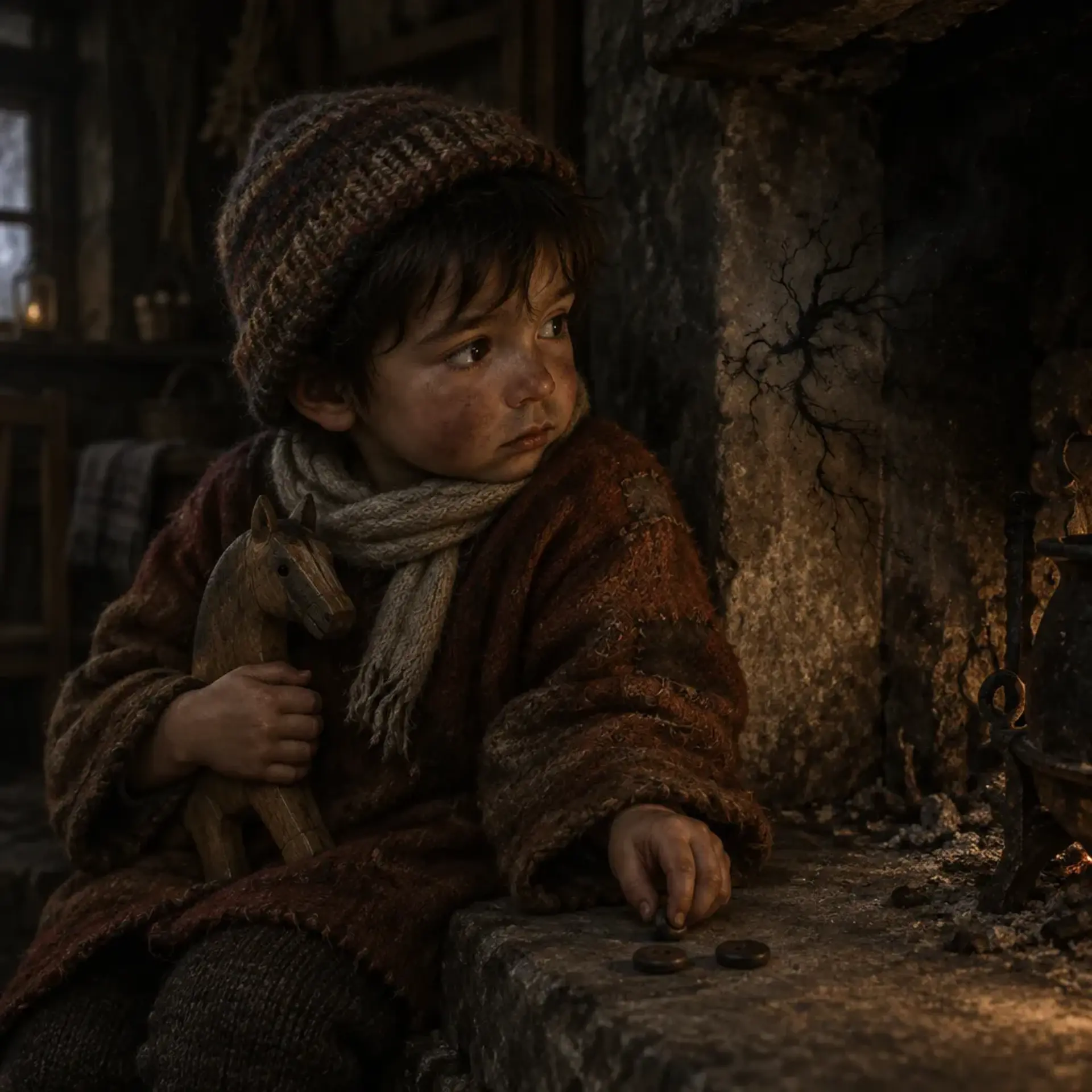
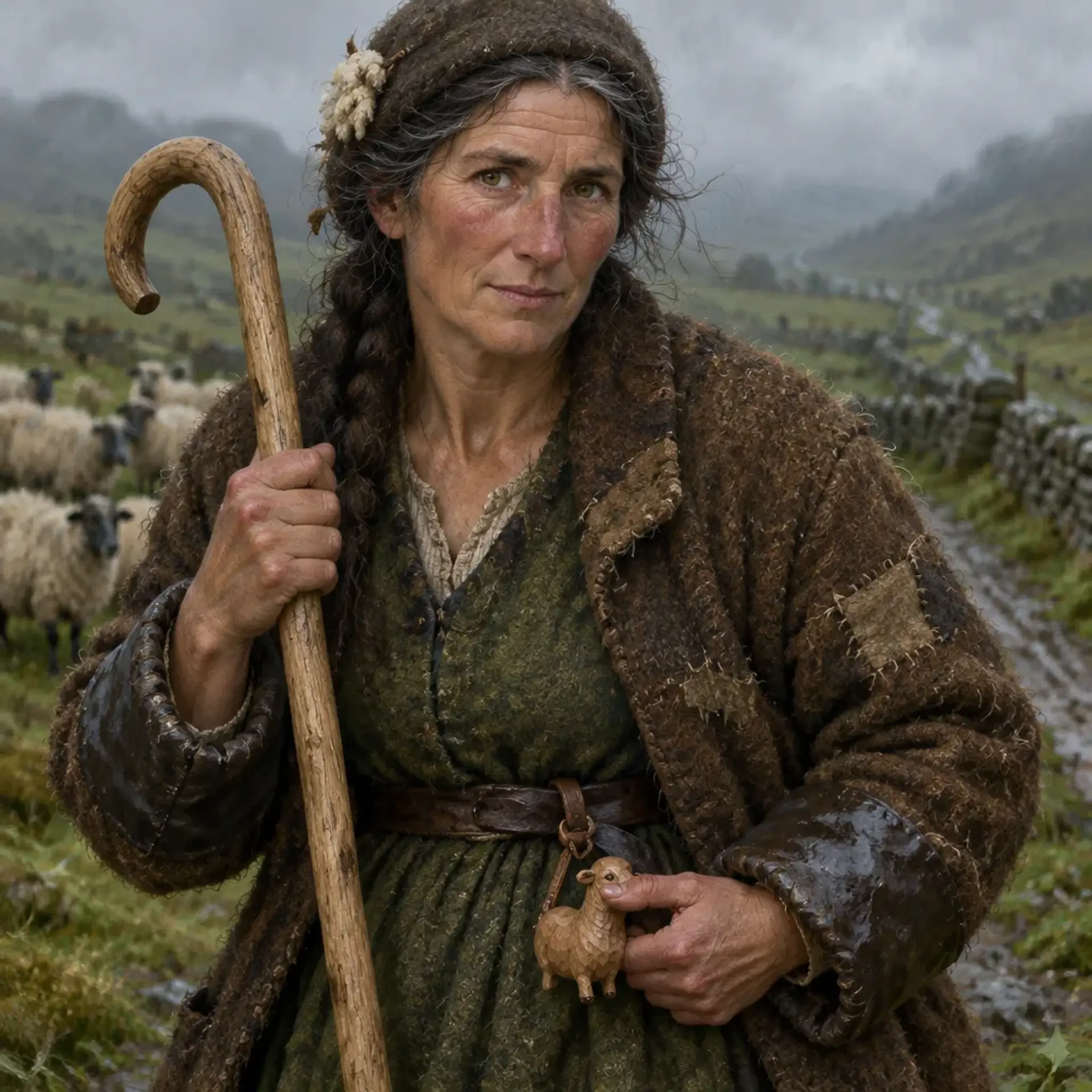
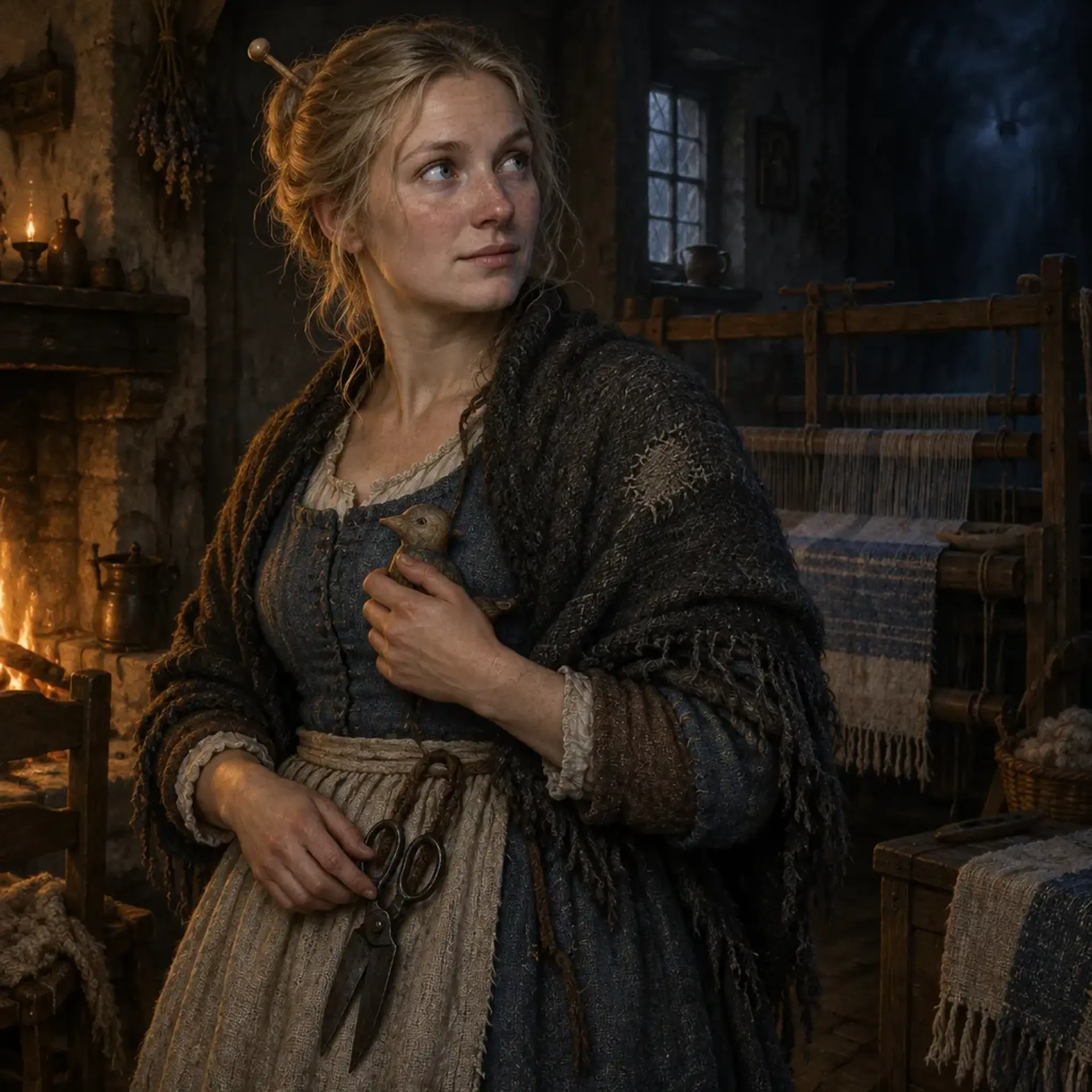
Oswin Hirst tells people he came south from the Yorkshire dales as a young man with little more than a coat, a strong back, and a habit of walking until the weather or hunger made him stop. It is a story he tells easily, with enough plain detail to feel true. He remembers cold nights in byres, the smell of wet wool, and roads that seemed to promise a destination only to bend away from it. He says he grew tired of wandering and wanted a place where he might be expected at supper. The truth reaches much further back, into the dark spaces between settlements, where paths cross old boundaries and travelers hurry on without looking behind them. Oswin was once a Barguest, a black hound of ill omen that haunted lonely lanes and moorland tracks. He belonged to no household and owed no allegiance to the folk who feared him. He roamed because roaming was all he knew. In those years, men and women saw the shape of a great dog in the night, or glimpsed burning eyes where no living animal should stand. Some heard paws behind them and turned to find nothing. Others saw a headless houndlike figure and ran home with the image lodged in their minds. In time, Oswin learned to wear a human shape. The change did not make him human, but it gave him a way to enter warm rooms, speak with farmers, and take part in the ordinary exchanges that held a village together. He learned to bargain carefully and to keep his oddities hidden. At first, a settled life was simply convenient. Then it became something he wanted. He met Mary when she was living with her father, a cautious farmer who had good reason to weigh every stranger twice. Oswin was taken by Mary's practical kindness, by the way she knew when an animal was sick before it stopped eating, and by the quiet certainty with which she set about each day's work. She represented everything he had never possessed: a warm house, familiar voices, lambing season, and a person who would notice if he did not return. He courted her with patience and a careful imitation of an ordinary man's hopes. Mary saw a quiet wanderer who had finally found a place to belong. Oswin saw a life he wanted so badly that he began to believe he might deserve it. The Hirst farm and its fine house came to him by means of arrangements that he rarely explains. Oswin has a talent for recognizing what people want and what they fear losing. He made bargains that secured land, animals, and a respectable name, and he sometimes took what he needed by less visible means. He would never call himself a thief, but he has been willing to cheat a little time from those who seemed unlikely to miss it. His face scarcely changed as the years passed. The difference went unnoticed at first, then became one more subject carefully avoided. Oswin learned that a good roof, healthy sheep, and a helpful hand at the right moment could distract neighbors from a great many questions. His wedding night should have been the beginning of the life he had chosen. Instead, it revealed the distance between the man Oswin had made himself and the creature he remained. He could not consummate the marriage in human form. Ashamed and bewildered, he retreated from Mary, then came to her in the other shape he had kept hidden. She saw a headless, houndlike apparition with eyes bright and red as saucers. She believed a Barguest had entered the room. Terrified, she seized iron scissors and tried to defend herself. Oswin was not angry with her. Her fear shook him because he understood that he had caused it, though he could not bring himself to explain how. Mary has never learned that the thing she saw was her husband. She later confided the story to her father, who has watched Oswin with a farmer's guarded attention ever since. Oswin knows the older man suspects him of something, though perhaps not the whole of it. He has had chances to tell Mary the truth. Each time, he has imagined what the confession might destroy: her trust, their home, the ordinary tenderness he had spent years trying to earn. So he has stayed silent, telling himself that keeping the family safe matters more than being understood. He knows the reasoning is selfish. He also knows that silence has done harm, even if he cannot yet bring himself to end it. Their son, William, has made that silence harder to bear. The boy was slow to find words, and his black hair stood out against the blond coloring of both parents. His eyes, however, are unmistakably Oswin's, burning blue and too vivid to pass unnoticed. Neighbors call him Black William, or Blackby. Mary fears he is the Barguest's devil-spawn, a child marked by the apparition she encountered on her wedding night. She does not know that the father she loves and the monster she fears are one and the same. Oswin watches William with fierce tenderness, helping him patiently and never demanding words the child cannot yet give. He will not allow the village's unease to make the boy feel unwanted in his own home. The family has suffered other losses. Several of Mary's later pregnancies have ended before a child could be welcomed into the house. Oswin suspects that something in his nature is responsible, though he has no proof and no certain remedy. He carries each loss quietly, with a grief he rarely knows how to share. Mary has her own sorrow, and he cannot offer her an honest explanation without laying bare the secret he has guarded for so long. At home, Oswin tries to be the husband and father he promised himself he could become. He notices a lame lamb, mends a gate before anyone asks, and makes himself sit with Mary and William through supper, even when every part of him longs for the open road. His gentleness is real, though it is not the whole of him. When a bargain threatens his land or danger comes near his family, warmth gives way to a cold, animal certainty. He can be startlingly shrewd, and those who mistake his mildness for weakness often discover it too late. At night, especially when the seasons turn and the veil between worlds grows thin, Oswin dreams of the dales and the boundless freedom of his roving years. He wakes restless, longing for the dark road and the old life that asked nothing of him. Still, he rises, returns to the house, and takes his place beside Mary and William. He wants them to know him through the daily work of staying: the supper shared, the sheep tended, the child comforted, and the door opened when he comes home. He hopes that care might one day stand where the truth should be, though some part of him knows it cannot.
Role in the story
A seemingly settled farmer whose domestic tenderness and supernatural history are in painful conflict. He can be an uneasy ally against local fae, a source of knowledge about old roads, or the center of a family mystery in which the most dangerous secret is not his monstrous shape but the choice he took from Mary.
“It is a story he tells easily, with enough plain detail to feel true.”
- Faction
- No formal faction. He belongs to the local farming community by marriage and trade, though some villagers quietly treat the black hound as an old warning best not named after sunset.
Known connections
Media
0 imagesNo images yet.
Turn Oswin Hirst into a sheet
A high-res, share-ready sheet you can post or print.