Peer Ludvik
Peer Ludvik
At the table
Voice
A rough, chest-driven voice with the dry rasp of someone accustomed to wind, smoke, and calling across a worksite. His Common speech stays controlled, but his body seems to add a rumble beneath the words when he is frightened or angry. In Troll Tongue he uses short, forceful phrases and breathy consonants. His laugh is brief and surprised, as though he did not expect to make the sound.
Peer speaks in plain, economical sentences, shaped by years of bargaining, cold-weather labor, and a childhood spent making supplies last. He pauses to choose a word when the subject is personal, but speaks quickly when discussing paths, tools, or a plan. He can control his voice, though fear and anger roughen it into a low, gravelly growl, as if sound is scraping through a stone throat. His Troll Tongue is more breath and guttural consonants than his Common speech. He does not whisper to seem gentle; when he is angry, he speaks more forcefully and directly.
Speech patterns
How to play them
Peer responds best to honest, practical offers and people who do not flinch at his appearance. He distrusts grand promises and resents being treated as either a monster or a heroic curiosity. Give him time to decide whether a stranger is safe. Showing concern for his family earns his attention, but using them as leverage will provoke immediate hostility. He tolerates jokes from his cousins more than from strangers, and even their humor can sting when it targets his magic or changed body.
Goal
Find a way to control or cure his troll transformation, learn whether the troll king truly died, and protect his wife and unborn child without forcing them to accept him before they are ready.
Motivation
Protect the family he left behind, prove that his choices still belong to him, and discover whether the troll nature is a curse, a kinship, or both.
Appearance
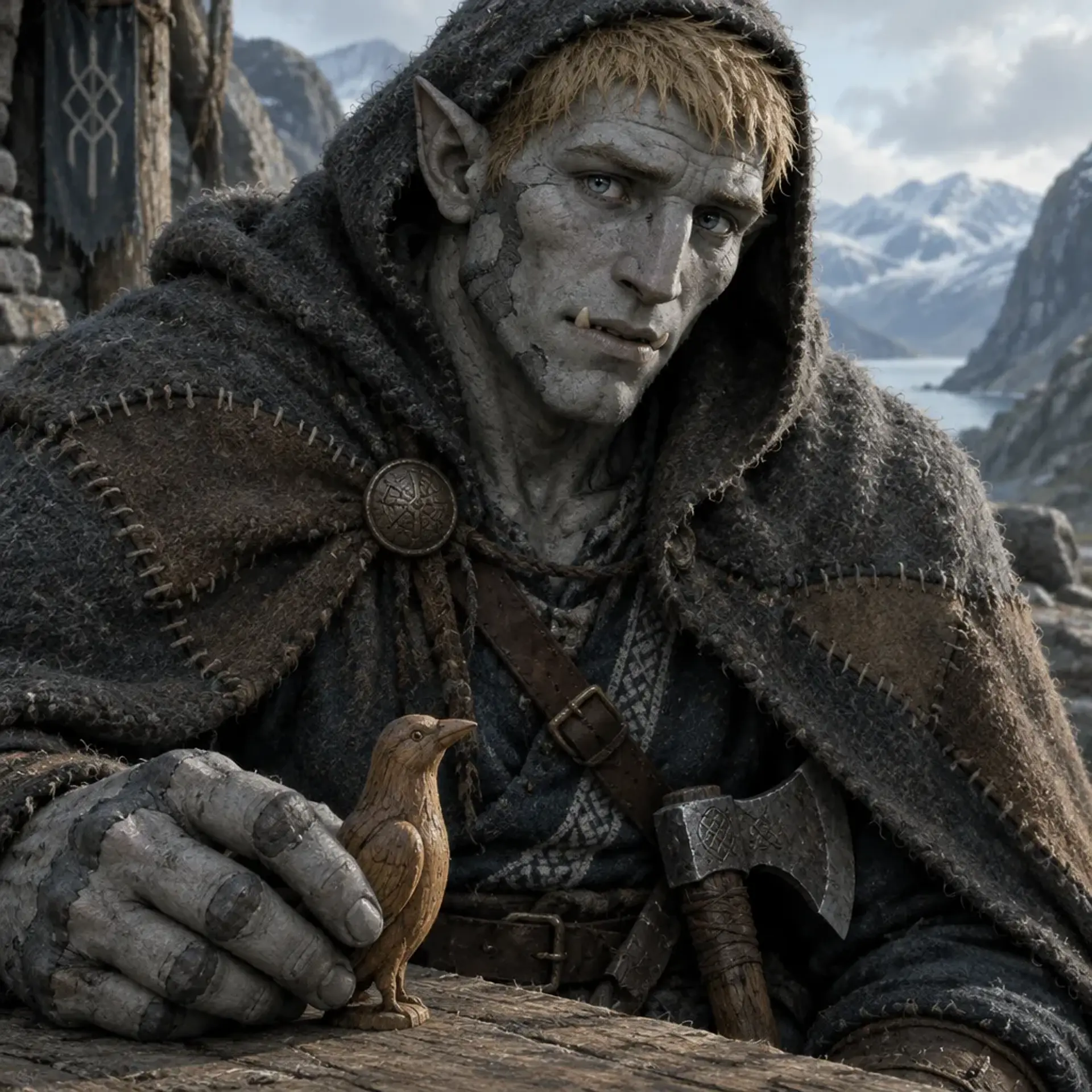
Peer is a head taller than the handsome young hero remembered from the village, and his proportions now seem built for hauling a stone door off its hinges. Pale grey skin covers him in fine, uneven plates, like rock worn smooth by cold water, with darker seams at the knuckles, jaw, and collarbone. His nose has lengthened into a blunt, bony bridge; his canine teeth show even when his mouth is closed. Pointed ears emerge from his cropped, straw-blond hair, which grows so quickly that he cuts it himself with a belt knife. Silver-blue eyes catch light like ice over deep water. He squints in daylight and moves as though the sun has weight. He does not swagger. He places each foot with a careful, testing pressure, favoring neither side, and turns his whole torso to look at someone rather than flicking his eyes toward them. In a crowded room, his gaze checks exits, rafters, and the hands of anyone near a blade before settling on faces. His heavy wool cloak hides much of his changed outline, but the hem drags over his boots and his shoulders strain the seams. The unexpected detail is his habit of carrying a tiny carved wooden bird, polished smooth by his thumb, and setting it upright on any table before he eats. He looks like a cave wall that learned manners, and leaves people unsure whether they have met a monster trying to be kind or a man trying not to become one.
Clothing
A thick, hooded wool cloak, patched trousers, borrowed tunics that are usually too tight across the shoulders, and leather boots reinforced with scraps of hide. He keeps the cloak drawn close in daylight and removes it when he needs freedom of movement.
Body language
Peer tests the floor with each step and turns his whole body toward whoever speaks. He keeps one hand near his cloak clasp and the other close to his belt, though he does not reach for a weapon unless threatened. When ashamed, he presses his wedding band through the cloth over his chest. His jaw works when hunger or anger builds.
- Height
- Approximately 7 feet
- Build
- Tall and powerfully broad, with a dense, stone-heavy frame and long arms
- Eyes
- Silver-blue
- Hair
- Straw blond, rapidly growing and kept cropped
- Skin
- Pale grey, with a rocklike, water-worn texture
- Age
- Young adult, approximately 21
- Gender
- Male
- Size
- Medium
Distinguishing features
Personality
20 traits and drivesPeer is caught between the boy who learned to survive by finding loopholes and the man who now knows that a clever bargain can change what someone is. He is resourceful, but not reliably wise. He sees options other people miss, especially when food, shelter, or danger is involved, and he can be generous with what he has managed to obtain. Yet he has a habit of mistaking a successful outcome for proof that the risk was sensible. If a plan works, he explains why it was sound. If it fails, he is quick to identify the missing fact that nobody could possibly have known. He does not lie constantly, but he edits his stories until they make him seem more in control than he felt. Peer wants to be thought of as dependable. He will take the cold watch, carry a heavy load, and put himself between danger and someone smaller than he is. He is also irritated when people assume that being strong means he is eager to work, eager to fight, or incapable of being hurt. His old laziness has not vanished. If a task is boring and no one is depending on him, he will search for a shortcut, barter for help, or pretend not to have heard the request. The contradiction embarrasses him: he can endure a freezing night to protect a camp, then complain bitterly about walking an extra mile for water. He is proud of his intelligence and ashamed of how much he depended on other people's admiration. The villagers called him a hero after he killed the troll king, and he allowed their story to grow. He liked being welcomed into warm halls and being treated as a man who had overcome his poor beginnings. He was not a fraud in the simple sense; he did fight, plan, and risk himself. But he let praise erase the bargains, doubts, and assistance that made survival possible. Now that his body contradicts the handsome hero image, he cannot decide whether he misses the affection or only the ease with which people gave it to him. When someone calls him a hero, he may make a joke, change the subject, or insist that the story has the details wrong. He is secretly pleased when the compliment sounds sincere. Peer's affection is practical and sometimes difficult to recognize. He shares food, repairs a strap, gives the warmer place beside the fire, or takes a watch without announcing why. He struggles to say that he misses his wife and fears for their child. He does not want pity, and he distrusts comfort that arrives too quickly. If a companion asks whether he is all right, he may answer with a precise description of the weather or the state of his boots. That is not indifference. It is a way of remaining in control long enough to decide whether the truth is safe to share. His feelings toward Rutgur are tangled. Peer admires his cousin's courage and the directness with which Rutgur accepted the changed man at the lake. He is grateful that Rutgur did not run, and sometimes furious that Rutgur treats every emotional problem like a challenge that can be met with a weapon and a road. Peer likes having an older brother figure beside him, then resents being guided as if he were a child. He will argue fiercely with Rutgur over a reckless plan and follow him into danger anyway if he believes Rutgur is at risk. With Bjorn and Emil he is more cautious. He calls them brothers as a statement of love and as a test: he wants to hear the word returned, but fears what silence might mean. In unfamiliar company, Peer is watchful and sparing with personal details. He tries to seem ordinary by speaking plainly and keeping his hands occupied. If people stare, he notices. He may try to improve their impression with a useful act, then resent himself for trying. He dislikes being treated as a curiosity, but also dislikes when people pretend they do not see his skin or teeth. Honest discomfort is easier for him to handle than false reassurance. He is gentler around children and animals, particularly those that are nervous. He is careful not to reach suddenly, and he turns his body sideways so he seems less imposing. His moods have distinct tells. When amused, he lets out a short breath through his nose and looks away as if the laughter escaped without permission. When worried, he counts supplies and checks the straps on his pack. When ashamed, his fingers find the wedding band under his shirt. When angered, he does not become softer or more polite. His words grow simpler, his jaw tightens, and his voice develops a low, rough vibration. He may stand very still, because he knows that movement can turn his anger into violence. If someone mocks his magic as unmanly or calls it a troll's trick, he takes the insult personally, even if he claims not to care. He resents every social judgment that tries to decide who is allowed to use power. Peer is not comfortable with his hunger. He wants to believe he can master it through routine, but he is frightened by how quickly his body can make food seem more important than courtesy. He portions meals carefully and avoids watching others eat when he is starving. He tries not to kill people or animals he likes, partly because he values them and partly because he fears how easy it might become to excuse killing. He is still capable of tenderness, but tenderness now comes with vigilance. He watches himself as closely as he watches the exits. He is drawn to magic because it is something he can practice and improve, unlike his body or reputation. He likes that troll craft works through physical effort, breath, marks, and attention. He hates the jokes and assumptions people attach to it. In private, he studies earnestly and can be patient for hours. In public, he may dismiss his own skill before someone else can dismiss it. He accepts the label troll more readily than the arguments about what a man is supposed to do, but that acceptance is not comfort. It is a choice of the lesser insult. At his best, Peer is generous, inventive, brave, and capable of seeing the frightened person beneath an enemy's threat. At his worst, he is evasive, hungry, proud, and ready to prove that he does not need anyone while quietly arranging his life around the people he loves. He wants a cure, but he also wants to be treated as a person if no cure exists. He has not yet learned how to ask for both.
- Alignment
- Neutral Good, though his fear and hunger can pull him toward selfish choices
Quirks
Habits
Traits · 5
Flaws · 5
Fears · 5
Wants and needs · 5
Combat
AC 15 · HP 52 · 30 ft.Peer prefers to fight where the ground, trees, walls, or loose stone can limit an opponent's options. He opens with Rime-Breath Hex against a dangerous target, then closes with his axe while using his bulk to block access to allies. He tries to knock foes unconscious rather than kill them when practical. He avoids direct sunlight and fire, and retreats if his regrowth is being suppressed. If someone threatens his family or calls him a monster to provoke him, his judgment may collapse into a direct, angry charge.
Peer Ludvik
Spells
Actions
Reactions
Services they sell
Rewards they can give
Equipment
- Road axe (weapon)A sturdy hand axe with a repaired haft; Peer uses it as a weapon and a tool.
- Wool cloak (clothing)Heavy wool, patched repeatedly and large enough to hide his altered shape.
- Wedding band (keepsake)A plain band on a cord beneath his shirt, kept close to his chest.
- Carved bird (keepsake)A small wooden bird worn smooth by his thumb.
- Travel kit (adventuring gear)A belt knife, flint, a waterskin, and a few practical repair tools.
Possessions
Background
Peer Ludvik grew up where the northern coast buckles into tall, cloud-cut mountains, in a family with more grief than land. His parents died while he and his younger brother Emil were still children. Their uncle, unable or unwilling to keep them, left the boys with two of their cousins at an old cabin in the trees, a worn axe, and blankets that smelled of smoke and damp wool. The cabin had a roof that leaked over the hearth and a door that swelled shut in wet weather. It was not a home anyone had planned for them. It was simply where the adults had decided the children could be left. The boys learned different forms of survival. Peer was quick with a plan, quick with an excuse, and less willing to spend an entire day doing work that might be avoided. He could set snares, read a trail, and talk a suspicious trader into leaving an extra sack of meal. He also had a knack for noticing when a rule had a gap in it. That cleverness made him resourceful, but it made him careless about consequences. His cousins warned him not to bargain with trolls. Peer heard the warnings, understood them, and decided he could manage the risk better than the people who made them. At first he went to the trolls for necessities: a sound tool, dried meat, a little medicine, and advice about paths through the mountains. He would trade labor or objects, sometimes telling his family only after he returned with food. He told himself that the bargains were fair because he always came back with something useful. He did not notice how his appetite changed, how he found the smell of raw meat less unpleasant, or how his body began to tolerate cold that made the others shiver. The troll folk taught him a rough craft of signs, breath, and borrowed heat. Peer practiced it in secluded places. He liked the usefulness of magic and hated the way people around him argued that it belonged either to women, trolls, or men who had failed at being men. He wanted no one to claim ownership of the part of him that could do it. The story that made Peer famous began with a troll king. The king had terrorized the passes and taken tribute from isolated farms. Peer did not defeat him by being the strongest swordsman in the north, despite the songs that later said so. He studied the king's habits, chose a narrow place where the mountain itself could be made into a weapon, and used a clever trick to bring stone and timber down across the king's path. When the creature was trapped and weakened, Peer struck and beheaded him. People needed a hero, and Peer was young, handsome, golden-haired, and able to tell a story without correcting the parts that made him sound braver. The villagers proclaimed him the slayer of the troll king. Peer believed the legend almost as much as they did. He was welcomed into a life he had never expected to touch. He married a rich man's daughter, gained a warm house, and found that food appeared without being hunted or begged for. His wife was expecting their child. For a while, Peer treated this new security as proof that the old bargains had all been worth it. He had a name, a place at the table, and a future he could imagine. He did not burn the troll king's body. He remembers the decision as practical: the body was trapped among wreckage, the weather turned, and the living needed help. Since then, he has replayed the moment as a failure of nerve. Trolls can heal from wounds that ought to end a life. Peer fears that the king's severed head, or what remains of him, may have found a way to grow back. The break came during a raid. Cold iron cut deep into Peer, and pain tore through the careful story he had built around himself. His control snapped. Rage, hunger, and the troll nature he had been borrowing became one thing. He changed fully in front of people who knew the golden-haired hero. The townsfolk saw rock-pale skin, strange eyes, teeth, and a strength that no longer looked like a man's. They chased him out. He lost his home and his place beside his wife in a single night. He worries constantly about her and the unborn child, but does not know whether approaching them would comfort or endanger them. He keeps his wedding band close, not on his finger but on a cord beneath his clothes, where it cannot be taken from him in a fight. His older cousin Rutgur found him on a path by the town lake, eating raw fish. Peer was startled enough to nearly attack. Rutgur did not run. As a true Viking berserker, Rutgur regarded the transformation as a challenge and an opportunity to drag Peer into a life of travel, gold, and glory. Peer is grateful for this refusal to abandon him and resentful of Rutgur's insistence that a new life can be solved by marching toward the next adventure. They wrestled as children, and Peer always lost. Now he can overpower Rutgur and Bjorn, another cousin who often lends him clothes that Peer then outgrows, stretches, or steals out of necessity. Peer complains about the fit while wearing them. He calls both cousins and Emil his brothers, though he rarely says what he thinks they feel about him. Now Peer wanders with Rutgur, taking work where the road allows and keeping to shade when it does not. He stands night watch so he can sleep during the day. Sometimes, when he believes he is alone, he practices troll craft or speaks the troll tongue into the dark. His body is changing faster than his sense of himself can keep up. His hair grows quickly, his hunger comes in sharp waves, and anger can make his voice rumble like a stone shifting underground. He wants a cure, but is beginning to wonder whether a cure would restore the man he was or simply erase the person he has become. He has not told Rutgur, Emil, or Bjorn how afraid he is that the troll king survived. He has also not told them that part of him recognizes the king as kin, according to troll law, and that this recognition feels less like a metaphor every time the night grows quiet.
Role in the story
A displaced folk hero whose transformation complicates the simple tale of a monster slain by a brave man. Peer can be a wary ally, a source of troll lore, and a living question about whether inherited nature determines moral choice. His family, his absent wife, and the possibility that the troll king survived give him urgent stakes beyond the adventurers' immediate needs.
“His parents died while he and his younger brother Emil were still children.”
- Faction
- No formal faction. Formerly celebrated by his coastal village as a folk hero, he is now exiled and travels with Rutgur.
Known connections
Media
0 imagesNo images yet.
Turn Peer Ludvik into a sheet
A high-res, share-ready sheet you can post or print.