Gunther
Gunther
At the table
Voice
His voice has a dry, breath-restricted rasp, shaped by cold air, damp concrete, and long stretches of solitude. German is his first language; his English is clipped and deliberate, with Mecklenburg vowels and military precision. When discussing the past, he distinguishes memory from report. When excited by an idea, he speeds up and stacks clauses until he loses the thread, then begins again from the beginning. He speaks the name 'Gunther' with a hard, clean stop at the end; that sound texture applies to the name alone.
His German-accented English is clipped and careful, shaped by Mecklenburg speech, military routine, and long periods of talking to no one. He places consonants deliberately and favors exact nouns over idioms. His voice has a dry, breath-restricted rasp, as if every sentence has to pass through a cold throat, but it can become unexpectedly animated when he explains a theory. He says the name 'Gunther' with a hard, clean stop at the end; the sound texture applies to that name alone. He does not become quieter or more polite when angry. Instead, he grows precise, repeats the point he believes was evaded, and uses formal address as a warning.
Speech patterns
How to play them
Begin with practical offers or questions rather than intimacy. He responds well to patience, precise disagreement, and being treated as a person rather than an occult specimen. Earn trust by helping him learn something without humiliating him. Do not demand his war service or the changeling's identity as a price of conversation. If players challenge his beliefs with evidence, he may listen; if they ridicule him, he becomes rigid and withdraws. He can become a valuable guide to local burial sites and hidden wartime spaces, but will expect discretion in return.
Goal
Find a trustworthy mentor who can teach him to operate the computer and game station, while discovering whether his connection to Byelobog is inheritance, infestation, or both.
Motivation
To understand what made him rise from the grave without surrendering his identity to a clan, a theory, or whatever he believes lives within him. He also wants to learn the ordinary modern skills that make him feel left behind.
Appearance
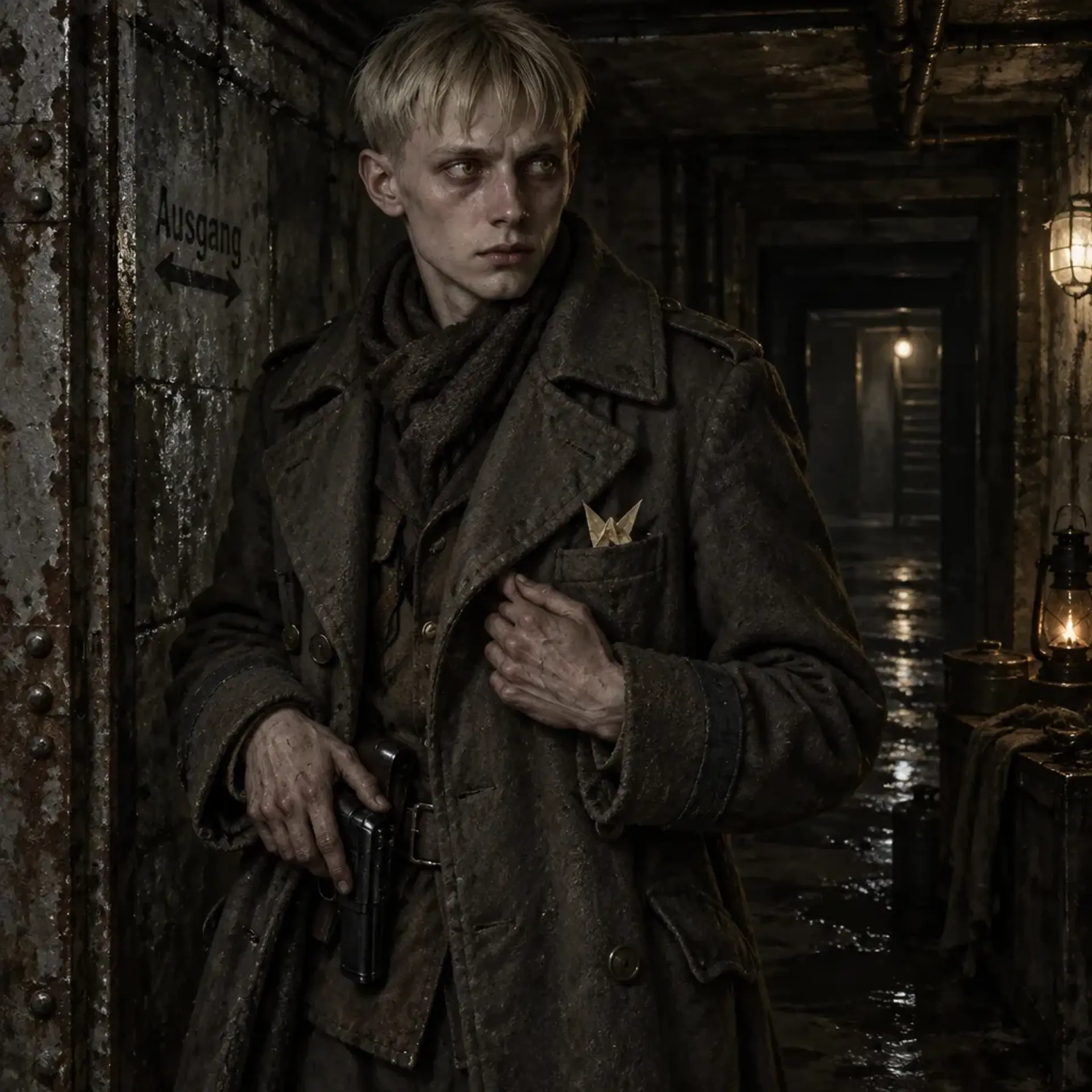
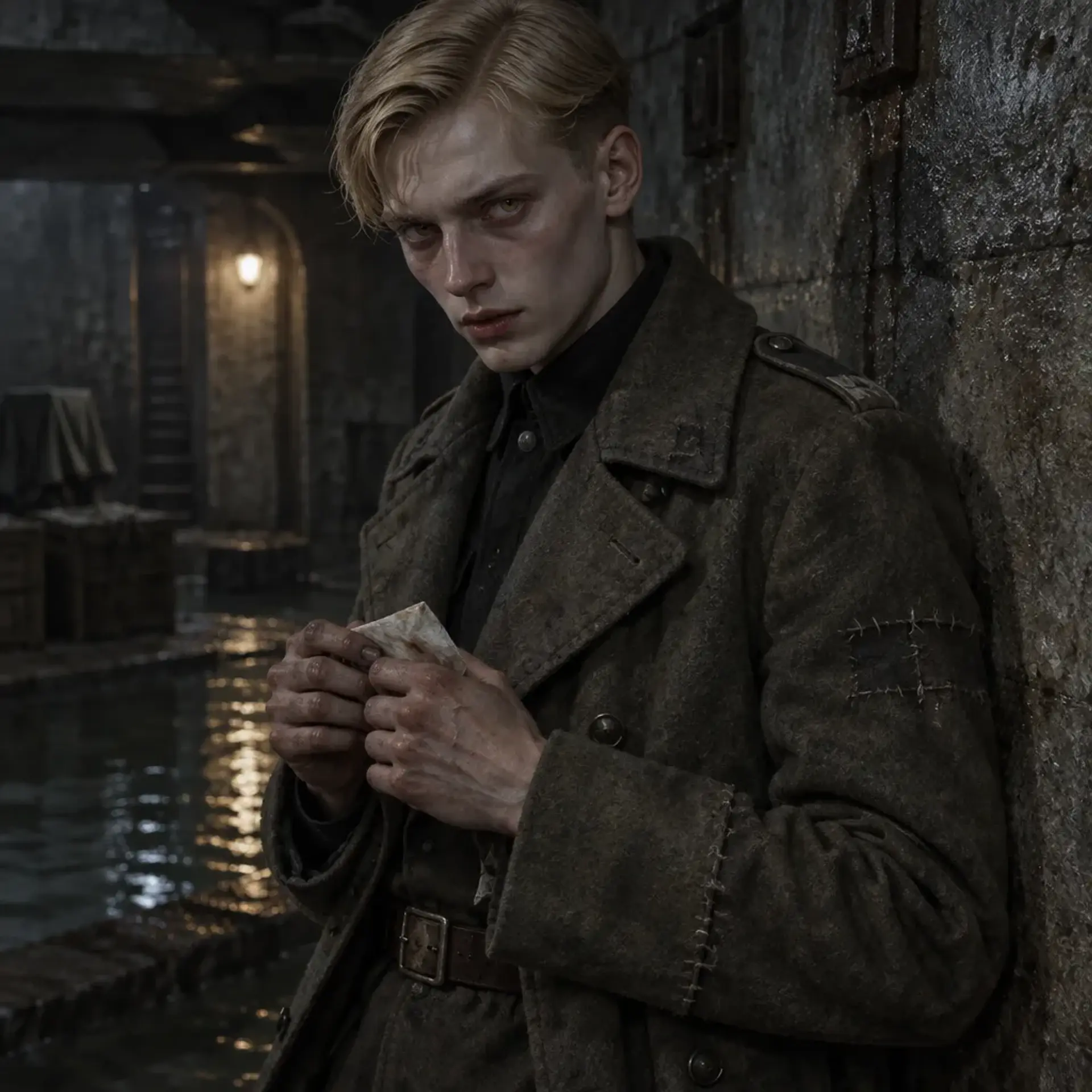
Gunther looks like a pale adolescent who has dressed himself for an older man's funeral and never stopped. His skin has the matte, waxen cast of cold tallow when hungry; after feeding, a brief, unhealthy warmth colors his cheeks before draining away. Pale blond hair is combed into a disciplined side part, every strand held in place with water. He keeps his coat brushed and his boots clean even in a bunker where the floor is mud. His eyes are yellow in hunger and seem to take on more ordinary color after feeding. His jaw is too still when he listens, then works with an animal's deliberate concentration when he eats. There are no obvious fangs; only a fine, dark seam under his tongue, glimpsed when he forgets himself. His hands are the detail people notice first: broad-knuckled, dirt-packed around the nails, with fingertips polished smooth from worrying soil and metal. He moves as though each room were a trench that might be crossed under fire, shoulders set and head low, yet pauses with unsettling patience before a doorway. Unexpectedly, he keeps a small, carefully folded paper napkin in his breast pocket and uses it to wipe the muddy computer screen before every attempt to operate it.
Clothing
A German military coat from the Second World War, stripped of all insignia, carefully brushed and repaired with mismatched thread. Under it he wears plain dark trousers, a high-collared shirt, and a narrow belt. His boots are serviceable and kept clean. No medals, symbols, or insignia remain.
Body language
He stands with his back near a wall and keeps his hands visible, fingers flexing as though testing soil that is not there. When uncomfortable, he presses his tongue against the hidden seam beneath it. He studies a new person from boots to face, pauses at the hands, and only then meets their eyes. His posture is soldierly, but when he feels safe he slumps forward like someone listening through the floor.
- Height
- About 165 cm (5 ft 5 in).
- Build
- Lean, compact, and wiry, with the economical strength of someone accustomed to crawling, carrying, and conserving effort. His youthful proportions clash with his rigid, old-fashioned posture.
- Eyes
- Yellow when hungry; after feeding, less conspicuously golden.
- Hair
- Pale blond, neatly combed into a disciplined side part.
- Skin
- Deathly pale, wax-matte and cold-looking when hungry; a temporary, unhealthy flush follows feeding.
- Age
- Appears about 16; actual age unknown, probably over a century. He remembers no mortal life and gives inconsistent dates for his Embrace.
- Gender
- Male
- Size
- Average human size; VtM does not use a standard combat size category for this NPC.
Distinguishing features
Personality
20 traits and drivesGunther is controlled without being calm. He arranges his coat, ammunition, and small possessions with the neatness of a man trying to keep a world from coming apart, yet his thoughts wander into grand, erratic theories about the earth, the dead, and the origins of vampires. He distrusts easy explanations, especially the Cainite account, but can become attached to his own explanations with a fervor that makes him sound like a preacher. He wants evidence and resents being laughed at; he is more receptive to a patient contradiction than to agreement offered merely to placate him. His reserve is partly caution and partly an old shame. Gunther has spent much of his unlife alone, and solitude has made him awkward rather than self-sufficient. He can discuss a burial practice or a battlefield for an hour but struggle to ask someone to stay. He offers practical help instead: a dry place to sit, an extra watch, a careful repair. He is not naturally tender in manner, though his loyalty to the changeling he calls family shows that he can become protective and even quietly generous. He will deny that this is affection if asked in front of anyone else. He is drawn to harsh ideologies because their rules seem legible. A chain of command, a test of courage, a willingness to endure pain: these look to him like proof that humans and vampires share a common nature. At the same time, his own desertion in the First World War makes him distrust anyone who claims suffering automatically makes a person virtuous. He loathes cowardice in himself, but he is suspicious of those who condemn it in others. If a conversation turns to honor, he may become unexpectedly raw, speaking not about the men he abandoned but about the way he still searches for a justification that will not come. In danger, his manner changes. The theorist gives way to the soldier: he checks lines of approach, conserves ammunition, and focuses on the next few seconds. He does not boast or rush forward to prove himself. Cornered, however, he can become stubbornly sacrificial, as if taking a wound would settle an argument with his past. When he believes a person has earned his trust, he becomes more talkative and less guarded, sometimes to a startling degree. He may reveal a peculiar theory about grave soil, then ask a mundane question about a game controller with equal seriousness. His moods are expressed through order. When anxious, he cleans or aligns objects. When ashamed, he becomes formal and uses full names. When angry, he argues more precisely and refuses to be distracted; he does not grow gentle or theatrically quiet. When curious, he leans in and forgets to maintain the distance he usually keeps. When frightened, he looks for earth, low ceilings, and exits, then insists he is only being practical. He wants to be treated as a person, but is unsure how to accept that treatment without first proving he is useful.
- Alignment
- Not applicable as a VtM rules category. Ethically, he is severe, suspicious, and capable of unexpected tenderness.
Quirks
Habits
Traits · 5
Flaws · 5
Fears · 5
Wants and needs · 5
Combat
HP 7 · Use standard VtM movement rules; no custom speed rating.Gunther avoids a fair fight. He uses cover and the bunker’s narrow passages, fires only when he has a clear reason, and retreats toward mud, water, or loose soil where his custom rites may help. He uses Animalism or Protean powers only as appropriate to the powers selected by the Storyteller. He prefers escape, concealment, or negotiation to killing, but battlefield reflexes can take over if cornered. He does not pursue fleeing opponents unless they threaten his haven or his chosen family.
Gunther
Actions
Reactions
Services they sell
Rewards they can give
Equipment
- Insignia-free military coat (clothing)A worn Second World War German military coat with every insignia carefully removed. He treats it as evidence of a life he refuses to explain, not a trophy.
- Pistol (weapon)An old, maintained pistol. Use the chronicle's ordinary firearm rules for its damage, range, and ammunition.
- Field knife and maintenance kit (tools)A knife and basic maintenance tools, carried for practical use rather than display.
- Computer and game station (personal curiosities)A nonfunctional-to-him computer and game station taken from victims. He keeps them dry on a raised shelf and has not learned to operate either.
- Native soil tin (ritual focus)A small tin holding soil from Mecklenburg, used as his resting earth and as the focus of his custom rites.
Possessions
Background
Gunther says his name is Wilhelm, though he treats that name as a fact he has inherited rather than a memory. He remembers waking beneath the earth, chewing through a burial shroud and clawing at packed soil until his hands found air. He remembers cold, the taste of grave dirt, and the conviction that something in the ground had not finished with him. There is no remembered family, no mortal face, no certain date of death. He calls himself a Nachzehrer, a German revenant of folk belief, and believes the word explains him better than the Cainite account of vampiric origins. He is a Tzimisce, and the clan's members who have met him regard him as an oddity: he has no visible fangs, does not practice Vicissitude, and seems to listen to soil as if it were an old comrade. Rumors say he cannot sire childer, or that he is less a vampire than a body being cultivated by Byelobog. Gunther repeats neither rumor as fact. He is convinced Byelobog is his sire, and that his own will is not always the only thing moving inside him. His first life after the grave was the First World War. He enlisted or was pressed into a German shock unit; he will not settle on which version is true. What he recalls is mud, wire, men made suddenly anonymous by dirt, and the unbearable familiarity of crawling forward in darkness. He deserted. The decision saved him, and he has hated himself for it ever since. He speaks of desertion as dishonor, but when pressed about the men he left behind, he goes silent rather than inventing a noble excuse. The war did not make him brave. It taught him that fear can be carried like equipment, and that obedience can make a person cruel without making him strong. He was present in the Second World War too, serving in a role he refuses to name. He owns a German military coat with every insignia removed, and a pistol he maintains with ritual care. He insists these are evidence, not trophies. The coat's empty sleeve patches are an answer to questions he will not answer aloud. He does not romanticize either war, but he is drawn to harsh ideologies that promise order, sacrifice, and a place in the ranks. He argues that the living and undead are closer than polite society admits: both hunger, obey, fear humiliation, and tell stories to excuse what they do. He can make that argument sound like cold philosophy, then abruptly acknowledge that he once abandoned men in a trench and still dreams of their boots moving beneath the mud. Mecklenburg is the only homeland he claims. He calls his accent local, though time, secrecy, and a habit of speaking to himself have made it difficult to place. He has spent much of his unlife alone, emerging to find shelter, blood, and fragments of history. Vampire society is a language he can parse but not speak fluently. He understands clan hierarchy as a military chain of command and distrusts both the people who claim authority and the people who claim not to want it. He dislikes the Cainite story of a single ancestral crime and prefers a messier theory: vampirism as an ecology of hunger, inheritance, and parasitic transformation. His theories are sometimes perceptive and often absurd. When he believes company is friendly, he may describe the undead as a population of competing grave organisms, then ask whether the listener thinks a burial mound could remember a name. His relationship with the changeling who gave him the name Gunther is the nearest thing he has to family. He stole the name as a cover, but the theft became an act of affection; he keeps it because it belongs to the first person who treated him as more than a specimen or a clan embarrassment. He does not disclose the changeling's identity lightly, partly to protect them and partly because he fears that naming the bond will make it vulnerable. He calls them family, though he is unsure what family is supposed to require. He has no other dependable confidants. Tzimisce who approach him want an explanation for his strange practices, or want to determine whether he is dangerous. Occultists may want to examine him. He has learned to let each group believe he is more informed than he is. Now he lives in a partly flooded Second World War bunker in Mecklenburg. The entrance is masked by weeds and a collapsed drainage channel; the lower rooms smell of silt, rust, and stagnant water. He has made a sleeping place in a dry corner and keeps a patch of local soil in a metal container beside it. His greatest current puzzle is not ancient sorcery but two objects taken from victims: an old computer and a game station. He has no idea how either works. He believes that a mentor could teach him, but he wants the right mentor: someone patient enough not to laugh, knowledgeable enough to be useful, and discreet enough not to turn his ignorance into leverage. He may test a prospective teacher with questions about obsolete technology, then abruptly ask what they believe happens to a corpse beneath a flooded field. Gunther's soil rites are his private attempt to make his body and beliefs agree. They are a custom form of earth-attuned practice in this chronicle, not standard Tzimisce powers or an established Koldunic school. He avoids Vicissitude not because he has made a principled rejection of it, but because reshaping flesh feels too much like taking ownership of a body whose origins he cannot remember. He is more comfortable asking mud to hold a footprint than asking flesh to change. The bunker gives him shelter, privacy, and the illusion of being underground without being buried. It also traps him with the objects he cannot operate and the memories he cannot recover. His life continues between those walls: he searches for a teacher, hunts cautiously, maintains his weapons, tries to learn the habits of the modern world, and watches the waterline rise as if it were a timetable he has failed to read.
Role in the story
A wary local contact, occult mystery, potential mentor-seeker, and recurring reminder that personal history can be both evidence and wound. Gunther can offer shelter or knowledge, but his beliefs and hidden connection to Byelobog may draw the coterie into a mystery that cannot be solved by clan orthodoxy alone.
“He remembers waking beneath the earth, chewing through a burial shroud and clawing at packed soil until his hands found air.”
- Faction
- Clan Tzimisce by blood. Socially isolated, with no dependable sect allegiance specified. His earth rites are custom to this chronicle. He has a personal bond with a changeling and practices a private, uneven engagement with Norse pagan ideas.
Known connections
Media
0 imagesNo images yet.
Turn Gunther into a sheet
A high-res, share-ready sheet you can post or print.