Mikkel Heimskrsson, called Dorve
Mikkel Heimskrsson, called Dorve
At the table
Voice
A clear but weather-roughened young man's voice, shaped by years outdoors and by a throat that sometimes resonates with a low troll growl. It is usually direct and measured, but family, fear, or confusion can make him abruptly louder and more expressive. Familiar words may falter as if he has to reach through a second voice to find them.
His voice comes from a young hunter's practiced breath and a throat altered by troll nature. Most of the time it is clear, direct, and slightly roughened, with words shaped by an upbringing in a Norse fjord household. His speech can stumble over family words or familiar phrases when memory falters. Stress makes him louder and more emotional; some vowels acquire a low, gravelly undertone that can slip into a growl. He does not deliberately whisper when angry, and he rarely makes a performance of his voice.
Speech patterns
How to play them
Approach him with concrete questions and give him time to place names and memories. Do not demand that he prove he is Mikkel or Dorve. He responds better to calm practical tasks, shared food, and respectful conversation than to accusations. A cross, iron object, or sudden attempt to restrain him can provoke fear or sickness. If a party earns trust, ask what he wants to do next rather than which side he serves; the answer may be conflicted but sincere.
Goal
Protect the people currently at risk, especially Sivi and the hidden household, while uncovering which memories and obligations are truly his. He wants to understand his return without letting either the trolls or his family decide his identity for him.
Motivation
To preserve the people he remembers loving, decide what his return means, and avoid becoming a weapon for either his captors or his household. He wants to be treated as a person while he is still learning what that person is.
Appearance
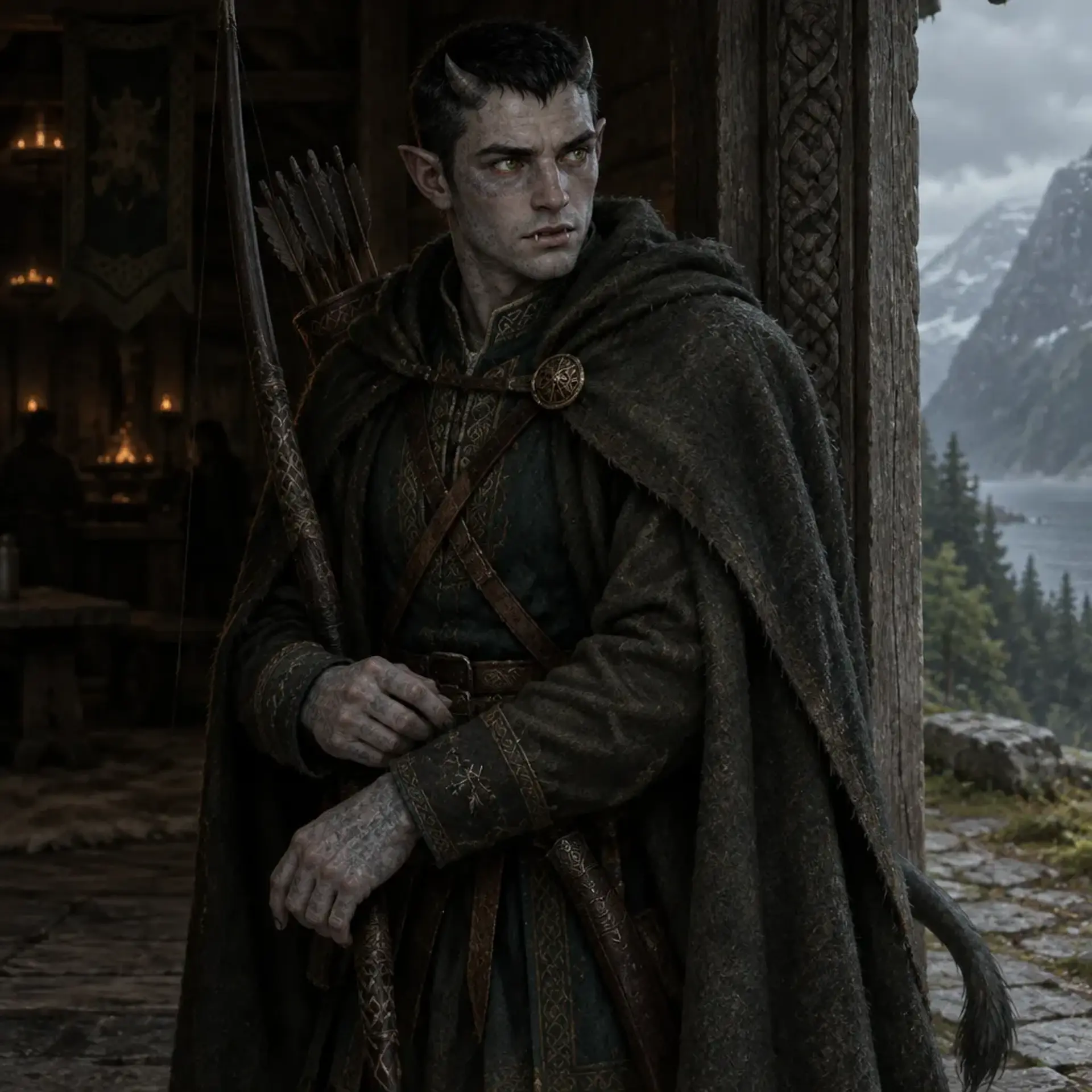
Mikkel Heimskrsson, now calling himself Dorve, looks close enough to his former self to unsettle his family, but not close enough to pass without careful attention. He has grown well beyond his old 5-foot-10 height, standing 6 feet 5 inches, and his broad, long-limbed frame makes doorways and crowded rooms feel smaller around him. His skin appears human at first glance, yet its pallor has a faint, cold stone cast; at the knuckles, temples, and throat, a granite-like grain sometimes shows through as if the disguise were stretched over rough rock. His black hair grows at an unnerving pace. He cuts it very short, then lets it reach a carefully chosen length before starting again. Under direct light, his familiar green eyes catch an amber gleam that seems to belong to another creature. His canine teeth have lengthened, the tips of small horns can press against his hair, and pointed ears and a narrow troll tail are difficult to conceal beneath fine clothing. He smells faintly of wet leaves, crushed fern, and the dark soil beneath roots. In a room, his eyes go first to the exits, then to the hands of whoever is speaking, and only afterward to faces. He tries to fold himself into a chair or stand against a wall, but his size makes the effort conspicuous. When he forgets to perform, he moves with a hunter's economy: shoulders forward, weight on the balls of his feet, gaze tracking the edges of the clearing rather than its center. The unexpected detail is that he carefully smooths and mends his noble cuffs before appearing at table, even when the rest of his outfit is muddy; the neatness is a surviving family habit he cannot explain.
Clothing
Worn troll-given clothes have been patched and altered to suit his larger frame: coarse wool, hide ties, and a weather-dark cloak that smells faintly of leaf mold. At home Svanhild makes him wear noble tunics and a belt appropriate to the jarl's son, though he tugs at the collar and worries the seams. He keeps his old ranger cloak and bow close. His clothing is arranged to hide the tail and soften the outline of his horns, with only limited success.
Body language
His height makes him take up space even when he tries to shrink away. He stands near thresholds, keeps his shoulders slightly rounded beneath fine clothes, and watches hands and exits before faces. When unsettled, he rubs thumb and forefinger together as if feeling for the missing signet ring. His tail sometimes shifts against a coat hem when his attention sharpens. In the forest his posture opens and his steps become quiet; in the hall he looks like a hunter attempting to imitate a seated noble.
- Height
- 6 feet 5 inches
- Build
- Tall, broad-shouldered, and long-limbed, with a hunter's balance over a newly heavy troll frame
- Eyes
- Green with a wild amber gleam that appears in certain light
- Hair
- Black, cut very short and repeatedly trimmed because it grows rapidly
- Skin
- Pale human-like skin with a cold gray, granite-like undertone that can show through as coarse stone grain
- Age
- 18, a young adult by human standards and still awkwardly young among trolls
- Gender
- Male
- Size
- Medium
Distinguishing features
Personality
23 traits and drivesDorve is not simply reserved, nor has he become simply wild. The young man his family remembers learned to keep his thoughts close, watch patiently, and land a dry remark only when it would do useful work. The troll-shaped life he has been taught is louder, more physical, and more immediate. These two selves do not alternate neatly. He can sit through a formal meal with his shoulders pulled in and his hands folded, then suddenly speak over the table because a servant has mentioned a missing horse. He can show genuine tenderness toward his mother and still scan her room for exits. He may apologize for a growl without seeming to notice he has frightened anyone. Around strangers, Dorve tries to be useful before he tries to be likable. He offers to carry a pack, inspect a track, stand watch, or find food. Practical service is safer than explaining who he is. His silence is often interpreted as coldness, but it usually means he is arranging uncertain information in his mind. If pressed about his past, he does not always become evasive deliberately. Sometimes he is honestly unable to tell whether a memory belongs to the Mikkel who rode Yippie, the Dorve who grew up among trolls, or a story repeated until it feels lived. He can hold onto the emotional truth of an event while losing its place, words, or cause. With family, this restraint breaks in uneven ways. He recognizes his parents and brothers, and recognition can strike before he has a sentence ready. His face may open with relief, then tighten because he cannot remember the room where they are standing. He is more emotional and louder than his old self, particularly when he believes a family member is in danger. He listens when Svanhild corrects him, even when he does not understand why her instructions feel familiar. Her authority is a thread tied to his childhood, and he accepts it with a kind of wary gratitude. He may still choose the ranger cloak over the noble clothes she has laid out, not as a rejection of her but because the cloak fits the body and habits he has now. He is proud of being capable. Mikkel had been a skilled archer and rider, and Dorve clings to those abilities as proof that something of the old person remains. He dislikes being handled as fragile or treated as a curiosity. Yet he is not good at asking for help. If he is confused by the hall's layout, he may walk the perimeter several times rather than admit that he cannot find his room. If iron makes his body falter, he may blame the weather. He resents pity and is more receptive to a companion who offers a task than one who offers reassurance. In the forest, he becomes more comfortable and more alert. He notices changes in wind and animal behavior, and his body seems to know how to move among trees even when his mind cannot place a remembered trail. He is still a hunter, but he does not treat every creature as prey. He watches before acting and can be unexpectedly patient with injured animals, frightened children, or anyone who has been made to feel out of place. He prefers an ordinary meal, cooked and shared, because human standards of eating are an intentional choice he can still make. He has no easy disgust toward raw meat, stone, clay, or church glass, but he considers waste worse than strange food. The possibility of eating a person is a capacity he hates having, not a desire he indulges. His relation to the trolls is deeply divided. Some were kind to him, and he remembers warmth, shelter, and companionship in their home. Others frightened him, especially after his failed escape. He knows he was trained to conceal his nature and spy, but he has also been taught that the trolls are kin and that Peer Ludvik's exile injured them all. This produces no simple hatred. If someone calls the trolls monsters, Dorve may defend a particular troll before he remembers that his defense could expose his own loyalties. If someone calls the trolls his family, he may go very still. He is capable of anger, but it often turns into a demand for particulars: who did what, when, and why. He distrusts broad claims because broad claims are easy to use as replacement memories. He is frightened by crosses and sickened by iron, yet he hates the loss of control these reactions represent. A cross held up in threat can make him recoil, snarl, or freeze. He may cover that response with a sharp challenge, especially if other people are watching. His temper can flare when he is cornered, hungry, or humiliated, but shame often follows quickly. A growl slipping into his speech is not a performance. He may not realize it happened until he sees the other person's expression. Dorve has a more genuine relationship to his changed self than Jor does, but that does not mean he has accepted every part of it. He has learned troll ways because they are now among his instincts and memories. He can recognize a troll's mood, understand a woodland custom, and feel at home under a root-roofed shelter. At the same time, he still reaches for human table manners, a proper bow, or the familiar rhythm of his mother tongue. His sense of self is not a contest in which one culture must win. He wants the choice to decide what he keeps, but he has not yet found a way to make that choice without fearing that every affection has been planted. Around Leif Skor and Sivi, he tries to show his value without demanding trust. He offers real help to protect Sivi and the hidden household, but the spy training leaves him alert to information, routes, and who knows what. Sivi's suspicion unsettles him because it resembles the caution he himself would use. He does not resent her for it. He is more likely to over-explain a practical point or volunteer for a dangerous watch than to ask her to believe him. Leif's attention makes Dorve behave more formally, while suspicion or interrogation can provoke defensive bluntness. When calm, he can be wry and observant, making a short remark that reveals he has noticed more than he let on. When ashamed, he becomes busy. When frightened, he checks exits and hands. When angry, he grows louder and more direct, not quieter or more polite. When grieving, he may appear strangely composed until a small domestic detail breaks through. He is capable of warmth, but it appears in acts: sharing the best part of a meal, returning a sharpened tool, keeping watch without being asked, or remembering someone's fear of the dark. He can be loyal, but loyalty is precisely what he is trying to reclaim as his own rather than accept as an order.
- Alignment
- Neutral Good, though his implanted troll loyalties and fractured memories can pull him into morally uncertain choices
Quirks
Habits
Traits · 5
Flaws · 6
Fears · 6
Wants and needs · 6
Combat
AC 15 · HP 49 · 30 ft.Dorve prefers to begin at range from cover, using his longbow and Favored Foe to pressure the most dangerous visible enemy. He uses Hunter's Mark only when he expects a prolonged fight and can spare concentration. He changes position rather than holding a line, using terrain, brush, and his speed to keep distance. If an ally is threatened, he may close with the longsword and use Extra Attack, but he avoids needless killing and will accept a surrender. Troll Regrowth makes him more willing than a human ranger to take a hit, but fire, acid, and iron remain serious threats. He retreats or seeks help rather than reveal his nature to a whole crowd.
Mikkel Heimskrsson, called Dorve
Spells
Actions
Reactions
Services they sell
Rewards they can give
Equipment
- Longbow (weapon)A well-maintained longbow he remembers using even when he cannot recall every detail of his former home.
- Quiver and arrows (ammunition)A practical, worn bow case and a quiver with 20 arrows. He makes his own simple repairs.
- Longsword (weapon)A plain longsword kept clean, with a grip wrapped for wet weather.
- Ranger cloak (clothing)His old ranger cloak, worn over troll-given clothes whenever he can avoid formal dress.
- Noble clothes (clothing)A set of noble clothing selected by Svanhild, with careful tailoring meant to hide his changed outline.
- Hunter's kit (adventuring gear)A small skinning knife, tinderbox, and practical field supplies.
Possessions
Background
Before he became Dorve, Mikkel Heimskrsson was the fourth son of Jarl Heimskr, an observant young ranger and hunter who knew his family's fjord country by hoofbeat, wind shift, and the habits of game. At eighteen he was reserved rather than shy, quick with dry observations when he trusted his company, and more comfortable in the saddle than at the high table. His favorite companion was Yippie, a sturdy fjord horse he rode into the woods while searching for prey and signs of trolls. He was a skilled archer, a careful rider, and the sort of young man who remembered which servants had been kept awake by a sick child, though he rarely said so aloud. The Heimskr household was never a simple place to be a son. Torvald, the eldest, became a harbor master and raider, living between the town's ships and its rougher obligations. Benji served as the jarl's steward and learned how to make household authority look effortless. Gorm left to join the Jomsvikings after Heimskr chose their cousin Olaf as heir. Olaf became law speaker, carrying a public duty that sat uneasily beside private affection. Mikkel had a younger brother, Jor, whose disappearance in the north had already made the family's silences feel dangerous. Their mother, Svanhild, kept the household tied together through daily care and firm expectations. She could tell a son was lying by how he handled a cup, but that did not mean she could always get him to explain himself. The town's conflict with Peer Ludvik gave the family fractures a wider cause. Peer, once a thane and folk hero, was exposed as a troll changeling and exiled. The community treated the revelation as proof that old oaths and old protections had failed. The trolls treated the exile as an insult against their people and a breach of the jarl's family's obligations. They retaliated in secret. During a harsh spring storm, when Mikkel had gone on a private hunt, the weather turned with unnatural speed. Strange lights were reported near the woods, and a farmer's horse vanished from its stall in the night. Mikkel did not return. Searchers found his iron-and-emerald signet ring near the boundary of the forest, but no body and no clear trail. The ring became a small, hard piece of evidence that the family could hold while fearing the worst. The trolls had taken him as punishment and leverage. They also found a way to exploit the memory gaps that followed his capture. In their home among the trees, Mikkel learned that ordinary food was no longer the only thing his changed body could eat. Raw meat, stone, clay, and even church glass could be swallowed. He did not welcome this. He continued to prefer cooked meals and human table manners, not because his body required them, but because the habits meant something to the person he remembered being. The trolls' strength and healing came with iron sickness, a bodily revulsion that turned contact with iron into nausea and weakness. He acquired a fear of crosses and an unnerving ability to smell the blood of Christians. The trolls presented these changes as facts of life, then set about filling the blank spaces in his memory with their own account of his life and obligations. His formative break came when he tried to escape. The attempt failed. The trolls caught him, and the punishment was not merely physical: they used his confusion to teach him that his former home was no longer safe, that he had been abandoned, and that the troll household was the only place where his new nature made sense. Their story was mixed with true memories, which made it harder to reject. Some trolls had been kind to him, sharing food or warning him away from a dangerous slope. Others frightened him, and he learned to watch their moods as carefully as he watched the woods. He cannot reduce them to a single enemy without lying to himself. After the escape attempt, his captors trained him in troll craft and concealment. He is less capable than Jor at hiding his nature, and the concealment is never perfect, but it can pass in a hurried glance or in bad light. They also retaught him the human name Mikkel, because a spy who could return to his family needed to answer when called. Now he has returned to Heimskr's household under the name Dorve. He remembers his family with startling clarity: his mother's presence, his brothers' voices, and the shape of affection that remains even where language falters. He does not recognize the layout of his home or the town streets as familiar. He may find the right person but not the right room, and his mother tongue comes out fluently some moments and strangely distant in others. He does not answer to Mikkel unless reminded, and sometimes looks at the name as if it belongs to a dead cousin. He has been taught to think of Peer Ludvik as kin through the change, not as the old family friend his father once knew. That new kinship sits beside old recollections rather than replacing them. Svanhild is glad to have her son back and has set aside a room at Heimskr's request. She insists he wear noble clothing when he is expected at the hall, while he prefers his ranger's cloak and practical gear whenever supervision loosens. She corrects him gently but firmly, trying to rebuild the daily patterns of home. He listens, often because the sound of her authority feels more familiar than the words themselves. Olaf has seen the night letter warning that Mikkel has returned and may be a troll changeling and spy. Seeing Jor alive had already made Olaf feel that he had failed his brothers; Mikkel's return deepens that guilt. Heimskr has also received the letter but has not told Mikkel what it says. Gorm knows his brothers were taken, but he does not know they have returned or what danger surrounds them. Torvald and Benji remain close to the household's visible duties, each with his own reasons to notice the oddities in the returned son. Dorve has offered to help the Skor family, who are hiding Peer Ludvik's pregnant wife, Sivi, and a guard. Leif Skor keeps a wary eye on him, and Sivi is suspicious of his sudden offer and the gaps in his story. Dorve's motives are not false: he wants to help, believes that protecting the vulnerable is what a ranger should do, and feels an uncomfortable kinship with Peer. But his training has made him an observer and messenger as well. He has not told the family which of his sympathies the trolls expect him to serve. His current problem is not simply choosing between human and troll. He has to discover which memories are his, how much of his affection has survived the changes, and whether he can make a choice that neither captors nor family have already written for him. He is living, for now, between a room that feels unfamiliar and a forest that feels like home, trying to decide whether those feelings are evidence, habit, or both.
Role in the story
A returned missing son whose presence offers hope and alarm at once. Dorve can serve as a guide, ally, witness, or source of divided intelligence. His struggle makes the trolls' retaliation personal, while his uncertain memories let the party uncover how the kidnapping and cultural manipulation happened. He is not a simple villainous spy: he has offered genuine help, but may still carry loyalties or instructions he cannot fully recognize.
“His favorite companion was Yippie, a sturdy fjord horse he rode into the woods while searching for prey and signs of trolls.”
- Faction
- Heimskr's household by birth; secretly trained and culturally shaped by the trolls; presently offering aid to the Skor family while Leif Skor watches him
Known connections
Media
0 imagesNo images yet.
Turn Mikkel Heimskrsson, called Dorve into a sheet
A high-res, share-ready sheet you can post or print.