Friedreich
Friedreich
At the table
Voice
A compact, carefully articulated voice with a slight rasp, as if the words have crossed dry paper before reaching the listener. Borrowed faces change its timbre, but the same clipped cadence returns when Friedreich is excited or angry. His laugh is a sudden, breathy bark that often surprises him as much as anyone else.
His speech is crisp, consonant-heavy German-inflected English, shaped by Brandenburg memories, military formality, and long practice imitating other people's social rhythms. In German, he reaches for old-fashioned courtesy and local turns of phrase without being able to prove they are truly his. He sounds most natural when discussing football, markets, or the coven. On war and memory, he repeats precise phrases, revises them, and sometimes loses the sentence halfway through as a fragment of marching rhythm takes over.
Speech patterns
How to play them
Give Friedreich a way to be heard without making him prove his existence. He responds well to shared activities, practical questions, and being included in holiday plans. Do not treat his faces as disposable disguises: he reacts strongly if people mock the original identities or demand that he keep performing. He is more direct with trusted friends and more formal with strangers. Questions about Wilhelm's past should be asked with patience; Friedreich is angry, but he does not want to destroy the relationship.
Goal
Discover what the spirit that opened his Caul wanted, learn what Wilhelm did in the wars, and build a stable sense of self that does not depend on wearing another person's face.
Motivation
Belonging, accountability, and the hope that an authentic self can survive being unseen.
Appearance
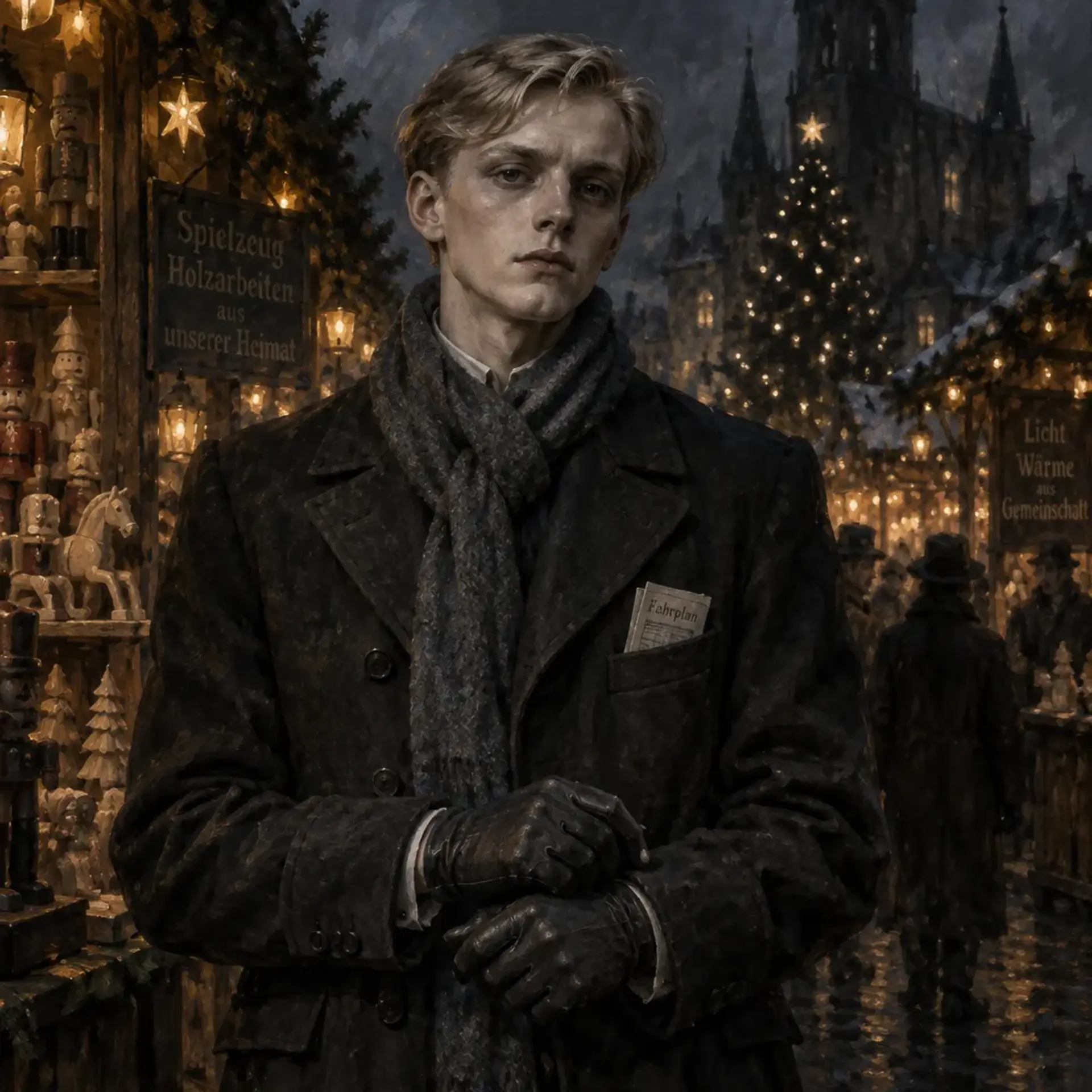
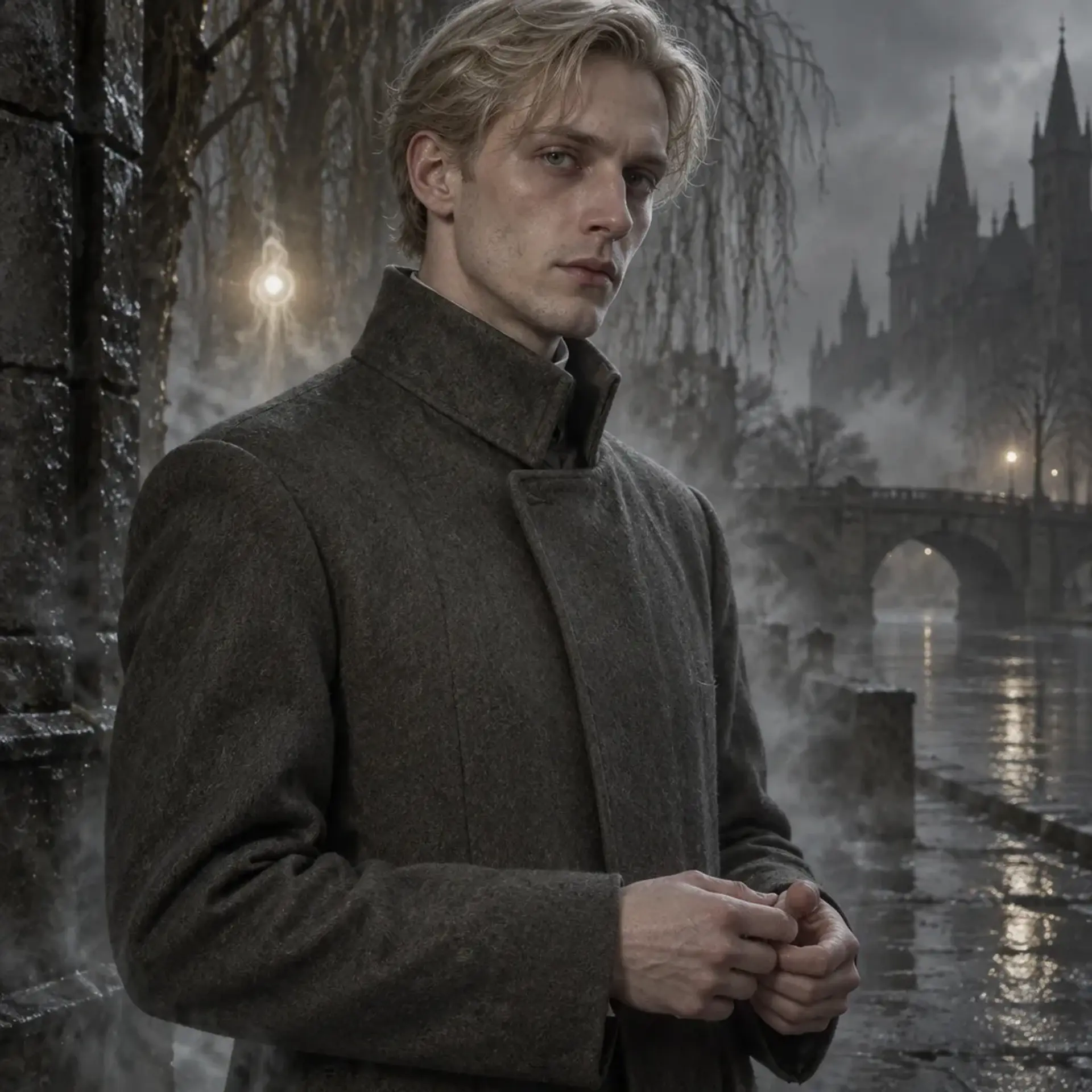
Friedreich is not reliably visible in his own form. On rare days when the boundary between the living world and the dead thins, a young Prussian-looking man resolves out of a watery shimmer: tall enough to carry himself like a cadet, though his shoulders seem a little too narrow for the severe coat he prefers. His borrowed faces have skin with convincing pores, faint shaving roughness, and the slight warmth of a living cheek. Their expressions arrive a fraction too deliberately, as if he is remembering how a human face behaves rather than simply making one. He stands with heels aligned and chin tucked, then moves in abrupt, economical turns, as if following an order nobody else heard. The unexpected detail is that he is a patient, almost fussy football tactician: he can cheerfully spend an evening explaining how a winger should have used the empty space, with the grave attention of an officer correcting a map.
Clothing
His favored borrowed identities wear practical period-appropriate coats, polished shoes, and tidy collars. When only partly visible, he appears in an unbadged, field-gray coat with a high collar and no reliable insignia. He avoids claiming any particular historical uniform as his own because his memories of service are incomplete.
Body language
In a borrowed body he holds his shoulders square and keeps his chin level, an old habit of drilled posture. His steps are measured, with neat turns and a slight pause before crossing a threshold. Under frustration, his borrowed expression remains fixed while his hands give him away: thumb to forefinger, thumb to forefinger, like counting an absent roster.
- Height
- Appears around 173 cm in his preferred manifestations; no fixed height when unmanifested.
- Build
- Lean, youthful, and military-straight in his preferred manifestations.
- Eyes
- Uncertain in his own form. Wilhelm says gray; his borrowed faces retain the eyes of their originals.
- Hair
- Uncertain in his own form. Wilhelm remembers blond hair; borrowed faces have their originals' hair.
- Skin
- Not fixed. His own manifested appearance is remembered as fair, while borrowed faces retain their original skin tones and texture.
- Age
- Appears seventeen or eighteen when manifested. His age at death and the length of his existence as a wraith are uncertain to him.
- Gender
- Male, as far as Friedreich can tell
- Size
- Medium when manifested; otherwise a wraith's Corpus has no ordinary living size
Distinguishing features
Personality
20 traits and drivesFriedreich is simultaneously formal and hungry for ordinary intimacy. He can make a simple purchase sound like a matter of supply and discipline, yet he is moved by the unremarkable warmth of friends passing food around a table. He wants to be useful because usefulness gives him a place in the group, but he resents being valued only when his face can solve a problem. He is protective without being naturally gentle: he will stand between a friend and danger, then scold them for taking the risk, even when the friend had good reason. With strangers he adopts the posture and manners of whichever face he is wearing. He listens first, studies how the person would hold a cup or respond to a joke, and makes a careful performance of belonging. With the coven he is more idiosyncratic. He interrupts to correct football tactics, offers blunt advice about bargains, and grows openly excited when more people arrive for a holiday. When he feels secure, his humor is dry and unexpectedly boyish. When ignored or treated as a trick, he becomes impatient and insists on being acknowledged; he does not become quieter or more deferential when angry. His loyalty to Wilhelm is intense but not uncomplicated. He believes that brothers must tell one another the truth, yet his own missing memories make him terrified of what truth might do. He condemns Wilhelm's desertion and wartime crimes, then feels guilty for condemning a man whose life he cannot fully remember. He wants Wilhelm to explain himself, but part of him fears that the explanation will make him responsible too. This makes their arguments circle: Friedreich asks, Wilhelm refuses, and Friedreich interprets the refusal as proof of both guilt and affection withheld. Friedreich is fascinated by embodiment. A convincing borrowed face lets him experience a coat's weight, a meal's flavor, water on skin, the ease of sleep, and the scent of a market street. These sensations can make him generous and delighted, particularly when he shares an experience with friends. They can also make him envious. He wonders whether he could lend Wilhelm the feelings Wilhelm lacks, and has not entirely abandoned that hope despite the failed possession attempts. He knows intellectually that taking over another being is dangerous; emotionally, he still wants a miracle that could return something to his brother. He has a disciplined streak inherited from his image of the Junker and Prussian worlds he thinks he remembers. He likes clear plans, proper preparation, and a person who keeps their word. Yet he is wary of orders because his Harrowings and war fragments associate command with faceless boots and shame. He can therefore be both skeptical of authority and quick to create rules for those he loves. When calm, he will revise a plan if someone explains the need. When afraid, he may insist on obedience and only later recognize that he has repeated the behavior he hates. His feelings about identity are in constant motion. Friedreich enjoys choosing a face and performing its physical details, but every successful disguise carries a small danger: the borrowed posture feels easier than his own uncertainty. He prefers dead or absent originals because he will not knowingly steal a living person's place, though even that rule cannot make the act harmless. If someone says that a face suits him, he may be pleased for a moment and then feel ashamed of the pleasure. The Shadow can magnify this contradiction into envy, anger, and the claim that he should simply keep whatever life he can wear. He is capable of tenderness, but he often expresses it through practical attention rather than confession. He remembers who likes which card game, notices when Mila has been left out of a conversation, and saves the best market advice for friends. He would rather walk someone home than explain that he was worried. When his mood is low, he becomes exacting and retreats into lists: faces, dates, football formations, gifts. When hopeful, he allows himself to speculate about a job, a future holiday, or a face he might one day no longer need. The contradiction at his center is not whether he cares. It is whether he believes he can be loved without first becoming useful, visible, or someone else.
- Alignment
- Protective and duty-bound, but capable of resentment and morally compromised loyalty.
Quirks
Habits
Traits · 5
Flaws · 5
Fears · 5
Wants and needs · 5
Combat
HP 0 · Storyteller-defined; no canonical numerical speed rating suppliedFriedreich avoids a fair fight. He uses a convincing face to enter, distract, or escape, then attacks only if someone threatens the coven or corners him. He relies on surprise and the confusion of being suddenly tangible. He has no standard D&D armor, hit points, or attack bonuses. The Storyteller should resolve his custom manifestation and Corpus attacks with appropriate Wraith traits and table rules. His greatest combat weakness is that anger can make him hold a borrowed identity too long.
Friedreich
Actions
Reactions
Services they sell
Equipment
- Face List (personal record)A private, altered list of favorite borrowed identities, with identifying details and checks that the original person is dead or no longer nearby. It is not a magical focus.
- Field-Gray Coat (manifested clothing)A remembered, unbadged field-gray coat that appears with certain manifestations. It carries no claim to an official rank or unit.
- Playing Cards (keepsake)A small collection of cards for games with the coven. Friedreich cannot always handle them without manifesting a face.
Possessions
Background
Friedreich remembers Brandenburg as the smell of wet leaves, chalk dust, and a horse sweating beneath a leather harness. He remembers being young, or remembers the shape of being young: a narrow bed, a hard collar, a family expectation that a boy should learn to sit straight and answer plainly. He cannot prove that any of it belonged to him. His own face is a blank he has tried to fill with Wilhelm's descriptions. Wilhelm says Friedreich had fair hair and gray eyes. Friedreich suspects that Wilhelm is either remembering something true or inventing a kindness, and the suspicion has become one of their oldest arguments. What Friedreich does remember clearly is the Caul. The living world narrowed around him, and the dead world did not open like a door so much as a wound in the order of things. He was not freed by a wraith, mage, or occult scholar. A spirit of land and human history found him, a being Klaus later described in deliberately tangled Garou terms: born of the Weaver's blessed adopted children, bearing the Wyrm's spoils and a trace of Luna. Friedreich does not know whether Klaus was explaining, warning, or concealing an allegiance. The spirit showed Friedreich a brief, indistinct image of a blond young man with clear blue eyes. Then it vanished. Friedreich woke beyond the Caul with a willow-wisp drifting nearby, and the endless marching rhythm that had filled his last stretch of confinement stopped. That wisp may have been a guide, a remnant of the spirit, or simply the first thing he could bear to follow. His first Harrowings taught him that a wraith's private pain can become a place with its own cruel rules. He remembers a corridor of marching boots whose owners had no faces, and a winter field where a voice called him a deserter until he could no longer distinguish accusation from memory. In another ordeal, he saw a Christmas market rendered as a maze of stalls selling the faces of people he loved. He escaped by refusing to choose one. These remembered Harrowings have left him wary of orders, though he still finds comfort in a tidy plan and a clear duty. He has never established whether these are literal events or memories reshaped by the Shadow and his own incomplete recollections. Wilhelm became the closest thing Friedreich has to family. They were together as much as Friedreich could manage through the two world wars, though he has no complete, reliable account of what that means. A few moments from the First World War come back as fragments: a breath fogging in cold air, a hurried movement near the front, and Wilhelm leaving. Wilhelm calls his departure dishonorable and will not explain it. Friedreich is angry at him for deserting, yet feels a strange, involuntary share of the shame, as if he had stood beside Wilhelm in the same uniform. In the Second World War, Friedreich saw enough to know that Wilhelm took part in crimes he will not name. Wilhelm's evasions have made their kinship more painful, not less. Friedreich wants the truth; he also fears that learning it will prove there was never a brotherhood to begin with. The coven is the life Friedreich built around that uncertainty. Wilhelm is his brother by attachment rather than any known blood or clan. Gunther, a changeling who spent much of his existence in Arcadia before returning to the mortal world, sells clothing made with moss and plant matter. Friedreich admires the way Gunther makes something practical from what other people overlook. Klaus is a ronin Get of Fenris, or perhaps a skin-changer of another sort; even Klaus's description of himself has shifted. He is passive-aggressively sharp with most people, but hesitates when he means to wound Friedreich. Mila, a mage from Bremen, is kind to Friedreich and can see and touch him even when he has not borrowed a face. He thinks of her as a little sister and guards her as a matter of duty, never because he believes her helpless. Their ordinary meetings matter more than their grand theories. They play cards, hunt, fish, drink, and watch football. Holidays bring extra members of the coven, which makes Friedreich feel briefly included in a family whose shape does not depend on his being visible. He particularly loves Christmas markets. He advises his friends on bargains and useful gifts with the solemn confidence of a quartermaster, then sometimes directs them toward the thing he secretly wants because he cannot possess it himself. A carved toy soldier, a warm scarf, or a paper cone of roasted almonds can become a small, private grief. He makes a point of celebrating even when the others are tired, because he remembers that the dead are not guaranteed a next holiday together. His ability to steal a face is both gift and hazard. Friedreich keeps a list of favorites, changing names and details for privacy and checking that each original is dead or gone from the area. He favors men near his apparent age: a clean-shaven military clerk with a long nose and a habit of chewing his lip; a police constable whose square jaw and tired eyes make him seem dependable; and a minor nobleman's son with a careful part in his hair, polished boots, and an expression of practiced patience. He uses these identities to speak with the coven and, occasionally, to move through the living world. When the disguise is strong, he can feel fabric, taste food, smell wet streets, bathe, and sleep. The bodily completeness delights him. It also sharpens his grief: after a long borrowed life, he may look in a reflection and resent the person whose features he has worn. Three experiments in possession made his curiosity more cautious. The first began during an evening with Wilhelm, Klaus, and Gunther. Friedreich wondered whether he could lend Wilhelm the feelings of living, or perhaps unlock a memory by sharing a body. Wilhelm agreed, and they forced the attempt together. Friedreich's presence crowded into Wilhelm's dead flesh; it did not make Wilhelm human. Instead, their wills pressed against one another. Friedreich felt the stiff, unfamiliar resistance of a body that did not breathe, while Wilhelm experienced an intrusive second intention moving behind his own thoughts. Friedreich tried to share sensations: the imagined comfort of warmth, the taste of food, the reflex to inhale. They arrived as confused impressions, not gifts. Wilhelm's buried instincts answered with force, and Friedreich felt himself being shoved into the narrow spaces between those instincts. Klaus moved to intervene, visibly alarmed. Gunther, unsettled but fascinated, asked whether they could distinguish whose memory was whose. The attempt ended with both brothers shaken and no recovered past. Friedreich learned that affection does not make possession gentle, and that a vampire's body is not a vacant house. The second experiment was with Gunther. Gunther's curiosity was sincere: he wanted to know what separated their kinds and whether a shared body could exchange memories. Friedreich entered with more confidence than the first attempt had earned. The experience was stranger and less orderly. Gunther's changeling nature made the boundary feel elastic, full of associations that did not hold still. Friedreich encountered sensations that might have been Gunther's, might have been Arcadian echoes, or might have been his own mind trying to label a flood of unfamiliar impressions. Gunther felt an unwanted presence pressing against his sense of self; Friedreich felt the same pressure in reverse, as if the body could decide what he was before he had time to choose. They broke contact quickly. Gunther had more questions afterward, but Friedreich said, 'Never again,' and meant it. He now understands that curiosity is not the same as consent that can be safely sustained. The final attempt was with Wilhelm, under an explicit one-last-time agreement. Neither treated the previous failure as proof; both were looking for a way to make the first experience mean something. They prepared, set a stopping point, and tried again. For a moment Friedreich thought he felt a breath that was not his, a cold, involuntary pull at the chest that might have been an old memory or the body's imitation of breathing. Wilhelm felt no miraculous return of emotion and no clear recovered identity. What came instead was an uncomfortable overlap: anger from one, shame from the other, impossible to assign with confidence. They stopped before either could turn the struggle into a test of loyalty. Neither has brought it up casually since. It left Friedreich more protective of Wilhelm and more furious that Wilhelm still refuses to explain the war. Today Friedreich is trying to determine who opened his Caul and why. Klaus knows more than he says. Friedreich has heard Klaus mention the spirit's affiliations with an air of someone reciting a warning, then change the subject. Friedreich also wants to know whether his natural-looking manifestations are unusual among wraiths, and whether a borrowed identity could support a steady job without slowly consuming him. His life beyond the coven is not empty: he watches the dead and living come and go, maintains his list, and waits for the next holiday. But the central conflict remains intimate. He wants to be seen as Friedreich, not as a useful face or a brother's reflection, while fearing that the only way anyone can see him is for him to become someone else.
Role in the story
A social and emotional anchor for a mixed-supernatural group, a source of unsettling face-based infiltration, and a living question about memory, consent, and the cost of being seen. His links to Wilhelm's unknown past and Klaus's withheld knowledge can lead into investigations of war crimes, the Caul, and the spirit that opened it.
“His own face is a blank he has tried to fill with Wilhelm's descriptions.”
- Faction
- A member of an informal supernatural coven. No specific wraith faction, legion, or guild is established.
Known connections
Media
0 imagesNo images yet.
Turn Friedreich into a sheet
A high-res, share-ready sheet you can post or print.