Friedreich
Friedreich
At the table
Voice
A dry, careful sound preceded by a small intake of breath, as if he must remind himself how to begin. His voice carries the clipped habits of a boy raised around hierarchy and the fatigue of someone who has spent too long speaking to people who cannot hear him. He can be formal without sounding grand, and his excitement over football or market bargains breaks through the composure in quick, bright bursts. Borrowed faces may alter the audible voice, but his timing and preparatory breath often remain recognizable.
His speech sounds shaped by military formality and Brandenburg German, though he is not certain which parts are authentic memory and which are habits acquired in the Shadowlands. He places consonants carefully, gives simple instructions the neatness of a drill command, and tends to state a price or plan as though precision could prevent disappointment. Before speaking, there is a faint dry intake, like a throat preparing to work. Borrowed faces can change his accent and rhythm, but his pauses remain slightly too measured. Around the coven he relaxes into teasing, market gossip, and abrupt enthusiasm for football. When angered, he does not automatically soften his voice: he becomes blunt, exact, and willing to ask an uncomfortable question.
Speech patterns
How to play them
Treat Friedreich as a person even when he is not visible. Address him directly, ask before touching or entering his personal space, and do not treat a borrowed face as proof that the person depicted is present. He responds well to practical companionship, inclusion in ordinary plans, and honest questions asked without demanding an immediate confession. If he is unseen, a direct invitation to join the conversation may matter more than a grand reassurance. Never assume that his wish to protect someone grants consent to possess them. If he becomes fixated on a face or on recovering Wilhelm's memories, gently redirect him toward the boundary he and Wilhelm agreed to keep.
Goal
Discover why the land-spirit opened his Caul, establish which memories and features are truly his, and find a way to remain close to Wilhelm without trying to force his memories or feelings.
Motivation
Friedreich wants to be recognized without borrowing another person's identity. He wants Wilhelm to remember, or at least to explain, what happened in the wars. He also wants the coven's ordinary rituals to continue: the football, the cards, the market visits, the familiar arguments. His longing for a complete past competes with the quieter possibility that a self can be made through promises kept in the present.
Appearance
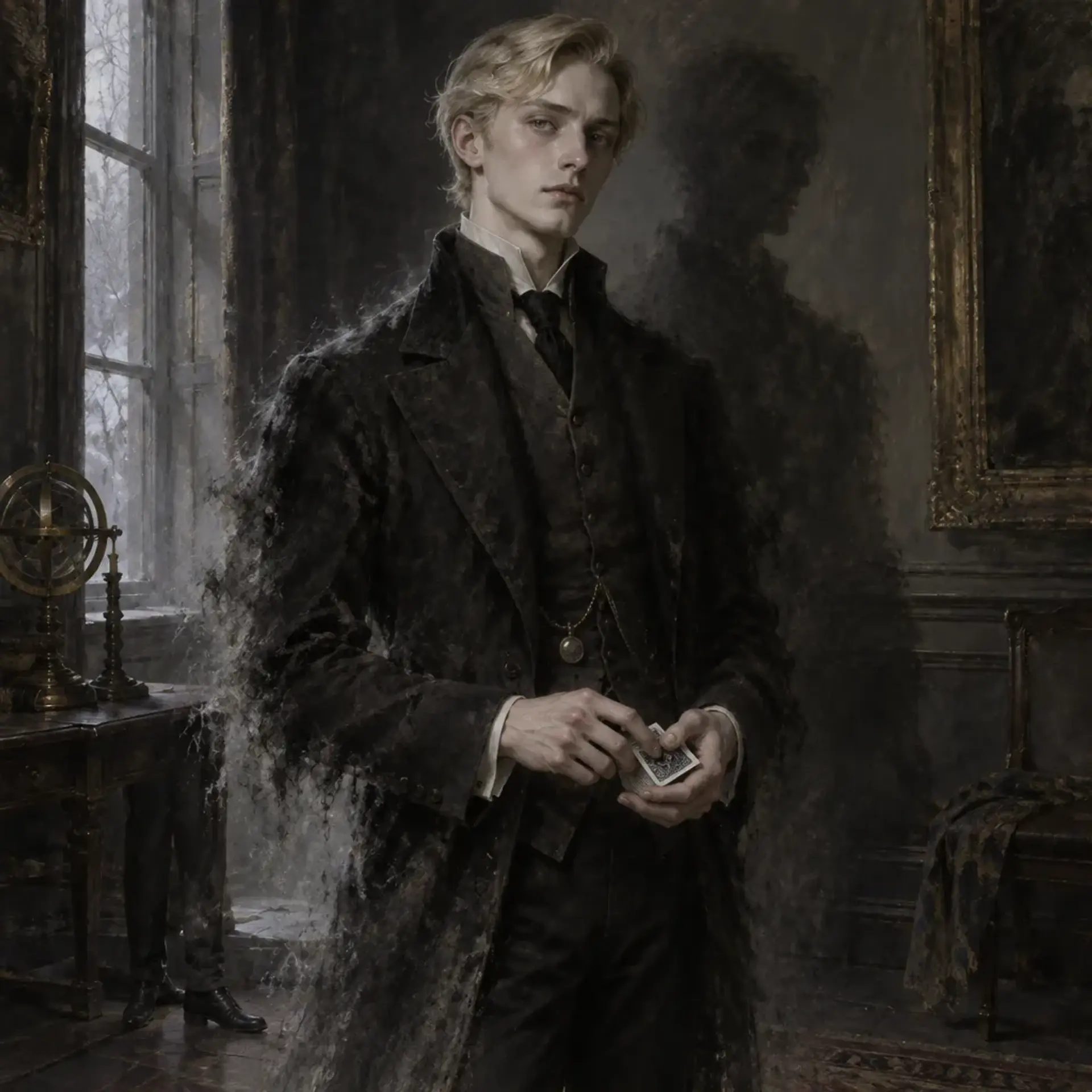
Friedreich usually appears as a narrow-shouldered German youth in an old-fashioned, carefully composed posture, as though he expects an inspection. In the Shadowlands his outline has the flat, ink-dark quality of a figure cut from a military photograph; edges of his coat and jaw sometimes trail a moment behind his movements. When he steals a face, the effect is not a mask laid over his own. His whole presence settles into the borrowed person's proportions, blink, and habitual tilt of the head, with only a slight wrongness in how long he holds eye contact. On the rare days when the boundary loosens and the living can see him, his image gains texture: damp wool, pale skin, the faint shine of hair combed into place. He moves with clipped economy, giving other people room as if a crowded corridor were still an army passage. Before he speaks, he draws a small, dry breath that a living listener might mistake for a boy's nervous preparation. The unexpected detail is that he is a shrewd, opinionated Christmas-market shopper: he can spend ages comparing the workmanship of wooden toys and arguing that the cheapest stall is not always the best bargain.
Clothing
A carefully maintained, old-fashioned dark military-cut coat with no insignia, plain trousers, and a high-collared shirt. He avoids medals and claims not to remember earning any. When he can be physically present, he likes a wool scarf and practical gloves. The coat's precise shape is more an expression of his remembered ideals than evidence of a particular regiment.
Body language
He stands as though a superior might enter at any moment, shoulders squared without making himself imposing. He gives people an unusually generous amount of space, then unconsciously closes it when worried about them. When frustrated at being unseen, his hands open and close at his sides as if trying to grasp the edge of the living world. While borrowing a face, he reproduces its posture with unnerving accuracy but retains his own habit of taking a preparatory breath before speaking.
- Height
- About 170 cm when he is perceptible in a humanlike form; his apparent height varies with the face he wears.
- Build
- Slim and youthful, with the compact, controlled carriage of someone trained to stand at attention.
- Eyes
- Usually described by Wilhelm as gray when Friedreich appears as himself; Friedreich is unsure and distrusts the certainty of that description.
- Hair
- Believed to be blond when he appears as himself, though he has no independent certainty. Borrowed faces carry their own hair.
- Skin
- Pale, with the washed-out quality of an old photograph when visible as himself; a borrowed face carries its own appearance.
- Age
- Appears seventeen or eighteen; his actual age at death and the duration of his unlife are uncertain to him.
- Gender
- Male
- Size
- Medium when manifested; otherwise a wraithly presence whose apparent dimensions depend on manifestation.
Distinguishing features
Personality
21 traits and drivesFriedreich is formal without being cold, affectionate without being easy, and eager to help while quietly resentful that help does not always make him visible. He uses manners as scaffolding. A plan, a scheduled gathering, a correctly remembered football fixture, or a fair price gives him something stable to hold when his own biography will not stay still. He likes to be useful and dislikes being treated as an ornament of the supernatural. When someone asks him to help choose a coat or find a safe route, his attention sharpens; when someone says they are sure they know what he must feel, he withdraws into stiff courtesy. His instincts pull in opposite directions. He is loyal to Wilhelm and furious with him. Friedreich believes Wilhelm's desertion in the First World War was dishonorable, even while recognizing that Wilhelm regrets it and that survival may be more complicated than the word desertion suggests. He is angrier about Wilhelm's concealed actions during the Second World War, but he cannot say exactly what he knows, and Wilhelm will not explain. Friedreich sometimes feels that Wilhelm's choices are entangled with his own missing past, an intuition strong enough to hurt and too uncertain to serve as proof. He wants to demand an answer. He also knows that his brotherly affection can become a way of claiming access to Wilhelm's secrets. On good days he asks a direct question and accepts a refusal. On bad days he turns the refusal over for hours and reads it as a judgment on their entire bond. Friedreich's tenderness is practical. He stands between danger and Mila, checks whether friends have eaten, remembers what people like at the market, and tries to ensure nobody is excluded from the holiday gathering. He does not protect Mila because he thinks a mage is helpless. He protects her because she is his little sister in the only sense that matters to him, and because she is one of the few people who can touch him without a special occasion. That care can become overbearing. He may decide that a risk is unacceptable before asking whether the person facing it agrees. If challenged, he initially stiffens and cites duty. Later, after he has cooled, he can admit that fear made him mistake his judgment for someone else's choice. He is especially vulnerable to the difference between being present and being perceived. When the living cannot see or hear him, he can bear it for a while by following routines: sit in the customary place, track the cards, watch the football, wait for someone to notice a cold patch or a moved object. But repeated exclusion makes him angry. He may speak as if the others have deliberately ignored him, though he knows they could not hear. The anger is real even when its target is unfair. If a boundary-thin day or Embody lets him be seen, he can swing from guarded restraint to almost boyish excitement. He wants to tell everyone about the market, ask what they have been doing, and hear his own voice answered. He can then feel embarrassed by the intensity and return to formal composure. He has a genuine capacity for delight. A good football match can occupy him completely. He likes a close game, a clever pass, and the shared indignation of watching a poor call. Cards let him study other people without having to talk about himself. Fishing and hunting offer a quiet rhythm that resembles the marching he once carried in his mind, but without the old compulsion. At Christmas markets he knows how to compare carving, stitching, and price. He is generous with advice and occasionally dishonest about his motives: if he sees an object he wants but cannot have, he may insist that a friend should buy it because it is a remarkable bargain. He then watches it in that friend's hands with a mixture of pleasure and envy. Friedreich's relationship with his own appearance is unsettled. He has been told that he is blond with gray eyes, but he does not trust Wilhelm's account. He is drawn to faces of young men around his apparent age, especially people whose bearing resembles the ideal of a soldier, policeman, or minor noble he carries in his head. He admires disciplined posture and clear purpose, yet his history is too broken to prove that he ever possessed either. Borrowing a face can make him feel nearly alive: able to interact, speak, and, under the right circumstances, experience touch or appetite. It can also start a quiet theft from himself. He begins by borrowing a face to be understood, then notices that the face's remembered habits come naturally, then becomes angry when friends address him by his own name. He is frightened by the anger but still envies the completeness of the other person's life. The failed possession experiments have made him more thoughtful but not entirely at ease. With Wilhelm, he approached possession as an act of brotherly generosity: perhaps he could lend the vampire the emotions he no longer seemed to experience or help unlock a memory. The attempt taught him that intention does not make a forced entry harmless. He felt Wilhelm's body as pressure, appetite, and an absence where breathing should be. Wilhelm felt Friedreich's grief and will pressing into his own thoughts. Neither received a recovered past. The first attempt left them startled by their lack of control; the final attempt, made after they promised it would be the last, taught Friedreich that affection can lead two people to repeat a mistake together. With Gunther, curiosity about shared memory produced something less like a clear exchange and more like overlapping stories. Friedreich sensed impressions that might have been Arcadia and could not tell whose interpretation shaped them. Gunther experienced a foreign presence intruding on his identity. Friedreich said never again, and this time he means not to ask. When relaxed, Friedreich can be wry, attentive, and unexpectedly competitive. When anxious, he starts organizing what can be organized: seating, routes, meeting times, shopping lists. When ashamed, he becomes formal and uses full names. When angry, he does not reliably grow quiet or polite; he speaks more directly, names the injury, and asks for an explanation. If he has been unseen too long, his frustration may flare before he can reason through it. If someone gives him time and does not ridicule the flare, he can return to the conversation and admit what he was actually asking for: not obedience, but proof that his place in the group is real. He is not at peace with the Shadow that can weaponize these needs. His Shadow finds the sore point between being invisible and wanting to be admired. It can tempt him to keep a borrowed face because people respond better to it, to resent Wilhelm for withholding the truth, or to force a possession in the name of love. Friedreich recognizes the danger in principle, though recognition is not immunity. His most important emotional struggle is learning to let other people remain unknowable without treating uncertainty as abandonment. He is trying to believe that a brother is not a memory to recover, a friend is not an audience that owes him attention, and his own face can be his even if he cannot yet remember it.
- Alignment
- Protective and dutiful, but capable of vindictive resentment. Wraith moral and Shadow mechanics should be used instead of D&D alignment rules.
Quirks
Habits
Traits · 6
Flaws · 5
Fears · 5
Wants and needs · 5
Combat
HP 7 · Use the troupe's Wraith rules for movement and any relevant Arcanos; no D&D speed is assigned.Friedreich is a poor choice for a stand-up fight. He avoids direct confrontation, uses the environment and his knowledge of spirits to escape, and tries to protect allies by drawing danger away or becoming visible at a useful moment. His borrowed face is an infiltration and social tool, not a combat buff. Resolve all rolls, Pathos costs, Corpus damage, and Arcanos effects using the troupe's Wraith rules. His custom face technique should not bypass a target's defenses or grant skills he has not learned.
Friedreich
Actions
Reactions
Services they sell
Rewards they can give
Equipment
- The Face List (personal record)A carefully folded list of borrowed faces, recorded under false labels with notes about their age, bearing, voice, and whether the person is believed dead or absent from the area.
- Unbadged coat (clothing)An old-fashioned military-cut coat with every insignia removed. It expresses his remembered idea of himself, not a verified uniform.
- Pocket schedule (keepsake)A small paper scrap on which he writes market prices, football fixtures, and questions he intends to ask Wilhelm or Klaus.
Possessions
Background
Friedreich's life before death comes to him as fragments with the confidence of memories and the reliability of a damaged photograph. Brandenburg is the place he names as home, but he cannot reconstruct a street, a family table, or the sound of anyone calling him in from the cold. He believes he died at seventeen or eighteen. Sometimes he remembers a breath during the First World War, a physical inhale that seems impossible in the Shadowlands. He does not know whether it belongs to his last day alive, a borrowed memory, or a detail his mind has built to cover a gap. His manners suggest an old Junker household and a Prussian military upbringing: attention to rank, neatness, and obligation. Those manners are not proof of his class or service. They are the surviving shape of a self he cannot fully remember. His Caul did not open through a wraith's intervention, nor through the work of a mage or occultist. A land-spirit did it deliberately. Friedreich recalls an indistinct image of a blond young man with clear blue eyes, and then a sudden absence where the repeated marching in his mind had been. Afterward, a willow-wisp was all that remained of the rhythm that had held him in his Caul. Klaus later offered an explanation in the vocabulary of his own supernatural world: the spirit was tied to the land, marked by the Wyld, born of the Weaver's blessed adopted children, and gifted with the Wyrm's spoils and a trace of Luna. Friedreich accepted the account as a lead, not a satisfying answer. He now suspects Klaus knows more than he admits, and that the spirit's generosity had an intention hidden from him. He has no reliable name for the spirit and does not claim that Klaus's account is universal Wraith cosmology. In the Shadowlands, Friedreich found himself drawn to a young vampire named Wilhelm. Wilhelm was a Tzimisce from Mecklenburg, pale and meticulous, who called himself a Nachzehrer and seemed as unable to remember his life before death as Friedreich was his life before dying. Friedreich cannot explain why he regarded Wilhelm as a brother almost immediately. They shared stretches of the world wars as far as Friedreich could follow him. He remembers the First World War through flashes of mud, a shock troop's urgency, and Wilhelm's eventual desertion. Wilhelm now sees that desertion as dishonorable and regrets it. Friedreich has also glimpsed something of Wilhelm's later service in the Second World War, but Wilhelm refuses to explain what he did. Friedreich is angry at him for those crimes and frustrated by the silence, while simultaneously feeling that Wilhelm's choices have somehow become part of his own missing history. This is not a claim that Friedreich served in Wilhelm's unit or knows the facts. It is the emotional knot he cannot undo. Friedreich's knack for wearing faces began as a survival tool and became his most dangerous pleasure. When an occasion lets him be seen, he has learned to give the living an intelligible person to look at. His Borrowed Visage is a custom technique, not a claim that every wraith can steal faces. He selects dead or absent people whose identities are unlikely to cause immediate harm and keeps a private list under altered names. He favors men near his own apparent age, especially soldiers, police officers, and minor nobles whose bearing feels familiar. The list includes a square-jawed young military clerk with a carefully oiled part, remembered as 'the Ulm portrait'; a police constable whose cropped hair and skeptical mouth make people answer questions; and a minor estate heir with a long, pale face, a stiff collar, and a habit of smoothing one cuff. These are labels, not their real names. He checks, as best he can, that the people are dead or gone from the local area. He worries that one day he will use a face and discover he has forgotten which parts were his own. The first long borrowing that truly frightened him lasted beyond a practical conversation. He began to want the borrowed person's approval, felt injured when a friend spoke to him as Friedreich, and caught himself remembering a childhood garden he had never seen. When the face fell away, he felt no relief at first, only a deep envy of the dead person whose history had seemed more complete than his. Since then he alternates favorite faces rather than keeping one for too long. He still wonders whether he could hold a steady job by using them. He wants the respect, the usefulness, and the ordinary routine, but knows that a job built on someone else's appearance could turn into another private Caul. His chosen family is a loose supernatural circle that calls itself a coven, though the label is affectionate rather than a shared formal organization. The circle makes time for cards, fishing, hunting, drinking, and, with near-religious seriousness, football. Holidays matter especially. More of the group tend to appear at Christmas, and Friedreich becomes visibly animated when the market is open and the boundary allows him to experience it. He advises friends on what is well made and what is a bad deal. Sometimes he urges someone to buy an object because he wants it himself and cannot own it. He is capable of being both honestly helpful and quietly envious in the same breath. Gunther is a changeling who spent much of his life in Arcadia before returning to the ordinary world and now sells clothing made with moss. Friedreich enjoys his questions and trusts his curiosity, though their experiments have taught them that curiosity does not make possession safe. Klaus is a ronin Get of Fenris, or perhaps a Skin-Dancer; Friedreich does not know which, and Klaus has not settled the matter for him. Klaus is passively aggressive with most people but hesitates around Friedreich, a hesitation Friedreich reads as care and possibly guilt. Mila, a mage from Bremen, can see and touch him even when others cannot. She visits on holidays, and Friedreich treats her as a little sister. His protectiveness is not based on believing her weak; it is an old, deeply felt obligation that becomes more pronounced when she is in danger. Three possession experiments altered the circle's sense of its own boundaries. The first was with Wilhelm, by mutual agreement and curiosity. Friedreich wanted to know whether he could give Wilhelm feelings he no longer seemed able to experience, or help retrieve a memory through shared sensation. Wilhelm agreed. Friedreich did not simply enter him like a guest stepping through an open door. They forced the attempt against the resistance of a vampire body and a will that did not naturally welcome him. Friedreich's awareness narrowed into pressure, appetite, and a body that did not breathe. The details are specific to this custom scene, not a universal rule for possessing vampires. Wilhelm experienced the intrusion as an unwanted, intimate pressure behind his own thoughts. Friedreich tried to lend him the feeling of breath, warmth, and a human pulse, but found no simple switch to turn. For an instant they both mistook a remembered sensation for a recovered memory. Then Wilhelm's hunger and Friedreich's desire to be recognized collided. Wilhelm's body clenched; Friedreich felt its violence as his own, and Wilhelm felt a foreign grief trying to steer him. They broke contact before either could tell whose anger was rising. No lost memory returned. Wilhelm was shaken by the sensation of having another will inside him; Friedreich was ashamed that his loving intention had still been an act of invasion. Klaus was alarmed and ready to intervene. Gunther, less frightened than fascinated, asked what each of them had felt and whether they had shared actual memories or only interpretations. Friedreich could not answer, and the question stayed with him. The second experiment was with Gunther. Gunther consented because he wanted to understand what separated their lives and whether they could exchange memories. Friedreich entered with less force and greater confidence, but Gunther's changeling nature made the experience stranger, not easier. The world around them acquired the unstable quality of a story being retold by several people at once. Friedreich felt flashes of Arcadia that did not belong to him, but could not determine whether these were Gunther's memories, the ambient influence of the Dreaming, or his own imagination responding to an unfamiliar mind. Gunther felt a cold, military-shaped presence crowding his sense of self and found that his own reactions no longer felt entirely private. Their identities did not merge cleanly. Instead, each felt the other reaching toward a memory and changing its emotional color by trying to understand it. Gunther ended the attempt. Friedreich emerged with a sharp sense of dislocation and said, 'Never again.' He meant it. Gunther had more questions afterward, but stopped asking them as experiments and began asking them as a friend. The last attempt was another agreement with Wilhelm, described between them as one final try. It did not resolve the first failure. The familiarity made it worse: Friedreich knew the shape of Wilhelm's resistance, and that knowledge made him too confident. Wilhelm, wanting an answer and perhaps wanting to repay Friedreich's care, held the door open longer than was wise. Friedreich felt the old pull toward Wilhelm's body and the possibility of making him feel something; Wilhelm felt the memory of being overrun before the intrusion was even complete. Their intentions were kinder than their method. The contact lasted long enough for each to recognize the other's fear, and not long enough to cure it. They stopped by agreement. Afterward Wilhelm did not tell Friedreich what he had hoped to remember. Friedreich did not ask. The silence was not forgiveness, but it was a boundary they had finally chosen together. The circle still gathers. Friedreich watches football with a concentration that makes every missed goal feel personal, argues about cards, and hovers at the edge of conversations when no one can see or hear him. He can become frustrated, even furious, when he is present in every emotional sense but absent to the people he loves. On good days the boundary loosens, or he uses Embody, and he can feel, eat, sleep, bathe, and smell with startling clarity. He does not know whether this degree of apparent physical life is unusual among wraiths. He sometimes wonders if he could somehow give Wilhelm those sensations. He has begun to understand that wanting to give a person a feeling is not the same as having the right to put it inside them. He still attends the Christmas market when he can, still gives advice about purchases, and still recommends things he cannot have. He is working toward three answers: why the land-spirit chose him, what Wilhelm did during the Second World War, and whether the face he calls his own ever belonged to a living boy with blond hair and gray eyes. Wilhelm has told him that description. Friedreich wants to believe it and does not trust the source. The question is not merely what he looked like. It is whether he can build a self without recovering every missing piece.
Role in the story
A companion and emotional hinge between a mixed supernatural circle and the unresolved histories of Wilhelm, the world wars, and the land-spirit that opened Friedreich's Caul. He can provide access to the Shadowlands, social infiltration through a carefully limited custom face technique, and a personal stake in any story about identity, memory, consent, or wartime responsibility.
“Brandenburg is the place he names as home, but he cannot reconstruct a street, a family table, or the sound of anyone calling him in from the cold.”
- Faction
- A loosely connected supernatural friend group that calls itself a coven. Friedreich is also part of the Shadowlands and is bound to his own Fetters and Passions as defined by the troupe.
Known connections
Media
0 imagesNo images yet.
Turn Friedreich into a sheet
A high-res, share-ready sheet you can post or print.